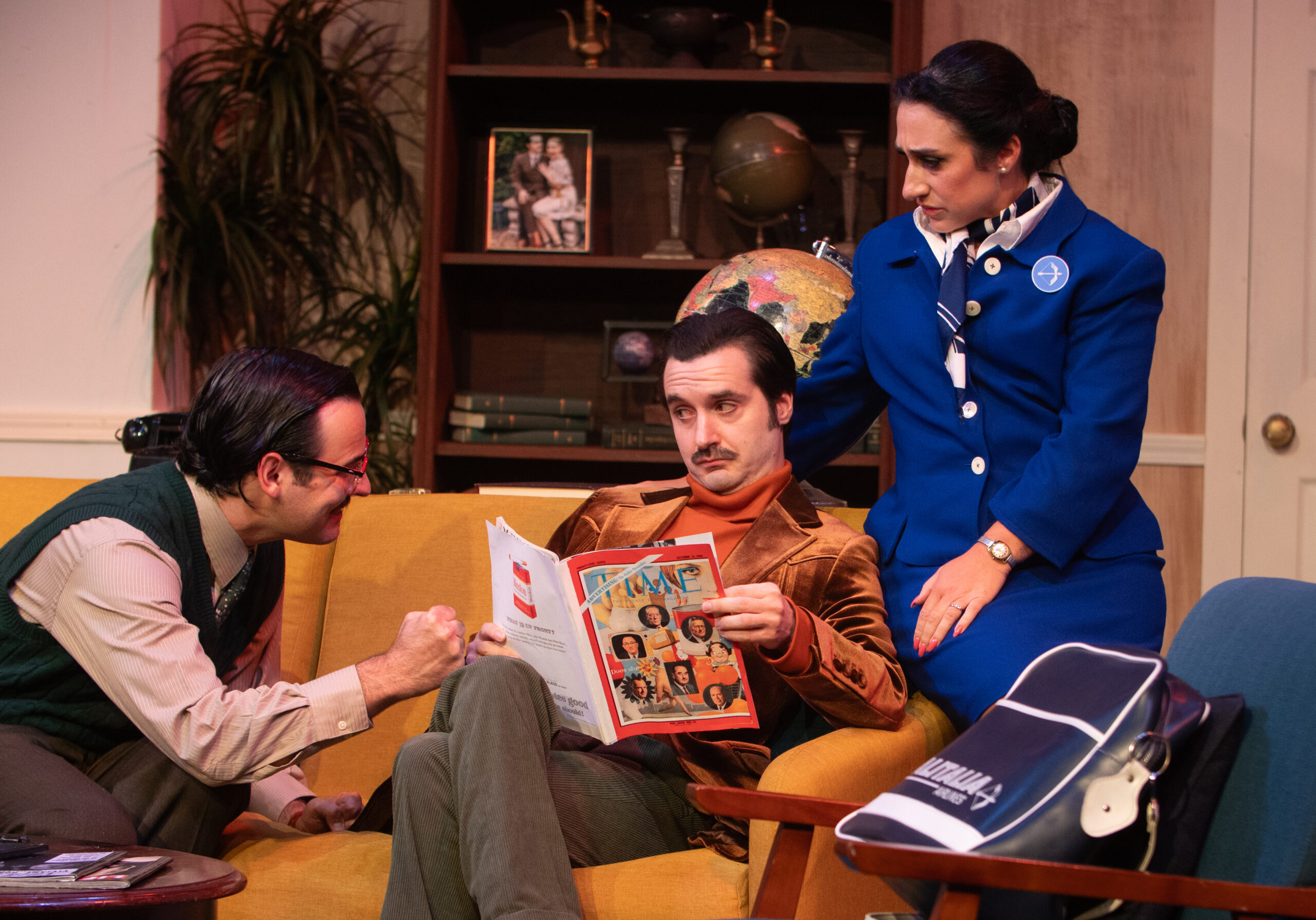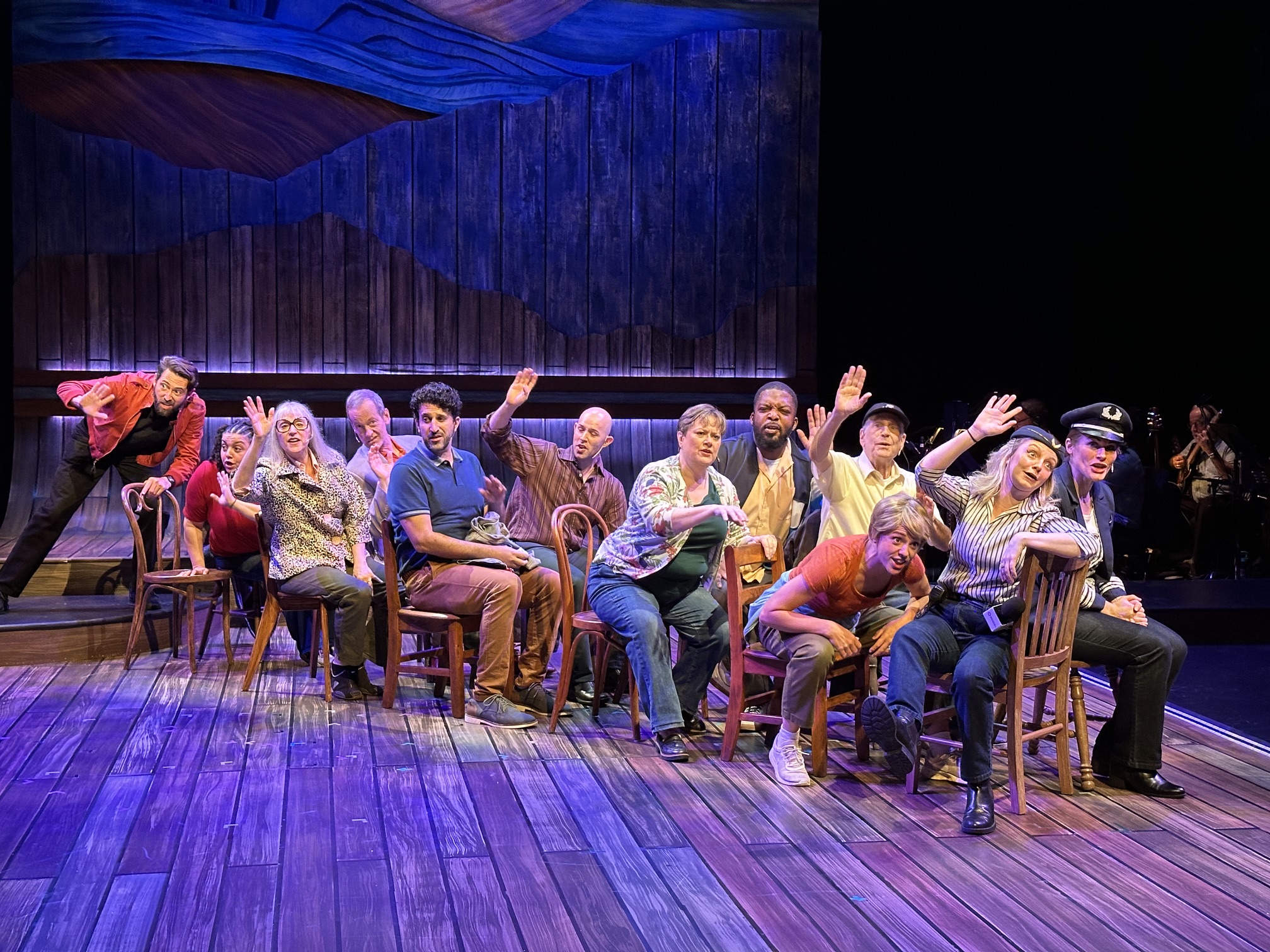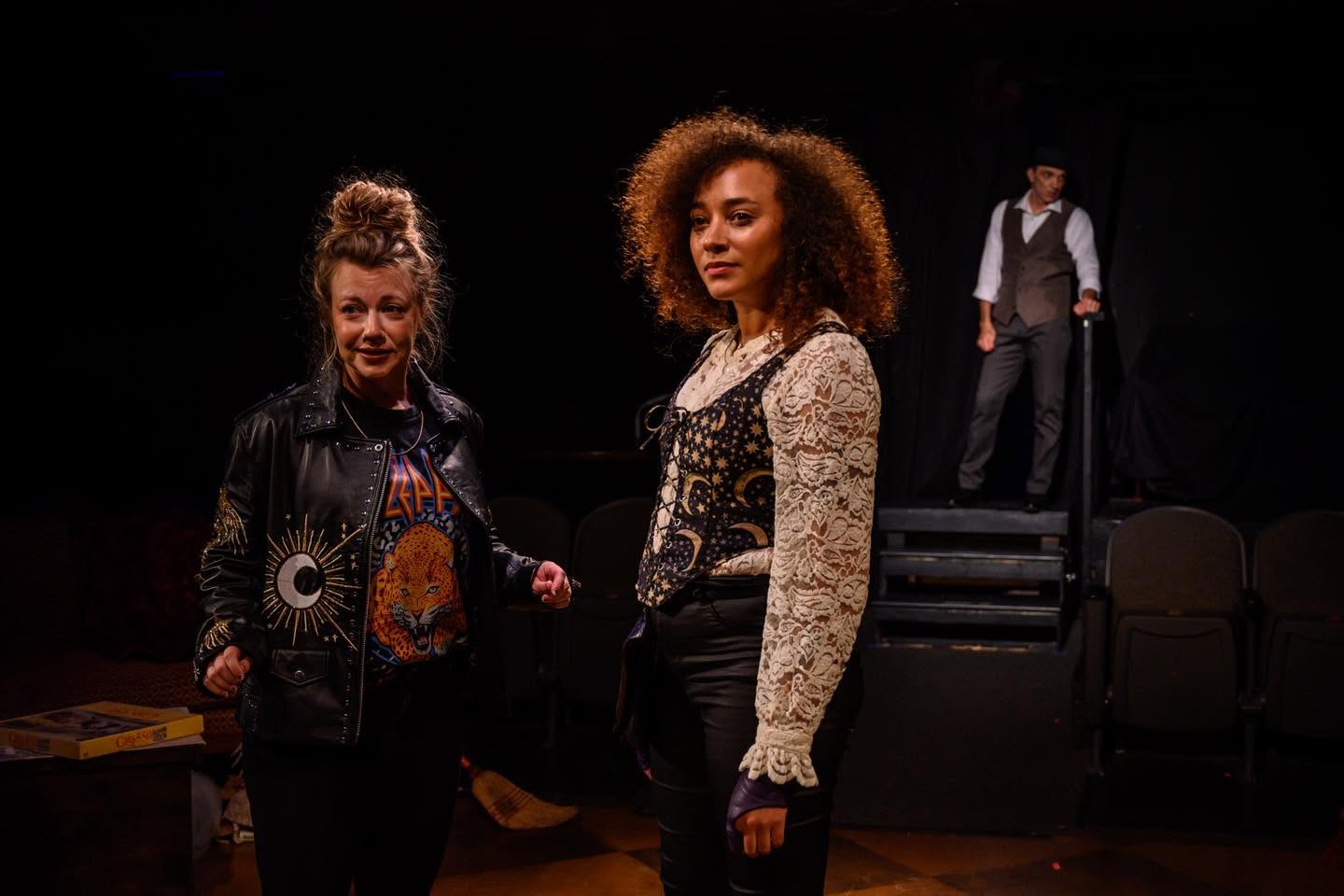
Threading a Tapestry with Lyrics and Song – Review of “Beautiful: The Carole King Musical”

by Claire DeMarco

Carol Joan Klein was musically gifted from a very early age. After her first song was picked up by a music publisher, this young teenaged songwriter declared that she would now be known as Carole King.

This musical biography takes us from Carole’s younger days to her growth as a songwriter to an independent songwriter/performer.

Carole King (Kyra Kennedy) knows exactly what she wants to do.  Her goal is to write music and have it published.

Her mother, Genie Klein (Christine Laitta) has other plans, but Carole prevails. Don Kirshner (J. Alex Noble) is the music publisher King is originally associated with and stayed with for many years.

King meets Gerry Goffin (Dylan S. Wallach) at college, and they immediately form a partnership with King composing the music and Goffin writing the lyrics.  Their partnership quickly turns into a love relationship, and they marry at a very early age.

Surprisingly and collectively King and Goffin wrote a number of songs for other performers.  Carole King at this point in her career is strictly writing songs for other artists – hit songs like “Take Good Care of My Baby’ (Bobby Vee), “Chains” (The Beatles), “Up on the Roof” (The Drifters).

Two other songwriter/lyricists join the agency also associated with King and Goffin.  This talented pair, song writer Barry Mann (Barrett Riggins) and lyricist Cynthia Weil (Lee Harrington) provide an ongoing competition between the two factions.  Surprisingly, the competition proves to be congenial, and the ultimate and true outcome is the ongoing, everlasting friendship between the two couples.

Goffin’s mental issues and philandering are the main thrust for King’s final break away from her marriage.  This freedom now convinces her to not only continue to write new compositions but also to perform them herself.

Her breakout came with the Tapestry album release that contained notable songs like “It’s Too Late” and “Beautiful”, among others.  All her songs have a special emotional bent, often expressing what has or is going on in her personal life.

A new chapter evolves as King also takes the performing route.  The pinnacle of her success centers around the album, Tapestry.  That album catapulted her to the height of her career, winning King Album of the Year, Record of the Year (“It’s Too Late”), Song of the Year (“You’ve Got a Friend”) and Best Pop Vocal Performance, Female).

“Beautiful:  The Carole King Musical” knocks it out of the park. There are so many wonderful songs by Carole King and Gerry Goffin, Barry Mann and Cynthia Weil and the memories they recall.

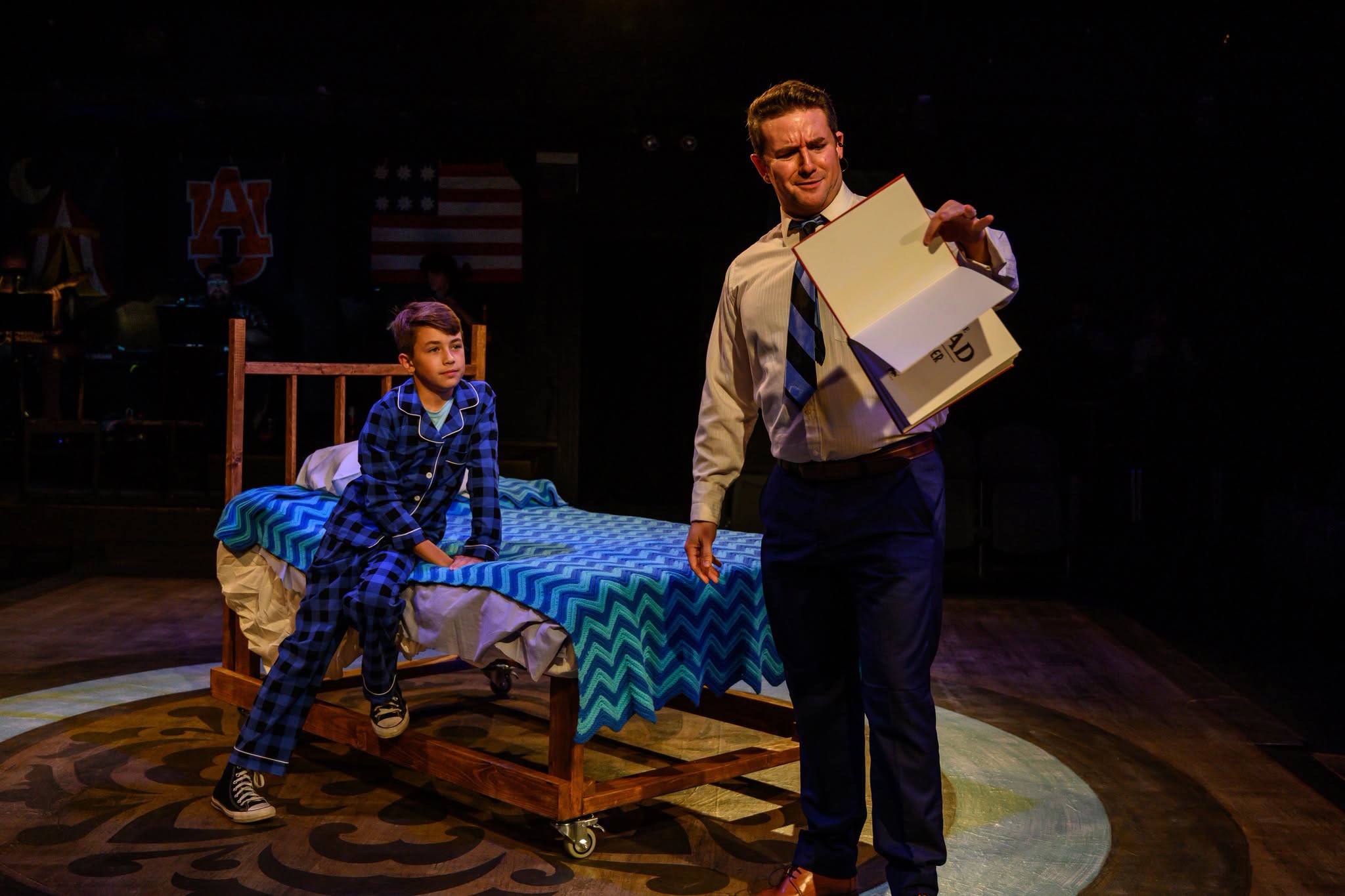
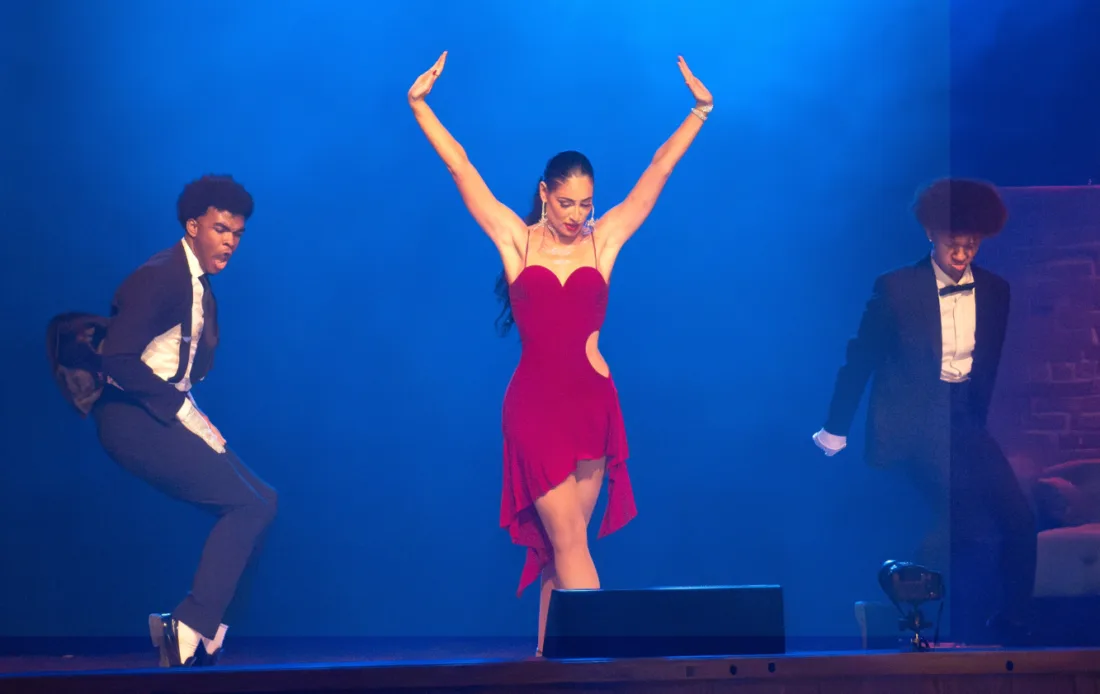
Kyra Kennedy as Carole King

Kennedy is superb as the multi-talented King.  Her voice is spectacular.  She presents a side of the great songwriter/composer as a woman who always wants to create music but also yearns for a more traditional life as a wife and mother.  Her renditions of “(You Make Me Free Like) A Natural Woman” and “It’s Too Late” are excellent.  She shows the support side of King as she puts up with endless misbehavior on Goffin’s part.

Wallach’s performance is believable as he wavers between rational behavior and mental illness.  His ultimate goal is to become a playwright, but he fails miserably at that.  At times he is extremely likable.  He easily transitions to the moody, selfish philanderer whose ultimate behavior leads to King’s ultimate success as a solo composer/performer.

A bit of a character and a semi-hypochondriac, Riggins provides comic relief.  His comedy chops are often balanced by his portrayal of Mann’s ambition and talent in composing multiple top hits.

Harrington’s character is strong, independent and competitive.  She portrays Weil as Riggins’ confident, high-energy partner.  Committed to her craft, she is less inclined to commit to marriage with Mann but eventually softens on the idea.

Alex Noble plays Don Kirschner as the music publisher, demanding non-stop that his composers continually produce the next hits. He also has a kindly streak and at times a bit of sarcastic humor.

Laitta’s role as Carole’s mother is small but she has some great lines and forcefully delivers them, Brooklyn accent and all. Quite bossy when Carole was younger, she grows into a more mellow, caring parent.

Charles Curry II, J’Quay Gibbs, Kai Sachon and Justus Wheatley wow with the Drifters’ hit “On Broadway”, a song written by Barry Mann and Cynthia Weil.

As the Shirelles – Cadence Gates, Samantha Allison Nelson, Avery Ramsey and Bree S. Taylor ‘s version of “Will You Love Me Tomorrow” is terrific.

Special recognition to:

  • Dan Knechtges, Director, Choreographer
  • Catie Brown, Music Director, Conductor
  • Paul Miller and Jonathan Spencer, Lighting Designers

Book for “Beautiful:  The Carole King Musical” by Douglas McGrath.,

Words and Music by Gerry Goffin and Carole King, Barry Mann and Cynthia Weil

-CED

“Beautiful:  The Carole King Musical” is a production of Pittsburgh CLO.  Performances run from June 23rd to June 28th at the Benedum Center, 237 7th Street, Pittsburgh, PA. 15222. For more information, click here.


A Blast From the Past—A Review of Our Town

By: Joseph Szalinski

Decades before Midwesterners made viral videos advertising their cities, featuring flammable rivers and diseased fish, they wrote plays about fake northeastern towns because few cared about the real ones. One such town, Grover’s Corners, which, sadly, has nothing to do with Sesame Street, is the setting of The Summer Company’s latest production, Our Town, directed by Heather Ruppert, now running at Duquesne University’s Genesius Theater.

Thornton Wilder’s Pulitzer Prize-winning play-within-a-play has returned to the stages of the Steel City after a decade-long absence. I mean, the guy’s other most famous work is about a bridge disaster, so I’m surprised he isn’t some local pariah. Audiences are treated to a show about life in Grover’s Corners between 1901 and 1913. This rendition, however, is subtly set in the 1930’s, the decade in which the play was written, without altering the script, as if a subsequent generation of townsfolk is reenacting the trials and triumphs of their predecessors. We meet all sorts of people, from families to more distinct individuals, and see how time treats them. The town changes as well, with the introduction of automobiles and shifting demographics, such as the Polish diaspora. Gotta watch out for the Poles. One of them might grow up to write a review of the town’s meta-play.

Madeline Zabela (Emily Webb) and Ryan Graves (George Gibbs) Photo Credit: The Summer Company


A hallmark of this production is its sprawling cast, and the actors who comprise it ensure there’s no shortage of talent. Shepherding spectators is Mark Yochum as the Stage Manager, the world’s best tour guide. Leah Klocko and John E. Lane Jr. are marvelous as Mrs. Gibbs and Doc Gibbs, respectively. Ryan Graves is fantastic as George Gibbs, a role that allows him to showcase his emotional range. His younger sibling, Rebecca Gibbs, is portrayed by Ellie Troiani. Bob Hartley does a tremendous job as Mr. Webb, the editor of the town newspaper, while Shannon Galligan-Stierle is a formidable force as Mrs. Webb. Madeline Zabela delights as the bright and brilliant Emily Webb. CJ Gatsby is another actor adept at portraying a younger relative, in this case, Wally Webb. Rachel Potts does double duty as the doomed Joe Crowell Jr./Baseball Player, along with Annalyssa Pace as Si Crowell/Baseball Player. Frank Schurter displays wonderful physicality as Howie Newsome/Heckler. Tim Ruppert is a lot of fun as Professor Willard, a role he seems more than fit to play. Travis Barkefelt can balance the comic and tragic elements of his character, Simon Stimpson, the choir director. Lisa Rugh laughably loves a good wedding with her portrayal of Ms. Soams. Rounding out the engaging ensemble are Nancy Batko as Constable, Lorrie Lykins as Samantha Craig/Heckler, Deborah Geary as Heckler/Cemetery Resident, Ashley Caldwell as Josephine Stoddard, and Jay Keenan as Cemetery Resident.

Technical elements are present despite the minimal props and simple set, which are staples of Wilder’s vision. Aubrey Posluzny helps bring order to the chaos as the production stage manager, assisted by Ashley Caldwell and Rachel Pott. Set designer Joe Hartnett, who also serves as technical director, does his part in fabricating a fleshed-out world that doesn’t rely on as many bells and whistles as a typical production. Justin Ocepek-Sines and Antonia Gelorme work their magic as lighting designers, with the latter serving as lightboard technician alongside Erin Fulton. Arii Metz crafts a superb sonic supplement as sound designer, expertly executed by Darius Pollnac as soundboard technician. Ashley Caldwell creatively clads castmates as a costume designer. Ashley C. Brown masterfully handles marketing and social media. Finally, Jill Jeffrey wraps things up as producer.

The Summer Company has graced the boards since 1993. Primarily focusing on shows from 1850 to 1950, they have expanded to include more recent productions and even an original musical. Returning to their wheelhouse for this classic, they take advantage of the opportunity to show folks why they’ve managed to stick around for over three decades.

Genesius Theater is a beautiful venue in the city. While a part of Duquesne University’s campus, it can exist by hosting a variety of troupes and companies. Shows are small enough to retain a degree of intimacy, but seating space is large enough to accommodate fairly sized crowds. I’ve seen a handful of productions there already and look forward to seeing more.

-JS

Our Town continues its run June 25-27, with two performances on Sunday, at Duquesne University’s Genesius Theater in Downtown Pittsburgh. For tickets or additional information, click here

A Kooky Caper—-A review of “Lucky Stiff”

by Lonnie the Theater Lady

The Ahrens and Flaherty musical farce “Lucky Stiff” opens with hapless British shoe salesman Harry Witherspoon (Ryan Hadbavny) learning his American Uncle Tony (who he has never met) has passed away and willed him six million dollars. However, there is a catch. The will stipulates that Harry must fulfill his uncle’s lifelong dream and take his corpse on a dream vacation to Monte Carlo. Harry eagerly jumps at the chance to escape his dull, mundane life. It would be difficult enough to travel with a corpse in a wheelchair, but the trip is further complicated.

His uncle’s floozy girlfriend Rita LaPorta (Krista Strosnider) and Anabel Glick, (Riley Tate) an employee of the Universal Dog Home, show up in Monte Carlo believing they both have the right to claim the fortune for themselves. They use any means possible to procure the millions. There is no limit to their chicanery. Ridiculous events ensue—things get crazy.

The entire cast does a fantastic job with their sight jokes and physical comedy. Their high-octane energy is nonstop—they never run out of gas as they run in and out of doors while changing costumes in record breaking time.

“Lucky Stiff” cast.   Photo Credit:  Carina Iannarelli

Hadbavny is convincing as the slightly nerdy, awkward Harry. He’s likable and earnest, making it nearly impossible not to root for his success. He’s an example of meticulous comedic timing.

Tate’s Anabel’s passion for dogs rings true. Her transition from tough stalker to sweet, innocent woman endears her to the audience.

Strosnider’s delightful portrayal of the brash, somewhat clueless hussy, Rita never fails to amuse. Her lovely vocals delight in all of her musical numbers.

Rita’s brother Vincent DiRuzzio (Travis Miller) is reluctantly pulled into Rita’s pursuit of the money. His uneasy discomfort with her escapade elicits sympathy from the audience while simultaneously being laugh worthy.

Sean Michael Barret is a riot as Luigi —the overly friendly, somewhat mysterious man who frequently pops up unexpectedly. His obsequious exuberance is reminiscent of that neighbor one always tries to avoid.

Dead Uncle in Wheelchair, (Sean Nagle) performs flawlessly. He’s perfectly motionless unless one of the actors moves one part or another of his lifeless body. It’s amazing that he’s able to keep his face expressionless in the midst of all the hi jinx and frenzy surrounding him! Terrific!

Without exception every member of the ensemble brilliantly embodies each and every one of the many characters they play.

Adrien-Sophie Curry is hysterical as the drunken hotel maid. They kill that role.

Joel Ambrose is beyond hilarious playing his wacky, spirited characters–French waiter, tourist with a baby, night club singer, lawyer— He hams it up in every role and is truly a joy to watch. His accents and physical comedy are a total crack up!

Compliments to director Cameron Nickel. The numerous scene changes are seamless and very quick. There is never a moments lapse in the action. He precisely choreographs all the sight gags to get the most humor out of them. He clearly encourages the cast to lean into their crazy— to the delight of the audience.

The ingenious set (April Beiswenger, designer), has the abundance of doors necessary on the set of a musical farce. The additional sliding platforms and large rolling set pieces cleverly provide a myriad of set locations!

Costume designer Rob Hockenberry must have worked overtime to come up with such a great number of first-rate costumes. Ranging from tuxedos and gowns to maids and waiters—and so many more! Nicely done!

This remarkably funny show is full of surprises and unforgettable scenes –no spoilers here.

“Lucky Stiff” is a delightful, wild, frenzied bit of comedy mayhem chock full of surprises, frivolity and twists. It’s “Weekend at Bernie’s” on steroids. In these tumultuous times, everyone desperately needs a laugh. This loco show provides much more than a laugh or two. Its nonstop hilarity is guaranteed to brighten and lighten everyone’s mood!

LTL

“Lucky Stiff” is a production of South Park Theatre.  Performances run from June 18th through July 5th.

For more information, click here.


The Play’s the Thing – a review of “Hamlet: The Bad Quarto”

By Michael Buzzelli

“The Play is the thing, wherein I’ll catch the conscience of the king.”

After Hamlet (Ayden Freed) is visited by the Ghost of his father (David Nackman), he is tasked to avenge his father’s death in William Shakespeare’s “Hamlet: The Bad Quarto.”

This isn’t your father’s “Hamlet.” It’s your great-great-great-great-great-great-granddaddy’s version.  “The Bad Quarto” was written 20 years before the famous First Folio. While some of the names have changed (to protect the not-so-innocent), the plot remains the same. It’s still a tale of regicide and Hamlet’s indecision, but it’s streamlined in many ways. This is a leaner slice of Ham.

Note: A preview piece about the differences can be found here.

The nuts and bolts remain. Just as it is in the more famous Folio, Claudius (Johnny Patalano), Hamlet’s uncle, murdered his father and married his mother, Gertred (Joanna Lowe), AKA Gertrude (in the famous First Folio).

Claudius’s top advisor, Corambis (Brett Sullivan Santry), AKA Polonius (in the First Folio), is the father of Hamlet’s friend, Laertes (Ryan Rattley), and of his girlfriend, Ofelia (Ailka Samora).

The names Rossencraft (Jordan Coury) and Gilderstone (Lorna Lominac) are slightly altered, but they still plan to betray their friend from college, Hamlet, for a price set by the dastardly King Claudius.

While there are entire passages that differ, including the famous “To Be or Not To Be” speech, it still ends badly for Hamlet and his relations.

Hamlet (Ayden Freed) goes to the highest parapet in the castle to confront his father’s ghost. Photo Credit: Hawk Photography, LLC

P.S. Shakespeare is meant to move. When delivering dialogue, think more Lorelai Gilmore and less Lawrence Olivier. Most actors can reach the end of the soliloquy before Olivier reaches the second “to be.”

The famous speech is in a rough draft here, but its placement makes more sense. He delivers the soliloquy in front of Ofelia rather than alone in a room. It gives the speech more urgency, more meaning.

Jeremy Seghers directs a kinetic version of the play, with a talented cast of hand-picked actors. The show moves at a breakneck pace (it’s hard to believe the runtime is 2 hours and 30 minutes, including a 15-minute intermission).

Side note: Seghers is a director, set designer, costumer, and more. He handles every job but the acting, which he’s left to a stalwart crew of near-perfect professionals.

Freed is a charismatic lead. He embraces the role with zest, playing the Danish prince with zeal. It’s a star turn for the recent Point Park grad. At one point, Freed’s Hamlet melts through the negative spaces of a strategically placed ladder, bending and contorting in his melancholia.

Patalano’s diabolical Claudius is magnificent. Shakespeare even gives the murderous king a moment of anguish and doubt as he begs God for forgiveness, but turns around and plots more villainy.

Lowe’s Gertred is equally brilliant. The scene between Hamlet and his mother is breathtaking. The characters writhe around on the floor in a tumult of feverish emotions. Lowe gets another devastating scene when she carries Ofelia’s corpse into the royal chambers.

Spoiler alert: Gertred’s death is particularly gruesome, when the poisoned wine causes her to foam at the mouth.

Ofelia’s death is heartbreaking because Samora plays her with such a spirited kindness and joy…until her lover’s sword kills her father.

Rattley’s rage as Laertes is palpable. He explodes with fury over the death of his father, and then he collapses in utter grief when his sister dies. It’s another fine performance in a show of flawless performances.

Sullivan Santry’s Corambis is a delightful fool. Normally, this reviewer cheers when Hamlet dispatches Polonius with his sword, but this time, it seemed more bittersweet. Sullivan Santry imbues the fool with enough humanity to make his quick demise sadder than usual.

Even the side characters, Nackman’s wise fool of a Gravedigger, Steven Gallagher’s Jersey Boy Braggart Gentleman, and Mike Psenick’s Player One each get a moment to shine, and they all shine brightly. Lominac doesn’t have many lines as Gilderstone (and fewer as Cornelia), but she delivers them with panache.

The costumes are elegant and tasteful, if understated. The set is simple but ethereal and spooky, with long diaphanous drapes illuminated by candlelight (artificial candlelight… but candlelight nonetheless).

If you’ve seen “Hamlet,” you can marvel at the variations. If you haven’t, you can let the play wash over you anew. “Hamlet: The Bad Quarto” is a chance to see the Danish Prince in a new light.

Mark you well, Pittsburgh theater-goers will be talking about this production for years to come. You don’t want to miss it.

-MB

Hamlet: The Bad Quarto” runs from June 19 to June 28  at the Richard E. Rauh Studio Theatre, 4200 Fifth Avenue, Pittsburgh, PA 15213. For tickets and more information, click here


A Little Bit of Lunacy While Waxing Philosophic—A Review of Closing Time at the Moonside Cafe

By: Joseph Szalinski

June is a busy month for the Steel City. Pittsburgh Pride takes to the streets, baseball games are in full swing, and the Three Rivers Arts Festival features plenty of artisans, vendors, and rain. This translates into no viable parking, particularly at my beloved Smithfield-Liberty Garage. It’s during all this beautiful chaos that Vigilance Theatre Group opens its latest immersive production, Closing Time at the Moonside Cafe, written by Sean Collier and Renee Rabenold, and directed by Connor McCanlus (with assistance from Brooke Echnat), now running at Three Stories in Downtown Pittsburgh.

As with any immersive piece of theatre, there’s a frame to the production, and then numerous opportunities for audiences to become involved. Think of it like the Hot Pot equivalent of live entertainment. This time around, those intrigued enough to buy a ticket are treated to an evening of music. Things quickly get a little weird, prompting patrons to scatter throughout the sculpture-littered space as they attempt to ascertain exactly what is going on. People are encouraged to talk to other humans and visit the bar, where they can exchange light labor and divulge secrets in exchange for exclusive non-alcoholic beverages. They’re tasty and a fun detail of the show. Not feeling especially sociable? No worries. Sit back and watch the drama unfold before your eyes.

Laina Stanek at the counter with Bradleigh Bell. Photo Credit: Sean Collier.

Actors brilliantly demonstrate their abilities to sing, improvise, and simultaneously stick to a script. Bradleigh Bell leads the charge as Knox, the cafe’s mysterious owner. Lyco, the host of the evening, is delightfully played by Noah Kendall. Working magic on the microphone are Marisa Postava as Merida, the story’s starlet, and Jess Uhler as Luna, her curious complement. Isaac Miller and Megha Pai provide plenty of laughs as Gus and Justina, one a bumbling busboy and the other a sheepish newer hire. Cap, the intimidating bouncer-type dude, is powerfully portrayed by Max Petrunya. Gwen Arbuckle and Harper York hold down the fort as bartenders, Vera and Mercury, respectively, the most sought-after cast members. Rounding out the talented cast/employees of the cafe are Laina Stanek as Kyrie, Hannah Brizzi as Vesper, Allie Burns as Livy, and John Feightner as Frank.

Technical Elements are equally marvelous as the performances. Music director/keyboardist Travis Rigby and drummer Brayden Ball provide a superb soundtrack to the staged strangeness, aided by Janus Young’s top-notch sound design. Remy Porter’s lighting design impeccably illuminates the insanity, highlighting the creative costuming courtesy of Allie Lampman-Sims. The discerning taste of set designer Heather Heitzenrater furnishes this wacky world. And, of course, none of this would be possible without the tireless efforts of stage managers Sun Marshall and Sarah Dugan.

The Three Stories venue is a cool space and a cooler concept. Owned and operated by the Pittsburgh Cultural Trust, it hosts free rentals for artists and companies in a black box theater, along with a downstairs space with dressing rooms and the like. Don’t worry, fellow Yinzers, there’s also a bar area.

Vigilance Theater Group is a unique organization that has been staging immersive shows since 2018. Comprised of folks who have incredibly interesting backgrounds from the cast to those behind the scenes, their productions are guaranteed to be supremely spellbinding. Even when faced with a sweaty sprint from West General Robinson Street Garage on the North Shore to Liberty Avenue in under 10 minutes, as someone who detests running, outside the scope of playing with my dog, I accepted the challenge because I knew they have something special in store.

-JS

Closing Time at the Moonside Cafe continues its run June 14, 18-21 & 25-27th at Three Stories in Downtown Pittsburgh

If It Ain’t Hoboken, Don’t Fix It—A Review of Over the River and Through the Woods

By: Joseph Szalinski

It was the best of times; it was the slightly less-than-best of times. It was 1994. A bygone age when airport security was fairly lax and those in the tech industry were still partying instead of advocating for surveillance states. A year when the U.S. found its way out of a recession, and people had the luxury to deliberate over taking a job. Good for them. This era marks the start of Red Barn Players’ production of Over the River and Through the Woods, directed by Johnny Gallagher, now running at Red Barn Theatre in Fombell, PA.

Taking its name from a referenced poem/song that evokes memories of Christmas and Thanksgiving, Joe DiPietro’s play explores Italian American heritage, family dynamics, love, and uprooting oneself for a career. Despite the company of his four grandparents in New Jersey, Nick wants to make a break for it, like his parents and sister, and move to Seattle for a marketing promotion. His family has other plans, hatching a scheme to make sure he doesn’t leave them behind on the East Coast.

This impassioned family is brought to life by quite a cast. Actors, in addition to providing their own costumes, deliver tremendous turns in their respective roles. Luke Carter is fantastic as the fretful, fawned-over grandson, Nick Cristano. His employment of physicality and line delivery allows him to assume the character with entertaining ease. John Brenner is a lot of fun as Frank Gianelli, Nick’s mandolin-playing grandfather. Lani Cerveris-Cataldi is a perfect complement as Aida Gianelli, Nick’s maternal grandmother, who loves to cook extraordinary meals. Tom Bickert, the show’s producer, is a delight as Nunzio Cristano, Nick’s paternal grandfather. He channels Nunzio’s penchant for storytelling perfectly, doing so with ample humor and charm. His wife, Emma Cristano, is brilliantly portrayed by Lauranne Ferrara. Rounding out the cast is Sarah Campbell, who also took the publicity photos, and is marvelous as Caitlin O’Hare, the woman whom Nick’s grandparents connive to set him up with.

The cast of “Over the River and Through the Woods.”

Shows are often more than the sum of impassioned performances. This production features technical elements that have been laboriously crafted by folks who also have a desire to bring imagined worlds to life. Steven Burnsworth, Kim Smolka, John Brenner, Paul Brenner, Robert S. Hazen, and Tom Bickert handle the intricate set design and construction. Set decoration is managed brilliantly by Lauranne Ferrara. Robert S. Hazen’s sound and lighting design finds a competent operator in director Johnny Gallagher.

The Red Barn Players are a terrific company composed of many hardworking and talented artists who typically do double duty, with responsibilities both on stage and behind the scenes. Usually boasting familiar faces, the group is also more than welcoming to actors looking to join the fold or a production. Just like the summers of the past, Red Barn Players have a fantastic season planned.

Hosting events since 1955, Red Barn Theatre is a wonderful venue that’s surrounded by natural beauty. While the auditorium is rustic and old-fashioned, the rest of the facility is a little more modern. The perfect place to catch a summertime performance, Red Barn Theatre is a regional staple that more people should check out.

-JS

Over the River and Through the Woods continues its run June 10-13 at Red Barn Theatre in Fombell, PA. For tickets or more information, click here.

Get Courtside Seats for Pickleball

Reviewed by Dr. Tiffany Knight Raymond, PhD, and Theron Raymond (seventh grade)

Little Lake Theatre continues its Home Is Where the Heart Is themed season with actor (turned playwright) Jeff Daniels’ play, Pickleball.

As you guessed, the show capitalizes on the popularity of this racquet sport that was invented by three dads in 1965. That also makes pickleball 6 years younger than Little Lake Theatre Company, which is celebrating its 77th season.

Pickleball exploded during COVID as an age-inclusive, socially distanced outdoor activity. Daniels’ post-pandemic 2022 play brings the Little Lake line-up to the present day. You can easily envision future trivia questions inquiring about “What racquet sport spiked in popularity in the 2020s?”

This co-reviewing team will volley that answer. We’re regulars on the pickleball court. Our knowledge of the sport augmented the experience, but being a player, or even knowing the game, is not a prerequisite to enjoying this banger from Little Lake.

Like any sport, pickleball has its devotees. The play follows a quartet of competitors that includes the widow, Billie (Amanda Weber); bumbling womanizer, Larry (Cole Vecchio); recently divorced Spike (Darrin Mosley Jr); and retiree Sheldon (Ted Froats).

Thanks to director Michael Patrick Trimm, this foursome has an effortless chemistry. While they may have come together via pickleball, they are embedded in each other’s lives. Mosley Jr. captures Spike’s tension as a freshly minted divorcé trying to follow his ex-wife’s admonishment to “turn over a new leaf.” Froats counters with comic relief. He reminds his team he “blew out my butt muscles” and navigates the effects with some extraordinary feats of physical comedy.

Maddie Kocur as Perfect, left, with Larry (Cole Vecchio) and Billie (Amanda Weber) in “Pickleball.” Photo Credit: courtesy of Little Lake Theatre

The quartet’s bonds are tested with the introduction of the aptly named star pickleball player, Perfect (Maddie Kocur). Perfect also looks flawless, dressed in a dazzling white skin-skimming pickleball dress with a saucy sashay to match. Perfect consistently misremembers each character’s name, calling Billie “Barbie” and Larry “Lenny.” It’s as if she can’t be bothered with such details, but it’s all part of her manipulations.

While the performance capitalizes on the dedicated foursome, one character stands out for his distinctive headgear. Ralph’s (Gordon Robertson) forehead is, throughout the play, adorned with a pickleball splattered with (thankfully fake) blood. This innovative costume design is all the work of Little Lake’s clever prop and costume designer, Sylvia Sims-Linkish.

Not surprisingly, the show is set on a pickleball court where almost all the events take place. The court, while not regulation-sized, is depicted on the stage floor to give the audience a well-ordered visualization of the game. Scenic designer Alex Keplar skillfully extends the court into a third dimension by adding four sections of chain-link fencing hanging above the stage, each covered with a smattering of pickleballs.

Jeff Daniels light-heartedly capitalizes on the popularity of pickleball. This high-energy show has perfect seasonal timing. It’s a fun kickoff to summer that makes you eager to get outside and swing a pickleball racquet – or enjoy the outdoor summer activity of your choice, be it porch-sitting or parkour. Pickleball reminds us that whatever it is, it’s always better with friends.

-TKR, Ph.D. & TR

Little Lake Theatre’s production of Pickleball (recommended for 13+) runs through June 14, 2026, at 500 Lakeside Drive, Canonsburg, PA 15317. Purchase tickets online here.

Chess on Mondays at McDonald’s – Review of “Coconut Cake”

by Claire DeMarco

If you think that men never talk to other men about diverse, personal topics, you’re wrong.

Four retirees gather at the local McDonald’s to ostensibly play chess, but generally they end up engaged in rather diverse commentary.  Topics like racism, ageism, and personal problems often take center stage. Many of the discussions are delivered with humor (sometimes not).

They are at the age where they all have more of the past behind them than the future ahead of them.

Eddie (Art Terry) is convinced that his wife wants to kill him.  She did, after all, point a knife at him.

Marty (Sheldon Ingram), a moral man and a Christian, is usually a mediator in any situation that gets out of hand.

Always on the quiet side is Hank (John Reilly), the guy who sets up the chessboard each time they all play.

And then there’s Joe (Alex Morris), flamboyant and blustering, who, although retired, still has his hands in real estate.

On the periphery is Gotdamnit (Kevin Brown), who appears to be homeless and infrequently comes into McDonald’s to grab some money from one of the men to eat.

Eddie, Marty, Joe, and Gotdamnit are black.  Hank is white.

Two females (never seen or heard) but often referenced play a part in the gentlemen’s lives.  Ms. Brulée recently moved into one of Joe’s habitats.  Her delicious coconut cakes are not the only thing she serves. A beautiful, nameless young woman walks by McDonald’s, much to the enjoyment and ogling of our retirees, who rush to the window as she passes.

These five men will all be affected in one way or another by the two females (never seen or heard) and the underlying secrets and knowledge that rise to the surface.

“Coconut Cake” is a wonderful production, a dramedy full of laughs and serious subjects.  The actors are a cohesive group, well-balanced and extremely talented.

This production is a “must-see.”

Morris is as dynamic as Joe. He is boisterous, loud, and constantly moving on stage.  He’s got some great comedy lines that he delivers with panache.  He is demanding and at times overwhelming.

As the unfaithful husband, Terry’s character is both a bit argumentative and certainly defensive, and extremely funny as he attempts to rationalize why his wife wants to kill him.

Ingram’s Marty is the group’s stabilizer.  He’s the go-to guy whom the others turn to for advice and support.  He is believable as the God-fearing church deacon – structured, supportive, moralizing.

Reilly’s characterization of Hank as a rather quiet, sad man who doesn’t do much talking initially transitions into a more vocal character who inserts himself into ongoing conversations.

Brown plays Gotdamnit as a troubled man on the edge (or already there) of mental dysfunction.  His enthusiastic religious display is genuine and believable.  He pops into McDonald’s occasionally, providing some comedic moments.

Set designer/carpenter Herb Newsome’s set is so realistic that one can almost smell the French fries.

Director Eileen J. Morris brilliantly choreographs the movements and dialogue of her robust cast.

“Coconut Cake” was written by Melda Beaty.

-CED

Coconut Cake” is a production of New Horizon Theater, Inc.  Performances run from May 28th to June 14th at the O’Reilly Building, Helen Wayne Rauh Rehearsal Hall, 3rd floor, 621 Penn Avenue, Pittsburgh, PA 15222. For more information, click here.


Preview of “Hamlet – The Bad Quarto”

By Michael Buzzelli

Jeremy Seghers would like to tell you that he is directing “Hamlet: The Bad Quarto,” but he’s doing much more, including producing, lighting design, and set decoration.

It’s a project of love. A Shakespearean-sized love. For it, Seghers is going all the way back to the source material, the first quarto.

Seghers said, “William Shakespeare’s play, ‘Hamlet,’ was published in 1623. It is widely regarded as ‘the first folio,’ but earlier versions existed. some as early as 1603, twenty years earlier.”

He added, “Quarto [pronounced quart-o or cort-o’] refers to the size of the paper. It was quarter sheets.” Seghers gestures, miming the size of a pocket notebook. “About this big.”

Seghers said that the first quarto is a streamlined version, but it wasn’t found for over 200 years. Making it the earliest and least known text of William Shakespeare’s powerful and influential tragedy.

Over the past century, it has been dissected and debated. Character names are different. Dialogue is different. The exact “whos” and “whys” have largely remained a mystery, with several theories circulating in scholarly circles. Often dismissed as “the bad quarto,” one aspect is undeniable.  Seghers said, “It is more action-driven than any other version of the text.”

There are unique changes in the First Quarto; for example, Polonius is called Corambis. Seghers said, “Polonius was first proposed as a parody of Queen Elizabeth’s leading counselor, Lord Treasurer and Principal Secretary, William Cecil, Lord Burghley, but to conceal his identity from the crown (it was treason to mock the monarchy), his name was changed to Polonius after the death of the queen.”

Promotional image for the upcoming play. Pictured: Ayden Freed as the Danish Prince.

Seghers would also like to showcase the talents of some remarkable Pittsburgh actors. Seghers said, “I cast the play with actors the age of the characters. Often, you see much older actors playing Hamlet (Derek Jacoby, David Tennant, Sir Ian McKellan, etc.), but Hamlet was in college.”

Seghers cast Ayden Freed, a recent graduate of Point Park University. The director said, “If you age down Hamlet, his mother would be in her forties instead of her sixties.”

He cast Joanna Lowe as Gertred (not yet called Gertrude), and Johnny Patalano as Claudius, with Brett Sullivan Santry as the aforementioned Corambis.

Side note: Lowe and Sullivan Santry last worked together on a spectacular production of “Who’s Afraid of Virginia Woolf,” which you can reread here.

Another Point Park University student, Ailka Samora, will play Ofelia (not spelled Ophelia yet). Other notable actors in the show are Ryan Rattley as Laertes, Steven Gallagher as Montano, Andrew Lasswell as Barnardo, and David Nackman as the Ghost, among others.

Seghers is looking forward to showing one of the most popular and influential plays in the English language in a new light, a rare glimpse at a work before it became the play everyone knows today.

-MB

“HAMLET: THE BAD QUARTO” runs June 19-28 at the Richard E. Rauh Studio Theatre. For additional information and tickets, click here

The Party Keeps Roaring On – a review of “The Great Gatsby”

by Michael Buzzelli

“He stretched out his arms toward the dark water in a curious way, and, as far as I was from him, I could have sworn he was trembling. Involuntarily I glanced seaward—and distinguished nothing except a single green light, minute and far away, that might have been at the end of a dock.” – F. Scott Fitzgerald 

When World War One (called the Great War since WWII hadn’t happened yet) vet Nick Carraway (Joshua Grosso) moves to New York, he meets the enigmatic millionaire Jay Gatsby (Jake David Smith), and his life changes forever in “The Great Gatsby – A New Musical.”

The titular character and his exploits are based on an American Classic by F. Scott Fitzgerald, required reading in high school from sea to shining sea.

Side note: You, dear reader, probably already know this.

Gatsby is in love with Nick’s cousin, Daisy (Senzel Ahmady), who, unfortunately, is married to Tom Buchanan (Will Branner). Daisy introduces Nick to Jordan Baker (Leanne Robinson), a tennis star who lives in the Buchanans’ guest house (just as Nick is living in Gatsby’s guest house).

Since it’s the Roarin’ 20s, morals are loose, and the bathtub gin is flowing. Tom has an affair with a married woman, Myrtle (Lila Coogan). When Nick sees the detestable Tom carry on behind his cousin’s back, he arranges a meeting between Daisy and Gatsby. The two had met years before the war and were madly in love, but status and the Great War prevented them from cementing a matrimonial union.

Meanwhile, the shady Meyer Wolfsheim (Edward Staudenmayer) is using a gas station owned by George Wilson (Tally Sessions) to run his illegal activities. In an amazing coincidence, George is married to Myrtle, Tom’s side piece.

If you haven’t read the book or seen the countless movie adaptations, you will be shocked by the turn of events that come roaring on. No spoilers.

The cast of “The Great Gatsby.”

“The Great Gatsby” is the tentpole of a fantastic circus, a brilliant story with, literal and figurative, fireworks. The entire production is a spectacle.

Since the story is about the crazy excesses of the 20s, all the excesses are on full display. There is the most beautiful scenery by Paul Tate dePoo II, with equally impressive projection design (also by dePoo). There are glorious costumes by Linda Cho (frilly, sparkling numbers that dazzle under Cory Pattak’s incredible lighting). The choreography, by Dominque Kelley, is astonishing as the chorus gyrates to Jason Howland’s delightful score.

Director Marc Bruni does a superb job of keeping the source material as poetic as intended.

A few songs are memorable, but they’re not songs you will be humming on the way to the parking garage. That said, the acting and singing were among the best.

The main cast each gets a moment to shine, and they all shine brightly.

Grosso’s comical acrobatics in “The Met” are spectacular. He slinks over the furniture like a rubber snake. He has a powerful vocal instrument.

Smith is oozing charisma (it’s a Gatsby requirement and he meets it with aplomb).

Robinson is a belter of the highest order. She gets to hit some amazing high notes. Jordan’s role seems expanded here, and it’s a wonderful choice that gives a stronger female presence in a male-dominated story.

Despite this reviewer’s dislike of Daisy Buchanan as a character, Ahmady gives a fantastic portrayal. She gives the character more depth than she deserves, and charms the entire audience (this Daisy hater included).

Note: Daisy defenders are welcome to comment (but I will play the Hit-and-Run card).

Unlike most musicals, there is a depth behind the pomp and circumstance. It’s not just visual cotton candy (though this show has visual delights to satisfy every appetite). The story is universal. It’s a tale of love and jealousy. It shows the rich and the poor, both struggling with matters of the heart.

“The Great Gatsby” reminds us that the heart and the soul can be far apart on a variety of issues.

If you want to instill the love of theater in a young mind (or any mind), this is the show that reminds you why “The Great Gatsby” is an American classic, and you’ll have a blast while sharing the story.

-MB

“The Great Gatsby” runs from Tue, May 26 – Sun, May 31, 2026, at the Benedum Center, Seventh Street and Penn Avenues, Pittsburgh, PA 15222. For tickets and additional information, click here.

css.php