
Ta-Ra-Ra Boom-De-Ay – a review of “Three Sisters”

\

By Michael Buzzelli

In Vyacheslav Ivanov’s poem, “Moscow,” he writes:

“Lingering in azure, the clouds
Grow heavy with languid moisture.
The drooping birches show white,
And the river trails along below.”

It’s almost as if Ivanov wrote the poem for the Prozorova’s, the rich Russian aristocrats exiled to a provincial garrison town in the hinterlands of Russia in Anton Chekov’s “Three Sisters.”

Olga (Reighan Bean, alternating with Paulina Bradley) Masha (Addison Keys), Irina (Santina Traficante, alternating with Chloe Gorman) and their brother Andrei (Jay Zhu) occupy an estate with tenants and military troops.

Masha is unhappily married to Fyodor Ilyich Kulygin (Santosh Sooriamurthi).

When Aleksandr Ignatyevich Vershinin (Tyler Guinto-Brody), also unhappily married, comes to town, he and Masha form an intense bond (wink, wink, nudge, nudge).

In the first act, the girls yearn for a bigger life, a return to Moscow, and, oddly, the long to be productive, to be of service.

In the second act, life for the three sisters and their brother changes drastically. They are weighed down with ponderous jobs, duties and family obligations.  The three sisters are disappointed in Andrei. Instead of becoming a professor in Moscow, he has settled into his life with his unpopular shrew of a wife, Natasha (Bri Thel), who has taken over the household, bearing heirs for Andrei.

Even though Natasha is busy raising Bobik and Sofia, she’s having an affair behind Andrei’s back.  No one gets what they want in “Three Sisters,” and, even though there’s humor, it all ends unhappily ever after.
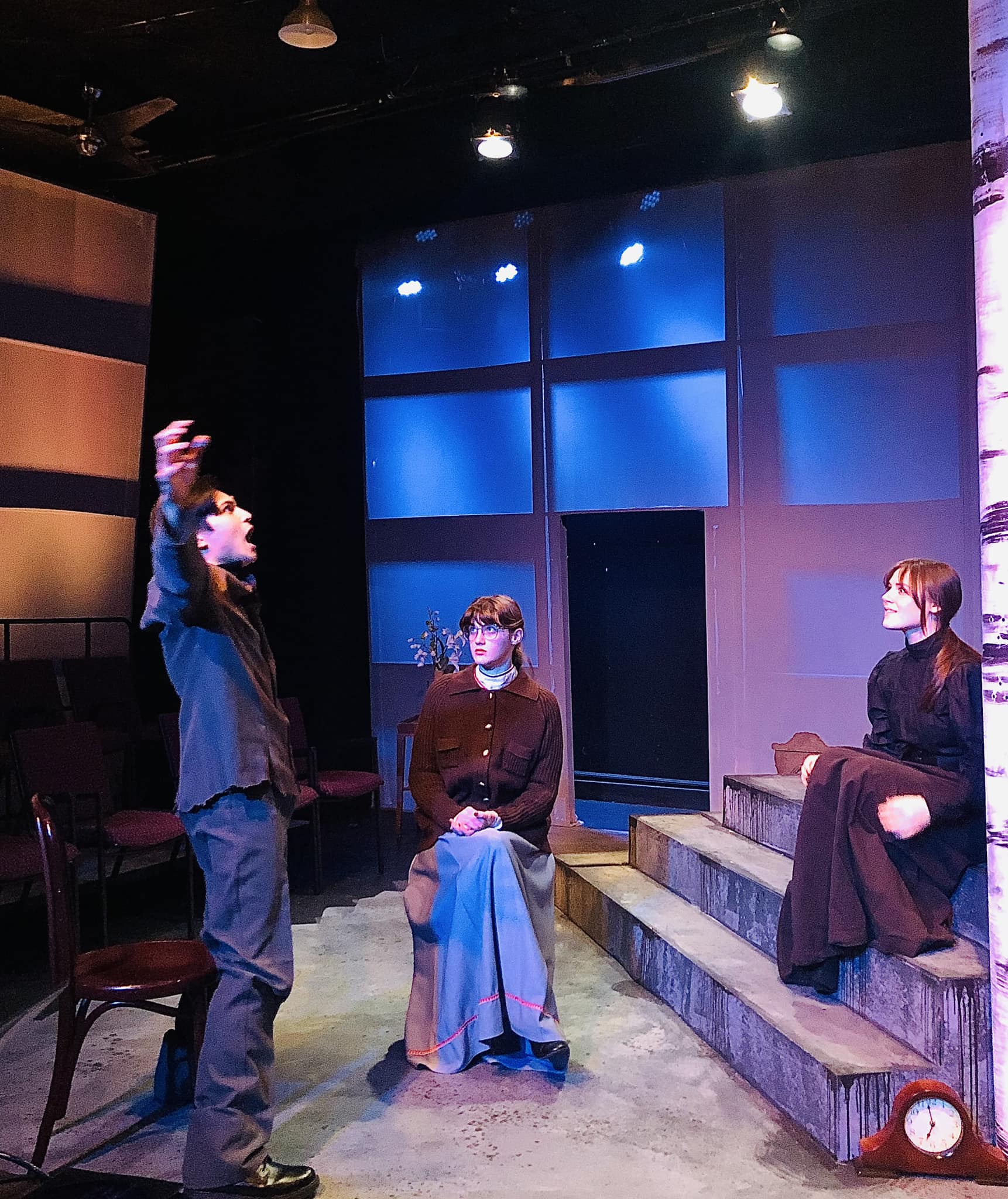
Aleksandr Ignatyevich Vershinin (Tyler Guinto-Brody) dramatically recounts a story to two of the Three Sisters, Olga (Reighn Olga) and Masha (Addison Keys),) Masha (Addison Keys),

The Collective, a new theater company founded by Michael Campayno, uses a new adaptation by actor and playwright Tracy Letts (“August: Osage County,” “Superior Donuts,” etc.). It’s a breezier, lighter version, but rife with internal (and eternal) suffering, a Russian “Gilmore Girls” with three fast-talking siblings. The Chicago Tribune called the adaptation, “Zestier and more colloquial.” It’s perfect fodder for the Collective’s first outing.  

The cast, many of them are students of Griffith Coaching Acting Studio (the director’s own acting academy), is excellent, particularly the three sisters. Bean, Keys and Traficante are marvelous choices. At different points in the show your allegiances shift from one sister to the next, and, since it was so expertly cast, it’s easy to root for all of them.

Guinto-Brody’s Vershinin is a charmer. It’s easy to see Masha falling for the “Lovesick Major.” He has poise and gravitas every time he takes to the stage.

Poor Kulygin. Sooriamurthi plays him as joyful, even though is character is a pitiable mess of a cuckolded schoolteacher, wringing the humor out of the scenario. Each time he says, “Where’s Masha?” it’s side-splittingly hilarious.

Callum Williams who plays Staff Captain Vassily Vasilyevich Solyony is only in a few scenes, but the actor is terrific. He has a naturalistic style.

There is no waste in a Chekov play. Derisive jibes and biting barbs wound, ricochet and wound again, like bitter bon mot boomerangs.

Tucker Topel’s set, like Ivanov’s poem, is filled with birch trees. It’s a lovely touch, but sometimes it’s hard to see the actors through the forest of stark white trees with burnished black swatches.

Daina Griffith directs a fast-paced version of a Russian classic. It’s energetic and enthusiastic.

Side note: The play runs concurrently with an all-female production of “Jesus Christ Superstar” and “Gutenberg! The Musical.” Check the site for dates and times.

The Collective has come out of seemingly nowhere, but it has an ambitious and impressive schedule of shows. Bravo and Brava.

-MB

“Three Sisters” runs until January 21. If you have a particular performer you want to see in the show, consult the show’s schedule and get tickets here

Yes, SHE is a Superstar – a Review of “Jesus Christ Superstar”

By Claire DeMarco

“Jesus Christ Superstar” is loosely based on the Gospels and the well-known story that details the life and times of Jesus Christ (Paulina Bradley) from his adulthood up to His death and resurrection. Although the characters coincide with those portrayed in the Bible, there is more of an emphasis on Judas (Bella McKivigan) and Mary (Emma Zelesnak) and their relation to Jesus. Judas is a tormented soul who appears to have a love/hate relationship with Jesus. We
see Mary as the supportive friend with a suggestion that the relationship might be more than casual.

Bradley’s portrayal of Jesus is multi-dimensional. It is often her facial expressions that convey her emotions. She is both tender and caring but shows anger when confronted by zealots. Ultimately, she is forgiving. Her emotions are highlighted in “Look at All My Trials and Tribulations.”

One sees the pathos in McKivigan’s portrayal of Judas as her mixed feelings about Jesus eventually destroys her. Her nuanced attitude towards Jesus is expressed in the songs she sings. Especially poignant is “Damned for All Time/Blood Money.”

Jesus Christ (Paulina Bradley) speaks to Her apostles.

Zelesnak’s rendition of “I Don’t Know How to Love Him” is superb. She easily and believably conveys her love and support for Jesus.

As the wicked Pilate, McHugh is convincing as she berates and physically abuses Jesus.

Shout out to fellow cast members Cara Vereb, Piper Redford, Santina Traficante, Sophia Burik, Keira Mosklaa, Natalie Koenig and Gray Wagner. Job well done.

Note: This is a great production of a well-known musical portrayed by an all-female identifying cast. It is especially gratifying to see this group of highly talented high school and GAP year students successfully tackling these roles.

They are part of The Collective, a pre-professional theater training academy.

Check out their website at wearethecollectivepgh.com for more
details on this innovative program.

The set is minimal with an elevated platform above the stage. There are no set pieces on stage and any props (like microphones on stands) are brought in by the actors themselves. The stage and surroundings are various shades of gray.

Costumes are not period specific but reflect modern day clothing.
Excellent Direction by Artistic Director Michael Campayno.

Note: Depending on the date, some actors’ roles are performed by other members of the cast.

-CED

“Jesus Christ Superstar” is a production of The Collective. Performances at Carnegie Stage in Carnegie, PA run from January 11 through January 21.
For more information, click here.

Forever Young – a review of “Girl From the North Country”

by Michael Buzzelli

Things are sad in Duluth, Minnesota in 1934, and getting sadder for the Laine family in Conor McPherson’s haunting “Girl From the North Country.”

Dr. Walker(Alan Ariano) steps up to the microphone and narrates the tale of the Laine family and their guests. It’s a brooding Irish playwright’s version of “Our Town.”  Dr. Walker’s exposition is completely unnecessary, and while Aiano is very talented, his character is superfluous. His final summation at the end of the play is somewhere between maudlin and a real bummer.

Let’s get back to the Laine’s. The patriarch Gene (Ben Biggers) is running a dilapidated boarding home (think AirBnB with three square meals), and caring for his wife Elizabeth (Jennifer Blood), who is suffering from some sort of vague mental illness. Gene’s son, Nick (John Schiappa), is a drunken writer (Hemmingway without a publisher) and his adopted Black daughter Marianne (Sharaé  Moultrie) is pregnant.

It’s already a lot, but their boarders have their problems, too.

Mr. Burke (David Benoit) and Mrs. Burke (Jill Van Velzer) are caring for their mentally challenged son, Elias (Aidan Wharton).  The lovely widow, Mrs. Neilsen (Carla Woods) is waiting for her husband’s inheritance but has eyes for Gene.

More trouble comes to town when Mr. Scott (Matt Manuel) and the unscrupulous Reverend Marlowe (Jeremy Webb) arrive into town.

All Conor McPherson projects (“Shining City,” “The Birds,” “The Seafarer” etc.) can be described as haunting, but in “Girl From North Country” the playwright turns to the jukebox and presses all the Bob Dylan buttons (taking all the quarters).

Marianne (Sharaé Moultrie) and Joe Scott (Matt Manuel) in the “Girl from North Country.” Photo Credit: Evan Zimmerman)

“The Girl From North Country” is the meat in between “Mrs. Doubtfire” and “My Fair Lady,” an unlikely combination for a sandwich. The play is brooding and atmospheric. It tackles issues such as unwed pregnancy, blackmail, bribery, murder, and mental illness. Unlike, “Mrs. Doubtfire” and the upcoming “My Fair Lady,” this story is not family-friendly.

“Girl From the North Country” would seem to make a better play than a musical. Perhaps even a PG-13 miniseries on Netflix or Max. It does have some grand music, though. It would be worth saving the musical numbers just to keep Woods and company singing “Pressing On,” an absolute showstopper (right where the show actually stops).

Keep your eye on Carla Woods. She was phenomenal.

While there are a ton of characters, every actor gets their moment in the sun. The actual sun never shines in this gloomy part of Duluth, except when Wharton’s Elias dresses in a white linen suit and sings his heart out toward the end of the second act.

Blood’s Elizabeth gives a heartrending performance as a woman in anguish but lights up the room when she sings. She also gets some of the best lines zinging straight to the truth in the most uncomfortable ways.

Manuel is charismatic and oozing charm all over the stage, and he sings magnificently.

The women team up for a few songs and they are all excellently rendered.

Webb’s Marlowe is deliciously evil. You will want to walk up on stage and smack him with a shovel. He’s terrifying and annoying, an unwelcome stranger with a pitch-black secret.

Conor McPherson loves a good ghost story, and there is an element of a ghost story here when Elizabeth proclaims, “I hear the cries of the girl in the hole.” In “Girl From the North Country,” every character is sort of a ghost marching toward their inevitable doom, but here they are alive, vibrant and filled with song. They will be, pardon the pun, forever young.

If you’re looking for something off-the-beaten-path, and you’re tired of the slap-happy silliness of the traditional musical, or you simply love the music of Bob Dylan, “Girl From the North Country” is the show for you.

-MB

“Girl From the North Country” runs from January 9 to 14 at the Benedum Center, Penn Avenue, and Seventh Street, Pittsburgh, PA 15222. For more information, click here.

Joe Szalinski’s Weird Little Article of Theatre Criticism & Random References—A Review of Bob Cratchit’s Merry Christmas Carol Sing Along & Variety Show

By: Joseph Szalinski

Move over, Night of the Day of the Dawn of the Son of the Bride of the Return of the Revenge of the Terror of the Attack of the Evil, Mutant, Alien, Flesh Eating, Hellbound, Zombified Living Dead Part 2 in Shocking 2D, there’s a new mouthful of a title in town. Well, Butler specifically…Hobnob Theatre Company’s latest production, Bob Cratchit’s Merry Christmas Carol Sing Along & Variety Show. 

The brainchild of cast member Deanna Sparrow and musical director Ken Smith, who wrote the book and music, respectively, and collaborated on the lyrics, this festive play reexamines a literary classic from another character’s perspective.

Original productions are the lifeblood of theatre. Sure, it is an artform that allows and encourages the perpetuation of a show, as great work should always be blessed with a sort of immortality, but theatre stagnates without new plays. Composing a script or a score is an impressive feat, but collaboratively creating an entire production from nothing is even more so. Especially one in which the characters do the same thing. While the narrative isn’t necessarily the focus, plot points are solid, dialogue is hilarious, familiar faces are further fleshed out, and lyrics are equally silly and ingenious. Clocking in at around an hour, this show breezes by and leaves audiences wanting to see it again. It could easily continue to be staged every year after this until it becomes a tradition in its own right. 

Matt Leslie is wonderful as the titular Bob Cratchit. He, like the other performers, gets to show off his singing and dancing prowess, in addition to his acting. But unlike the other two, also gets to do some puppetry too. And no, no Muppets are involved. With a good voice, great comedic timing, and a clumsy charm, he adds dimension to a man who’s more than Scrooge’s mistreated employee or Tiny Tim’s dad. 

In a role not relegated solely to the page, Deanna Sparrow also appears onstage as the wildly entertaining Emily Cratchit, Bob’s wife. Within that main portrayal, she also gets to be a cast of characters herself, many of whom give her a chance to really let loose, especially Gentlemime and Scrooge’s nephew, Fred. Such performances are not just a testament to her talent but also a reinforcement of the fact that the greatest part of being onstage is enjoying one’s time up there, which is most certainly the case here. 

Deanna Sparrow, Matt Leslie, and Phil Ball.

Philip Ball is wonderfully fun as Ralph Enscombe, an aspiring thespian/barkeep at the Nimble Goose Pub, where the show takes place. Full of plenty of energy and ego and chutzpah, he delights as the grandiose showman and proprietor. He’s a hilarious foil to the more wholesome dynamic of the other two, but he’s not without his own moments of heart. Utterly magnetic while simultaneously pairing perfectly with his costars, Ball terrifically rounds out the cast. 

Musically, this play is fantastic. From backing numbers, to percussive stings after jokes, to general sound effects, the instrumentation elevates the onstage antics and masterful choreography by Laura Crago. One might mistake Jessica Sanzotti for a Hemingway with how she knows her way around the keys; Karen O’Donnell unleashes her inner Animal on the kit; and Jon Pincek expertly proves the bass is not a fish, even though it still has scales. All jokes aside, the three musicians are a brilliant complement. Ken Smith has masterminded a menagerie of music, composed of both holiday staples and new songs, with the former being an invitation for the audience to sing along periodically, provided the cue is given. 

Set pieces are static and simple. For the most part, it’s just a black backdrop behind a table and some chairs. However, in concert with some awesome costuming by producer Elizabeth Smith, it’s all that’s needed to bring their world to life. Bob Ivory helms the technical aspects of the production, with assistance from Ken Smith, Phil Ball, and Trey Lorenzini. 

This show is the perfect event to officially reopen the historic Penn Theater. Not only is it an absolutely marvelous venue, but the rebirth of a beloved cultural institution is exactly what Butler needs. Likewise, it proves how vital arts are to the community, particularly live theatre, which is having a bit of a renaissance as of late. No company exemplifies this as much as Hobnob, who have plenty of projects in the works that will really make an argument for why productions up north deserve much more attention. 

-JS

Bob Cratchit’s Merry Christmas Carol Sing Along & Variety Show has a sold out run at the Penn Theater in Butler, PA on December 22nd at 7:30pm and December 23rd at 1pm and 7:30pm. For more information, click here.


There’s Snow Business Like Show Business – A Review of White Christmas

By: Joseph Szalinski

For millennia, societies have celebrated holidays by putting on a show. What once started as something rooted in ritual has now been transformed into a tradition all its own: supporting theatre. Particularly musicals, which are all the fun of enjoying Christmas carols, but far less invasive. The folks at The New Castle Playhouse have decided to help their community get in the spirit with their production of Irving Berlin’s White Christmas the Musical, directed by Justin Bryan.

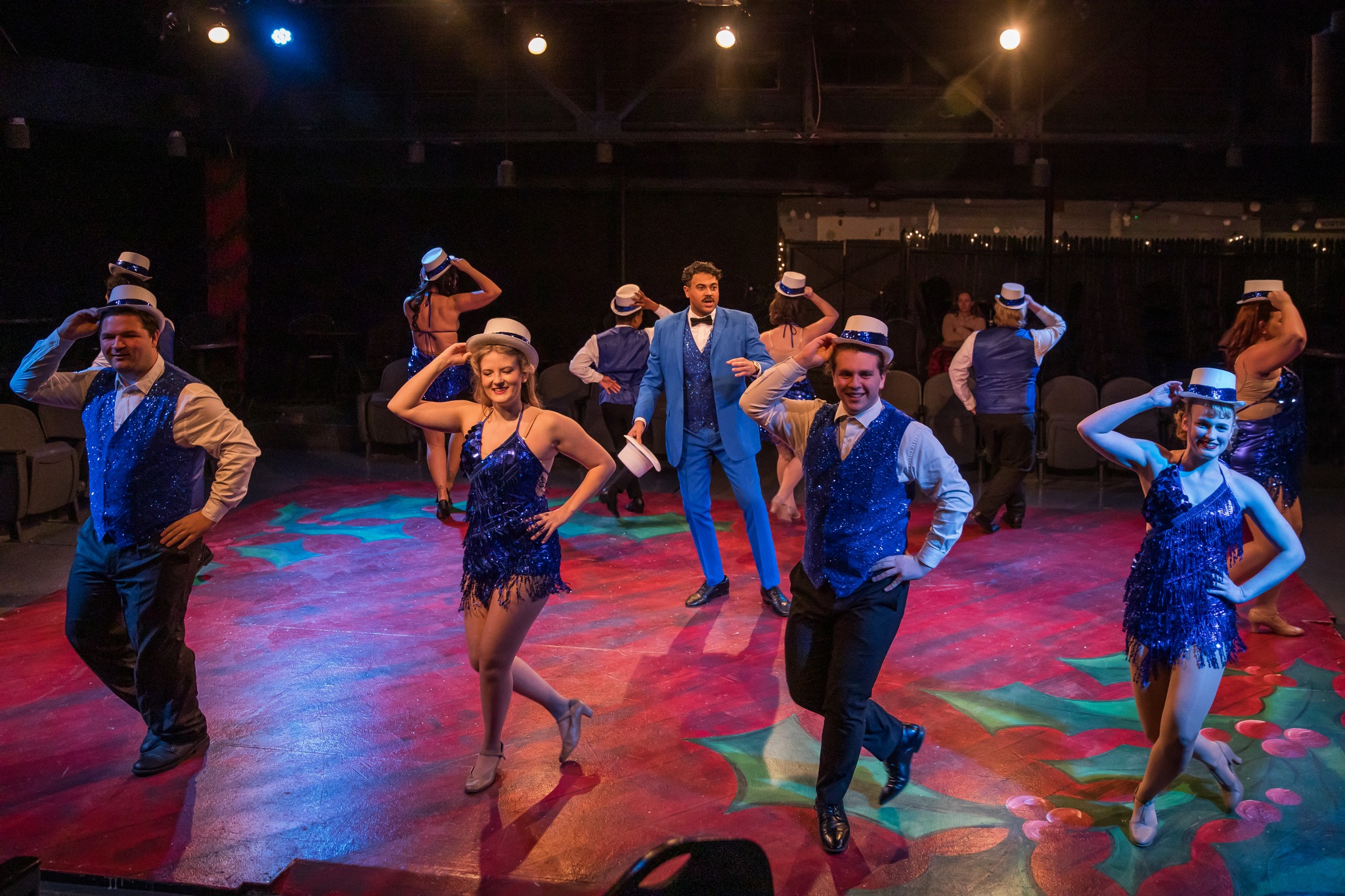
The play, which is based on a movie that is based on a song based on a dream famous composer Irving Berlin had, follows two soldiers, Bob Wallace (Mark McConnell) and Phil Davis (Connor Proctor), with a knack for performing who are determined to ditch the European Theater for Broadway. After breaking into the scene back home, the tenacious twosome become producers and stage their own successful production. From there they wind up in an unseasonably warm Vermont with their respective budding love interests, sisters, Betty (Kassie McConnell) and Judy Haynes (Cassidy Sprik); run into their former General (Dave Dougherty) who is struggling to run an inn; learn about friendship; and laugh and dance all the while.

Scenes from “A White Christmas.”

This show features a sprawling cast crawling with talent, at their best during the slew of musical numbers peppered throughout the plot. Their collective adeptness at juggling the comedic and serious elements of the story, in addition to rhythmic proficiency, makes this show such a joy to watch.

Mark McConnell amazes as Bob Wallace, the former Broadway star who decides to get back into the arts after a close call overseas. Not only is he great at exploring the depths of his character sans soundtrack, but he is also a tremendous singer who finds himself in many of the show’s strongest songs.

Connor Proctor is a perfect complement in the role of Phil Davis, Bob’s younger partner/army buddy and regular ladies’ man. A brilliant vocalist and actor in his own right, he really shines in conjunction with his castmates and their respective dynamics, ranging from the heartfelt to the humorous.

Similarly, Kassie McConnell and Cassidy Spirk are wonderful as siblings Betty and Judy Haynes, both possessing an abundance of nuance and charm. A shared comfortability with the choreography of dance and drama perfectly showcases their skills onstage. As further testament of her talent, Kassie McConnell even provides the play its musical direction.

Rounding out the rest of the major players are T.V. executive/army buddy Ralph Sheldrake (Alex Chapman), overwhelmed housekeeper Martha Watson (Mandy Mays), the ambitious Susan Waverly (Sammie Patterson), twins of temptation Rita (Isabella Fellion) and Rhoda (Allyson Kremm), frantic Mike (Jason Pastore), and the ever necessary Tessie (Angela Fowler). A fantastic mix of charisma, commitment, and comedy, all supplemented by a solid ensemble.

Sets, effects, and costumes enhance an already entertaining production. Every aspect of the show is evident of the consideration and care the cast and crew took in crafting a piece of theatre that excites a community like presents under a tree.

-JS

White Christmas continues its run December 14th-17th at The New Castle Playhouse in New Castle, PA. For more information, click here


A Leg Lamp, a Lamppost and a BB Gun – a review of “A Christmas Story”

by Michael Buzzelli

All Ralphie Parker (Sebastian Maloni) wants for Christmas is a “Red Ryder carbine-action, 200-shot range model air rifle with a compass in the stock and this thing that tells time (a sundial)” in Jean Shepherd’s beloved, and perennial Christmas story, “A Christmas Story.”

In Philip Grecian’s adaptation, Adult Ralphie (John Shepard) narrates this tale from the sidelines, and, occasionally, jumps into the action as a Christmas tree salesman and a mythologized version of Alan Lane, the Red Ryder himself.

Young Ralphie tries desperately to persuade his Mother (Jamie Agnello) and his hapless Old Man (Tim McKeever) about the desired bb gun, but they’re busy with their own problems. The Old Man (an unfortunate moniker) fights with the furnace, fends off a pack of the neighbor’s dogs, and struggles with his new-to-the=Parker’s used car.

Mother is busy with making meatloaf and red cabbage and caring for Ralph’s younger brother, Randy (an adorable Neal Raj Wadhwa, Jr.), who has bladder control issues and likes to hide in tight corners around the house.

At school, Ralph hangs with his besties, Flick (Colin Bozick) and Schwartz (Kaaveri Patil), avoids the school bully, Farkas (Eamonn McElfresh), and struggles to understand his friendship with Esther Jean (Natalie McGovern).

Their teacher, Miss Sheilds (Hope Anthony), tries to keep all of them in line.

Unless you were raised in the jungle with Tarzan or grew up in a fallout shelter next to Kimmy Schmidt, you’re probably familiar with “A Christmas Story.” Here, in the U.S., it runs on a near endless loop on Christmas Eve and Christmas Day and it can be found on a variety of networks and streaming services for the rest of recorded history.

Miss (Hope M. Anthony) is wowed by a Ralphie (Sebastian Maloni) in a hilarious dream sequence in “A Christmas Story.” Photo Credit: Michael Henninger

” A Christmas Story is strung together, like popcorn on a Christmas tree, by a series of comedy sketches. Some of the sketches are about Ralphie’s desire to own the “Red Ryder carbine-action, 200-shot range model air rifle with a compass in the stock and this thing that tells time,” and some are not.  The Leg Lamp and the Lamppost scene have nothing to do with the arc of the story, but the non-sequiturs are delightful kernels.

The product placement (yes, it’s a real thing and you can find the eponymous bb gun on display at the Daisy Airgun Museum in Rogers, Arkansas), is undeniable. The breathless words, “Red Ryder carbine-action, 200-shot range model air rifle with a compass in the stock and this thing that tells time,” are repeated thirty times in the play. It’s follow-up phrase, “You’ll shoot yer eye out,” is repeated several times as well.  The show would be fifteen minutes shorter if the boy wanted a football.

Shepard is brilliant as Adult Ralphie. He spins his yarn with exuberant joy, like a big kid reveling in his own antics. It’s an amazing thing to watch.

McKeever makes the role of the Old Man his own. His energy and enthusiasm for the role is boundless. His natural charm exudes out of him, and Ralphie’s dad becomes far more likable with McKeever in the role.

Agnello makes the Mother her own as well. She plays her as loving and compassionate, with added whimsy and a soupçon of sarcasm.

Anthony brings a pizazz to the role of Miss Sheilds, especially in Ralphie’s bizarre fantasy sequences.

Maloni is a sympathetic Ralphie. He plays the character with childhood innocence. It’s a lovely performance. The rest of the kids, some of whom only garner a few lines, deliver their dialogue with aplomb.

Tim Mackabee’s living room set is marvelous, as if lifted from the celluloid and transported into the present. The Parker home rotates like a rotisserie chicken, revolving into the classroom, a Christmas tree lot, and a department store Santaland. It is complimented by some amazing projection design by Bryce Cutler.

The dialogue is crisp and precise thanks to Sartje Pickett’s sound design.

If there’s a reason this show, which ran last year at the Pittsburgh Public Theater, came back, it’s due to Michael Berresse’s breezy and fluid direction.

“A Christmas Story” isn’t really about the “Red Ryder carbine-action, 200-shot range model air rifle with a compass in the stock and this thing that tells time,” but that the Parker family, through all of its faults, finds love at a special time of year, and that’s the true meaning of Christmas, and the best Christmases are the ones when we’re all together.

-MB

“A Christmas Story” runs until December 23 at the Pittsburgh Public Theater/s O’Reilly Theater, 621 Penn Avenue, Pittsburgh, PA 15222. For more information, click here. 

Dickens Meets the Dub V: A Review of A Christmas Carol

By: Joseph Szalinski

It was the best of times…wait, no, wrong story. Let’s try again. ’Twas the night before…Gah! somehow more correct and less correct at the same time. One last try.  Charles Dickens was dead, to begin with…for a while, actually, but that doesn’t matter because the talented Bob Colbert brings the celebrated author to life with an awe-inspiring performance as the scribe himself as he
narrates his famous holiday tale, playing all of the characters along the way, in Steel City Shakespeare Center’s latest production at the West View Hub, A Christmas Carol.”

Featuring a rousing demonstration of memory, among other things, Bob/Chuck hits all of the familiar plot points, as well as the parts most people pretend to remember, stopping only to wet his whistle before jumping back into the beautiful prose that would intimidate most performers.

For nearly two hours he delivers such an animated performance, one would swear that he’s a cartoon. In addition to impressive physicality, he further embodies the litany of literary Londoners by juggling a range of distinct voices and revolving costume pieces, an approach made even more entertaining when the text makes him jump from one character to the next in
rapid succession. A truly matchless act. Well, except for when he uses one to light a candle.

Bob Colbert takes on “A Christmas Carol” by himself.

Speaking of props, and I do not mean the kind words written above, Colbert makes great use of a few accoutrements to heighten the experience, whether they be the aforementioned candle, rattling chains, or a multi-purpose cane that also plays more than one role. A simple assortment of even simpler effects that aid in immersing audiences in this festive fable.

The set is also quite simple, being composed of two chairs, a desk, and a coatrack. However, through utterly magnetic showmanship, the HUBWORKS stage is rendered into whatever scene required by the story. Despite being held in a rather intimate venue, this play contains a boundless amount of heart, humor, and horror that is certain to dispel any humbuggery harbored
by any unfortunate souls. Blurring the line between theatre and spoken-word, Bob Colbert’s masterful interpretation is sure to delight everyone. His rendition of this timeless classic would surely be loved by Dickens himself, whose ghost, one hopes, is in attendance every night, thrilled to have his feelings toward Pittsburgh dispelled; happy to know he has a simultaneous
immortality through his words which are used to bring a community together, making a good place to live even better, made possible by the efforts of a wonderful theatre company and an organization that champions the kind of charity the world needs to see more of.

-JS

A Christmas Carol continues today at 2:00 PM on December 10th at the HUBWORKS, 435 Perry Highway in West View PA. TIckets can be found here

Caught in the Rain again – a review of “The Mystery of Edwin Drood”

By Michael Buzzelli

A mystery is afoot in Cloisterham and the townspeople are more than willing to sing about it in Rupert Holmes’ (“Escape” AKA The Pina Colada Song”) madcap whodunnit based on Charles Dickens’ unfinished novel, “The Mystery of Edwin Drood.”

In this play-within-a-play, the inimitable-and-insufferable stage actress Miss Alice Nutting plays Young Edwin Drood (Alondra Trinidad-Colon) in the Music Hall Royale, where she and a ridiculously large cast of actors perform Dickens’ final work.

On a rainy Christmas Eve (the Dickens you say), Edwin Drood disappears. Is he dead? Is he alive and secretly trying to solve his own murder as detective Dick Datchery? Who knows?

Here’s the hitch…since it’s an unfinished work, the audience is going to “Choose Your Own Adventure” the ending, like “Clue,” there are several different resolutions based on votes from the audience. If you shout louder than the guy next to you, the killer identity changes from the obvious choice of the wicked John Jasper (Riley Nevin) to the grave digger Durdles (Gabriel Hammesfahr), or maybe it’s one of the recently-orphaned Landless siblings, Neville (Juan Romero Muñoz) or his sister, Helena (Andrea Nalbandian).  Maybe the killer among them is the right Reverend Mr. Crisparkle (Braden Andrew).

Even though the ending changes from night to night, there will be no spoilers here.

The cast of “The Mystery of Edwin Drood.” Photo credit: John Altdorfer
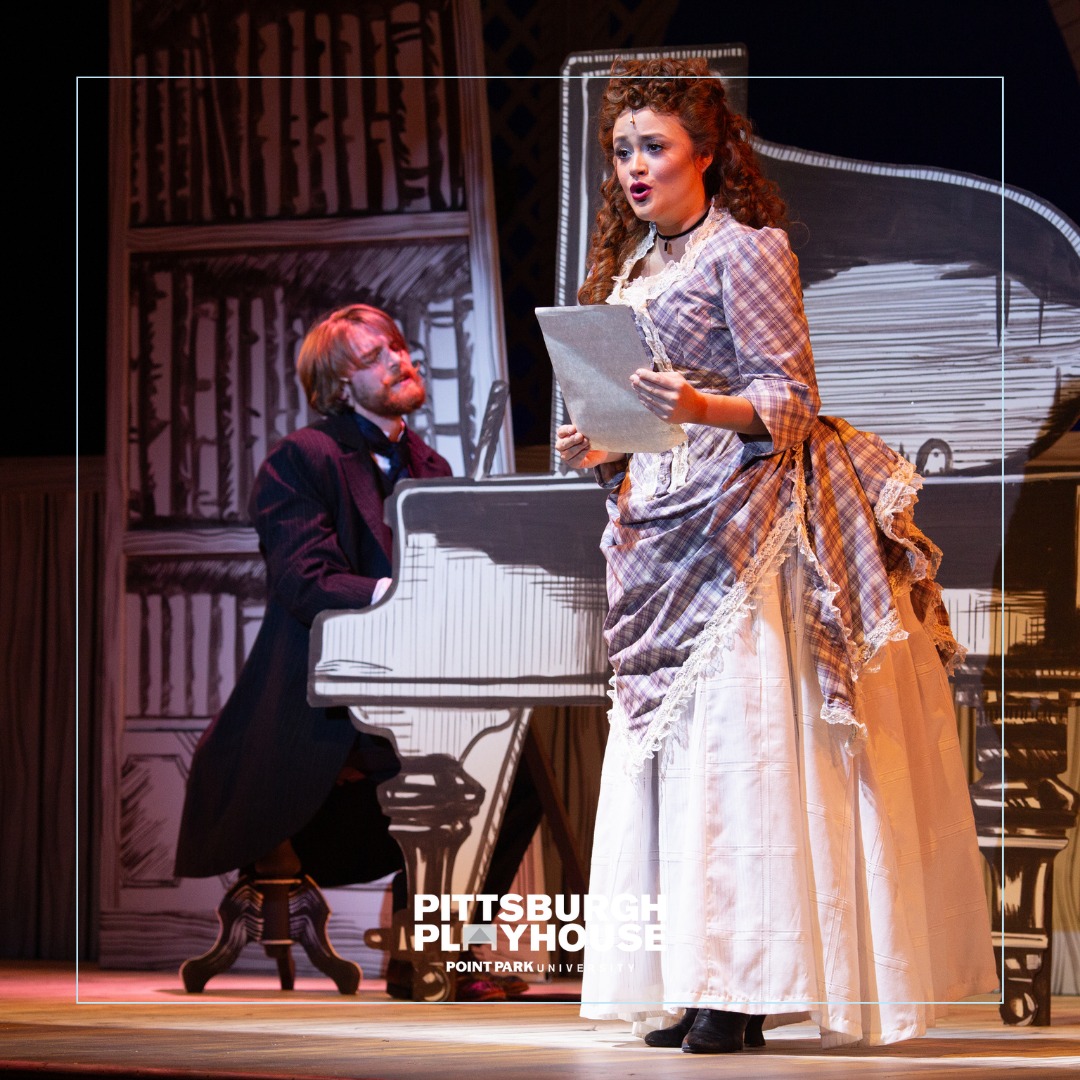
The malevolent John Jasper (Riley Nevin) plays the piano while Rosa Bud (Olivia Aubrey) sings. Photo credit: John Altdorfer

The actors in “The Mystery of Edwin Drood” are encouraged to go as far over the top as they can, and they do! The cast – and there’ s a lot of them – is top notch from James Cunningham to James Hitchens (in order of appearance).

Every character in this light-hearted musical has their own unique walk.  From Nevin’s Jasper as he thrusts himself about in an awkward, angular stride down to Elijah Corbin’s Master Nick Cricker, II, who bounces about like Tigger hopped up on methamphetamine.

Trinidad-Colon has a powerful stage presence and belts out a final tune (no spoilers).

Hammesfahr is bawdy and brilliant as Mr. Nick Cricker/Durdles.

Andrew does a nice job prattling and posing as the Reverend Crisparkle. Having recently seen the national tour of “Mrs. Doubtfire,” the reverend’s appearance struck an uncanny resemblance to one Mrs. Euphegenia Doubtfire.

Muñoz chews the scenery with a flamboyant flair as the shifty Neville Landless.

Nalbandian manages to grab a laugh just by raising her eyebrow (and it goes as high as it’s biologically allowed).

Gabriela Garza plays Miss Angela Prysock playing Princess Puffer, the owner of an opium den. Her character is steeped in Dickensian tradition, a woman crawls her way to the top by being the most lowly of creatures. She is fantastic in the role and gets the award for Best English Accent. Her rendition of “The Wages of Sin” is a showstopper.

Johnmichael Bohach’s set design is a marvel, an Edward Gorey rendering or a cartoon by Charles Addams leaping off the page, black and white etching and cross-hatching on everything from piano to lamppost. The Black and white set contrasts with the kaleidoscopic colors of Michael Montgomery’s costumes, each seam and stitch is pure perfection.

The songs aren’t much too sing about, though the jaunty “Off to the Races” is filled with verve. The orchestra was terrific, but, at times, it overwhelmed the singers, making it difficult to hear some of the lyrics. Ironically, when the curtain is pulled back, the orchestra is in perfect harmony with the performers, but when the curtain closes, the music is oddly amplified.

The first act goes a little long, but this reviewer’s inconvenience stemmed from an immediate need of the lobby’s restroom.

“The Mystery of Edwin Drood” is masterfully directed and choreographed by Zeva Barzell with a stellar cast. The show encourages the audience to “Kick off your boots, loosen your corsets…and enjoy yourselves.” In other words, don’t take any of it seriously and have a bit of silly fun.

-MB

“The Mystery of Edwin Drood” runs from December 6 – 10 in the PNC Theater, inside the Pittsburgh Playhouse, 350 Forbes Avenue, Pittsburgh, PA 15222. For more information, click here

Find Holiday Magic at Little Lake’s White Christmas

Reviewed by Dr. Tiffany Raymond, PhD

Mid-century classic movies like White Christmas (1954) and It’s a Wonderful Life (1946) are synonymous with the holidays. Unlike visits from some relatives, these films are a happy, feel-good part of the holiday reunion season. The 2000 theatrical musical adaptation of White Christmas by Irving Berlin, Norman Krasna, Norman Panama, Melvin Frank, David Ives, and Paul Blake features 17 enchanting Irving Berlin songs.

As Little Lake Theatre Company closes its 75th anniversary season with White Christmas, two classics unite. What makes this particular show incredibly special is that real-life Hawk sisters Alexis (Betty) and Samantha (Judy) play the fictional sister singing act, the Haynes Sisters. They authentically capture the range of intuition, banter, cattiness, and the sixth sense of sisters whose shared childhood has them in lockstep sync, whether they want to be or not. The sisterly duo turns family trio as mom Kathy Hawk capably steers the show as director.

The play tracks WW2 veterans and musical act, Captain Bob Wallace (Dylan Pal) and Private Phil Davis (EJ Christopher). We see them go from performing for their compadres in army camo to appearing bedecked in sequins on The Ed Sullivan Show. Kathy Hawk deftly directs Pal and Christopher to evolve from slightly hapless to polished professionals in the space of those sequences to demonstrate the refinement and evolution of their act.

The cast of “White Christmas.” Photo credit: Hawk Photography and Multimedia LLC

The play subtly demonstrates how military hierarchy extends beyond the bounds of service. Costume designer Ayana Sicheri has Captain Wallace in a black sequined blazer, whereas the lower ranked Private Davis only gets a black sequined vest. Later, their assistant Tessie (Audrey Wells) pointedly notes to Wallace that “You and Mr. Davis are on the train.” Kathy Hawk has Wells adjust her tone and issue a subtle eye roll to indicate Davis is the lesser of the duo. They do end up on a train – but to Pine Tree, Vermont instead of Miami – as Wallace and Davis fall for (and follow) the singing Haynes sisters.

After dreaming of a White Christmas, Pine Tree, Vermont finally gets snow. Photo credit: Hawk Photography and Multimedia LLC

The flipside of privilege is discrimination, and we see military service isn’t always a benefit. The duo’s former commanding officer, General Waverly (John Herrmann), is in danger of losing his Vermont inn. The song “What Can You Do With a General?” reinforces the paradox of the general – respected but overqualified for civilian life. Wallace and Davis organize the original GoFundMe to save Waverly’s inn by calling in their 151st division mates to descend on his inn for Christmas.

Military service isn’t the only discrimination we see in the play. As Phil, Christopher consistently ogles the ladies, even after he unites with Judy, reinforcing stereotypes of the lowly private as uncouth. Pal demonstrates a sense of discernment associated with rank. As Captain, he is more subtle in his pursuit of the ladies and focuses more on the duo’s career advancements.

As career military, the General seems clueless about women. He huffs at his innkeeper, Martha (Lisa McCoy), that he “got along just fine without you in the army.” McCoy’s snappy comeback that “It took 17,000 men to take my place,” elicits laughter and foreshadows feminism with her post-WW2 Rosie the Riveter confidence. By the end of the play, Waverly has evolved and realized the truth in her statement. He refers to Martha as “his superior,” suggesting a new worldview in which men no longer anchor gender to hierarchy.

The play opens on Christmas Eve 1944 as Wallace and Davis perform for the troops. They ponder what 1945 will bring and then wonder where everyone will be in 10 years in impossibly far away 1954 (no one suspects Pine Tree, VT). In the midst of war, they solemnize, “let’s pray it’s a better world.” As 2023 bends into 2024, one thinks of the coming year and a seemingly far decade out. Let’s hope history holds, and it’s a better world in 2033 too.

-TR

Find joy this holiday season. White Christmas runs through December 16, 2023 at Little Lake Theatre Company in Canonsburg, PA. Purchase tickets online at https://www.littlelake.org/whitechristmas

If Ignorance is Bliss, Why Are All These Polish People So Ornery – A Review of The Last Mass at St. Casimir’s

By: Joseph Szalinski

Nineteen-seventy-seven was the year that Buffalo, New York saw a lot of snow. And I’m not just talking about Rick James’ house. The infamous Blizzard of ’77 ravaged the city, shutting it down and claiming a few lives in the process. It’s during this winter calamity that Butler Little Theatre’s latest show, The Last Mass at St. Casimir’s, produced by Karen O’Donnell, takes place. While being the third entry in a semi-autobiographical trilogy of plays by Buffalo playwright, Tom Dudzick, audiences aren’t required to have seen the first two to understand or appreciate the swan song of a saga that traces the trajectory of the Pazinski family as they navigate life and all of its complexities.

Our glimpse into the lives of these pieróg enthusiasts begins with siblings Eddie (Steve Kalina) and Annie (Deanna Sparrow) hobbling into their family’s former tavern as the latter is suffering from an encounter with a lamppost. You know, a pole she isn’t related to. The pair are eventually joined by their brothers George (Matt Leslie) and Rudy (Sam Thinnes), and ultimately the matriarch of the family, their mother, Ellen (Katie Moore).

Everyone has gathered to see off the tavern and attend one final mass at St. Casimir’s before its imminent demolition. It’s almost like a Slavic-American spin on Deliverance’s “one last hurrah” that’s set on Lake Erie instead of the Chattooga River, and without the murder, pig squealing, or inbred banjo players. Thank God. As the storm rages on, our five favorite Polka People find themselves trapped by the snowfall, forced to face hard truths, argue about religion, and handle some big news. All dealt with splendidly by a compelling quintet. The cast is rounded out by a handful of voiceover roles heard via the Pazinski’s radio, performed by Disco Jake, Bob Cupp, Tyler Friel, Ryan Saeler, Jay Kline, Bob Dandoy, and director Jerry Johnston.

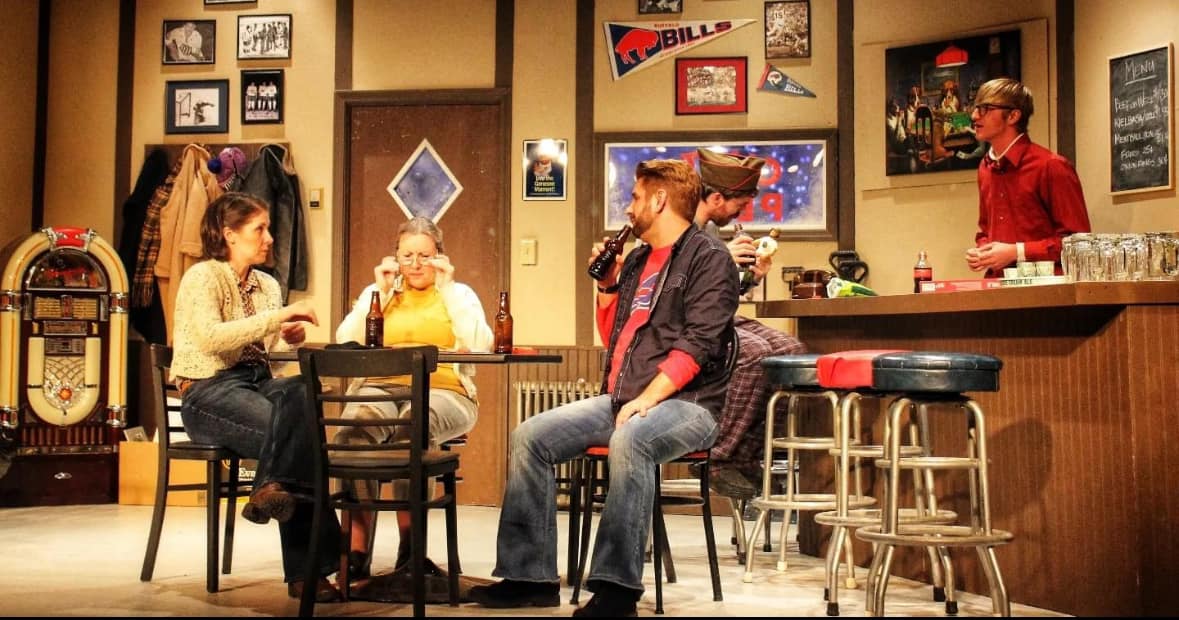
The cast of “The Last Mass of St. Casimir” from left to right: Deanna Sparrow, Katie Moore, Steve Kalina (Back at the bar) Matt Leslie and Sam Thinness.

Deanna Sparrow is fantastic as Annie, the sole Pazinski sister. She masterfully demonstrates her comfortability slipping into character. Oscillating between comedic moments and dramatic ones, Sparrow’s turn as Annie is both riotous and raw.

Steve Kalina is terrific as Eddie, a veteran with a passion for art who isn’t Bob Ross. He embodies someone who’s tough and tortured, a balance brilliantly brought to the stage.

Sam Thinnes charms and occasionally annoys as Rudy, the witty youngest brother of a Polish family who is skeptical about faith and aspires to be a writer, all the while cracking insensitive jokes. Yeah, totally not relatable at all…haha…far more than the playwright’s self-insert, Rudy symbolizes a rejection of the derivative development that shackles his siblings yet is spackled with echoes of a way of life he’s desperate to deviate from. Thinnes’ performance is wonderful and perfectly demonstrates his capability as an actor.

Matt Leslie delights as George, or Georgie as he’s called. His rendition of the character avoids caricaturizing someone facing mental illness, and instead provides plenty of depth equally bottomless as Georgie’s stomach. Despite having less variety in dialogue than his castmates, his performance is still powerful, due largely to his layered physicality.

Katie Moore is a joy to watch as Ellen. A character whose blend of stubbornness and being a source of comfort and sober judgement, is executed effortlessly.

The play’s sixth character comes in the form of the tavern itself. Being a place so instrumental in the upbringing of the Pazinski children, Chet’s Bar and Grill, named after their late father, is as much of a relative as any of the other family members who are merely mentioned and not featured onstage. For as cold as the scene is outside the windows of the closed establishment, there is a warmth that exists within its walls. It feels familiar. Even to those who’ve never ventured to Western New York or were alive during disco’s heyday. Chet’s is a place that we wouldn’t mind being trapped in ourselves, provided there’s plenty of Coca-Cola and potato chips to help us weather whatever weather that rears its ugly head.

Reflecting on the environment also enables one to acknowledge BLT’s position as a storied staple of the community that houses it. An inviting venue that boasts phenomenal productions, Butler Little Theatre is a pioneering institution in a city that is embracing the arts more and more, particularly live entertainment. The Last Mass of St. Casimir’s is another great show in their 2023-2024 season.

-JS

The Last Mass of St. Casimir runs Through December 9th at the Butler Little Theatre, One Howard Street, Butler, PA 16001. For more information, click here

css.php