


An Interrupted Life – a review of Etty

Mike Buzzelli

By Michael “Buzz” Buzzelli, ‘Burgh Vivant

During the Nazi occupation of Holland, Esther “Etty” Hillesum (Susan Stein) is encouraged by her unconventional therapist, Julius Spier to keep a diary of her innermost thoughts in Susan Stein’s “Etty.”

Etty spills her life out in her journal. She is very forthright in describing her passions on the page. She writes about her lover Han and her affair with the very therapist that recommended that she write the diary in the first place; the brilliant and eccentric Julius Spier.

Her life takes an unfortunate turn when she is shipped off to Westerbork, a transit camp where Jews were interned before being deported to concentration and extermination camps in Eastern Europe.

As her rights are slowly stripped away, Etty finds her strength and power through her writing. It’s a powerful piece of the Holocaust literature.
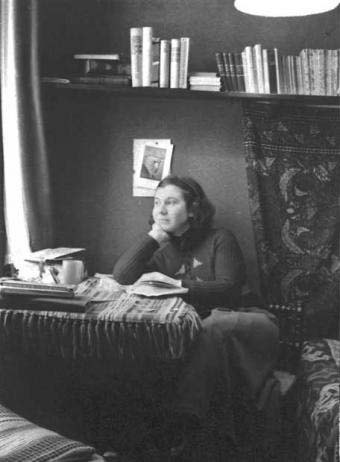
Esther “Etty” Hillesum looking off wistfully, surrounded by her beloved books.
Etty (Susan Stein) writes in her diary.

Stein is the actor and playwright in “Etty.” She has been working with the diaries for years and is deeply invested in Etty’s story. She immerses herself in the part.

She embodies the writer. It’s a moving portrayal of the interrupted life of Etty Hillesum.

There is practically no scenery. It’s Stein on a stage with a suitcase (she sometimes uses as a chair). She doesn’t need anything else. She paints a very vivid picture of Etty’s life without props or scenery.

It’s a very educational piece of theater.

Austin Pendleton directed the sparse one-woman show.

Side note: There is a milder, PG-rated version that Stein performs for middle-school and high school kids. Like “The Diary of Anne Frank,” the play seems like a perfect educational tool to engage children in learning about the horrors of the Holocaust.

The play is a brisk 52 minutes with a talk back at the end of each performance. In the talk back, Stein becomes herself again, freely chatting about all the things she wanted to tell us about Etty, but didn’t get into the actual play.

She lights up discussing the woman and her art. Stein speaks of her meeting with Hertha, Julius Spier’s finance. Though the elderly woman is in the throes of dementia, she vividly recalls her encounters with Spier and Hillesum. It was fascinating to hear about Stein’s moments with the survivors of that horrible time in our history.

Stein’s conversation with the audience was even more brilliant and exciting than the show itself. She shines when casually chatting about the woman and her work. It’s rare for any reviewer to claim that they loved the talk back even more than the show, but here we are.

The Holocaust is a shameful period of human history, but as philosopher George Santayana said, “Those who do not learn history are doomed to repeat it.” Sadly, it seems as relevant and important as ever.

“Etty” runs through Sunday, February 10 at the Carnegie Stage, 25 West Main Street, Carnegie, PA 15106. For more information, click here.




Warren Peace – a review of “Run the Rabbit Path”

Mike Buzzelli

By Michael “Buzz” Buzzelli, ‘Burgh Vivant

A father wants his adult children to become their best selves before moving away from them forever in Ray Werner’s world premiere play, “Run the Rabbit Path.”

Pop (James FitzGerald) sits in the kitchen as noodles dry on the table before him. His daughter, Patty (Karen Baum), stirs a vat of chicken noodle soup.

She’s not really ignoring him, because he’s not really there. Pop died the day before, a few feet away from where he sits in the kitchen, waiting.

As her father’s caretaker, the last few months of Patty’s life have been a blessing and a burden. She plans the funeral as her family rolls in.

Patty’s brothers Charlie (Reed Allen Worth) and Tommy (Tony Bingham) make their way home.

They bring little physical luggage (Charlie carries his guitar, and Tommy comes only with his cell phone in hand), but they bring heaping piles of emotional baggage. Charlie is sort of adrift, and Tommy is harboring a dark secret.

None of them can see or hear Pop. Sometimes the ghost makes suggestions that nudges them along in the right direction. They don’t see him or hear him, but they do feel his presence.

As in all stories, a secret will out. This particular skeleton in the cupboard has the potential to irrevocably change the lives of all the siblings forever.

Hint: The secret involves the hill behind their home where Pop and Tommy once hunted rabbits with their faithful hunting dog along the rabbit path.

Alan Stanford gathered four exceptional actors for the play, and each one of them elevates the work.

Baum is magnificent as the tough but tired older sister. She has a daunting task in this production. She has to be stubborn but sweet, cranky but conciliatory, frazzled but firm. It’s a high wire act, and she’s a flying Wallenda.

Bingham’s character Tommy has a lot of work to do. Tommy isn’t very likable. On paper, he comes off as smarmy business dude, but Bingham imbues him with a certain charm.

Worth is newer to the PICT stage. He performs perfectly alongside some of Pittsburgh’s best actors.

FitzGerald’s character is unheard and unseen. It’s a tough spot. It’s as if two shows are happening simultaneously. A family drama with a one man show hanging out on the same stage. FitzGerald pulls it off with aplomb.

“Run the Rabbit Path” is a world premiere and Werner has some kinks to work out if he plans on taking the show elsewhere. Even at 90 minutes, it feels a little long. There is no central hero or central villain, just four people coping with life and death. It’s a familiar subject and will touch each person differently. It’s especially moving if you’ve ever lost a parent.

It’s “This is Us” meets “Topper” with a little “Law & Order: Special Victims Unit” thrown in. It’s a serious drama and has very few laughs. There is, however, some lovely poetry woven in.

“Run the Rabbit Path” has a sweet, poignant ending, but it takes a little too long to get there.

-MB

PICT Classic Theatre’s “Run the Rabbit Path” runs through February 16th at WQED’s Fred Rogers Studio, 4802 Fifth Avenue, Pittsburgh, PA. For more information, click here.

Brave new world – a review of “The Tempest”

Mike Buzzelli

By Michael “Buzz” Buzzelli, ‘Burgh Vivant

A woman, in a hospital bed in Pittsburgh, is dying from late-stage breast cancer. She dreams of a magical island where she can exact revenge on her enemies and protect her daughter from the outside world. Nearing the end of her life, the audience is whisked away to the stormy isle inside her cavernous imagination in a beautiful retelling of William Shakespeare’s “The Tempest.”

Is the story just a dream?

To quote legendary comic book writer, Alan Moore, “This story is imaginary…aren’t they all?”

All stories are as real as we want them to be. And Shakespeare’s tale is simultaneously very real and very fantastical.

Prospero (Tamara Tunie) wields powerful magicks to protect Miranda (Kerry Warren). When she spots a boat carrying her sibling and rival, Tonio (Rami Margron), she summons a storm to sink the ship. Lightning flashes! Thunder strikes! The ship wrecks! The crew is scattered about the isle, marooned, grieving for their compatriots, unaware that many of them still live!

Pospero has two magical creatures in his service, a nymph, Ariel (Janelle Velasquez) and an unexplainable humanoid creature, Caliban (Shammen McCune).

On the isle, one cluster from the shipwreck includes the queen, Alonso (Deena Aziz), her advisor, Gonzalo (Laurie Klatscher), Sebastian (Aryana Sedarati) and the aforementioned Tonio. The shipmaster, Trinculo (Jamie Agnello), and the boatswain, Stephano (Bethany Cuputo), are marooned elsewhere on the island. The queen’s contingent is menaced by Ariel. While the shipmates Trinculo and Stephano encounter the woeful Caliban.

Meanwhile, the queen’s child, Ferdinand (Rad Pereira) is similarly marooned, but Ferdy isn’t tortured by sprites or dealing with monsters. Instead, the queen’s first born happens upon Miranda and a romance blossoms.

The situation gets desperate for all of the castaways until Prospero has a change of heart and vows to no longer use magic, even though the magic is keeping Prospero alive.

Tamara Tunie as Prospero Photo credit: Michael Henninger
Shammen McCune as Caliban Photo credit: Michael Henninger
Janelle Velasquez as Ariel. Photo credit: Michael Henninger

Marya Sea Kaminski directs the thrilling adaptation, casting women in all the roles. Correction: Casting amazing performers for each and every role. Every. Role.

The stage crackles with energy and vitality throughout the entire show.

For hundreds of years, from the ancient Greeks through Shakespearean times and beyond, actors were male. Holy Peg Hewes! This production is long overdue.

We might not ever need men on stage again. It is, indeed, a brave new world!

Tunie is dynamic. She plays Prospero not as a wizened wizard but a powerful conjurer, more Storm of the X-Men than Gandalf of Middle-Earth.

Kaminski abbreviated several scenes, especially the ones with the Trinculo and Stephano, but a truncated Trinculo and a shortened Stephano served the show well. The clowns were never funnier. Caputo and Agnello kept the audience in riotous fits of laughter nearly every moment they were on stage.

Pereira and Warren were a sweet pairing, reminding us that it doesn’t matter if it’s a man and woman…love is love.

Klatscher and Aziz have a different kind of chemistry. You can feel the affection from the back row. It’s Philia instead of Eros, but it was just as palpable.

McCune is remarkable. Caliban is a creature whose soul is crushed by years of servitude, desperately yearning for freedom. Her anguish is visceral.

There were other incredible elements that made “The Tempest” magnificent.

The O’Reilly is magically transformed by L.B. Morse’s scenic and multimedia design. Craggy gray rocks jut skyward with Prospero’s parapet (say that five times fast) peeking out on top. At the very beginning of the play, a Fast-Mo Pittsburgh cityscape is gloriously projected onto the slate backdrop. It is breathtaking.

Morse was aided by Nicole Pearce’s lighting design and sound design by Andre Pluess and stunning costumes by Nephelie Andonyadis.

There were some mind-boggling visuals in the show, including a fierce harpy that issued out a dire warning, with flaming red eyes and billowy wings. It was Julie Taymor-esque (that’s a thing now).

“The Tempest” is not one of Shakespeare’s finest plays (come at me). “Hamlet,” “MacBeth,” “Romeo and Juliet” and “Midsummer Night’s Dream” get the top honors. “The Tempest” has several flaws. Prospero has a sudden change of heart that comes out of nowhere. There’s a lot of extraneous plotlines that seemingly go nowhere. And blah, blah, blah.

That said, it’s a spectacular production. Kaminski frames the story in a unique way enhancing the pathos.

“The Tempest” was the stuff that dreams are made on.

-MB

“The Tempest” runs through February 24 at the O’Reilly Theater, 622 Penn Avenue, Pittsburgh, PA 15222. For more information, click here.


American Dreamer – a review of “Where Did We Sit on the Bus?”

Mike Buzzelli

By Michael “Buzz” Buzzelli, ‘Burgh Vivant

Brian Quijada (pronounced Key-Hada) describes his search for his own identity growing up as the son of two illegal Salvadoran immigrants in suburban Illinois in his multimedia solo show, “Where Did We Sit on the Bus?”

The show is all Quijada. The set is a plain white square stage adorned with a table and chair. The table, however, has laptop, microphone, Loop Station (more on that later) and a child-sized guitar not much bigger than a Barbie doll.

Quijada shares his life on stage. He starts with the time he proposed to his Austrian Swiss girlfriend and works backward. He goes…all the way back! He reenacts the minutiae of his birth, literally and figuratively. Spermatozoa meets egg. Boom. Heartbeat. Birth.

A birth described in dramatic, gory and hilarious detail.

Quijada beat-boxes through his tale, with an assist from the aforementioned Loop Station, which reproduces and repeats the sounds he makes with his voice, giving his dramatic life story a hip hop flare. He expresses significant moments in his life with rhythms, raps, songs, poems, spoken-word pieces and dance. The dude can move.

The title comes from a third grade classroom lecture on Rosa Parks during Black History Month. Quijada ponders, “If the blacks had to sit in the back of the bus, and the whites got to sit in the front of the bus…where did we (Latinx) sit on the bus?”

The author-performer recalls his teacher saying, “Latinos weren’t around then.” The answer flipped him out, leading him to erroneously believe Latinos did not have a part to play in any aspect of American History.

Side note: In Pittsburgh, we are, at least, taught about one Hispanic hero: Roberto Clemente, a Puerto Rican baseball player who died in a plane crash on his way to help earthquake victims in Nicaragua. Arriba! Arriba!

Brian Quijada plays his mini guitar, singing about his love of theater.

Quijada is a tour-de-force. He is energetic, buoyant and charismatic. He moves around the stage with aplomb and grace. It is a riveting performance.

“Where Did We Sit on the Bus?” is a tight 80 minutes with no intermission, expertly directed by Chay Yew.

There’s some excellent lighting and projection design by Diane D. Fairchild and Liviu Pasare. Quijada who wrote and starred in the show also did the sound design.

All art is political and Quijada is a Dreamer, born to illegal Salvadoran immigrants. He does discuss the hateful rhetoric around “the Wall.” It is a powerful and poignant moment, and it touched my Liberal Bleeding Heart.

If you own a MAGA hat, you might want to check it at the door. This show may not be for you.

It is, however, for everyone who has ever believed the American Dream is for anyone and everyone who pursues it.

– MB

“Where Did We Sit on the Bus?” plays until February 24 at the City Theatre, 1300 Bingham Street, Pittsburgh, PA 15203. For more information, click here.

THE LEGEND OF GEORGIA MCBRIDE opens barebones productions’ 2019 season

barebones productions will open its 2019 Season with The Legend of Georgia McBride. Written by Matthew Lopez and directed by Patrick Jordan, The Legend of Georgia McBride runs from February 14, 2019- March 9, 2010 in the Barebones Black Box in Braddock.  The Opening Night performance is Valentine’s Day, Thursday February 14m 2019.

Georgia McBride focuses on Casey, an Elvis impersonator who loses his job and adapts to drag performance in order to pay the rent and support a baby on the way.  He transforms from “The King” into a queen with the help of some new friends who become the second family he never saw coming.

“This is a bit of a departure for us” says Patrick Jordan, barebones Artistic Director. “While still exploring socially relevant and of-the-moment themes, we wanted to bring a message of self-love into the forefront to open this Season. We’ve all been so beat-up lately with the barrage of negativity and conflict- we found the perfect piece that brings themes of acceptance and transformation. We’re at an important time in history right now where we are rewriting what it means to be yourself.” Jordan continues “In addition it’s a chance to really let our hair down here – it’s going to be fun.”

The cast features Andrew Swackhamer (Casey), Shua Potter (Ms. Tracy Mills), Justin Lonesome (Rexy), and Sara Williams (Jo).

The creative team includes Andrew David Ostrowski (Lighting), veteran costumer, Ange Vesco, LaTrea D. (Choreography), and Brittany Spinelli (Stage Manager). Georgia McBride is directed and produced by barebones’ Artistic Director Patrick Jordan.

The opening night performance of The Legend of Georgia McBride will be Thursday, February 14, 2019 at 8pm.  Regular run performances will be Thursdays, Fridays, Saturdays at 8pm and Sundays at 3pm through March 9 at Barebones Black Box, 1211 Braddock Avenue, Braddock, PA 15104.  Tickets are $35 advance; $40 at the door, and are on sale now at barebonesproductions.com or 1-888-71TICKET.  Discounts available for students and artists at the door when available.  Discounts available for groups of 10+ by emailing info@barebonesproductions.com.

barebones productions is a Pittsburgh theater company whose mission is to facilitate the growth of local theater artists through the production of challenging, entertaining, thought-provoking plays and to attract new, young audiences by employing minimal production elements for maximum impact. Founded in 2003 by theater artist Patrick Jordan, barebones has garnered a reputation for producing high-quality, risk-taking plays.  More information can be found at barebonesproductions.com


Berlin Stories – a review of Hershey Felder as Irving Berlin

Mike Buzzelli

By Michael “Buzz” Buzzelli, ‘Burgh Vivant

A boy from Belarus grows up and becomes one of America’s most iconic and prolific songwriters. The show has no title, it’s simply called, “Hershey Felder as Irving Berlin.”  Presumably, because the title “White Christmas” was taken.

The show encompasses the whole of Berlin’s life and body of work from his boyhood back in Imperial Russia, to Tin Pan Alley, all the way to his deathbed at age 101.

It’s a lovingly-rendered history lesson with music.

Felder plays a few snippets of the songs from Berlin’s songbook from his first hit, “Alexander’s Rag Time Band,” to his final flop “Miss Liberty” with hundreds of songs in between. He wisely lingers over some of the more popular tunes, but there are a few clunkers in the mix. Felder knows it and winks and nods when he hits the keys.

Note: Felder plays the music in chronological order, some of the best songs such as “Happy Holidays” and “White Christmas” come near the end of the show.

The famous composer had an amazing life and career, and it’s a fascinating journey. He weaves some delightful tales of the famous composer. Felder as Berlin drops some famous names… Kate Smith, Fred Astaire, and…wait for it…Elvis Presley. Apparently, Berlin hated Presley’s version of “White Christmas.”

Aside from a swipe at Elvis (a National treasure), the show is very patriotic, because Berlin was very patriotic. After all, Berlin wrote “God Bless America.”  Even though he was religiously agnostic, he deeply believed in America. After all, he went from bowery boy to legendary composer. His music has attracted worldwide attention and artists continue to record it.

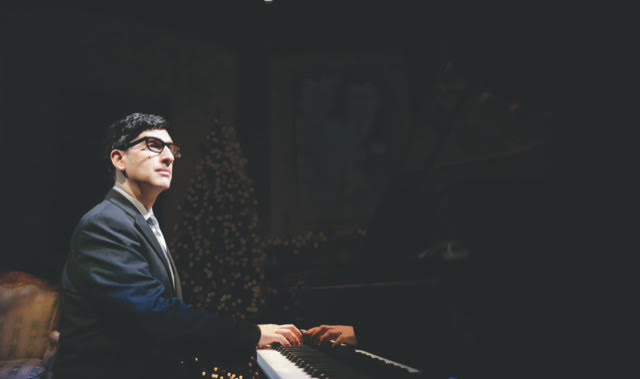
Hershey Felder as Irving Berlin in “Hershey Felder as Irving Berlin” Photo courtesy of the Pittsburgh Public Theater

Felder is a talented musician; his fingers fly over the black keys of the piano (Berlin composed most of his music in F sharp).

He deflty switches voices seemlessly from one character to another. Felder does, however, employ many of the one-man-show tropes. I will give him this, it’s much more interesting to watch Felder talk to an empty chair than it was to watch Clint Eastwood do it.

There’s an incredible amount of information about the composer swimming around in Felder’s head. The show was meticulously researched by Meghan Maiya, M. A. Berlin’s story is sweet, funny and sometimes tragic with plenty of great music.

Many people want to sing along to the classic songs, and it’s encouraged.

Personal Pet Peeve: I don’t want to sound like a Christmas Curmudgeon, but I hate it when I go see a show and the performer stops singing and asks the audience to finish it up. Gladys over there is sitting next to me singing off-key and I’m supposed applaud. At one point, Felder asks the audience to croon along to “Puttin’ on the Ritz.” It took every ounce of energy in my body to NOT emulate Peter Boyle in “Young Frankenstein.” POOOOODINNNN ON THE REEEEEEEETTZ.

Felder is multi-talented. Not only does he tell some delightful tales about the iconic Berlin, he designed the set, and it’s a beauty! The posh living room set is decorated for the holidays with a piano, Christmas tree and snow softly falling outside the “window.” It looks like a holiday issue of Better Homes and Gardens, and its reminscent of those old-timey Christmas specials with Bing Crosby and Dean Martin. The set is enhanced with some amazing projection design by Christopher Ash and Lawrence Siefert.

If you want to know more about one of America’s greatest composers, you need to put on your top hat, brush off your tails and head down to the Pittsburgh Public Theater.

The show runs until December 30 at the O’Reilly Theater, 621 Penn Avenue, Pittsburgh, PA 15222. For more information, click here.
https://ppt.org/

Truth or Consequences – a review of “Game On”

Mike Buzzelli

By Michael “Buzz” Buzzelli, ‘Burgh Vivant

Monty Price (Jason Shavers) welcomes contestants to the anniversary episode to everyone’s favorite game show in “Game on.” It’s okay if you’ve never heard of “Game On” before, it’s an imaginary anniversary for a fictional TV show.

It’s not easy to describe the show in 25 words or less. It’s sort of “Let’s Make a Deal/or No Deal,” with a little bit of “Family Feud” thrown in just for the hell of it.

Like the Howie Mandel hosted show, there are a variety of numbered mystery boxes, each containing a prize from a penny to a million dollars. Monty’s beautiful assistant, Gillian Van Ness (Marissa Buchheit) opens the boxes on command. The player must decide to keep his/her box or trade it in for some bigger prize negotiated by the Banker…er…um…Executive (a silhouette of a beautiful woman in a smart pantsuit).

The prize is usually one million, but, on this special anniversary episode, the Executive decides to up the ante to TEN MILLION DOLLARS! Gasp!

While there is some interactivity to the evening, it’s a scripted show with a book by Marcus Stevens and music by David Dabbon. These contestants have to carry the tune, not name it. Luckily, three of the four contestants are actors.

The contestants are schlubby, worrywart Felix (Connor McCanlus), decisive and forthright Natalie (Josey Miller) and newly retired Grace (Christine Laitta). As for the fourth contestant; it could be you!

While Natalie and Felix are chosen from opposite ends of the room, we learn that the duo share a past. The two have baggage. During the show, their past unfolds. The couch potatoes were once lovers who bonded over their love of “Game On.”

Grace also has a secret.

As the show goes on, the Executive raises the stakes and things get weird. Things go from typical game show shenanigans to a million dollar mind game.

Who will win? Will Natalie and Felix reignite the fire between them? Will they make a love connection, or does Felix just have a candy crush?

There will be only one survivor.

From left to right: Natalie (Josey Miller), hostess Gillian (Marissa Buchheit), Grace (Christine Laitta), an audience member, and Felix (Connor McCanlus).

The actors are magnificent. Shavers plays Monty as the quintessential game show host, with a nod to Chuck Woolery and a wink to Wink Martindale. As the show goes on, Monty gets grouchier than Groucho, but Shavers remains charming.

Buchheit is buoyant and adorable as Gillian Van Ness, earlier in the evening Buchheit shows up as a contestant from the previous episode, Deborah, and she’s and even bubblier and bouncier.

McCanlus does a superb job as Felix. He gets most of the evening’s laughs with his indecisive character, wringing his hands as he tries to decipher the clues Natalie is dropping as he tries to win the game. You can almost see the flop sweat from the back of the room.

Miller’s Natalie is a lot of fun. Of the three scripted contestants, she seems like the one you’d most want to grab a beer with.

Laitta’s Grace is reminiscent of a Rachel Dratch SNL character. Laitta gives the performance oodles of depth.

Director Jen Wineman perks the show up with some really skillful choreography, especially in the number “I Want It.” The cast executes said choreography wonderfully.

Tim Mackabee’s set is dazzling, enhanced with lighting from Alan C. Edwards. It looks like an actual set from a million dollar game show.

Christian Fleming’s costume design is artful and fun, from every button on Natalie’s jean jacket down to the Monty Price’s fabulous footwear. If the Wicked Witch of the East had workout clothes, Shavers’ sparkly kicks would be in her gym bag.

To tell the truth, “Game On” isn’t as funny as it could be. The actors are great, but the writing is… the weakest link. While it is funny, I was hoping “Game On” would try harder to make me laugh, but no dice.

Dabbon’s idea, a musical about a game show, is brilliant. It’s just not executed as well as it could have been. One or two more catchy songs and a bit more wit would have made this show a blockbuster. Luckily a talented cast, a smart director and a gorgeous set keep “Game On” from being a wipeout.

-MB

You can get your “Game On” at the Greer Cabaret Theater, 655 Penn Avenue, Pittsburgh, PA 15222. For more information, click here.



The Dickens you say  – a review of “The Old Curiosity Shop”

Mike Buzzelli

By Michael “Buzz” Buzzelli, ‘Burgh Vivant

A gambling grandfather (Patrick Conner) loses everything except the love of his granddaughter, Little Nell (Caroline Lucas), in Charles Dickens’s “The Old Curiosity Shop.”

Mrs. Jarley (Kendra McLaughlin) and her carnival barkers (Jonathan Visser and Ken Bolden) describe the tragic circumstances of Nell’s life, briefly narrating her tale.

Through our whimsical narrators, we quickly learn that the grandfather is on the verge of losing his shop to the sinister Mr. Quilp (Martin Giles) playing poker after dark (way before Jennifer Harman, Phil Laak and Daniel Negreanu made it cool).

Quilp wants the shop, the money and the granddaughter. It’s a sick package deal. Quilp is dark and twisted (physically and emotionally) and pines lustfully for the fourteen-year-old Nell. Let’s face it, this dude is creepy.

Quilp is often seen in the company of his lawyer, Brass (James FitzGerald) and a ragamuffin he simply calls Boy (Matt Henderson).

The grandfather has very few allies. His grandson, Nell’s brother Fred (Sean Lenhart), is after his nonexistent money. The grandfather and Nell only have the extremely loyal shop boy, Kit (Jacob Epstein), to count on.

When Fred is convinced his grandfather can’t help him, he confides in his best friend, Dick Swiveller (Jordan Ross Weinhold), that he has to leave town to escape his creditors.

The grandfather and Nell also flee in the middle of the night to escape Quilp’s clutches, but the villain does not give up easily. He begins his manhunt…er…um…girl-hunt. The vile man moves people around like chess pieces. He gets Dick Swiveller to a job working for Brass and his sister Sally (Karen Baum) in case Nell contacts him.

Meanwhile, Kit gets a job working for the law firm of Garland (Visser) and Witherden (Bolden), but Quilp finds a way to manipulate Kit with his treacherous underlings, Brass and his sister.

Out on the road, the old man and his granddaughter face all sorts of calamity. Luckily, a landlady (Kaitlin Kerr) takes them in. They are befriended by a schoolmaster (Sean Lenhart) who employs them as caretakers to the property surrounding his school.

All the while, Quilp gets one step closer to his prey.

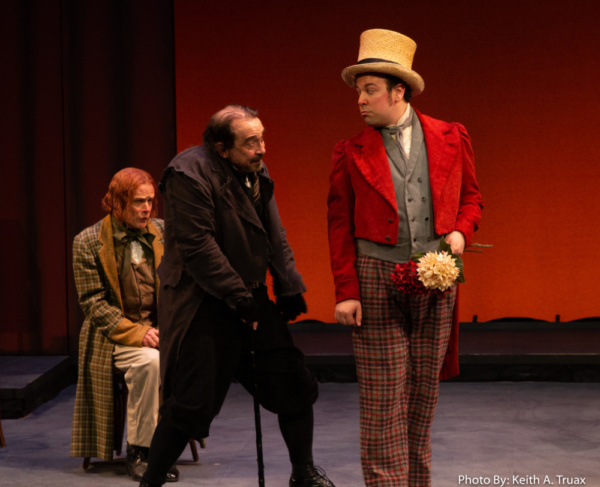
From left to right: Brass (James FitzGerald) cowtows to his boss, Quilp (Martin Giles) while chatting with the aimable Dick Swiveller (Jordan Ross Weinhold). Photo credit: Keith A. Truax.

“The Old Curiosity Shop” is filled with plot and character. There’s a lot going on. While it’s a lengthy show, it’s never tedious. It’s chock full of Dickensian wit and charm.

The cast is magnificent under Alan Stanford’s guiding hand.

Giles romps around as the villainous Quilp. There’s a glint in his eye as he beats back the Boy with a cane and slobbers over young Nell, relishing in his dastardly deeds. It’s a grand performance.

FitzGerald and Baum are incredible as the Brass siblings. FitzGerald’s Brass strongly correlates to our contemporary times. He’s Cohen to Quilp’s Trump, devilishly sycophantic until the worm turns and he is caught. Baum’s Sally is basically an Ebenezer Scrooge without the redemption.

Side note: There’s a prevailing theory that the nameless handmaiden, the Marchioness (Calema Graham), is the illegitimate offspring of a devious union between Sally Brass and Quilp. It’s icky enough to be true (as true as anything in this fantastical tale).

While the villains attempt to steal the show, there are some amazing turns among the heroes and those who live in the lines between good and evil.

Weinhold’s comic timing is impeccable. When Dick Swiveller has the unfortunate assignment of describing an apartment, he says, “They are very charming apartments, sir. They command an uninterrupted view of – of over the way, and they are within one minute’s walk of – of the corner of the street.”

Epstein’s Kip is marvelous. The young lad holds his own amongst a bevy of Equity actors. He is charming and charismatic.

Visser and Bolden do a remarkable job with their multiple roles, each, literally and figuratively, wearing many hats.

Joan Markert’s costumes are flawless. She captures 1850’s London raggedy and sooty style with an artistic flair.

The Christmas season is upon us, but, instead of seeing the same old Scrooge, mix up your Dickens a bit and go to “The Old Curiosity Shop.

-MB

“The Old Curiosity Shop” runs through December 15 at WQED’s Fred Rogers Studio, 4802 Fifth Avenue, Pittsburgh, PA 15213. For more information, click here.


Variations and Fugue – a review of “Coram Boy”

Mike Buzzelli

By Michael “Buzz” Buzzelli, ‘Burgh Vivant

After a dispute with his father, a talented young composer and singer, Alexander Ashbrook (Sophie Aknin), runs away to pursue a musical career in Helen Edmundson’s adaptation of Jamila Gavin’s “Coram Boy.”

Alexander is a happy child. He spends his days and nights in the choir at the Gloucester Cathedral, composing music in his off hours and hanging with his bestie, Thomas Ledbury (Mei Lu Barnum). His father, Sir William Ashbrook (Chris Knudsen), however, thinks it’s time to put away such childish things and become a man.

During a performance in front of his family and friends, his voice cracks and young Alexander becomes a man (Kyle Irish-Gorvin). He falls for the governess’s daughter, Melissa (Alysia Vastardis) and they do what young people in fresh out of puberty often do. Boom Chicka Wow Wow.

Unable to comply with his father’s wishes, Alex flees the family estate and runs away. His father scratches his name out of the family bible. Gasp!

However, he left Melissa with an unexpected consequence of their brief encounter (the unitended result of said puberty).

Meanwhile, the devious Coram Man, Otis Gardiner (Mike Mekus), takes unwanted children from hapless mothers and buries them (dead or alive) for a price. He tells them that the children will be cared for at the well-known Coram Hospital (for wayward children). Otis accomplishes his wicked deeds with the aid of his own indentured servant and son, Meshak (Daniel Murphy).

Melissa gives up her newborn to the housekeeper, Mrs. Lynch (Blake Doyle), who is in cahoots with the Coram Man. Otis commands Meshak to dispose of the baby. Meshak runs away with the child.

Several years later, an orphan, Aaron Dangerfield (Sophie Aknin in a dual role), ends up in a choir with the same desire to pursue a musical career.

A famous composer, George Frideric Handel (Michah Stanek) discovers the child’s talent and brings him to be tutored by Thomas Ledbury (now played by Tommy Bo).

Alexander Ashbrook, now living under a nom de guerre, reunites with Thomas and meets Aaron, unaware that the boy is his son. Dunt dunt da!

But wait! There’s more! Aaron’s best friend, Toby Gaddarn (Zetra Goodlow) is taken in by a dastardly slave trader (who may or may not be someone from Alex and Melissa’s past). And, for some reason, there are angels (Augustine Ubannwa and Tyquan White) flying about.

It’s difficult to pick a central character or theme to the show, because there isn’t one. There is no central POV (Point of View) and myriad plotlines go off of their own accord much like the aforementioned angels.

The play is very long. Toby’s storyline started midway through the second act. It was the “Look down at the watch moment.” There was, however, no kitchen sink in the play, but it felt like the only thing missing.

Frankly, it’s hard to imagine why Edmundson gathered numerous Tony nominations for this adaptation.

Director Tome Cousin does garner some fantastic performances out of his actors.

Murphy does a stellar job writhing around as the tortured Meshak. Think of him as a quasi-Quasimodo – – without the spinal malformation.

Aknin does a spectacular job as both young Alex and Aaron.

Mekus is reprehensible villain. He pulls it off, despite his boyish good looks. Doyle’s Mrs. Lynch is delightful as the unscrupulous maid.

There are some great but tiny performances from Blumethal, Barnum and Goodlow, and Stanek’s Handel is a hoot.

“Coram Boy” is not a musical but a play with music. It’s a fine distinction. No one bursts into song unexpectedly, but the number one reason to see the play would be for the choir. They are heavenly.

-MB

“Coram Boy” runs until December 2 at the new Pittsburgh Playhouse, 350 Forbes Avenue, Pittsburgh, PA 15222. For more information, click here.

 

css.php