Dear Evan Hansen Delivers the Message

Reviewed by Dr. Tiffany Knight Raymond, PhD, and Theron Raymond (7th grade)

Pittsburgh Musical Theater brings Dear Evan Hansen to the stage. It’s about teen suicide, specifically the suicide of a teenager named Connor Murphy (Joshua Clark). The dark subject matter is not characteristically musical-like, and since most of the songs are solos, Lucas Fedele’s choreography becomes more of an afterthought.

Connor snags a letter Evan (Anthony Marino Jr.) has written to himself out of the high school computer lab printer. It’s an assignment from Evan’s therapist. When Connor’s body is found, the note is on his person. Since it’s addressed to “Dear Evan Hansen” and signed “me,” Connor is presumed to be the author.

Tucker Topel’s set design is spare. A large frame at a canted angle arches over the stage, and other posts extend upward to anchor it. These towering elements are lit in varying colors to signify different characters and moods. They’re often overlaid with projections from visual media designer Scott Andrew. While striking, they don’t have as much visual impact as they could because of the frames’ narrowness.

Evan is a milquetoast and doesn’t speak the truth when he learns about Connor’s passing and the note from Connor’s parents. In his effort to provide comfort, Evan slides into assuming the role of Connor’s best friend, despite the fact that they barely knew each other. Evan’s long-term obsession with Connor’s younger sister, Zoe (Erin Cain), significantly complicates his motives to nurture his relationship with the Murphys.
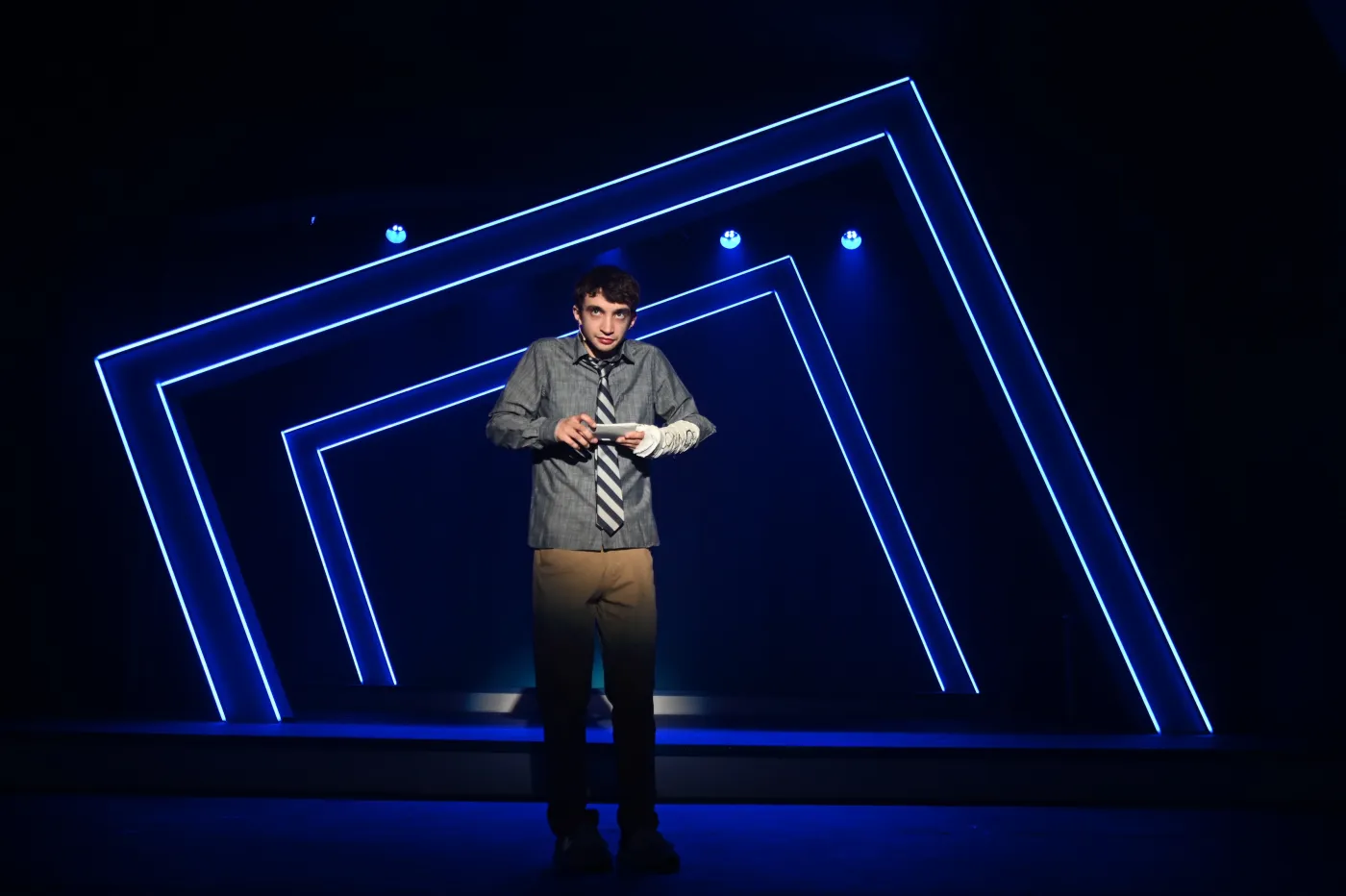
Anthony Marino Jr. as Evan Hansen. Photo Credit: Matt Polk

Connor struggled with substance abuse and was both feared and disliked. Ironically, it is only through Evan that Connor comes to life – and becomes likable. But the same is true for Evan. Evan goes from weird outcast to popular by association. Connor’s death creates a viral moment that people want to associate with. The play explores the lengths one goes to in order to extend a moment and keep something significant when the world is constantly moving on. In a world of social media-driven attention spans, new tragedies and events continually draw us in other directions.

Director Tim Seib has Marino lean into a disarmingly quiet presence that brings both Connor and Evan to life through storytelling. Their fictional friendship reflects a heart-achingly real wish for connection. Evan’s only friends are his “family friend” Jared (Max Milligan) and another socially awkward classmate, Alana (Maya Fullard). Both Fullard and Milligan create memorable supporting characters without overplaying their roles. Fullard continually talks over Marino to corner her own piece of Connor’s memory, reminding his parents she was one of his “best acquaintances,” and you can see the wheels spinning as she wants to parlay the moment into a college application essay.

Evan loves trees; nature provides a companionship and comfort he can’t find with humans. It’s not accidental that the fictional friendship takes place at an abandoned apple orchard that Connor used to visit with his family. Apples are symbols of temptation, and Evan succumbs to the temptation to keep elaborating on this fictional friendship to draw closer to the Murphy family. They’re upper-middle-class and embrace Evan. This contrasts with Evan’s hard-working single mom, who’s rarely home as she struggles to make ends meet as a nurse’s aide while also completing her education. Her absence in Evan’s life is understandable, but it’s one more dimension of his loneliness that is countered by the affirmation and attention the Murphys give him.

You know this house of cards must eventually collapse, and that anticipation heightens as Evan is caught in a swirl of his own lies that is at odds with the genuine affection he has for the Murphys and his attraction to Zoe. While Steven Levenson’s book elides climactic confrontation, the staging dynamically compensates. The musical opens with the two moms in a duet, singing about “making this up as I go.” It’s not just a line about parenting but about life, and Dear Evan Hansen inspires deeper discussions about how we each make it up as we go. Those choices can never be perfect, but thanks to Dear Evan Hansen, they do inspire reflection.

-TRK, Ph.D. & TR

Pittsburgh Musical Theater’s production of Dear Evan Hansen runs through May 24, 2026, at the Gargaro Theatre, 327 S. Main Street, Pittsburgh, PA 15220. Purchase tickets online here.

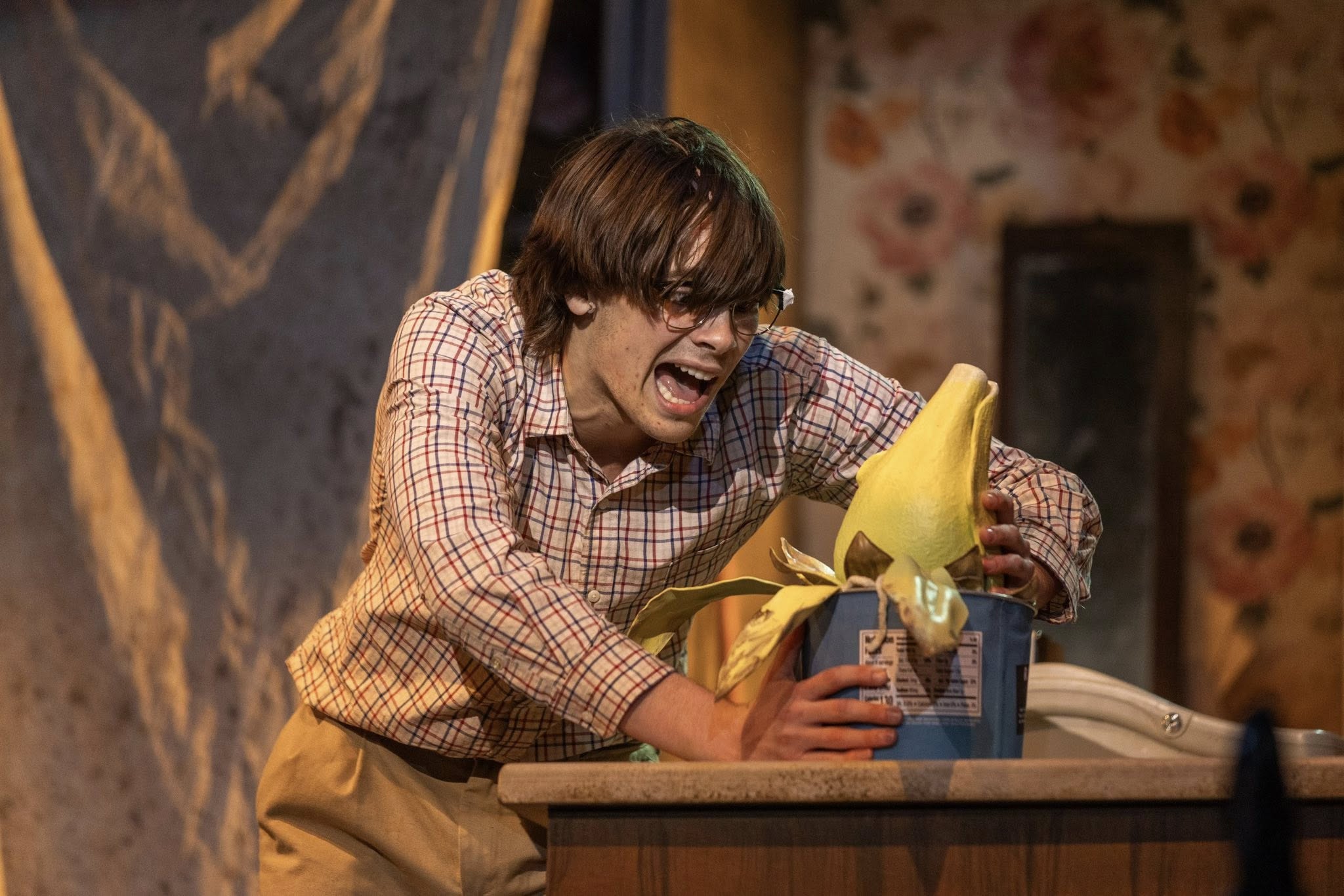
Pod Cast – A Review of Little Shop of Horrors

By Timothy Ruppert

If Point Park University alerts Seymour Krelborn to the frost advisory currently in effect for Pittsburgh, let’s hope he doesn’t put Audrey II out on Forbes Avenue overnight—we would miss a terrific new production of Alan Menken and Howard Ashman’s hilarious musical, Little Shop of Horrors.

Admittedly, the diffident but loveable florist Seymour (Braden Max Stroppel) has good reason to wish the otherworldly plant Audrey II (Bianca Dixon) out of his life. A bloom with vampiric tendencies and a taste for human beings, Audrey II happens into Seymour’s hands after a solar eclipse takes place. Seymour names the plant for his secret love, Audrey (Mariana Sarmento), who works with him at a nearly bankrupt Skid Row flower shop owned by the often-irascible Mr. Mushnik (Konstantin Kipshidze). When Mushnik allows Seymour to display the plant in the street-side window, the shop’s fortunes take an instant turn for the better—seemingly. Soon enough, though, Audrey II’s sinister thirsts compel Seymour to seek out sustenance for her, leading him to plan the murder of Audrey’s sadistic dentist-boyfriend, Dr. Orin Scrivello (Logan Johnson). After Orin dies of a nitrous oxide overdose, Seymour gives his remains to Audrey II, initiating a terrible sequence of events that intensifies the chaos at Mushnik’s shop even as it betters the profits beyond what anyone could have imagined.

Seymour (Braden Max Stroppel) meets Audrey II.

Like Cats or Sweeney Todd, Little Shop of Horrors is an eccentric masterpiece that asks a lot of its performers and technical staff. The cast and crew of this Point Park offering have the vision and commitment to make it succeed. As Seymour, Stroppel commands the stage without ever losing the thread of his character’s charming forlornness as it evolves from “Grow For Me” to “Suddenly Seymour” and beyond. Sarmento sings goldenly, most notably in her gorgeous rendition of “Somewhere That’s Green.” Kipshidze anchors the triumvirate of principals with a fine sense of world-weariness tempered with a quiet compassion and an inclination to hope against hope. Johnson delights as Orin, finding the essential vein of humor in his sometimes polite but always cruel character. Chiffon (Kat Bruce), Crystal (Mia Laverne), and

Ronette (Kendal Williams) comprises a savvy, skeptical chorus whose lovely voices and enthusiastic performances endow this production with a graceful cohesion. Dixon ensures that Audrey II plays as funny as she is menacing—no mean achievement for a character in which 1930s horror cinema meets 1960s Motown brilliance. And, of course, Luka DePasquale, Madyn Harris, and Jo Welch do excellent work with Stella Frazer’s strikingly designed puppets. The production staff, under Michael Campayno’s sure-handed direction, deserves recognition, with the work of dance captain Jayla McDonald, choreographer Latrea Rembert, and sound designer Zach Moore particularly notable. Add in a splendid orchestra conducted by Camille Villalpando Rolla, and the formula for an outstanding evening is complete.

As this new spring brings old temperatures back to the region, remember to bring in your plants—unless you find Audrey II among them. If you do, please have her go to the Pittsburgh Playhouse right away. She has songs to sing and murders to commit for Point Park’s exceptional interpretation of Little Shop of Horrors.

—TR

“Little Shop of Horrors” runs through 3 May at the PNC Theatre, Pittsburgh Playhouse, 350 Forbes Avenue, Pittsburgh, PA, 15222. For more information, please visit https://playhouse.pointpark.edu/shows-events/conservatory-theatre/Little-Shop-of-Horrors/.  


I Want My Baby Back Baby Back Baby Back Ribs—A Review of Agamemnon

By Joseph Szalinski

Diets have been all the rage throughout history. Germany had a Diet of Worms, Gandhi ate nothing, and lions in Rome ate Christians. Greece has been a hotbed of health fads, serving as one of the progenitors of the “Mediterranean Diet,” but before they touted the benefits of fish and fruit, they enjoyed the “Aegean Diet,” children’s pot pie. It’s because of this feast of champions, and maybe some additional sacrifice, that they can emerge victoriously in the Trojan War, which is discussed in Steel City Shakespeare Center’s production of Agamemnon, directed by Alexandra Hellinger and Lauren Scheller-Wolf, now running at West View Hubworks in West View, PA.

The first part of the Oresteia Trilogy by Aeschylus (the Daddy of Sadness)—Aggro Pokemon. No. Itchy Nimrod. No. Achey Samsung. No. Agamemnon. Yes—Agamemnon is a story about the titular king’s homecoming after a decade of fighting. While he’s anticipating a warm welcome, his wife Clytemnestra, of all people, is plotting his murder so she can get with her lover, Aegisthus. If the king gets a side piece, why shouldn’t she? Her new boo has a bone or two to pick with ol’ Aggy, which results in history’s most awful bath time. Taft’s got nothin’ on him!

Promotional poster.

The amazing actors are the backbone of this production, with most doing double duty in their roles, playing a major character and a member of the chorus. Bob Colbert is tremendous as everyone’s favorite Grecian knife block, Agamemnon. His booming voice and physicality make him seem larger than life. Sarah Elizabeth captivated as the conniving Clytemnestra, complemented by the vengeful Aegisthus, played expertly by Álvaro Muñoz. Colleen Nammond’s tremendous turn as Cassandra is foretold the moment she takes the stage. Trevor Buda has his eyes on the prize as the Watchman as well as the Chorus Leader, while Felicia Perez proclaims her prowess as the Herald. Anna Bopp, Soren Mills, and Joseph Vasquez round out the cast as impassioned players in the chorus.

Technical elements are sparse. Nearly nonexistent. Lighting is left to the ceiling bulbs. Sound is dictated by the venue’s acoustics. The handful of props and costumes merely decorate the world brought to life by the cast’s efforts. Intimate and raw, this 90-minute theatrical experience demonstrates the power of live performance.

Steel City Shakespeare Center is a terrific company that has been putting on stellar shows for several years. This is but the first production in an exciting season, and every play of theirs further proves that they are a staple of the scene. From age-old classics to more contemporary titles, SCSC has created quite a legacy for itself, inspiring and helping future generations of thespians hone their talent.

West View Hubworks is a neat performance space. Although a bit different from a typical theatre, it can still host feats of imagination and triumphs of art. Part of a larger organization that does so much to foster a better world, West View is lucky to be the home to a place where all kinds of folks can be dazzled by the talent and tenacity of people who love what they do.

-JS

Agamemnon continues its run April 17th-April 19th at West View Hubworks in West View, PA.

From the Dark Room into the Light: Photographer Robert Ketcham Discusses New Local Nonprofit, Braddock Photo Works


Gina McKlveen, Art Correspondent

“Imagine instead of posting your life on your social media, imagine you are a member of a community where you can print your photographs, and once a week, you come to an event where you can share those with other people. You can share the work you’ve made, which gives you time to really understand and learn what your work is. And you don’t have to come and say ‘I made this photograph with a Nikon this and that, with this lens, and F8 at 125’—all of that can fade away because the work is what matters now. The work is what matters, not how you made it. I want to see the work become what’s important.”

For Robert Ketcham, imagining a place to practice photography that focuses on seeing the photograph just as much as seeing the photographer, has been a work in progress. However, when Ketcham first entered the building located in downtown Braddock, he captured a vision of what this place could be.

Artist Robert Ketcham

“The building kind of chose me,” Ketcham said. “I was working for Gregg Kander, [who] was in the middle of the Ohringer building, and he bought another property up the street that everyone just knew of, which had been Woolworth’s. That’s as far back as anybody went. It took me a lot of digging to figure out that Andrew Carnegie, himself, in 1891, bought that piece of property where the building at 818 Braddock Ave, it’s called the Braddock Arts and Media building now, where Braddock Photo Works will be housed, was bought to move the Carnegie Cooperative Store.”

Braddock Photo Works

He described looking at the back of the first floor, which has a 15-foot ceiling, and he thought, “I could do a dark room here. This could be something related to photography, and this is in 2019 that I’m starting to have these ideas.”

He imagined it much like the former Pittsburgh Filmmakers, where people could use a traditional dark room or computers, including any editing software for digital photography.

“It was always not far from my mind that this would be a great photo center,” Ketcham stated. “I want to make sure that this space has what every photographer or aspiring photographer or retired photographer or anybody with even a casual interest in photography would want to visit and learn more about what we do.”

Eventually, Ketcham decided he needed to start a nonprofit focused on photography education. In naming the new nonprofit, Ketcham resolved on Braddock Photo Works. He had considered using “Cooperative” to tie into the building’s historical lineage. Still, he intentionally chose “Works” as a homage to Edgar Thomson Steel Works and the US Steel Mills of Pittsburgh, especially in Braddock.

“Works is a place where work is done, where things are made…It told the story in the name, which is what I wanted.”

Ketcham was just as intentional about selecting Braddock as the location for his photography nonprofit. As Ketcham describes it, when he first came to Pittsburgh in 2002, he asked to see the steel mills and was told that there weren’t any, except in Braddock, but he shouldn’t go there. “That’s all I needed to hear,” Ketcham reflected, “I was here [in Braddock] with a camera immediately and have been photographing Braddock ever since.”

This year, Braddock Photo Works has already engaged with the community in meaningful ways. From an introductory community gathering at Public House in February of this year to the first of many photo walks around Braddock, taking place just this past October, what happens inside the building is equally important to Ketcham as what happens to the community outside it.


“Our first event as Braddock Photo Works was recently a partnership with the American Society of Media Photographers, Pittsburgh branch, to do a photo walk in Braddock, and the response was overwhelming. We had a great group of photographers who were very enthusiastic about photography, but by the time they left, they were enthusiastic about Braddock.

“It was just so gratifying to watch as everyone just went off, they would see something, and they would go off to make a photograph that they wanted. And that’s exactly what I wanted to see. I wanted to see people immersed in photography, then come together with people they didn’t know, never met, to discuss things, introduce themselves, and talk about their work and their goals in photography. Over the course of 5-6 hours, that’s what happened.”

Ketcham’s own photography, which he primarily exhibits in black and white, also documents the changing landscape of Braddock and now seeks to share it with and contribute to the community he knows and honors so well.

“I had a camera firmly in my hand since I was 15 years old,” Ketcham continued, “My photography began in the dark room. I got tired of paying someone else to develop my film, so I took the photography classes. When I had a study hall, I would get a pass to go to the darkroom. After school, as long as I could stay, I would work in the dark room.

“There’s almost nowhere to go that you can use a dark room…where you can go and complete the process. While you’re developing the film, you’re learning to interpret your vision. What you have tried to make in the camera into a negative, and ultimately into a print…I want everybody to have the full experience of what making a photograph can be.

“Photography has been around for a long time. And a lot of the technique and process have come and gone. But a lot of those alternative, old processes like tin type, platinum printing…and all of these absolutely gorgeous and magnificent ways to make a print exist… For any of these processes, I want to be able to offer the education and facilities where they can be done.

“The educational component of [Braddock] Photo Works would also include the basics, looking at photographs. There are all kinds of different ways to, even people who are not photographers could take advantage of something like that—seeing, learning to see again. Part of the ultimate goal from doing classes with kids, local kids, summer programs, [is] you get to keep the camera we got you. Those are the things I look forward to seeing.”

In our modern society, teaching people to see again has become increasingly important, given the shortened attention spans caused by social media scrolling and the various risks posed by an onslaught of AI-generated images. Ketcham is rightfully concerned about how AI will affect the future of photography.

“From a generative standpoint, it’s a genie that you can’t put back in the bottle. It’s cheap, it’s the lazy way out as opposed to sending a photographer to use their brain and imagination and skills and talent, to make a photograph… I don’t want AI to doctor my photo. The idea is to get it right in the camera so that you don’t have to do that. And that goes all the way back to film: you’re spending less time in the darkroom trying to correct a print. Get it right in the camera, you don’t have to worry about it.”

For Braddock Photo Works’ role in a mainstream AI-dominated world, Ketcham stated, “All I want to do, in my own little piece of the world, is provide an alternative. Ketcham went on to quote one of his favorite quotes from Alfred Stieglitz, an early pioneer in the movement to make photography seen as art. The quote, “Photography is not just about capturing what’s in front of you; it’s about capturing what’s inside of you as well,” reflects much more about the process of making a photograph, and for Ketcham, “That’s something that I can’t imagine AI will ever do.”

Having stood in the place where Braddock Photo Works will eventually be filed with seasoned and budding photographers, I can say with confidence this space is much needed for the arts in Pittsburgh. Its interior mirrors the collaborative hub of any great artistic community, and Braddock is all the better for it. The exterior, adorned with colored lights and mural art painted by internationally recognized artists, is a beacon for the future of Braddock.

My conversation with Ketcham covered more subjects than this article can convey, including the current risks to investigative journalists, the return of Polaroid cameras among Gen Z, Ketcham’s personal pet peeve, his Henry Project, and much more. For the complete conversation, take a listen below. To stay updated on Braddock Photo Works, follow along on Instagram @braddock_photo_works. Any questions on how to get involved, please get in touch with Robert Ketcham directly through his website: https://rjketchamphotography.com/contact/

-GM


Catching Sunbeams at the Frick Museums & Gardens Will Transport Viewers to Their Grandmother’s Garden

By Gina McKlveen

Tucked between greenery and hanging from the glass windows of The Frick Pittsburgh Greenhouse, Atticus Adams’ abstract sculptures are like cocoons waiting to birth something magical. “The Catching Sunbeams From The Porch Swing of Wisteria Castle” exhibition featuring Adams’ work is on display through October 26th.

Adams’ art captured the attention of the Frick Museums & Gardens after he shared his dream of exhibiting his artwork in a greenhouse atmosphere with the Greater Pittsburgh Arts Council. The CEO of GPAC, Patrick Fisher, put Adams in touch with the Frick Museums & Gardens. “Atticus visited the Frick, and we visited his studio and [we] were utterly charmed by him and his work,” says Dawn R. Brean, Chief Curator & Director of Collections. “Atticus’ ethereal and nostalgic sculptures now hang from the windows and ceilings of our greenhouse and add a whimsical touch to the vibrant, flora-filled oasis. We love that our historic site continues to be a source of inspiration for artists working today.” Brean adds.

For his sculptures, Adams uses a variety of natural and industrial materials, including crystals, mesh, wire, and metals such as aluminum, copper, and steel. Describing his work, Atticus says, “I come from a tradition of using simple, easily available materials for creative expression. I like to think of my work as Neo-Appalachian folk art.”

Adams was raised in West Virginia, and much of his childhood there remains a part of the work he produces today as a Pittsburgh-based artist. He explores themes of childhood wonder and nostalgia through his choice of materials and artistic process, which are reminiscent of his childhood memories, such as spending hours on his grandmother’s porch swing, building forts out of quilt blankets, or watching a wisteria vine spill over the edges of a window sill in his grandmother’s home. Walking through the Frick Pittsburgh Greenhouse, you feel as though you’re stepping into your grandmother’s garden again, full of surprising trinkets and knick-knacks.

For this particular display, Adams’ art is primarily associated with the Frick family. Brean explains, “Atticus created a site-specific sculpture that was inspired by our history, collections, and founder, Helen Clay Frick. Before creating the sculpture, Atticus and I reviewed Helen’s collections and spent time in her room to give him a sense of what she liked as a child. From that, he created a pink mesh sculpture featuring a bird’s nest inside of it, with the different sections of the nest representing the members of the Frick family.”

For Adams, representation through sculpture is tied to memory, places, and the meaning of home. Much like Helen Clay Frick, who also had an affinity for her childhood home, Adams’ message is this: “Though grander houses existed, Clayton was home. This piece seeks to honor that sentiment—home not as grandeur, but as the quiet keeper of one’s deepest affections.”

If you’re feeling homesick for a place or person, catch some sunbeams at The Frick Pittsburgh Greenhouse and enjoy Adams’ airy, artistic sculptures amidst the array of plants.

GM

The Frick Pittsburgh Greenhouse is open Tuesday through Sunday, from 10:15 AM to 3:00 PM. Learn more about the artist by visiting: atticusadams.com

All we see is sky for forever – a review of “Broadway at the Overlook”

By Michael Buzzelli

Pittsburgh Musical Theater (PMT), literally and figuratively, made an announcement from on high as it declared its 25/26 season  with a stunning preview concert at the West End Overlook.

Ben Sheedy, joined by Brecken Newton Farrell, Elexa Lindsay Hanner, Kamilah Lay,  Dylan Pal and an phalanx of student singer, actors and dancers announced upcoming season by singing songs from their featured shows.  The shows include “Annie,” “Dear Evan Hansen,” “Disney’s Newsies,” “Evil Dead the Musical,” Beetlejuice JR.,” and “A Lyrical Christmas Carol.”

The cast of the “Broadway at the Overlook” show.

The “Broadway at the Overlook” show had some memorable moments. The students acted out a scene from “Newsies” before launching into a song. Their exaggerated New York accents were hilarious, especially listening to them mangle the word “oyster,” a bit from the original Disney movie, “Newsies.”

Farrell’s “For Forever” from “Dear Evan Hansen” was remarkable. It was a big swing and he knocked it out of the park.

Hanner was spectacular singing a solo from “Beetlejuice, Jr.,” a shortened kid-friendly version of the Movie-to-Broadway-Musical.

The pièce de résistance came when the entire assemble gyrated to “Do the Necronomicon,” the silliest song from the silliest of musicals, “Evil Dead – the Musical.” 

The show ended with a bright and buoyant rendition of “Tomorrow” from “Annie.”

‘Broadway at the Overlook’ is a free CitiParks event with a family-friendly, community atmosphere. Attendees are encouraged to arrive early and pack a picnic for an evening full of live music with the city skyline as the backdrop as professional performers alongside PMT Conservatory students bring the magic of Broadway to life.

Its not a fun-free evening, but a fun, free evening. Make sure you dress appropriately, Friday’s show was extremely chilly for the end of August, even in Pittsburgh.

-MB

“Broadway at the Overlook” runs the rest of the weekend at the West End Overlook. You can learn more about the concert and PMT’s upcoming season by please clicking here.

Annie Oakley Ain’t Got Nothin’ On Her—A Review of Hedda Gabler

By Joseph Szalinski

Move over Chekhov, there’s a new gunslinger in town. Well, not necessarily new…his work has been around for quite some time, but no town in Western Pennsylvania is big enough for two pistoleros, so it seems that the “Scandinavian Shakespeare,” Henrik Ibsen, has found a home up north with Hobnob Theatre Company, and their production of Hedda Gabler, directed by Duane Peters, now running at their studio space in Butler, PA.

Made a legend from penning superb pieces of drama and kept relevant by references on the Netflix animated series Bojack Horseman, Ibsen has left quite a legacy, particularly with this trigger-happy tragedy. The true timelessness of his work is on full display with modified lines that don’t leave the story tied down to one era, being an example of the “theatre of here and now,” as director Duane Peters puts it.

Front: Jack Senske, Daniel Williams Back: Kevin Vespaziani Photo Credit: Ken Smith

Natalie Spanner is phenomenal as Hedda Gabler/Tesman, the show’s troubled titular character. Plagued by boredom, Hedda resorts to manipulating people like they are toys in a doll’s house. Employing expert prowess every time on stage makes Spanner’s performance so engaging. Her moments in the mirror, for instance, gradually become as sinister as her deceit over the course of the show. Beyond the malicious aspects of the character, she does a terrific job succumbing to sadness or reveling in rendezvous, showcasing her range.

Eilert Lovborg, Hedda’s former fling and an enemy of the people for his drunken antics, is brilliantly embodied by Jack Senske. Charming during spirited dialogue and wildly entertaining when enraptured by vicious vice when out with the “Brack Pack,” Senske’s interpretation of the genius scribe and wild duck of the bunch is incredible.

Daniel Williams delights as George Tesman, AKA Gabler’s knob, Hedda’s academically inclined husband who’s so caught up in his research, he fails to notice the machinations of those closest to him. Stimulated by his special interest: books, he cocoons himself in the glory of ghosts; triumphs of titans of the past while the pretenders amongst his friends actively conspire to ruin his life.

Judge Brack is brought to life by Kevin Vespaziani, who uses both voice and physicality to delve into the calculated creepiness of his character. An assumed pillar of society, Vespaziani slowly erodes that façade with a performance that enthralls and unsettles.

Jocelyn Hillen, Jennifer Sinatra, and Danyle Verzinskie are great as Juliana Tesman, Thea Elvsted, and Berta, respectively. This talented trio not only seamlessly supplement scenes, but they also have their own moments to shine. Hillen harnesses emotional vulnerability as a doting aunt who never recovered from her brother being stuffed inside a burial mound; Sinatra’s similar strength is her desperation; while Verzinskie offers advice and insight when not keeping the house in order.

Technical flourishes elevate this production. Jadelin Kirkvold serves as stage manager in addition to handling props and helming the lighting and sound consoles, helping to make the environment more immersive. There’s even a coziness the faux house has, despite the chaos within the walls, that lulls audiences into accepting the onstage events as reality.

While Hobnob does a fantastic job of putting on original productions and doing things outside of traditional theatre, they also excel in putting their spin on classic plays. Typically, their brand is The Bard, however, a few other public domain playwrights sneak in. As much as Hobnob loves comedy, as evidenced by their improv and stand-up events, drama is something they know how to do really well. The rest of their 2025 season will certainly serve as a testament to that.

 -JS

Hedda Gabler runs March 28-30; April 5-6 at Hobnob Studio Theatre in Butler, PA. For tickets and additional information, click here. 

A Multiverse of Madness – a review of “Constellations”

By Michael Buzzelli

A charming beekeeper, Roland (Ethan Davis Butler), and a brilliant cosmologist, Marianne (Rebekah Hukill), grapple with love and death in a multitude of iterations in Nick Payne’s “Constellations.”

If you’ve been to a Marvel movie, you know that the term “multiverse” has been thrown around in media way too much lately, but the concept began with the ancient Greek Atomists, such as Leucippus, Democritus, Epicurus (father of hedonism), Lucretius and Chrysippus.

The Atomists believed that there is a new path for every decision we didn’t make. Simply stated, that in another universe, Robert Frost took the other road that they diverged in that yellow wood, and it presumably made a difference.  It’s the reason why Tobey Maguire, Andrew Garfield and Tom Holland can all be different versions of the same Spider-Man.

Instead of Fate vs. Free Will, it’s more Free Will is Fate, because we are on the path where we made the decisions that put us on this path.

Confused?

Picture the improv game, “New Choice.” In that game an actor or improviser will say a line, “Can I pet your dog?” They will then bend over and pet the imaginary dog. The Gamemaster will yell out, “New Choice!” The actor must then say something else, such as “Can I pet your giraffe?” Instead of bending over to pet the imaginary dog, they will stretch up as high as they can reach, pantomiming petting a giraffe.

While “Constellations” creates a tapestry of choices, Roland and Marianne’s decisions are explored from many angles. It’s a fascinating idea, but the thesaurus cites that a synonym for repetition is monotony.  Payne’s play lies in some alleyway between fascinating and monotonous.

A meet-cute goes sideways in several versions, but, in many, they end up together – for a while – forever? Who’s to say.

Rebekah Hukill and Ethan Davis Butler under a starry night in “Constellations.” Photos: Alexis Hawk from Hawk Photography.

The play is likely to start a debate on the ride home. A debate that, theoretically, will go every which way, depending on which universe you live in.  I hope you live in the universe where no one has to sleep on the couch.

Butler and Hukill are amazing. They have to open scenes with the same or similar lines over and over again. The task of getting it right each time seems to be astronomically difficult.

There is a palpable chemistry between them.

Intimacy coordinator Olivia Hartle navigates the duo through some very close, very romantic moments.

There is one additional character in the show, the Grim Keeper (Reed Callan), the world’s most ominous stage hand. He has no lines of dialogue but he is both hilarious and terrifying in a full beekeeper costume.

(Once again, Marvel made me afraid of beekeeper costumes (“WandaVision,” episode 2).

Director Caitlin Dobronz does an excellent job moving the characters around the stage in ways that keeps the action fresh – even after we’ve seen a few iterations of the same action and dialogue. She is also credited with set design, where she made equally beautiful and luminous choices.

There may have been a few too many costume changes, but the clothes probably helped the actors remember which version of the story they were on.

While the writing seems tedious at times, there is a strange emotional wallop by the end of the play (no spoilers). Overall, I’m glad I live in the universe where I saw this “Constellations.”

-MB

“Constellations” runs until November 23 at the Allegheny RiverTrail Park, 285 River Ave, Pittsburgh, PA 15215. For more information, click here.

An Enchanted Evening – a review of “Cinderella”

By Lonnie the Theatre Lady

Rogers and Hammerstein’s Tony Award winning “Cinderella” modernizes the well known plot with a couple additions that allude to social justice, unexpected alliances and benevolent leadership. To say more would be a spoiler. I know, spoiler? Cinderella, really? Yes, really!

The huge (too many to mention) cast and company is comprised of talented actors, strong vocalists, accomplished dancers and skillful musicians.

Cinderella (Maggie Brashear) is an engaging lead. Her heartfelt vocals ring rich and true in every number. Her eyes and facial expressions convey the sweet, kind nature of her character.

Marie (Joyce Hinnebusch), a stunning vocalist, shines in every one of her songs. Her comedic timing and body language are delightful.

Cinderella, portrayed by Maggie Brashear with ensemble members, Caitlin Cade (L) and Rachel Hampsey (R)

Prince Topher (Ryan Hadbavny) looks his role as he strikes princely poses with his proud upright stance. His tender, emotional rendition of “Bring Her Home to Me,” is a crowd pleaser.

Sebastian (Brook Stanley), is entertainingly droll, smarmy, diabolical and foppish in equal measure.

Lavish, elaborate colorful costumes effectively support the show’s wondrous magical tone. (Michelle Nowakowski and Ivy Ferris)

The many well performed, imaginative dance numbers delight and entertain. (Cara McClaine and Nathan Hart)

Director Michael Newkirk orchestrates an extravagant production of sound, color, and movement resulting in a gleeful show.

This upbeat gorgeous show satisfies and uplifts on a visceral level. Need an infusion of cheerfulness? Then, this show is for you.

-LtTL

“Cinderella” runs through November 17 at the Andrew Carnegie Free Library and Music Hall, 300 Beechwood Boulevard, Carnegie, PA 15106. For more information, click here.


Eat More Carrots If You Wanna See Him — A Review of Harvey


By: Joseph Szalinski

Everyone, get your tickets for the most “hoppening” event to hit the North Boroughs since their Easter festivities a few months back. The wonderful folks over at Community Theatre Players have a fantastic production from directors Katie Abramowich-Good and Libby Larsen about a misunderstood man and his hallucinatory hare companion. And no, it’s not a stage adaptation of Donnie Darko. It’s the celebrated classic, Harvey, now running at Community Presbyterian Church in Ben Avon.

Often overshadowed by its cinematic counterpart, due in large part to the man behind the voice that haunts the streets of Indiana, PA, Mary Chase’s Pulitzer Prize-winning drama is both hilarious and heartfelt; a poignant play about an unorthodox way mental illness can manifest in a person and a family.

Cast members do a terrific job of embodying their characters, particularly through humor. Christopher Franz dives headfirst into his role as Mr. Wilson by embracing comedic physicality. The other hospital personnel, Lyman Sanderson, M.D. (Alex Bowman); William R. Chumley, M.D. (Mark Spondike); and Ruth Kelly, R.N. (Kassaundra Rodriguez) have a funny and fantastic chemistry amongst themselves and with the other characters as well. Similarly, Judge Omar Gaffney (John Hayes), Myrtle Mae Simmons (Emma Kendrew), and Veta Louise Simmons (Ellen Kalik) are another group who bring plenty of laughs to the stage.

The cast of “Harvey.”

Matt Hartman delights as Elwood P. Dowd, the Benjamin Bunny to Harvey’s Peter Rabbit, but human. He’s a charming eccentric who isn’t afraid to attempt to show off his best friend, much to the chagrin of his relatives. Hartman is not only able to showcase his skill solo or alongside his castmates, but also “with Harvey,” an effortless and established connection that demonstrates his strengths as a performer. Keep a large ear or two perked up for when he imitates Harvey’s voice…

Technical elements are another highlight of this show. Jeff Cieslak masterfully handles lights and sound while an army of dedicated folks handle set construction and decoration. Speaking of sets, this one is relatively simple yet effective, and its interchanging pieces are brilliantly swapped out during scene changes to transport audiences to either the library or Chumley’s Rest. But perhaps the best display of technical prowess comes in the form of Harvey’s presence. Manipulating furniture, curtains, and the like is a phenomenal way of bringing the invisible animal to life.

The Community Presbyterian Church of Ben Avon is a marvelous venue. Not only is the theatre nice and cozy, but it’s just one room in a big, beautiful building. Nestled on the sleepy streets of Ben Avon, this is a quaint space to catch a performance.

Now in their 35th year/season as a company, Community Theatre Players continues to deliver quality productions to the Greater Pittsburgh Area, particularly the North Boroughs. Putting on larger shows in the fall, and producing smaller events in the months between them, CTP actively enriches the scene with dazzling dramas and captivating comedies. Unlike the titular lagomorph of their current show, they can be seen entertaining audiences throughout the year, and hopefully for many more to come.

-JS

“Harvey” continues its run Nov 1st & 2nd at Community Presbyterian Church of Ben Avon. For more information, click here. 

css.php