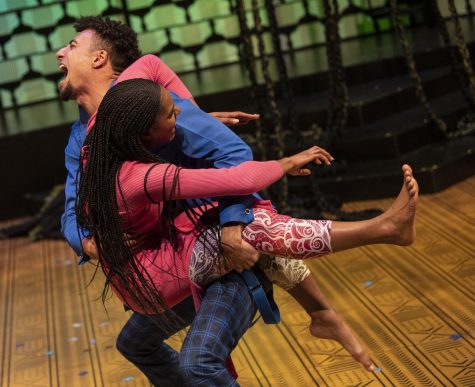
In 1869, Civil War veteran John Wesley Powell (Haley Holmes) was appointed to President James A. Garfield to take a group of men on an exploratory mission down the Colorado River and through the Grand Canyon (as it would be named later). Playwright Jacklyn Backhaus delves into Powell’s journals of that fateful expedition in a bright, imaginative way in “Men in Boats.”
First, there are no men in “Men in Boats.” The cast is made up of women and non-binary actors. It is the single most fascinating thing about the play. Gender doesn’t matter.
The men in the boats were Jack Sumner (Isabella Duran Shedd), William Dunn (Chloe Chamberlin), Walter “Old Shady” Powell (CG Squire), the Howland Brothers, Oramel (Esther Lee) and Seneca (Ariela Pineda Salgado) among others.
They journeyed on boats that the group named “Emma Dean (after Powell’s wife),” “Kitty Clyde’s Sisters,” “Maiden of the Canyon,” and “No Name.”
While Powell professes brotherhood, we quickly learn that brotherhood is not a noble tie that binds all human hearts and minds. Many of the men are seeking fame or glory, particularly William Dunn . There relationship is contentious, but it is Frank Goodman (Hattie Baier) who is the first to abandon the mission.
Additional Historical side note: When the Howland’s leave with Dunn, they name the point of departure Separation Canyon.
Archive photo of one of Powell’s boats.
While the subject is serious, “Men in Boats” is a delightful little trip. It’s a playful reimagination of historical events. Backhaus’s script is sharp, but a little too repetitious. While I wasn’t rooting for any of the men to die, boredom crept in as they continued to survive every deadly encounter. Their continued survival sucked the suspense out of the show. Any deaths that may have actually occurred happened off stage.
Side note: It’s possible that some of the explorers were killed by the Shivwits band of Paiutes, a native American tribe who believed that Powell’s men were encroaching on their terrority.
The acting is superb. Cheers to the entire ensemble. Sha Cage’s direction is frenetic, exciting and fun.
Holmes is terrific as the leading person. Like the real Powell must have been, you can see the gleam in their eye at each new discovery, their steadfast determination.
Goodman, an Englishman, is the butt of a few of the jokes. The character has a lovely little monologue about retreating to Provence, France, and Baier’s accent is spot on, old chap!
A good deal of comic relief comes from the cook, Hawkins (Kaitlyn Hare), who delivers her lines like Hawkins doles out biscuits – with flair.
Under Backhaus’s writing, each personality shines. The men in the boats are very different from each other. Adventure, however, works better in films than on stage.
Daniel Allen’s scenic design is brilliant. There’s a small tributary around the set, a two inch gulley of water surrounding a long island. Propped up on the island are the remnants of the boats. On one end of the theater space there is an immense rock wall expertly lit in crimson hues by Madelyn Miessmer. Strewn about the stage are Cedar Sage Ellwood’s very authentic looking props.
While there are flaws in the script, Point Park’s production of “Men in Boats” is well crafted, and it’s an amazing exploration of history told in a unique way.
– MB
“Men in Boats” runs from March 15 – 19 at the Highmark Theatre, In the Pittsburgh Playhouse, 350 Forbes Avenue, Pittsburgh, PA 15222. For more information, click here.
The six wives of Henry VIII rap battle for dominance as they sing their story in modern parlance in Marlow and Moss’s “Six the Musical.”
Think: A distaff “Hamilton” across the pond.
Things aren’t so merry for these wives of Windsor. Henry divorces two of them, and decapitates two more. They are, in chronological order:
Divorced: Catherine of Aragon (played on opening night by Jana Larell Glover) has a divorce is so messy that England leaves Catholicism behind and forms the Church of England.
Beheaded: Anne Boleyn (Zan Berube) has her head cut off for being as sexually free as her hubby. While Henry wanted a son, Anne’s daughter goes on to get a whole era named after her.
Died: Jane Seymour (Amina Faye) is not “Dr. Quinn, Medicine Woman,” but the O.G. Jane.
Divorced: Anna of Cleves (Terica Marie) was the only queen to live in luxury after her marriage to the monarch ended.
Beheaded: Katherine Howard (Aline Mayagoitia) may or may not have had an affair with her cousin Thomas.
Survived: Catherine Parr (Sydney Parra) is the only one to outlive the king.
Though he was famous/infamous historically, he was not a popular king when he was on the throne, and these ladies set out to prove it. While there were seven Henry’s before him, Henry VIII was such a royal pain that there were no kings named Henry after him.
The six queens of “Six the Musical.”
The story of the regal dames isn’t really a story, just a song about each of them. Technically, “Six the Musical” is more of a musical revue than a musical, but it, literally and figuratively, dazzles. The six stars, each getting equal time to shine, are amazing.
Glover (who replaced regular Catherine, Gerianne Pérez) was spectacular. You won’t regret getting “stuck with the understudy” as you would with some shows.
The six are backed up by a glorious band banging drums and strumming guitars on a rock concert stage by scenic designer, Emma Bailey.
Gabriella Slade’s costumes are to die for. They sparkle with bling. It won’t be long before a drag queen bedazzles up Catherine of Aragorn’s gold lamé bodice and struts around dahntahn.
The show is energetic and fun, and it’s also short (under 90 minutes with no intermission) with top-of-the-line production values.
There’s an interesting side effect: It may cause you to look up the actual histories of the queens of Henry VIII, or, at the very least, cause you to get out of your chair and dance.
-MB
“Six” runs till March 19, 2023 at the Benedum Theatre, 237 Seventh Street, Pittsburgh, PA 15222. For more information, click here.
Guy (David Toole) is a singer/lyricist living in Dublin. He strums his guitar and sings to passersby, hoping to catch a few euro in his open guitar case propped beside him.
One of those passersby is Girl (Kate Queen), a Czech citizen separated from her husband. Working close by she hears and enjoys his music and begins a conversation with Guy.
Guy and Girl have something more in common than their mutual love of music (she plays the piano). He sells sweepers to support himself and she has one that needs repaired.
Note: There’s obviously a vacuum in their lives!
In order to pay for the sweeper repairs, Girl decides she’ll play piano for him in the piano store owned by Billy (Jack Boice).
As their music binds them closer together, Guy confesses that his former girlfriend left him and is now in New York. The lyrics in his songs reflect that despair.
It’s apparent to Girl that Guy does not have any confidence in himself or his music so she becomes his biggest cheerleader. Full of life she prods him into taking chances. Through her encouragement she pushes him to make a CD of his works and contact a local bank for funds to help promote his songs. The money also provides a means to get to New York (possibly to his ex-girlfriend).
Guy and Girl make several suggestions as to how their lives will proceed, with or without each other. Does Guy go to New York? Does Girl reconcile with her husband? Do we even know for sure?
David Toole sings and strums a guitar as Guy. Photo credit: Matt Polk
Toole plays a perfect Guy. He develops his character from the rather shy, dejected soul into one who grows exponentially as he regains lost confidence and sets future goals. His guitar playing and vocal presentations are spot on.
Queen shines as the Czech immigrant who is assertive, opinionated and bold. She also brings out the soft side of Girl. She is a skilled pianist with a lovely singing voice.
Both Toole and Queen provide a tender rendition of “Falling Slowly”.
Boice provides both serious and comedic moments. His characterization of Billy fluctuates between loud mouth anger to silly mannerisms and funny moments. Proud of his bit of Spanish ancestry, he often invokes the physical movements of a Spanish dancer in response to a question or comment.
It is the music itself from the entire cast that is the heart of “Once”. All of the actors play an instrument, dance and sing to perfection. It is amazing that these musicians are able to play their instruments, dance while playing, all in unison.
Note: It is especially fascinating to see the cello player with the other musicians as they all lift their instruments up while playing and dancing at the same time! Kudos to Music Director Dr. Francesca Tortorello.
A wonderful production of a Tony award winning musical!
Once is at Pittsburgh Musical Theater’s Gargaro Theater, 327 S. Main St., West End, March 9-April 2. For tickets and info click here.
Despite the weather, March roars in like a lion with the opening of “The Lion, The Witch and the Wardrobe.”
The Pevensie children, Peter (Jackson Conforti), Susan (Annabel Tew), Edmund (Eamonn McElfresh) and youngest Lucy (Molly Frontz) find a magic portal in a large, wooden wardrobe that leads to the realm of Narnia, an alternate reality of witches, dwarves and talking animals.
The book, published in 1950, by author C. S. Lewis, is probably the first recorded excursion into the multiverse (take that, Marvel, DC and Michelle Yeoh).
The kid’s journey has been prophesied. The four heroes are destined to join Aslan (Michael Barnett), and defeat Jadis, the White Witch (Rachel Pfenningwerth, channeling Cate Blanchette), the evil queen and usurper of Narnia.
The kids team up with Mr. & Mrs. Beaver (Anthony Luisi and Caitlin Young, respectively) on a journey to meet the Lion King.
“Nants ingonyama bagithi Baba Sithi uhm ingonyama!”
Not that Lion King.
Meanwhile, Edmund sneaks off to meet with the White Witch after having fallen under her spell, by ingesting enchanted candy, Turkish Delights.
However, when the witch tries to kill him, Edmund realizes that she’s pure evil. He is rescued, but the witch demands a life for a life by the old laws of Narnia, and Aslan sacrifices himself for Edmund’s transgressions.
As luck would have it, the lion is brought back to life and the Pevensie kids and their talking animal pals vanquish the queen in an epic battle.
Epic battle on a budget. We just see the highlights here.
The White Witch (Rachel Pfenningwerth) is the stranger offering candy to children, i.e. Edmund (Eamonn McElfresh). Photo Credit: Laura Slovesko
Like the book, the show is very Christian. The human children are called the “Sons of Adam and Daughters of Eve” and Aslan is an allegorical stand-in for Jesus Christ.
There’s a weird bit where Santa Claus (Isaac Miller as Father Christmas) shows up and gifts the children with weapons, a sword and shield for Peter, a bow and quiver of arrows for Susan and a dagger and healing potion for Lucy. I guess Edmund got coal because he was under the thrall of the evil queen at the time.
Note: C.S. Lewis had swords, arrows and healing potions before people were rolling 12-sided dice.
While preachy at times, the show never feels forced or condescending. It does get silly in parts, but the show is so well cast it’s forgivable due to the merits of the acting. The acting is superb.
The young actors even look like they came off the cover of the “Chronicles of Narnia” series.
As Lucy is the heroine of the book, Frontz is the star of the show. She’s terrific. Her lines are spoken with sincerity. It’s so cute she calls the fawn Tumnus (Andrew Lesnett) Mister Tumnus.
While Tew plays Susan with compassion, and Conforti plays Peter as the voice of reason, McElfresh gets to have an actual character arc, ping-ponging from good to evil and back again. He manages it with aplomb.
Barnett plays Aslan as a pious professor with a deafening roar. He towers over the cast, hidden under frizzy mane (thicker and more voluminous than 80’s hair band Twisted Sister) and leonine makeup by Laura R. Smith.
Pfenningwerth is delightfully evil as the White Witch. Her movements are slow, sharp and regal.
The White Witch’s evil hench dwarf (Matt Henderson) chewed the scenery and spit it back out with the verve of a Batman villain, grunting and gasping like Burgess Meredith’s Penguin.
There are a few deaths, Peter slays the wolf, Fenris Ulf (Trevor Buda), and a few more talking forest creatures bit the dust, but all-in-all “The Lion, the Witch and the Wardrobe” is a fun romp for the whole family.
– MB
“The Lion, The Witch and the Wardrobe” runs through March 12 at the New Hazlett Theatre, 6 Allegheny Square, Pittsburgh, PA 15212. For more information, click here.
The City of Pittsburgh has its fair share of famous natives, but when it comes to well-known artists from the area, one name tends to ‘pop’ into people’s heads—and that is, of course, Andy Warhol.
Born Andrew Warhola, Jr. on August 6, 1928, in Pittsburgh, Andy had a wildly successful art career in New York. From an early age, Warhol quickly carved out a path for himself in the commercial arts at Carnegie Mellon University, and eventually imprinted himself into the art world with his notable pop-art style silk screens of Campbell’s soup cans and other cultural icons, including Marilyn Monroe, Jackie Kennedy, Elizabeth Taylor, and most relevant recently, his works depicting the musician, Prince.
Andy Warhol’s famed “Self-Portrait.”
Following Warhol’s death on February 22, 1987, he returned to Pittsburgh for his final resting place at St. John the Baptist Byzantine Catholic Cemetery. Much of Warhol’s artwork also returned to Pittsburgh, in the form of donations by the Andy Warhol Foundation (“AWF”), a New York non-profit organization committed to the advancement of the visual arts and the preservation of Andy Warhol’s legacy, to The Andy Warhol Museum (“Museum”), one of four Carnegie Museums located in Pittsburgh. The Museum is a shrine to the artist’s legacy, touting the largest collection in the world of his work, including silk screen prints, drawings, paintings, and films.
On October 12, 2022, the Supreme Court heard oral argument in a case filed by the AWF (not the Museum) against the accomplished photographer and creative entrepreneur, Lynn Goldsmith.
The controversy before the Court arises form photographs of Prince that Goldsmith took in 1981. In 1984, Goldsmith’s photographs were licensed to Vanity Fair magazine to use as an artist reference, who commissioned Warhol to create an image of Prince for publication alongside an article about the musician and credited Goldsmith with the “source photograph.” Warhol ultimately created fifteen silk screens of the Prince pieces, which became known as the Prince Series. Ownership of the Prince Series belongs to the AWF, which donated four of the silk-screen prints to the Museum. The AWF also licenses the Prince Series for commercial, editorial and other museum use.
One of the Prince pieces in question.
Following Prince’s passing in 2016, the AWF once again licensed one of the Prince Series to Vanity Fair for publication in its Prince tribute issue. This time, Goldsmith received no credit as the source image. Therefore, Goldsmith notified the AWF of its alleged infringement of her copyrighted work, the AWF sued Goldsmith claiming that Warhol’s Prince Series was a “fair use” of her original photograph, while Goldsmith counter-sued the AWF for copyright infringement. After conflicting decisions from the federal district court in New York, which ruled in favor of the AWF, and the Second Circuit Court, which sided with Goldsmith, the case was brought before the Supreme Court to decide whether Warhol’s silk screen prints of Prince, infringed Goldsmith’s copyright by failing to satisfy the transformative use test under the law’s current fair use analysis. Stephanie Dangel, a Professor of Practice who currently teaches entertainment law at Pitt Law School, shared her impressions of the case. She noted, “Initially, when the Second Circuit decision came out, I think many Pittsburghers thought, ‘What does this mean for The Warhol Museum?’ because so much of his work is inspired by other artistic works and photographs.
Thankfully, Goldsmith did not challenge the original Prince Series of prints. Instead, she challenged the licensing rights related to those prints. However, the potential impact of the Supreme Court’s opinion on the work of Warhol and other appropriation artists is an open question.”
Prior to joining Pitt Law School, Professor Dangel was a law clerk for the late Supreme Justice Harry Blackmun and the former New York federal court judge, Judge Pierre Leval, who is famous for his “transformative” fair use test. Under Judge Leval’s test, an unauthorized use of copyrighted materials is more likely to be a “fair use” if it is “transformative,” or meaningfully different from the original work in terms of its message, meaning, function, or purpose.
Fair use, as Professor Dangel described, is an affirmative defense that in some circumstances allows for the unlicensed use of a copyrighted work. There are at least four factors codified in law that courts will consider in determining whether something meets the fair use threshold:
(1) purpose and character of the use, including whether the use is of a commercial nature or is for nonprofit educational purposes,
(2) nature of the copyrighted work,
(3) amount and substantiality of the portion used in relation to the copyrighted work as a whole, and
(4) effect of the use upon the potential market for or value of the copyrighted work.
Professor Dangel, who was also a filmmaker, learned first-hand from her filmmaking experiences that the AWF can be “very protective of Warhol’s works, and understandably so, since Warhol’s work is the forms the bulk of what they own.” In a documentary Professor Dangel produced about Pittsburgh, she said, “We talked about Andy Warhol and shot in The Warhol Museum. Even though we had permission to shoot in the Museum, and we interviewed the curator at the time, some of Warhol’s artwork was in the background. The Museum flagged the legal issue for us, saying, ‘We do not own all of the rights to this artwork. The Foundation owns some of these rights.’ In using the background images in the film, we ended up relying on a law firm’s fair use opinion and errors and omission insurance to protect ourselves, but I’m not sure that would have protected us from a lawsuit by the Foundation or the original photographer, if our film had been more successful.”
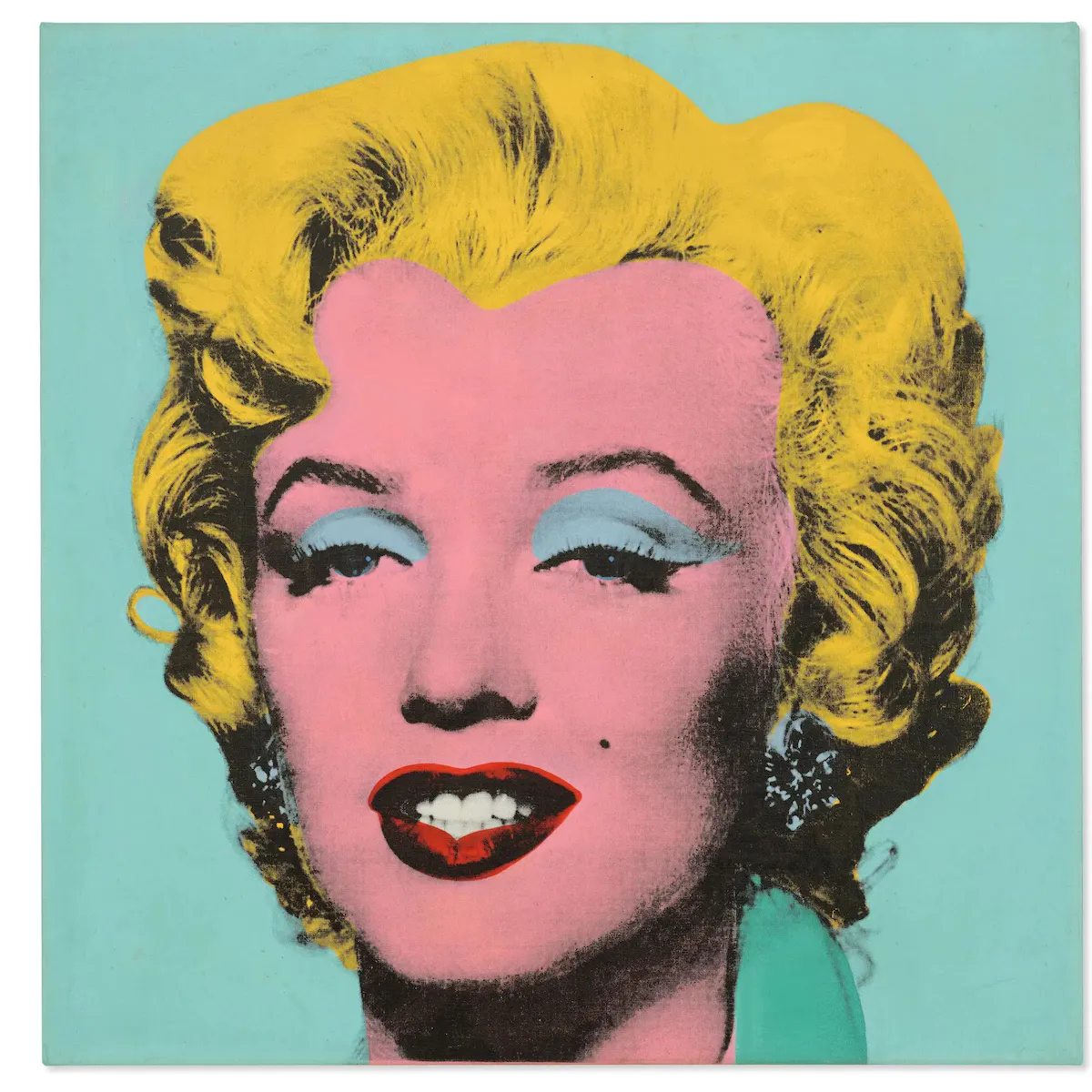
Professor Dangel also noted that the film included an interview with Andy Warhol’s nephew, who at the time worked in the Warhola family scrap business on Pittsburgh’s Northside. “The nephew was a good artist, including a tattoo he designed for himself based on his uncle’s Marilyn Monroe silk-screen print. But if the Supreme Court holds that the licensing of Andy’s work is not a “fair use” of Goldsmith’s photograph, could a photographer of Monroe or the Warhol Foundation sue Andy’s nephew over his Marylin tattoo? It seems ridiculous, but who knows?”
Andy Warhol’s “Marilyn Monroe.”
Given her filmmaking experience, Professor Dangel stated that now when she talks to her students about fair use, she emphasizes this an affirmative defense. She continued, “It’s a lot of money to litigate a copyright case, for those arguing in favor and against fair use. Lynn Goldsmith learned this the hard way, as her legal fees for the lower court cases were over $400,000. The Supreme Court case may have resulted in millions of dollars in legal fees, which led her to launch a GoFundMe campaign. Given these potential litigation expenses, I tell my students that, if you can afford to license the material, you should.”
Up until two years ago, the Supreme Court had not considered a similar fair use case since 1994—nearly 30 years ago—when it adopted Judge Leval’s transformative use test. Now there have been two fair use cases brought before the Supreme Court in the past two years. In April 2021, in Google v. Oracle, the Supreme Court ruled that Google’s use of source code owned by Oracle was protected by the fair use doctrine. However, the Google and Warhol cases may signal that changing technologies could require changes in the law.
Whether such changes in the law would benefit by from judges who are also trained in the arts remains to be seen. “Interestingly,” Professor Dangel pointed out, “[Judge Leval’s] wife, Susana Torruella Leval, served as curator and director of El Museo del Barrio throughout the 1990s. So, Judge Leval is very familiar with the art world. I believe that the transformative use test for him was quite a natural extension of both his legal opinions and his personal connection to the art world.” This insight led her to “wonder how Justices like Ginsburg and Scalia, who were very big fans of artistic works, particularly opera, might have tilted their decision on fair use in one way or another… whereas other Justices, who are not as familiar with the arts, might focus more on the commercial market for the works, rather than their transformative use. It will be interesting to see how much the personal backgrounds and interests of the Justices might play into how they approach this decision.”
Stephanie Dangel, J.D. photo credit: The University of Pittsburgh
Still, what makes this case so interesting to Professor Dangel and others in the legal and art communities is that there are artists on both sides of this case. The decision will “affect artists, both pro and con, depending on whether or not you’re the artist who created the ‘original’ work, or the artist who ‘appropriated’ the original work.” As Professor Dangel explained, “this will not be a pro- or anti-artist decision, because it depends on which artist you are representing.”
But for now, the art law world waits anxiously for the Supreme Court to speak on these issues. The Court’s opinion will likely be issued by July of this year. In the meantime, the oral argument is available here for further information and background on the Andy Warhol Foundation for the Visual Arts, Inc. v. Goldsmith case.
In the late 19th century few, if any, child labor laws existed in the States. If they did exist they were at the discretion of each state, often times totally ignored.
It was not uncommon to find young children working in extreme situations to make money in order to survive.
Note: “Newsies” is based on a true story that occurred in the late 1890’s in New York.
Jack Kelly (Ryan Jasaitis) is one of many young boys who sell the latest publications of New York’s major newspapers. They gather at a distribution location, pay for the papers they take and venture off to make a few cents on each copy sold.
When newspaper publishers like Joseph Pulitzer (Jacob Miller) decide to raise the cost of the papers Jack, Davey (Will Cobb), Crutchie (Sam Greene) and the other newsies decide to take action. They organize, declare themselves members of a union and strike!
What was seen as a minor interruption in the daily distribution of newspapers is further escalated through the reporting of aspiring journalist, Katherine Plumber (Marguerite Reed).
When profits continue to slide, Pulitzer and Kelly come face to face to determine a final resolution.
The cast of Newsies.
Jasaitis plays the tough guy with a tender side. He is multi-dimensional.
Greene shows his character’s vulnerability and pain through the song “Letter from the Refuge.”
Reed sings a great rendition of “Watch What Happens.”
Jordan Tidwell as Medda Larkin knocks it out of the park with her rendition of “That’s Rich.”
Cobb is effective as the “smart guy” in the newsies’ group, providing insight as well as support as their thoughts towards a union grow.
Miller is convincing as the autocrat he portrays.
Dancing and singing are central to this production and hats off to the entire cast!
Dancing was strong, graceful, athletic, gymnastic and always on point and the singing was emotional, inspirational and sometimes saucy with excellent choreography by Rocker Verastique.
Wonderfully supporting the singing and dancing is the orchestra conducted by Camille Villapando Rolla.
Don’t miss this production of “Newsies.”
-CED
“Newsies” is a production of Pittsburgh Playhouse of Point Park University. It runs from February 22 through February 26. For more information, click here.
Lydia (Isabella Esler, making her professional theatrical debut) is mourning the loss of her mother, when her dad (Jesse Sharp) moves her into a big, creepy Victorian whose previous occupants aren’t really ready to leave in “Beetlejuice: the Musical.”
The recently deceased Maitlands, Adam (Will Burton) and Barbara (Britney Coleman), aren’t shuffling off their mortal coil so easily. They’re inhabiting their home despite being electrocuted. They’ve made a friend on the other side, Betelgeuse (Justin Collette), who pronounces it “Beetlejuice.” If he can get one of the Livings to say it three times he can wreak havoc, which is, clearly, his favorite thing to do.
Say it three times fast and Beetlejuice quickly goes from friend to fiend. He frightens, but in a fun way.
The play veers a bit far from the Tim Burton film, but Scott Brown and Anthony King, who wrote the book, keep the spirit (get it) of the original. Some of the changes are big:
Lydia crushes on Beetlejuice – for a hot second.
Delia (Kate Marilley) isn’t a Deetz, but she’s about to become one.
The Maitland’s get a character arc in the song, “Barbara 2.0.”
Key elements remain. Lydia must team up with the Maitlands to exorcise Beetlejuice after freeing him.
While Eddie Perfect creates all new music and lyrics, the Harry Belafonte Calypso music remains. It wouldn’t be “Beetlejuice” without a rousing rendition of “Day-O.”
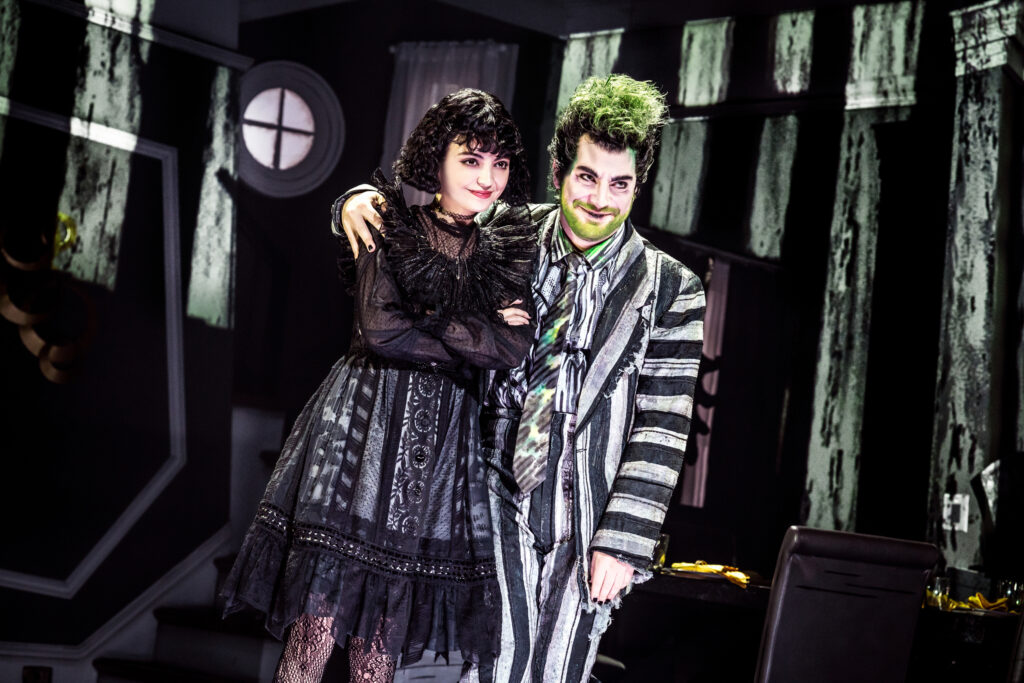
Pictured (L-R): Isabella Esler (Lydia) and Justin Collette (Beetlejuice). Photo credit: Matthew Murphy
Betelgeuse is a big star, and so is Beetlejuice (Science humor). Collette rips up the gorgeous scenery and outshines the brightest lights (and there are some tremendously bright lights in this show). The part is made for a gregarious, overwhelming presence and Collette has charm and charisma with a capital C.
Beetlejuice is a big flirt. A scary one, but a flirt, nonetheless. He flirts with Lydia, her father, the Maitlands and the audience. There are some canned “ad-libs,” but they work because of Collette’s aforementioned charm.
Esler is equally amazing. The young woman recently graduated from high school in San Jose, California and is now with a national touring company. Her solos, and she has a few, prove that her voice is powerful and emotive.
Burton (Will not Tim) does a fine job as Adam, the lovable childless geek armed with quirky but stale dad jokes. His dancing is reminiscent of the “Family Matters” character Urkel, but, underneath the jarring, jerky movements, there is a sublime grace. It takes a trained dancer to strut around in such a hodgepodge manner.
Coleman is a delight. She exudes a radiant energy. She is another irresistible member of an electrifying cast. Electrifying (that one was unintentional).
Delia is a flake. She has always been a flake, but just like phyllo dough, Delia is flaky, light and delicious. Marillley embodies her pure essence – you could say she “possesses” the character, especially during her rendition of the “Banana Boat Song.” The actor gets to go to camp – high camp – as the batty, whimsical madwoman.
The entire ensemble is terrific.
Beautiful scenic design by David Korins, amazing puppet design by Michael Curry and incredible special effects by Jeremy Chernick. It’s a visual feast, a modern day circus act.
Is it good? Some of us were hit with a wave of nostalgia for the original, but if you can be in the moment, you will love it. Any SUCK-YESS-FUL Life Coach would tell you to “Live in the moment.”
You might wail like a banshee at some of the bad jokes (there are some guaranteed groaners). It’s definitely goofy, campy and all sorts of weird, but that’s what makes “Beetlejuice” a blast.
If someone said, “The music guaranteed to make you jump in the line and rock your body in time,” I would say, “Okay. I believe you!”
-MB
“Beetlejuice: The Musical. The Musical. The Musical” runs from February 21 – 26 at the Benedum as part of the PNC Broadway Series. For more information, click here.
“A Burlesque Show with Clothes” – a Review of Alora Chateaux’s “Burlesque on the Bluff”
The word burlesque has a plethora of meanings and definitions and a long history. Most people probably think of strip tease when they reflect on the word.
Note: The playbill for this production contains “A Short History of Burlesque” that provides a history of this ever-changing, fascinating entertainment, now seen as artform.
Hosted by Alora Chateaux “Burlesque in the Bluff” is a variety show set in a cabaret-type setting. Well known musical numbers from theater and films are intermingled with select comedic pieces.
Alora Chateaux commands attention. Wigged and glitzy with ample cleavage she not only introduces each act but intermingles with the audience, often interjecting hilarious ad-libs. When Alora finds a captive audience member, her creative juices produce an extremely funny, often one-sided conversation. She delivers a mock homage to strip tease with a clever removal of one glove which hysterically turns into at least a 20-foot exercise as the glove constantly grows as she tries to release it.
Rachel Lewandowski’s rendition of “I Wanna Be Evil!” is outstanding. She has a lovely voice that is combined with an astute comedic delivery.
Dante Martin brings “Just a Gigolo/I Ain’t Got Nobody” to life with good vocals and movement.
Riley Moore delivers in James Thurbers’ “The Macbeth Murder Mystery” sketch.
Keith Reis with Moore rise to the occasion in their rendering of the classic comedy routine “Who’s on First,” originally created by Abbott and Costello.
The stage is minimal with a curtain as backdrop. The theater floor is actually part of the set as some theater goers watch the production from circular tables, reinforcing the cabaret-like environment.
Cheers to the entire ensemble!
-CED
Alora Chateaux’s “Burlesque on the Bluff” is a production of Duquesne University’s Red Masquers, performed at the Genesius Theater. It runs from February 14 – February 18. For more information, click here.
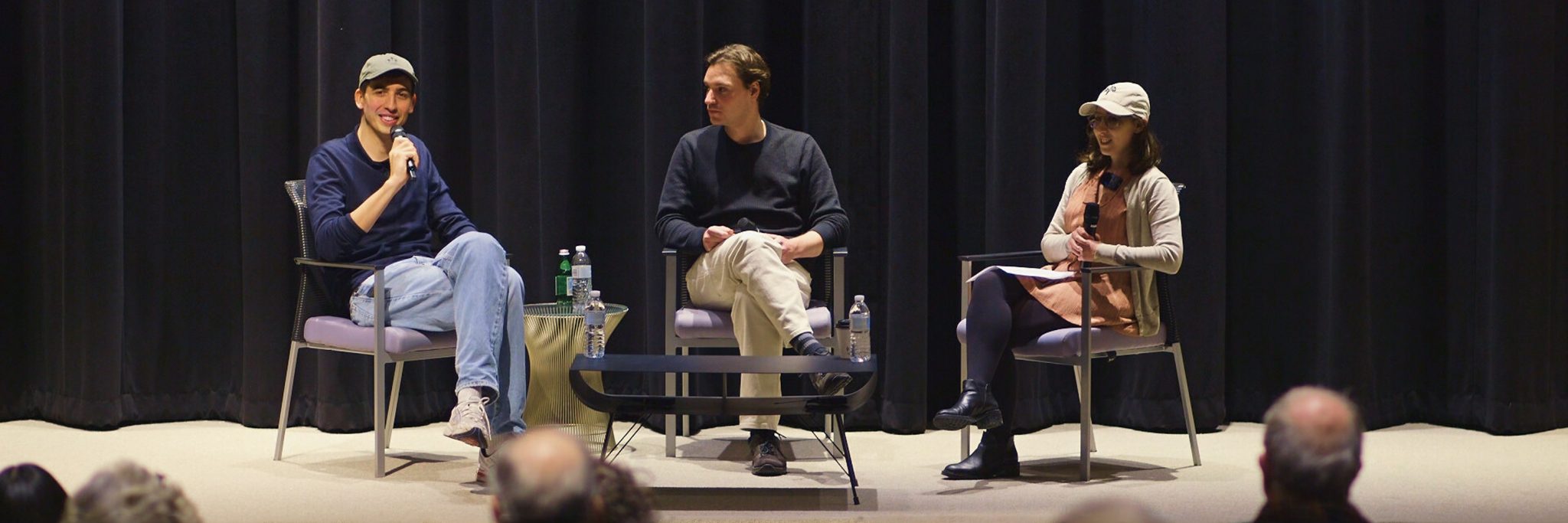
As many contemplate what flower arrangements to send to their special person this Valentine’s Day, one work at this year’s 58th Carnegie International Exhibition has viewers questioning the personhood of other flora in our ecosystem. Specifically, terra0’s A tree; a corporation; a person. is a black gum tree planted on the Community College of Allegheny County (CCAC) campus, which inspired greater conversation last month between Paul Kolling and Christopher Dake-Outhet, artists involved with terra0 and Talia Heiman, one of the International’s curatorial assistants, during the Carnegie Museum of Art’s Refractions Series.
Like most works of art, A tree; a corporation; a person. began with an idea. According to Kolling, back in 2015, he and other big thinkers who eventually formed terra0, wondered how a forest or a piece of land could own itself by appropriating exploitation through third parties, gradually raising capital, and then eventually, buying the land on which the forest is located. When terra0 first began acting on their idea, they received some push back from critics who saw the project as immoral in the sense that they’d be forcing a forest to cut down its own trees and from art institutions who at the time were not interested in supporting a high-tech centered concept. So, what was meant to be a short five-month study turned into a more than five-year long project.
Installation view of terra0, “A tree; a corporation; a person (DAO #01, Black gum tree, Pittsburgh, PA)” in the 58th Carnegie International. Photo by Sean Eaton courtesy of the artists and Carnegie Museum of Art
One of the initial iterations of the idea was a test case called, Flowertokens. The test case got its name because the artists used flowers to consider what would happen when they tokenized a living commodity using blockchain technology. After placing 100 flowers under a grow rack with a camera that monitored their growth 24/7, terra0 minted 100 tokens, each one representing one of the flowers, and placed them on a digital marketplace where real people could buy and invest in these so-called, Flowertokens. This took place in 2016, but was essentially an early version of today’s NFTs, or non-fungible tokens.
After the success of Flowertokens, terra0 went on to create further iterations that eventually lead to the creation of A tree; a corporation; a person. in Pittsburgh. The goal of the artwork is to establish the personhood of this tree. Other countries and nations have recognized the rights of elements of nature, such as in New Zealand where a river was granted personhood in 2017. In the United States, corporations are entitled to certain rights and personhood as natural persons. Kolling explained that historically Western law described personhood as a way of being able to own something. With its latest artwork terra0 supposes whether through new technologies like the blockchain could allow a nonhuman entity—such as a tree—to own something.
Terra0’s a tree, a corporation, a person on the CCAC campus.
To demonstrate this, they planted the tree and with the help of a team of lawyers from the museum and the college, created a legal entity, a 501(c)(4) tax-exempt organization that owns property (i.e. the tree and the land in which it is planted) and lobbies for granting personhood on behalf of the tree. Once personhood of the tree is recognized, the 501(c)(4) will dissolve and a limited liability company (LLC) will be formed with the tree being the sole proprietor of the organization.
From Left to Right: Paul Kolling, Christopher Drake-Outhet and Talia Heiman at panel discussion.
But until then, and even after the tree achieves personhood, it will require help from human intervention. As both Kolling and Dake-Outhet pointed out somebody will have to file the tree’s taxes.
-GM
For more information about this conversation and more of the Carnegie Museum of Art’s Refraction Series check out WQED’s Artist in the World podcast of visit the following link.Learn more about Terra0 here.
Theseus (Keith Lee Grant) is preparing for his wedding day to Queen Hpppolyta (Portia) and all of the townsfolk of Athens are in a tizzy in “A Midsummer Night’s Dream in Harlem.”
P.S. Harlem is Athens. Athens is Harlem. Don’t get hung up on it.
Note: Aside from a 125th Street sign, the play isn’t physically linked to any place on the isle of Manhattan. The play, as explained by Justin Emeka in the program notes, is spiritually connected to Harlem. Think Shakespeare with a funky Afro-Caribbean vibe.
What is important is that Hermia (Saige Smith) is betrothed to Demetrius (Brende Peifer) but she’s in love with Lysandra (Amara Granderson, a gender-swapped Lysander), and poor Helena (June Alvilda Almonte) is crushing hard on Demetrius, creating a love quadrangle.
Deep in the woods (reminder: Harlem is more of a theme than a place), Oberon (Keith Lee Grant in a dual role) seeks to snatch a changeling Boy (Akinlana Lowman) away from Queen Titania (Portia, also in a dual role). The King of the Fairies enlists Puck (Jaris Owens) to aid him in his schemes to thwart Titania.
Meanwhile the Mechanicals, Quince (E. Mani Cadet), Bottom (Andre G. Brown), Flute (Harry J. Hawkins, IV) and the rest are producing “The Most Lamentable Comedy and Cruel Death of Pyramus and Thisbe” as a tribute to Theseus and the Queen of the Amazons on their impending wedding day.
When Oberon takes pity on Helena, he instructs Puck to help her by hitting Demetrius with the love potion, but he mistakes Lysandra for Demetrius and things go off the rails. The love quadrangle is mangled into a love dodecahedron, and Lysandra and Demetrius fight for Helena while Hermia is scorned by her former lover.
As Shakespeare reminds us, “The course of true love never did run smooth,” but, boy, do things get complicated!
Director Justin Ameka has tight reins on the entire affair. It is a glorious spectacle with powerful drum solos by Akinlana Lowman.
Portia’s monologues are exquisitely delivered. She is a powerful presence on stage. It’s easy to believe she is a Fairy Queen or an Amazonian warrior.
Brenden Piefer’s Demetrius is pure energy. He is a loose-limbed creature who juts and struts all over the stage. He exudes joy.
It’s easy to see why anyone would fight for Hermia’s love. Smith is radiant in the role.
Almonte’s Helena brings some strong laughs, and – unlike past productions of the play – seems much more worthy of the unfair advantage Oberon gives her.
When Demetrius and Lysandra fight for Helena’s attention, both Piefer and Granderson use every possible comedic movement in the book – and create new ones. The scene is flawlessly choreographed by Jose Perez, IV.
The Mechanicals were always meant to be hapless goons badly attempting to complete an art project, but they are wonderfully absurd under Emeka’s direction. Brown’s Bottom is a marvelous buffoon. Cadet’s Quince is – in the words of my friend Orlando Ashley – a Church Gay – one of those pious queens who could have easily been cast as a choir director in a Tyler Perry movie.
The set is a masterpiece by Anka Lupes. An African mask hangs high above the actor’s heads and it is a character unto itself.
Demeatria Boccella’s costumes are stunning, particularly on Portia (in both roles). Her choice to drape the Mechanicals in urban blue collar streetwear was inspired. It defined them in a way unlike any other version of the play before it.
The play ends with a joyous group of weddings – three couples tie the knot/ jump the broom.
“Midsummer Night’s Dream” is exuberant, a joy to behold. A brilliant bouncy bit of fun for a midwinter evening.
“Midsummer’s Night Dream in Harlem” runs through February 17th at the O’Reilly Theater, 621 Penn Avenue, Pittsburgh, PA 15222. For more information, go here.