


Genius Bar – a review of “Picasso at the Lapin Agile”

By Michael “Buzz” Buzzelli, ‘Burgh Vivant

Important historical figures of the Twentieth Century converge at a Parisian bar for wine, frivolity and intellectual discourse in Steve Martin’s “Picasso at the Lapin Agile.”

A young patent clerk named Albert Einstein (Steve Gottschalk) is an early arrival at the titular bar, the Lapin Agile, which roughly translates into Nimble Rabbit. He’s so early, that the owner Freddy (Jenine Peirce) points out that he has, indeed, arrived out of order, according to the play’s program. He’s forced to leave, only to return minutes later, after Germaine (Lee Lytle) makes her entrance. It’s a surreal moment at the beginning of the play that lets the audience know that they’re in for a silly bit of fun.

Before the aforementioned artist arrives, a cast of bizarre characters haunt the watering hole. Gaston (Patrick Conner) is a lecherous old Frenchman, who reminisces about his former sexual conquests, meets Suzanne (Hannah Brizzi), a young woman who is hoping to have another chance encounter with Pablo Picasso (Nico Bernstein).

Other barflies include Sagot (Samantha A. Camp), a swaggering art dealer, the self-aggrandizing Schmendiman (Chris Duvall) and the mysterious Visitor (Stephen Ray), who breaks the barrier of the Time/Space Continuum to raise a glass with the masters of art and science.

“Picasso at the Lapin Agile” is not Martin’s best work. Literarily, it’s closer to “Cruel Shoes” than “Shop Girl,” but there are several laugh out loud moments. It’s absurd and pseudo-intellectual. Think Steve Allen’s “Meeting of the Minds” meets Jay Sommers’ “Green Acres.”

Warning: The Fourth Wall will break so often you’ll expect Deadpool to show up.

There is a profound statement underneath all of the humor. The beginning of the Twentieth Century is defined by science and arts, and the latter half is defined by rock n’ roll. One can only imagine where the Twenty First Century will end up.

Picasso’s Les Demoiselles d’Avignon or The Young Ladies of Avignon from 1907.

“Lapin Agile” is brimming over with witty bon mots, and, in places, it’s riotously funny.

Gottschalk is a cute Einstein. He gets a huge laugh from a referential portrait of the famed scientist.

Conner’s Gaston is a trip. He is charismatic and charming even while being lecherous.

Bernstein is a portrait of an artist as a young man. His costume looks as if it fell out of Renoir’s “Boating Party.” Costume designer Alex Righetti draped him in a marinière and beret, an outfit of a French sailor.

Duvall cut through the scenery with a knife. He plays a larger than life character larger than life! He’s hilarious every second he’s on stage.

Alas, Martin’s play would not pass the Bechtel Test. In the text, the only time women spoke, they spoke of men or love. Director Dan Freeman, however, evened the playing field somewhat by casting women in the roles of Freddy and Sagot; particularly talented women in Peirce and Camp.

Peirce’s Freddy gets some of the best lines. When one bar patron adds “No pun intended,” Freddy quickly quips, “No pun achieved.” Her performance is one of the best in the show.

Many puns are intended in “Picasso at the Lapin Agile,” but not all of them are achieved. However it’s a bright and enthusiastic cast and a lively ninety minutes up until Elvis has left the building.

“Picasso at the Lapin Agile” runs May 4th to May 12th at the Pittsburgh Playwrights Theatre space, 937 Liberty Avenue, Pittsburgh, PA 15222. For more information, click here.


Heartache and a thousand natural shocks – a review of “Hamlet”

By Michael “Buzz” Buzzelli, ‘Burgh Vivant

A sullen, young man, still grieving from his father’s death, learns that there’s something rotten in the state of Denmark in William Shakespeare’s iconic “Hamlet.”

Warning: Spoilers ahead. In fairness, it is a five hundred-year-old play.

Hamlet (Matthew Amendt) discovers his father has been murdered by Claudius (David Whalen). He just doesn’t have any proof. After all, the truth was revealed to him by a ghost (Darren Eliker), and they are not the most reliable sources. Here’s where the family tree gets very gnarled. Claudius was the king’s brother, Hammy’s uncle. Paging Dr. Phil! Stat!

The young Dane says, “A little month, or ere those shoes were old with which she followed my poor father’s body, Like Niobe, all tears—why she, even she(O, God, a beast, that wants discourse of reason – Would have mourned longer!), married with my uncle, my father’s brother, but no more like my father than I to Hercules.”

Note: You may not remember this from your high school Humanities class, but insults fly from Hamlet’s mouth like Don Rickles at Caesar’s Palace. He’s chock full of good poetical zingers.

Everyone, except his best bud, Horatio (Andrew William Miller), thinks he’s bonkers. The royal advisor, Polonius (Matt Sullivan), believes his madness springs from his yearning for his daughter, Ophelia (Jenny Leona). His behavior frightens his mom, Gertrude (Caris Vujcec), who just wants Hamlet to accept that she’s now married to his uncle.

But Hamlet is shrewd. He’s playing crazy to catch the newly crowned king in his deceit. He must ascertain his uncle’s guilt and avenge his father’s death. His procrastination, however, causes untold tragedy.

Fasten your seatbelts. It’s a quick ride. One of the best things about Ted Pappas’ direction is the dialogue and monologues are delivered swiftly. It’s less Sir Lawrence Oliver and more “Gilmore Girls.”

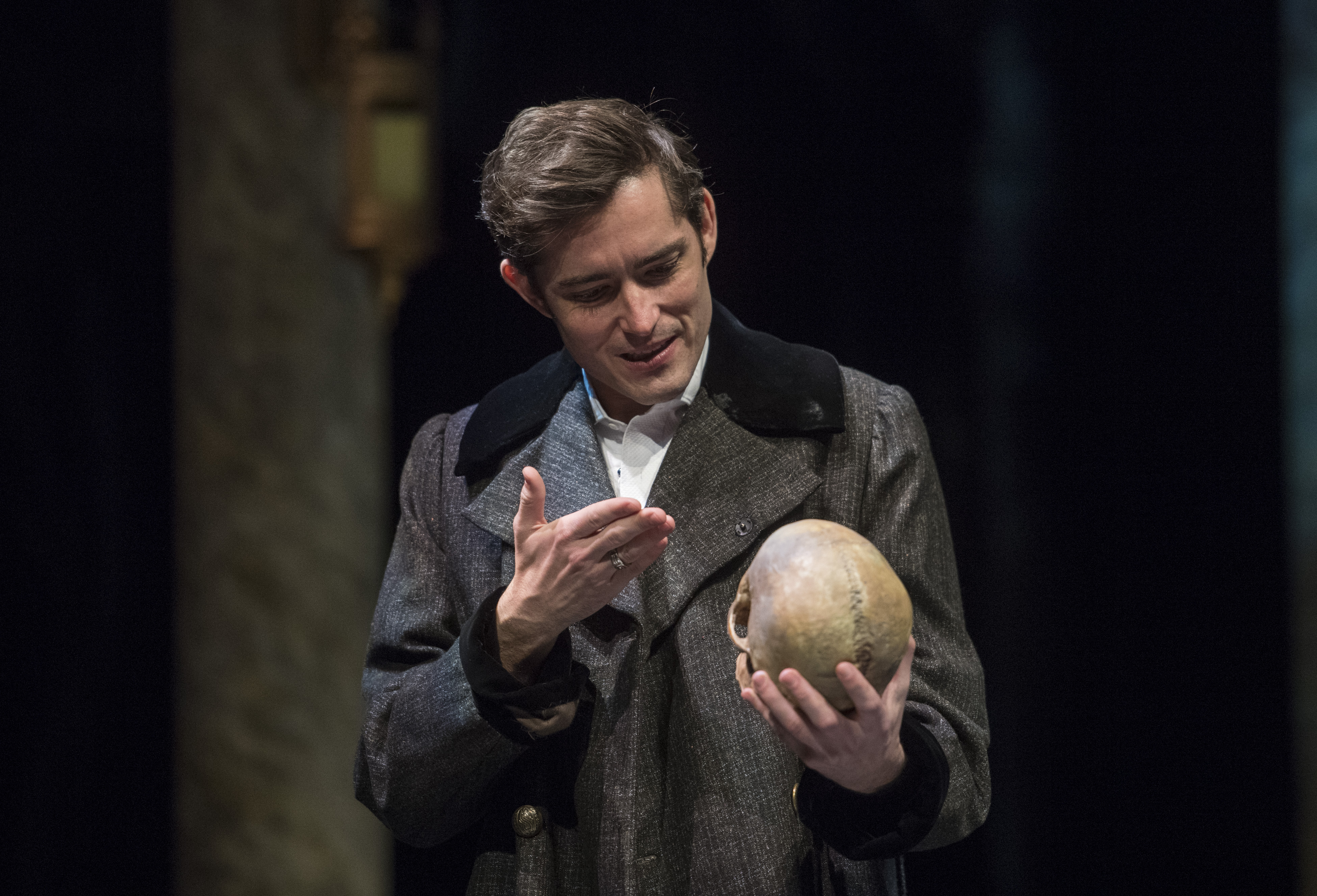
Matthew Amendt as Hamlet holding the skull of Yorick. Photo credit: Michael Henninger.

Amendt is amazing as Hamlet. He commands the O’Reilly stage as if he owns it. He is magnetic.

Side note: In 2009, the Royal Shakespeare Company adapted a version of the play for the small screen with David Tennant in the titular role. Amendt’s interpretation of the Prince of Denmark was reminiscent of Tennant’s performance.

Whalen rules as Claudius. He is riveting as the murderous king. There’s a magnificent soliloquy where Claudius prays for forgiveness after his evil deed. It was an electric performance.

Vujcec is a strong Gertrude. It’s hard not to want to jump up from your seat when she drinks from the poisoned chalice (Spoilers – you were warned).

One of the hardest roles in “Hamlet” is Polonius. Play him too large and the doddering, old fool becomes too broad and ridiculous. Play him too small and the audience will overlook the satirical nature of the character. Sullivan gives us the Goldilocks moment and plays it just right.

Constantin Stanislavski’s once remarked, “There are no small parts, just small actors.”

Hamlet is brimming with small parts, but not small actors. Tony Bingham delivers a deliciously humorous monologue as a gravedigger. Alan Synder and Luke Halferty bring a lot to Rosencrantz and Guildenstern. Erika Strasberg, Quinn Patrick Shannon, Don DiGiulio, Darren Eliker and Monteze Freeland are big actors in small roles. They each bring joy to the stage in each of their brief appearances.

In the last act, there’s dynamic sword work thanks to Fight Director Randy Kovitz.

Scenic Designer James Noone is elegant but sparse. The set is simple but lavish. A series of columns stand at attention, guarding a rotunda. The rotunda acts as the throne room, the palace walls, a bedroom, etc.

This is an effervescent production. While Pappas hits some of the jokes a little too hard, particularly the bawdy line, “Do you think I meant COUNTRY matters?” Overall, it’s a glorious final bow for director Ted Pappas, who is stepping away as the Producing Artistic Director for the Pittsburgh Public Theater, and handing the reins over to Marya Sea Kaminski.

Gentle reader, I implore you. If the Bard doth please you, get thee to the O’Reilly!

-MB

“Hamlet” runs until May 20 at the O’Reilly Theater, 621 Penn Avenue, Pittsburgh, PA 15222. For more information, click here.



Love, Labor and Loss – a review of “Byhalia, Mississippi”

By Michael “Buzz” Buzzelli, ‘Burgh Vivant

A young woman uncomfortably awaits the birth of her baby in the company of her cranky mother and her unemployed husband – – unaware that the child’s arrival will cause immediate chaos in Evan Linder’s “Byhalia, Mississippi.”

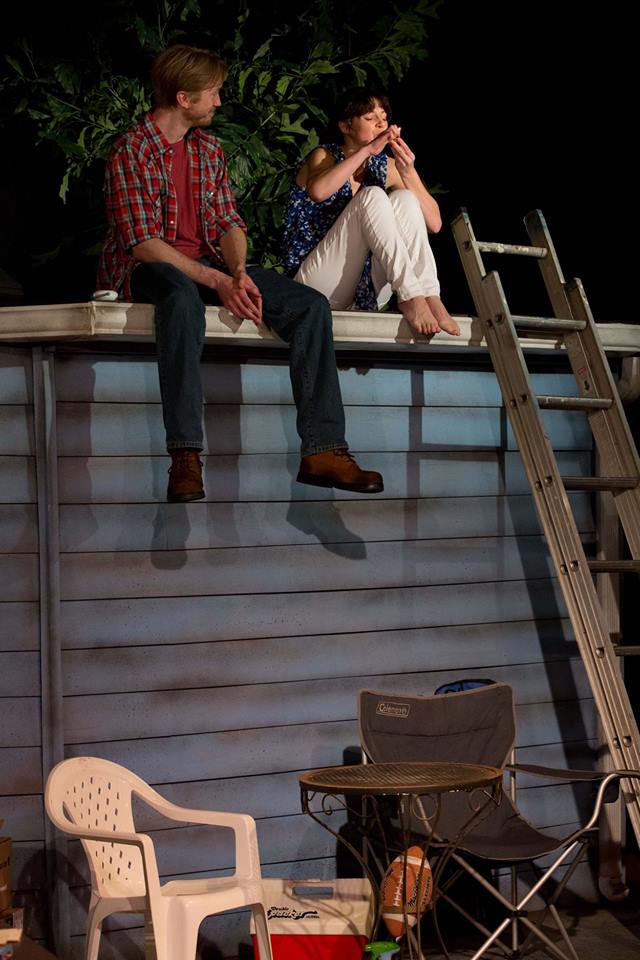
Tensions are frayed between Laurel (Erika Cuenca) and her mother, Celeste (Virginia Wall Gruenert), as they await the arrival of the long overdue child. Celeste decides to go back home to Jackson, MS, but not until she unleashes a litany of complaints about her son-in-law Jim (Brandon Meeks), who, unbeknownst to mother and daughter, is listening to the argument over the baby monitor while smoking a joint on the roof of the house.

Note: While watching “Byhalia, Mississippi” one must pay close attention to the baby monitor. It’s an object of great importance. It’s a gun and a Deus ex Machina. Let’s call it Chekov’s baby monitor.

Jim had returned from job hunting when he discovered the aforementioned baby monitor. During his job search, Laurel learns that he approached her boss, the high school principal, looking for a position there.

Additional side note: While we never see the high school principal, his presence looms large over the show.

When the Caucasian couple finally gives birth, it’s immediately clear that Jim is not the father. Call Jerry Springer! Stat! Jim jumps to conclusions and accuses his best friend, Carl (Lamar K. Cheston), of the infidelity, pummeling him into submission on the living room floor.

Celeste reacts poorly to having an interracial grandchild. Then, there’s the surprise visit from Ayesha Price (Hope Anthony), the wife of the high school principal.

Jim (Brandon Meeks) and Laurel (Erika Cuenca) enjoy a moment of quality time on the roof of the house. Photo credit: Heather Mill

Director Ingrid Sonnichsen has a masterful touch, but she’s also blessed with a very talented cast.

Cuenca is magnificent as the young woman struggling to keep all the pieces of her life together in one pile. It’s a beautiful performance.

Gruenert is a powerful presence on the stage. Her Celeste is brash, loud and controlling, issuing ultimatums that go unheeded.

Meeks is delightful as the affable slacker who believes his whole future is shattered by the skin color a small baby. He has an engaging smile that, most likely, lets him get away with far too much.

Cheston and Anthony have smaller parts but each of them gets a chance to shine, and they shine brilliantly.

Anthony is in a tricky situation. It would have been easy for her character to fall into the angry black woman trope, but she finds nuances in the role.

Adrienne Fischer’s set is tribute to the height of white trash culture – if there can be such a thing. Think Roseanne Connor’s iconic living room, sans C.M. Coolidge’s “His Station and Four Aces” i.e. “Dogs Playing Poker.”

Linder tackles some hot button issues in “Byhalia, Mississippi,” but, basically, the show is about acts of forgiveness. Mark Twain once said, “Forgiveness is the fragrance that the violet sheds on the heel that has crushed it.” While “Byhalia, Mississippi” delivers some crushing blows, there is a pleasant release.

-MB

“Byhalia, Mississippi” runs from April 20 to May 5 at the Carnegie Stage, 25 W. Main Street, Carnegie, PA 15106. For additional information, click here.


Review: THE WHITE CHIP, City Theatre

“It would be fun to see even more than once.” Lonnie The Theatre Lady is mending a broken hand and medicating with champagne – but it hasn’t stopped her from getting out and seeing some of the finest theatrical performances Pittsburgh has to offer. Tonight “via satellite” she talks about City Theatre’s production of THE WHITE CHIP by Sean Daniels, performing through May 6th, 2018. For tickets and more information, visit www.citytheatrecompany.org  Continue reading “Review: THE WHITE CHIP, City Theatre”

Featured
Featured
Review: THE WHITE CHIP, City Theatre
Loading
/

SHANNON JENNINGS – Soprano, Pittsburgh Opera

TONIGHT: Soprano, Shannon Jennings on her role as Giannetta in Pittsburgh Opera’s production of Gaetano Donizetti’s ELIXIR OF LOVE. Just what is this intriguing elixir? What’s in it? And what would you put in yours? This and more tonight on ‘Burgh Vivant! See Pittsburgh Opera’s ELIXIR OF LOVE, April 21, 24, 27 and 29, 2018 at Benedum Center. For tickets and more information, visit www.pittsburghopera.org  Continue reading “SHANNON JENNINGS – Soprano, Pittsburgh Opera”

Featured
Featured
SHANNON JENNINGS - Soprano, Pittsburgh Opera
Loading
/

More Than Just Horse Play – A review of “Equus”

 By Nick Mitchell, ‘Burgh Vivant

Few plays explore the relationship between psychiatrist and patient better than Peter Shaffer’s 1973 play “Equus.” For that very reason, it has been a go-to piece for theaters from the collegiate level all the way up to the Broadway.

Alan Strang (Evan Saunders) is a troubled seventeen-year-old male patient who speaks only in jingles. He also violently blinded six horses. Martin Dysart (John E. Lane Jr. ) is a middle-aged doctor whose fascination with his patients offsets the monotony of his mundane everyday existence.

The Red Masquers at Duquesne University selected “Equus” as a part of their “Masterpiece Season” and they, indeed, have the actors to back it up.

Alan Strang is a brooding, cryptic teen with wild eyes that cannot hide a continuous silent plea for relief. Before talking about his performance, attention should be paid to Red Masquers’ practice of casting students alongside age-appropriate faculty and professionals. This is invaluable experience for young actors and it lends even more credence to the faculty the next time they are in a classroom setting. While education is often plagued with the errant credo “Those who cant…teach.”, the students at Duquesne are surrounded by artists willing to do both. Professor Lane’s vulnerable, fiery, nuanced performance in “Equus” leaves no one doubting the fact that he can indeed do AND teach.

Such a complex play as “Equus” is not without it’s challenges. Performed in the round, director Justin Sines played his angles quite well. It did however appear that some sides of the seating area got a little more face time than others. Often this was partially due to the size disparity between Mr.Lane and Mr. Saunders. A wonderful aspect of the set was actually behind the audience. Two of the back walls of the intimate Genesius Theater were wood slats emulating the barn where much of the flashback action was set. The other two were walls of antiseptic blinds that would be found in doctors offices or hospitals.

Lighting designers Antonia Gelorme and Christina Levi subtly lit the walls to locate the action essentially enveloping the audience.  It would have been interesting if a little of that duality had also been built into the central set which lent itself entirely to accents of rustic barn decor.

“Equus” has been riding strong for 45 years. No matter how much time passes the story remains relevant. The doctor/patient dynamic affords actor, director, and audience endless perspectives. Alan Strang worships horses as his Gods. “Equus” wants you to ask yourself who your Gods are. What would you do if you felt you let them down? To whom could you even speak about it? Dr. Dysart wonders if taking pain away strips people of their humanity. Would you rather truly live with pain or simply exist painlessly? For these questions, and many others, it will be at least another 45 years before Equus is laid to rest in the glue factory

Equus continues Thurs April 19th and runs through April 29th. Thurs-Sat at 8pm. Sun at 2pm. Genesius Theater at Duquesne University. For more information, click here.

Fire and the Fuhrer – a review of ‘A Bright Room Called Day”

By Michael “Buzz” Buzzelli, ‘Burgh Vivant

Its fear and misery in the Third Reich when a group of friends witness the fall of the Weimar Republic and the rise of Adolf Hitler in Tony Kushner’s “A Bright Room Called Day.”

When contentious factions of a political party split, evil rises (we’re not talking about Hillary Clinton, Bernie Sanders and the ascension of Donald Trump, but we could be). In the 1930s, as social democrats and communists in Germany refuse to work together, Adolf Hitler climbs to the top of the dog pile. For actress Agnes Eggling (Sarah Pidgeon) and her contemporaries the escalation of his power seems swift over a two year period.

On New Year’s Eve, Agnes and her revelers celebrate the glorious New Year, unaware a dark shadow was stretching across Germany. She celebrates with her Hungarian lover, Vealtninc Husz (Will Brosnahan), and her friends including the beautiful film star Paulinka Erdnuss (Kennedy McMann), deeply red communist Annabella Gotchling (Eleanor Pearson) and flaming homosexual Gergor “Baz” Bazwald (Timiki Salinas).

Side note: Vealtninc Husz and Gregor Bazwald are double cast. They are played by Leon Schwendener and Carson McCalley respectively on alternate show times (consult the theater for their particular performances).

While Agnes and her pals watch the slow ascent of the Great Dictator, Zillah Katz (Aleyse Shannon) remains separate and aloof – watching the drama unfold from her distinct vantage point in the time/space continuum. She’s in 1980s America railing against the Ronald Reagan administration. Zillah basically points out that Adolf was the gold standard of evil. It’s hard to compare other monstrous world leaders to Hitler because of his audacious malevolence. Though she equates Regan’s silence through the AIDS epidemic with the gas chambers.

Meanwhile, several other monsters wander into the play. Cut to: stock photo of Steve Bannon. No, seriously.

Agnes is troubled by the wizened-but-voracious Die Alte (Diyar Banna), who appears to her in fevered dreams. She’s basically Agnes’ Gollum. Die Alte bends her crooked back, holds her gnarled hand inward and spouts off dark poetry about another ghoul, the Penny Man. The impish creature utters, “When the tree is black and bare, and the barren branches droop, don’t go to the kitchen where the Penny Man is making poison soup.”

There’s even a special guest appearance by the Lord of Lies. He’s been called Lucifer, Beelzebub or Mephistopheles. In “Bright Room” he’s called Gottfried Swetts (Clayton Barry), a purveyor of Spanish imports. His entrance is deliriously grand, heralded by a wolf with glowing red eyes. He is incredibly effective. Heinous and hilarious at the same time. The stuff of late night terrors.

P.S. Ten points for Gryffindor if you detect a heavy Brechtian influence.

It’s not “All’s Well That Ends Well” for the young German filmmakers, but there will be no spoilers here. Though it’s easy to surmise not everyone survives – its 1930s Germany after all.

Don’t let the daunting run time frighten you, Jed Allen Harris directs the play with verve. He’s also cast the show with exciting young actors.

Pidgeon is loaded with charisma. She is engaging and intense in the lead role.

McMann is beautiful as Paulinka Erdnuss. She is regal and commanding and could easily be mistaken for a 1930s film star.

Additional and weird side note: At first, this reviewer heard “Paul Anka” whenever her name was mentioned. I guess smoke got in my eyes…ears.

There are some very fine performances by Brosnahan, Salinas, Shannon and Pearson. There’s not a bad apple, orange or lemon in the bunch (fruit, for some reason, holds a significant meaning in this play).

Aubyn Heglie and Orlando Davis also appear in the play in smaller parts, but they perform admirably.

Even though Barry is in one scene, he’s tremendous. He shines darkly with devilish glee. He’s ominous and funny. P.S. He looks very much like 90s television icon Steven Weber, who has appeared in everything from “Wings” to “iZombie.”

Henry Blazer’s set is magnificent. It’s a gorgeously appointed apartment in 30’s Berlin, accentuated stacks and stacks of books. There’s remarkable lighting (Alex Fasciolo) and sound (Paula Halpern) design with some media design (Jessica Medenbach) to add an extra flourish.

The parallels to the present run deep in “Bright Room” even though Kusher first presented the play in a workshop version in 1985. Baz even tries to find good in members of the Nazi party. He practically says, “There’s good people on both sides.” Holy April 2017, Batman!

There’s a lot going on in this three hour drama. It’s buoyed by talented actors, a sumptuous set and incredible special effects.

If ennui has overtaken you and you’ve grown tired of marching in the streets for Women’s rights, LGBTQ rights, Parkland Survivors and science, and you need a little boost to get you back in “Resist” mode, head over to “A Bright Room Called Day.” You’ll be painting signs in the lobby by intermission.

-MB

“A Bright Room Called Day” runs through April 28, 2018 at the Carnegie Mellon School of Drama, Purnell Center for the Arts, CMU campus, Pittsburgh, PA 15213. For more information, click here.



“Vanya Has Regrets” – A Review of Uncle Vanya

By Claire DeMarco, ‘Burgh Vivant

Picture it: Russia. Late 1880’s. Vanya (Daniel Murphy) and his niece, Sonia (Kathleen Wilkinson), manage and live on an estate in the country owned by Sonia’s father, Serebriakov (Peter Brannigan), a professor who lives in the city with his second – and much younger wife – Yeliena (Allison Beauregard). The professor’s first wife was Vanya’s sister and the daughter of Maryia (Amanda Arcadia) who also lives on the estate. Serebriakov and Yeliena are currently visiting the estate much to everyone’s frustration.

We first meet physician and frequent visitor, Astrov (B.C. Gannon), and Marina the Nanny (Jessica Poje) in the garden of the estate reflecting on life. Astrov decries that “life is stupid”, “life brings you down,” and he “doesn’t love anybody.” Forestry is one of his only passions (although with an attitude like his, perhaps passion is a stretch). He is sad and worried about the scarcity of forests and the rivers drying up. As a longtime resident and helper at the estate, Marina has a more sensible take on life, talking generalities.

Vanya, also prone to depression, decries the fact that Serebriakov is visiting the estate. This visit upsets the everydayness of Vanya’s existence, and brings to the surface all the frustrations and regrets he harbors. He finds his life “meaningless”, “wasted”. “Where’d it go?” (his “woulda-coulda-shoulda” moment).

Serebriakov also has his share of depression, moaning that he is an old man and that he’s constantly in pain. His young wife, Yeliena, is not happy in the country, and she is growing tired of her marriage to a sickly, old man.

Other complications involve Astrov and Vanya who both love Yeliena and sweet, kind Sonia who loves Astrov.

Tensions increase when Serebriakov announces that he is going to sell the estate and use the money to maintain his current life style elsewhere. Vanya’s reaction is blistering.

Loves declared, angers vetted, frictions agitated… Does anything get resolved? Is the estate sold? What happens to the occupants? Does everything go back to normal or is life permanently changed for all?

Comedic comments are infrequent, sarcastic and often self-deprecating.

Gannon nails his performance, showing a wide range of emotion from sorrow to potential hopefulness.

Murphy takes Vanya from a world of indifference to expressing his frustrations concerning the estate’s potential sale.

Beauregard is forceful and insightful as the young wife.

Wilkinson portrays Sonia as a gentle soul whose emotions are often evidenced through her facial expressions.

Joan Markert’s costume designs are perfect.

– CDM

Point Park University’s Pittsburgh Playhouse ends its 85-year run in Oakland with its final Conservatory production of “Uncle Vanya,” a play by Anton Chekhov and translated by Elisaveta Fen. Play runs from April 12-15 at the Rauh Theatre, 222 Craft Ave., Pittsburgh PA. 15213. For more information, go here.


Putting on Eyre’s – a review of “Jane Eyre”

By Michael “Buzz” Buzzelli, ‘Burgh Vivant

A young woman endures a series of misfortunes as she searches for meaning and true love in Alan Stanford’s adaptation of Charlotte Bronte’s classic novel “Jane Eyre.”

There are three Janes in this bildungsroman. First, we are introduced to childhood Jane (Caroline Lucas). We follow her through to the bloom of her womanhood (Karen Baum). An older Jane narrates the story from a fixed point in the young woman’s future (Cary Anne Spear).

As an orphan, Jane (Lucas) is shuttled from her wicked aunt’s home at Gateshead Hall to the Lowood Institution for poor and orphaned girls. She is mischaracterized by a heartless preacher, Mr. Brocklehurst (James FitzGerald), but a kind teacher Miss Temple (Marsha Mayhak) befriends her. When she grows up (Baum), she becomes a teacher at the school. She leaves to become a governess at Thornfield Hall.

She meets the housekeeper, Mrs. Fairfax (Robin Walsh) and her charge, Adele Varens (Grace Vensel), a young French girl.

On an auspicious walk into town to mail a letter, Jane finally meets the master of the house, Mr. Rochester (Paul Joseph Bernardo).For him, its love at first sight. It takes Jane the rest of the first act to realize she is the object of his affection.

Unfortunately, Edward Rochester has a deep, dark secret. Even though the story is over 100 years old, there will be no spoilers here.

The entire show hinges on the outstanding performances of Baum and Bernardo. They have a marvelous chemistry together. Bernardo has a commanding stage presence. Baum is luminescent.

Meanwhile, Jane’s older self (Spear), holds the whole show together. As the narrator, she also gets some of the best lines. Mostly, because they are Bronte’s original words. She performs them flawlessly.

FitzGerald is a cunningly evil Brocklehurst. His seething anger seeps off the stage. When he shuns a sick, little girl, Helen (Abigail Gilman), you want to smash him in the face with a shovel. He’s that good at being bad. Something about FitzGerald that makes him a natural in period pieces. In character, he has a distinctive gait and pronounced mannerisms that belong to a bygone era, a je ne sais quoi perfectly fit for this Gothic story.

There are some fine performances from Paige Borak and Marsha Mayhak as the Rivers sisters. They provide the few laughs to be found in this tale.

Kaitlin Kerr (in a secret role) does a marvelous job. To say more would bring us to the edge of spoiler country.

High praise must be doled out to Joan Markert. Her costumes add depth and breadth to every scene.

The venue is also worthy of praise. It’s always a joy to be inside Fred Rogers Studio. It’s an iconic Pittsburgh space.

If you want to immerse yourself in a classic Bronte novel, “Jane Eyre” is just the ticket.

-MB

“Jane Eyre” runs from April 5 to April 28 at WQED’s Fred Rogers Studio, 4802 Fifth Avenue, Pittsburgh, PA 15213. For more information, click here.



The Monologue Project goes online with 30 original monologues

The Monologue Project announced today their online resource featuring 30 original monologues
from nationally recognized writers for theater is now available to the public.

Hosted by The Bishop Arts Theatre Center, The Monologue Projects online resource features
original works from such award-winning writers as Amy Evans, Pia Wilson, Charlayne Woodard,
Dominique Morisseau, Mfoniso Udofia, Cori Thomas and Chisa Hutchinson. Celebrating
Women of the African Diaspora and their impact on theater and the world, the monologues run
the gamut from intensely moving to fiercely funny.

By making these works available for free online as a resource, The Monologue Project aims to
increase the number of audition-length monologues for Women of the African Diaspora. Hearing
voices that have not been heard and providing greater opportunity for Women of the African
Diaspora will be of benefit to all.

Performances of The Monologue Project have taken place in Pittsburgh and Dallas over the last
year and have facilitated conversations on the essential role of black women in America by
joining in solidarity with the woman-driven activism of movements like Black Lives Matter. The
Monologue Project will have a performance in New York this July at the Dramatists Guild 2018
National Conference.

Participating Monologue Project Writers (in alphabetical order): Mando Alvarado, Chrystal
Bates, France-Luce Benson, N’Jameh Camara, Zina Camblin, Kia Corthron, Gethsemane
Herron-Coward, LeKeithia Dalcoe, William Duell, Kim El, Alesia Etinoff, Amy Evans, Rob
Florence, Imani Maryahm Harrington, Dave Harris, Yona Harvey, Chisa Hutchinson, Levi Jelks,
Christine Toy Johnson, Jewell McPherson, Dominique Morisseau, Ife Olujobi, Maxie
Rockymore, Bianca Sams, Daniel Talbott, Cori Thomas, Pamela Turner, Mfoniso Udofia, Bria
Walker, Keith Wallace, Amy Gijsbers van Wijk, Pia Wilson and Charlayne Woodard.

The Monologue Project is made possible through support from:
Advisory Committee Members: Siovhan Christensen, N’Jameh Camara, Ife Foy, Alexis Cash, Alesia
Etinoff, Sara Williams, Dominique Brock and Dave Harris.
Gab Cody, Pittsburgh Regional Representative for the Dramatists Guild
Teresa Coleman Wash, Executive Artistic Director, Bishop Arts Theatre Center
Seth Cotterman & Kyle Eberlein, Marketing and Communications, Brand It For Good!

Reginald Douglas, Artistic Producer of City Theater

Kyle Haden, Artistic Director, Ashland New Play Festival

About Bishop Arts Theatre Center (BATC):
The Bishop Arts Theatre Center is an award winning, multicultural, multi-discipline theatre that offers a full
season of theatrical performances, jazz concerts, speakers series and year round arts education
programs. Based in Dallas, Texas, the mission of the organization is to cultivate a diverse and vibrant arts
community while creating opportunities for local and emerging artists through performances and
education. Each year, the BATC impacts over 50,000 people nationwide.

For more information about The Monologue Project and the Bishop Arts Theatre Center click here.

css.php