

Death and Lottery Numbers – a review of “Everybody”

by Tiffany Raymond, ‘Burgh Vivant 

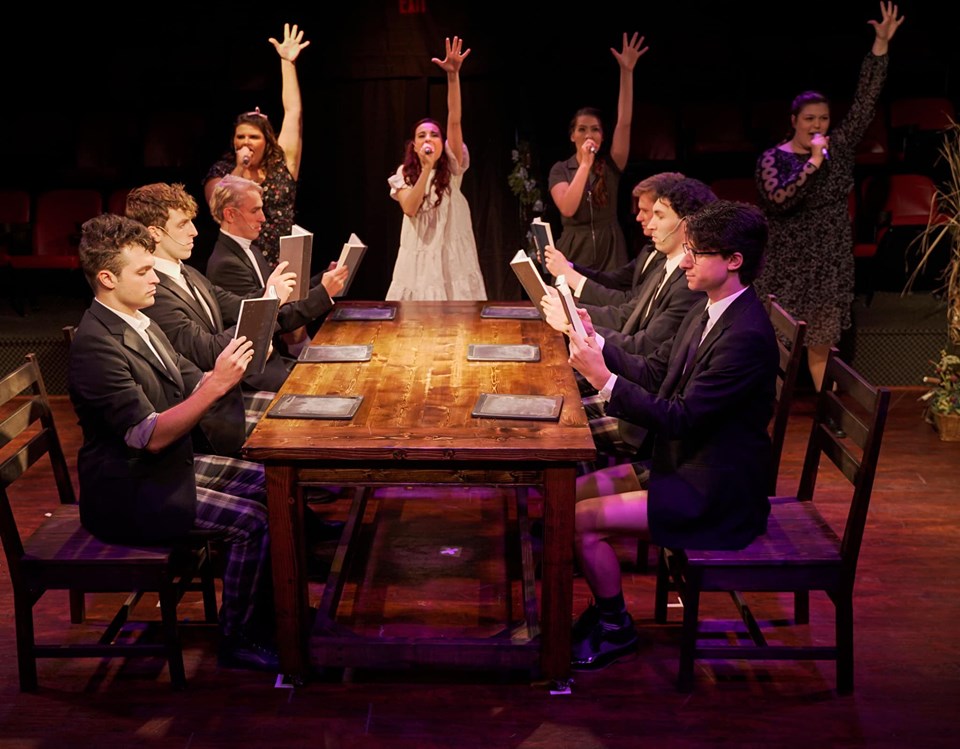
Vince Ventura and the folks at 12 Peers Theater uphold their mission to produce experimental work with their newest production, playwright Branden Jacobs-Jenkins’ 2018 Pulitzer Prize finalist, “Everybody.” There’s experimental, and there’s experimental done well. Any theatergoer knows that Venn diagram doesn’t always overlap.  As a production company, 12 Peers has distinguished themselves is by doing experimental work – and consistently doing it well.

Everybody” is based on a 15th century English morality play entitled “Everyman.” Jacobs-Jenkins’ gender-inclusive retitling is a nice nod to his version’s updated modernity. I remember reading excerpts of “Everyman” in my college British literature survey course. “Everyman” had characters like Death and Beauty. As a morality play, it was designed to teach a lesson around man’s earthly struggles and bolster Christian principles. “Everyman” is itself based on a Flemish play, which is perhaps based on a Buddhist fable. The play’s multi-country origins are shared with the audience very conversationally at the start. It’s a stark reminder that despite our differences, death and reconciling death have fascinated across history. Pondering those questions unite us in a shared curiosity and human experience that spans the centuries.

Jacobs-Jenkins’ “Everybody” maintains a cast of allegorical characters. The play’s basic premise is Death personified comes calling. Death informs the gathered group they’re each required to do a presentation for God accounting for their life. The characters offer up uneasy, disbelieving laughter followed by a sloppy slew of bribes and excuses about why they aren’t available or can’t fulfill that request. It’s reminiscent of the collective groan at the announcement of a pop quiz or having to create a PowerPoint deck that gets dropped on you at 4 pm on Friday. There’s a shared “whoa, hang on, we’re clearly not prepared” response as the characters furtively glance up to see which excuse might rouse success in delaying the proffered torture. It’s both humorous and relatable as few would embrace imminent demise with open arms. Despite the overtly instructive names, there’s a liberal seasoning of well-timed humor. In the midst of the litany of excuses, Death (played by a woman) shouts out exasperatingly, “This is hard enough without everyone thinking I’m a bitch.” There’s an unsettling pause as voices quiet and sympathies shift. Hmm, Death does have a thankless job.

Everybody (John Fieghtner) offers advice to Stuff (Paul Fields) in “Everybody.”

As with its 15th century inspiration, God and Death still lead the charge. However, Jacobs-Jenkins moves far beyond retitling in his reimagined version. At the play’s start, the actors all draw names onstage that determines their character for that particular production. Mathematically, this translates to 120 different possible acting combinations, likely making no two productions alike. This is no trite “choose your own adventure” format; there’s a laudable amount of memorization required of each cast member given the rotating parts.

While this could be disaster in less capable hands, director Vince Ventura ensures it’s seamless. He thoughtfully leverages recorded voiceover to help ease the burden of memorization without detracting from the show’s power. The actors who portrayed their lottery-drawn characters on the evening of August 2nd were entirely comfortable with their parts, suggesting countless hours of rehearsal well-spent. In watching them, it was actually hard to imagine them playing alternate roles given how convincingly and naturally they performed their randomly assigned characters for that evening.

 Both Peter Brucker’s sound design and Greg Messmer’s lighting design greatly enhance the production. The play effectively adopts the use of echo thanks to Brucker. Messmer’s lights surge and flicker at various points in synchrony with vocal intonations to create the effect and presence of a watchful higher power.

There’s a scene in which Everybody (the play’s representative human) repeatedly shouts, “This body is just meat, this body is just meat, this body is just meat, this body is just meat.” Ventura makes the repetition not the monotone maniacal cry of a madman but an unsettling evolutionary reverberation. The cry is enhanced by Brittany Tague’s choreography. She keeps “Everybody”moving about the stage, manifesting a distraught freneticism in the show’s quest to hang on to life. Ventura reminds us through “Everybody” that this vessel called our bodies is little more than the cow we casually consume. It’s both disturbing and humbling to have that repetition take effect and realize the frailty and lack of control we have over our bodies. As the play reminds us at every turn, we are not ultimately in charge.

12 Peers Theater’s production of “Everybody” plays through August 18 at the Cathedral of Learning, 4200 Fifth Avenue, Pittsburgh, PA 15260. For more information and to purchase tickets, click here.


A Bud That Didn’t Bloom – a review of “Spring Awakening”

by Claire DeMarco, ‘Burgh Vivant

Everybody has issues, especially a group of young adolescents in late 19th century Germany in rock opera retelling of Frank Wedekind’s “Spring Awakening.”

Wendla (Victoria Buchtan) is curious about where babies come from.  Her mother (Barbara Burgess-Lefbevre, playing multiple roles) avoids the question, coming up with an innocuous explanation that leaves Wendla still befuddled.

Meanwhile in the schoolroom we’re introduced to the boys: Melchior Gabor (Ian C. Olson), Moritz (Ryan Wagner), Georg (Tommy O’Brien),  Hanschen (Connor McNelis), Ernst (Palmer Masciola) and  Otto (Jeremy McCawley).   Moritz has several problems – he’s performing poorly in school, evidenced by an angry school master (Brady Patsy, also playing multiple roles), and he’s been having sexual fantasy dreams.  Moritz cajoles Melchior into helping him understand those nocturnal nightmares. Mechoir assists by writing  an essay about sex, complete with  lewd diagrams.

Wendla socializes with her friends and the subject turns to boys.  Melchior seems to be their favorite.  Martha (Sabina May) blurts out that her father has physically abused her.  Wendla, Anna (Mar Puet) and Thea (Marnie Butler), are appalled at this information, and promise Martha that they won’t tell anyone about her dilemma.  Martha does not want to end up as Isle (Madaline Struhar), a victim of abusive parents who was kicked out of her parent’s house.

Wendla encounters Melchior in the woods and is so traumatized by Martha’s abuse that she confides in him.  She insists that Melchior beat her with a stick so she can feel what Martha went through. He obliges.

Aghast at what he has done Melchior meets Wendla again and asks for forgiveness.  Feelings they have for each other escalate and they have sex.

Moritz fails at school. He is berated by his father for humiliating the family name. The boy commits suicide.

Wendla is ill with what she thinks is anemia but learns that she is pregnant.  Her mother is horrified, blames her and finds a back-alley abortionist. When it’s discovered that Melchior, he is sent to a reformatory.

Melchior finds out that Wendla is pregnant while he is incarcerated.  He escapes and attempts to meet Wendla, first visiting Moritz’s gravesite, attempting to pull his life together.

While there he is faced with several additional shocks that will affect him forever.

The cast of “Spring Awakening” performs “All That’s Known.”

Buchtan shines as the innocent caught up in time when “too much information” seems to be the standard.   Her rendering of “Momma Who Bore Me” is powerful.

Olson was somewhat uneven in Act I (probably due to opening night jitters) but he came to life in Act II.  His delivery of “Left Behind” was especially poignant.

Wagner pulls us into the soul of his character as he changes from an insecure teenager to a despondent soul.

In his multiple roles, Patsy cleverly changes from a stoic school master to a reprimanding father to a sympathetic doctor with ease.

This is a well-balanced, musically talented cast that compliments one another.

The choreography and general movement were stunning.   Kudos to Fight Choreographers Barbara Burgess-Lefebvre and Zakk Mannella and Dance Captain Victoria Buchtan.

Note:  At times with a theater in the round stage, those actors with their backs to the audiences are sometimes not heard, even with microphones in the small venue.

Another Note:  In Act I, specifically, there was static noise emanating from the sound system.

“Spring Awakening” focuses on teenagers in the late nineteenth century in Germany who are awakening to their sexuality.  Teenagers today also question their sexuality and intimacy but for the most part there’s a healthier, more open conversation about it.

“Spring Awakening” won the 2007 Tony Award for Best Musical with music by Duncan Sheik, book and lyrics by Steven Sater.  The  original play written by German dramatist, Frank Wedekind, in the early 1890’s.

-CED

“Spring Awakening” is a production of Comtra Theatre, 20540 US-19, Cranberry Township, PA. 16066.  It runs from August 2 – 17. For more information, click here.

Unfinished Love – a review of “Once”

by Claire DeMarco, ‘Burgh Vivant 

Guy (Stuart Ward) is an Irish musician, creating music and playing at a Dublin pub.  The Girl* (Esther Stilwell), a Czech immigrant and the mother of Ivanka (Lauren Ivory Vail), is taken with Guy’s music, and begins a conversation with him.  Both love music but their connection begins when Girl discovers that Guy’s day job is repairing sweepers in his father’s shop. And surprise! The Girl has a Hoover that needs fixed.

*Note:  We never get their real names, they’re just –  the Guy and the Girl.

Guy’s life is consumed with music but he’s lost his enthusiasm.  His girlfriend left him to pursue her dreams across the pond. Girl is entranced by his music but at the same time understands his low spirits.  She is able to encourage and cajole him out of his depression.

Girl drives the friendship, pushing Guy into publishing his music, enticing Billy (Paul Whitty) to provide a piano, encouraging Bank Manager (Andy Taylor) to issue a loan for the cause. 

As time passes their friendship becomes stronger with both Guy and Girl definitely past the “in like” stage of their relationship.  Girl tells Guy that she loves him (in Czech) and it doesn’t translate. She also indicates that she is married to Ivanka’s father and he is expected back in Dublin shortly.  Guy confesses that he has reached out to his ex in New York. Even though his songs were written about his former girlfriend, he now sings them about the Girl.

How does this all end?   Does Guy leave for New York?   Does Girl reconcile with her husband or was this just a brief interlude between two people who for a moment in time needed one another?

The Guy (Stuart Ward) meets the Girl (Esther Stilwell) in Once.

The unique factor about this show is that the characters are also the musicians and they all perform beautifully.

Stilwell provides a comedic slant to her character as she intertwines her Czech accent into conversations with her Irish cohorts.  But Stilwell also conveys a hidden sadness, often heard through her music.

Ward plays Guy as a tormented soul. His duet with Stilwell in “Falling Slowly” is powerful.

Whitty pulls it off as the rough and tough music store owner. 

Taylor is funny as the business professional who thinks (erroneously) that he, too, can become a star musician. 

The central set design is the pub and images of Dublin street are projected. Subtle movement of the props, whether it’s a piano or a bench, suggest changes in the location.

 “Once” won the 2012 Tony Award for Best Musical.  Book by Enda Walsh. Music and Lyrics by Glen Hansard and Markéta Irglová.

This is a fine production directed by J. Michael Zygo.

-CED

 “Once” is presented by Pittsburgh CLO at the Benedum Center and runs from July 30 – August 4. For more information, click here.

That 80s Show – a review of “Rock of Ages”

Mike Buzzelli

by Michael “Buzz” Buzzelli, ‘Burgh Vivant

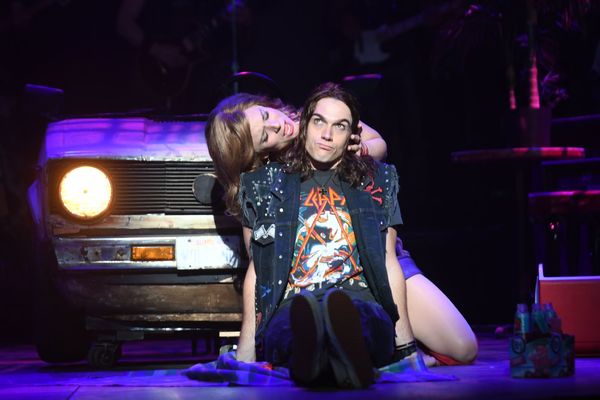
The Bourbon Room is rocking the Sunset Strip in the mid-to-late 80s, and Lonny (Nick Druzbanski), our fearless narrator, wants to tell you all about excitement in and out of the club in the hit musical “Rock of Ages.”

Lonny not-so-subtly explains everything we need to know about the popular rock venue, it’s owner, Dennis Dupree (Gene Weygandt), the greedy German entrepreneurs, Hertz Klinemann (Jeffrey Howell) and his son Franz Klinemann (Nathan Salstone), who are buying up blocks of the Strip to gentrify the neighborhood, and the young woman, Regina – rhymes with vagina (Tiffany Tatreau) – who is trying to stop them.

Lonny also introduces us to the main story; a love triangle (two-parts love, one-part lust) between our hero, Drew (Justin Matthew Sargent), a sweet, young girl from Kansas, Sherrie (Tess Soltau), and famed Arsenal lead singer Stacee Jaxx (American Idol’s Ace Young).

Drew wants to rock but he’s stuck behind the scenes cleaning up the club, emptying bags of garbage and plunging toilets. No job is too gross for Drew, because scatological comedy is king in this musical, but he’d rather be the lead singer in a big 80s hair band than clean vomit out of the men’s room. Who wouldn’t?

Our hero meets Sherrie just as she arrives in town –straight off the bus from some unnamed town in Kansas. Drew gets her a job at the Bourbon Room and the two continue to flirt, but Drew accidentally locks himself in the Friend Zone.

Meanwhile, Dennis Dupree, the Bourbon Room owner and operator, wants to have one last big blow out concert before they have to close up shop for good thanks to the aforementioned schemers, Klinemann and Klinemann. He convinces the hit rock band Arsenal to play one last gig in the club. The pompous Arsenal lead singer Stacee Jaxx agrees. When Jaxx arrives, he immediately puts the moves on Sherrie, and the three individuals converge, creating said love triangle. It’s your typical “Boy meets girl, Boy loses girl to famous rock star, Boy tries to win her back” story.

When Sherrie is unceremoniously fired because Sherrie gives Jaxx “bad vibes,” she runs into Mama (Aurelia Williams) the lesbianic prison matron who – wait! That’s “Chicago”  – she runs into Justice the lesbianic owner of the Venus Club, who gets Sherrie up on the pole, dancing for her money. Ironically, Tina Turner’s “Private Dancer” feels like the only rock ballad that DIDN’T turn up in the final cut of the show.

Sherrie (Tess Soltau) and Drew (Justin Matthew Sargent) go on a picnic high in the Hollywood Hills in “Rock of Ages.”

“Rock of Ages” is, yet again, another musical that weaves its plot around its songs – instead of the other way around. Some of those songs work and some are just jammed in there (a father sings a love ballad to his son and it feels super awkward). Bad puns go flying, some of them land with a thud. A vast majority of the comedic lines are merely groaners, but the superior cast kept “Rock of Ages” from being Schlock of Ages.

Young is charismatic as the charming but smarmy Jaxx. He lights up the stage, even when prancing around on a plush stuffed llama.

Sargent is perfectly cast as a fresh-faced Drew. He seems too earnest to be a rock star, and without spoiling the plot… probably is. He’s a good guy looking for a good girl and both he and Soltau are convincing.

By the way, Soltau can sing. She sings her way into Drew’s heart – and into the hearts of the audience. She also gets in a good comedic moment or two, particularly during a picnic high on  Mullholland Drive – overlooking the Los Angeles cityscape.

Weygandt’s performance is reminscent of Bill Nighy in “Love Actually,” only less famous. He’s terrific.

Williams is a powerhouse. Even though there were some faulty microphones on opening night, it didn’t matter to Williams as she belted out the tunes. It was a grand performance.

Howell and Salstone are burdened with ridiculous German accents, but the duo makes the best of it. Howell chews the scenery. He’s the central villain in the story, but you can tell he’s loving every minute of it. Salstone steals the show with a rendition of “Hit Me with your Best Shot.” It’s, hands down, the most fantastic moment in the show (this critic is a big Pat Benatar fan).

Beowulf Boritt’s set design is spectacular and Gregory Gale’s original costumes are amazing. The show is popping with bright colors and bold patterns. The show is a huge spectacle with great live music provided by band members Robert Neumeyer, Dan Peters, John Anthony, Paul Thompson and RJ Heid.

Playwright Chris D’Arienzo wrote a clunky musical, but if you love 80s hair bands,  like Guns & Roses, Styx, and Twisted Sister, “Rock of Ages” will rock you. Hard.  Just the way you like it.

-MB

“Rock of Ages” runs through July 28 at the Benedum Center, 7th Street and Penn Avenue, Pittsburgh, PA 15222. For more information, click here.


Review: BOEING BOEING, Little Lake Theatre Company

The Theater Lady is back tonight, serving up the dish on BOEING BOEING, the farce so nice, they named it twice, performing at Little Lake Theatre Company through August 3, 2019. For tickets and more information, visit www.littlelake.org  Continue reading “Review: BOEING BOEING, Little Lake Theatre Company”

Featured
Featured
Review: BOEING BOEING, Little Lake Theatre Company
Loading
/

Suicide is painless – a review of “‘night Mother”

Tiffany Raymond, ‘Burgh Vivant

Marsha Norman’s 1978 Pulitzer Prize winning play, “‘night Mother,” recently crested its 40th birthday, and while some details are inevitably dated, the play’s themes are still relevant today. It’s a dark family drama centered on a middle-aged daughter, Jessie (Briauna Brownfield), a divorcee living with her aging mother, Thelma (Samantha A. Camp).

At the start, Jessie announces she is going to commit suicide, and the play unfolds real-time, making the 90-minute show the same duration as the play’s action. Norman’s writing is incredibly tight, creating an intense hour and half for actresses and audience alike.

“‘night Mother” is a character-driven, dialogue-heavy play, and the emotionally weighty subject of suicide requires exceptional acting. Unfortunately, Throughline thoroughly misses in casting Brownfield as Jessie. Jessie is middle-aged in the play, but Brownfield is closer in age to Jessie’s young adult son.

Age aside, Brownfield gives a steadily one-dimensional, monotone performance. Her relentlessly flat affect is tedious, leaving one to wonder if director Sarah McPartland ever attended a rehearsal. The theater is small, and the close proximity visibly betrays Brownfield is often simply trying to remember her lines, which removes the potential for emotional nuance. Jessie’s compiled a list of personal questions to ask (“Did you love Daddy?”) and perfunctory information to share (the dryer repair number is taped to the side of the machine). Both the banal and the secret are unified under the same void expression, which prohibits the play from reaching its emotional valence. Brownfield’s only nod to tension is to touch and straighten her glasses, which may just be a nervous tic.

Jessie (Briauna Brownfield) comforts her mother, Thelma (Samantha A. Camp), after shocking her with a disturbing announcement.

Age-wise, Camp would be better suited to play Jessie. Brownfield’s phone-in performance definitely helps Camp shine as the stronger of the two actresses. Thelma’s character limps and uses a cane, which Camp observes with flagrant degrees of inconsistency, another missed opportunity for director Sarah McPartland. Camp does exhibit emotional range in her parade of reactions to Jessie’s suicide pronouncement that includes everything from total dismissiveness to downright panic to blame and self-pity. At one point, Thelma angrily knocks her crochet basket off of the coffee table, and it’s a moment of palpable tension where the fourth wall feels compromised as the basket comes hurtling towards the audience. Thelma loves candy, and in a thoughtful detail from McPartland, a hidden sweets stash comes flying out from beneath the yarn.

Tucker Topel’s set design is a praiseworthy bright spot. Visually, the set is rife with details that thoughtfully coalesce and immediately express this is a lower-middle class home, including a poor man’s cabinet door of a curtain on a slightly sagging string beneath the kitchen sink. The most resounding detail is partially exposed lath and plaster walls showing the inner layers of the home in a way that beautifully parallels the characters peeling back their own layers and exposing their truths over the course of the night.

A costume designer is conspicuously absent from the crew list. Both actresses appear to have been left to their own devices without directorial guidance from McPartland to visually unify them. To Camp’s credit, her Thelma is on point. She shuffles about in gray house slippers with faded black socks. She’s appropriately fashion-forgettable in her coral top as the hemline of her polyester skirt flirts with the top of her socks. The skirt’s floral pattern is trying to emerge from an unappealing chocolate brown background, mirroring Thelma’s own quagmire.

Jessie never leaves the house, and the play notes her getting house slippers for holidays, a woman old before her time. Yet, Brownfield’s sneakers read more hipster than house shoes, and she’s sporting an anklet that may fit her personal life but should be shuttered for the show. She’s supposed to be wearing her son’s clothes, suggesting the degree to which she decries caring about her appearance, but Brownfield’s form-fitting denim overalls are decidedly on-trend and feminine. The play takes place on a Saturday night, which is when Jessie does Thelma’s manicure. While the dialogue explicitly refers to Thelma’s chipped nails, her manicure look salon-fresh. The small, intimate venue makes visible these cumulative cracks that compound and diminish impact.

Despite the fact there are only two actresses in the show, the program’s cast list has their names reversed. It’s symptomatic of the show’s collective lack of attention to detail. The production feels premature, as if we’re seeing a rehearsal, so it may come together more tightly as the production run progresses. Norman’s writing is worth experiencing. She doesn’t shy away from the intricacies of how families hurt each other, even if the intent is good, and her exploration of a woman contemplating suicide is even more relevant today as suicide numbers reach all-time highs.

-TR

“‘night Mother” plays through July 27 at the Aftershock Theater, 115 57th Street, Pittsburgh, PA 15201 (on a seasonal note, fans are abundant, but the theater is not air conditioned). For more information, click here.


Take a chance on me – a review of “Mamma Mia”

Mike Buzzelli

By Michael “Buzz” Buzzelli, ‘Burgh Vivant

Sophie Sheridan (Alysia Vastardis) is getting hitched on a small, Greek isle. She wants her father to walk her down the aisle when she gets married. The problem is – Sophie doesn’t know who sired her. Her mother Donna (Stephanie Ottey) had three suitors twenty years ago; any one of them could have been Sophie’s dad. So, the bride invites all three possible biological fathers to her wedding in “Mamma Mia.”

Meanwhile Donna’s best friends – and backup singers from her heyday singing as “Donna and the Dynamos” – Tanya (Sara Barbisch) and Rosie (Missy Moreno) rush to the aid of the mother of the bride to prep for the big day.

Then, Sam Carmichael (George Heigel), Bill Austin (Nick Mitchell) and Harry Bright (Chris Martin) all show up on the island for Sophie’s impending nuptials. While the men are purportedly intelligent, none of them figure out why they were invited to the wedding (it takes the entire first act for them to work it out). Any one of them might be Sophie’s dad.

P.S. the bride did not tell her mother than she planned to bring the men to the island.

Chaos – and a lot of ABBA music – ensues.

The cast of “Mamma Mia” poses for a wedding photo at the end of the show.

The plot of “Mamma Mia” is flimsily framed around the songs of Benny Anderson and Bjorn Ulvaeus (Benny and Bjorn are the two middle B’s in ABBA). If you have a favorite ABBA song, playwright Catherine Johnson has wedged it in somehow – sometimes – with a sledgehammer.

No one has ever gone to any musical for the plot, especially “Mama Mia.” It’s all about the singing and dancing, and “Mamma Mia” has oodles of singing and dancing. It’s infectious, effervescent and joyous.

There’s a lot of talent in this cheery, little production. Kudos to co-directors Stephen Santa and Drew Praskovich for mounting such an energetic show. It’s perfectly cast. They bring a lot of spectacle to it on a shoestring budget.

Vastardis belts out quite a few of the songs beautifully.

Donna transforms from downtrodden taverna owner to disco diva in a few pithy tunes, but Ottey makes it work. She’s a star. Her version of ‘The Winner Takes it all” is a showstopper.

Heigel matches her in intensity with “Knowing Me, Knowing You.” Heigel has been in many Stage 62 productions, but he finally gets a bit of the spotlight here, and he deserves every minute of it. He shines bright here.

Martin is always fun to watch. His character HB is supposed to be British, but the accent sort of comes and goes (maybe he’s just peppering his conversation with British words). He does, however, have impeccable comic timing.

Mitchell does a fine job as the intrepid explorer. His reactions to Moreno’s “Take a Chance on me” are so unbelievably stoic (he deserves an award for being nonplussed through the whole, sordid song).

Moreno is a comedic force of nature. Even the grumpiest of theater goers will guffaw at her antics. Major LOL’s resounded from almost every audience member.

Clayton Edwards and Ivan Bracy Jr. bring a lot of charm and personality to Pepper and Eddie, respectively.

There is kinetic choreography from Emily Christ and peppy tunes from the orchestra.

Shout out to the set designer Rob James for a stunning Aegean backdrop and gorgeous costumes by Jessica Kavanagh.

Take a chance…Take a chance…Take a chance…on “Mamma Mia.”

-MB

“Mama Mia” runs until July 28 at the Andrew Carnegie Free Library and Music Hall, 300 Beechwood Avenue, Carnegie, PA 15106. For more information, click here.


Review: SCAPINO, Kinetic Theatre Company

According to Lonnie the Theater Lady and ‘Burgh Vivant host Brian Edward, this Scapino is a Scapi-YES. SCAPINO, adapted by Jeffrey Binder, directed by Andrew Paul, continues through July 28, 2019. For tickets and more information, visit www.kinetictheatre.org  Continue reading “Review: SCAPINO, Kinetic Theatre Company”

Featured
Featured
Review: SCAPINO, Kinetic Theatre Company
Loading
/

Review: HEATHERS THE MUSICAL, The Theatre Factory

‘Burgh Vivant host Brian Edward downs a martini with The Theater Lady and discusses HEATHERS THE MUSICAL, by Lawrence O’Keefe and Kevin Murphy, based on the film written by Daniel Waters, directed by Matt Mlynarski, and performing at The Theatre Factory through July 21, 2019. For tickets and more information, visit www.thetheatrefactory.org Continue reading “Review: HEATHERS THE MUSICAL, The Theatre Factory”

Featured
Featured
Review: HEATHERS THE MUSICAL, The Theatre Factory
Loading
/

Struggle with Rage and Love – A review of “American Idiot”

By Claire DeMarco, ‘Burgh Vivant

Three young men in suburbia Johnny (Jeff Way), Tunny (Jacob Krupitzer) and Will (Jordan Schreiber) are restless, bored and generally discontent with their lives. They feel trapped and want to escape, and move on to a more exciting place where they make their own rules and “find themselves.”

Will wanted to leave with his buddies but stays back in suburbia when his girlfriend Heather (Karli Sutton) discovers she is pregnant.

Johnny and Tunny head for the “big city” but after a time both find that city life isn’t exactly what they expected. Both men face the same restraints and traps they encountered in suburbia.

Heavy into drugs, Johnny stays in the city and finds Whatshername* (Chelsea Bartel).

*Note: Yep, that’s right. The poor girl doesn’t even have a name!

Johnny slowly entices his nameless girlfriend into his drug world. His alter-ego and figment of his imagination St. Jimmy (Allison Burns) is not a saint as she goads Johnny into more inappropriate behavior.

Tunny leaves the city, joins the military and is seriously injured in the war. While in the Middle East he falls in love with Extraordinary Girl** (Lydia Halkias).

**Note: And another nameless female!

Will, still in suburbia, lives his life vicariously through television, watching other people pursue active existences. He is bored and boring.

Johnny and Tunny eventually come back home to suburbia and reconnect with Will. Did they leave their rage behind? Did love prevail?

Jacob Krupitzer (as Tunny) plays the guitar while the cast of “American Idiot” looks on.

The seed for the musical opera “American Idiot” grew from the album of the same name produced in 2004 by the band, Green Day. Music was written by Billie Joe Armstrong. Book by Billie Joe Armstrong

Note: The time frame of the original musical reflected the early 2000s. This production is definitely indicative of 2019 as evidenced by the quick projected television images of the current President.

Way’s interpretation of Johnny as the angry, self-centered wise ass is spot on as is his rendition of “Boulevard of Broken Dreams.”

Schreiber is believable as Will as his movements and facial expressions indicate his much slower-paced life and indifference.

Bartel’s rendition of “Letterbomb” is powerful.

Burns’ portrayal as the psychotic, evil St. Jimmy is riveting.

Krupitzer successfully conveys the deeper feelings of Tunny as he grows from a restless youth to a gentler soul.

Set design is eclectic, simplistic, but striking. Sections of plywood (with the occasional stream of green bubble wrap) surround the stage. The plywood slabs are used throughout the musical to catch images of current events or silent symbols associated with the characters on stage. Hats off to Set Designer, John E. Lane, Jr.

Choreography by Assistant Director/Choreographer Nora Nee and Assistant Choreographer Mikayla Gilmer and the entire cast made the energetic, frenetic movements on stage appear seamless.

The Live Band is the delicious icing on the cake.

This production directed by Justin Sines.

Please note that this show contains adult content and strong language that may not be suitable for all viewers.

-CED

“America Idiot” runs from July 11 – 28 at the Genesius Theater, Duquesne University, 1225 Seitz Street, Pittsburgh, PA 15219 (adjacent to the Mary Pappert School of Music). For more information, click here.

css.php