

By Timothy Ruppert
Want a challenge? Stage William Shakespeare’s infrequently produced early comedy, Love’s Labour’s Lost, knowing fully well how few audience members will have any significant familiarity with the play beyond its alliterative title. Oh, and do so with paper puppets projected onto a screen. And throw in a singalong with the audience to close out the festivities. Interested?
Steel City Shakespeare Center accepts that challenge with verve and vision, proving that they are a theatre company meriting serious attention in the Pittsburgh arts community. Beautifully designed and superbly executed, their production of Love’s Labour’s Lost fashions a unique, not-to-be-missed theatrical experience.
The play itself begins with what seems an outrageously difficult task when King Ferdinand of Navarre (Aaron Crutchfield) charges three high-ranking courtiers—Berowne, Dumaine, and Longaville (the first two voiced by Bob Colbert, the third by Matthew Hartman)—to forego all physical gratification for the sake of scholarly pursuits: “Our court shall be a little academe,” boasts the sovereign, “Still and contemplative in living art” (1.1.13-14). This royal fiat—which includes an edict forbidding any woman within a mile of court—swiftly becomes a sticky wicket once the Princess of France (Anne Forrest) arrives with her entourage of ladies (Sarah Elizabeth as Maria and Ella Mizera as Rosaline and Katherine), sparking love and romance in place of arcane intellection. What follows is a mélange of elements that recur throughout Shakespearean comedy: the verbal fencing of eventual lovers so well beloved in Much Ado About Nothing; disguises and misidentifications such as we find in Twelfth Night and As You Like It; and a metatheatrical sequence that presages the work of Peter Quince and friends in A Midsummer Night’s Dream. We get a few important surprises, too, making Love’s Labour’s Lost a distinctive presence in the Shakespeare canon.
Álvaro Muñoz as the braggart Don Adriano de Armado and Joseph Vasquez as his page, Moth, complete a terrific cast of voice actors whose passion for their craft resonates throughout the evening. While Colbert, one of Pittsburgh’s best interpreters of Shakespeare, delivers an expectedly splendid performance (and he plays the accordion to boot), the actors prove to be impressive.
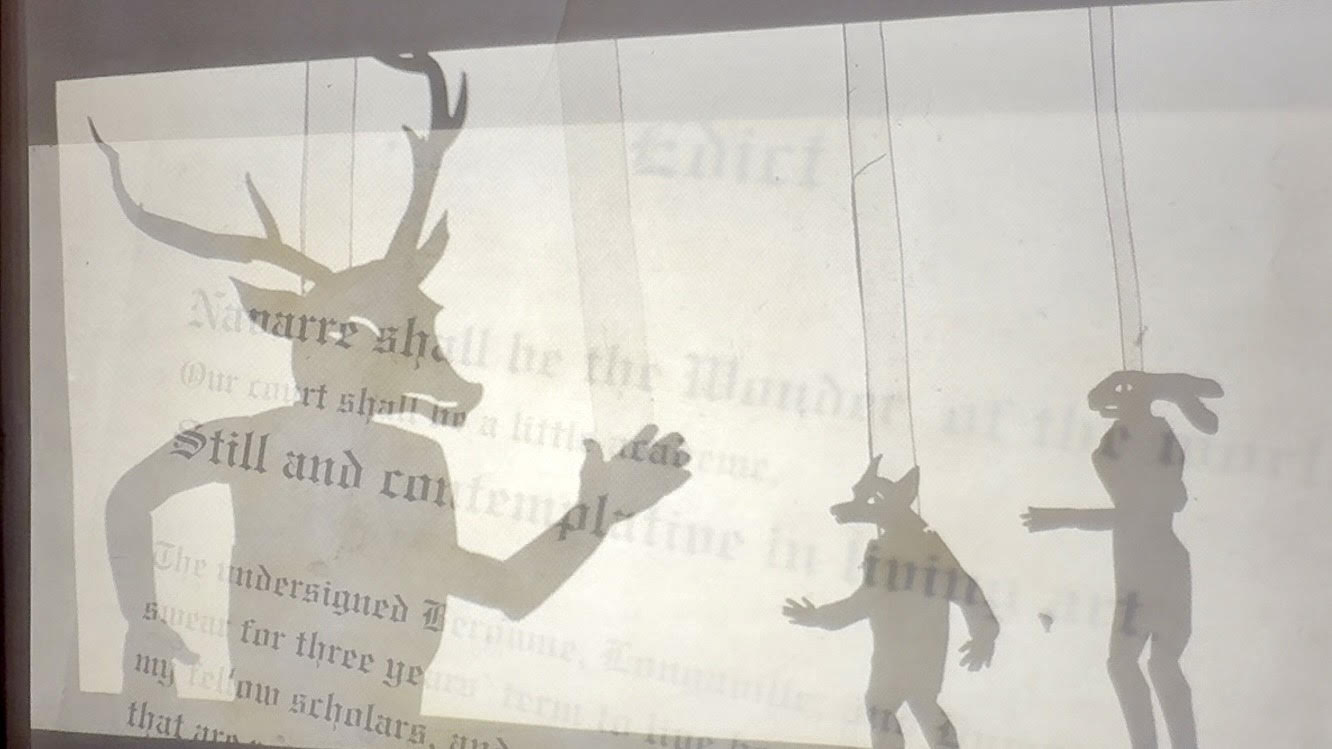
Director Cat Aceto deserves special notice for her designs and puppeteering. Along with Skylar Rella and Jenna Simmons, Aceto treats us to a striking display of shadow-theatre storytelling. The puppets are wonderfully constructed and varied, combining human forms with the heads of assorted animals—deer, rabbits, giraffes, owls, and many beyond—to render a theriocephalic spectacle that puts us in mind of folkloric magic generally and of Nick Bottom’s adventures among the fairies specifically. Together with the cast’s keen performances, the puppetry truly elevates this production to a remarkable level of achievement.
Not surprisingly, Steel City Shakespeare Center scores a very palpable hit with their current showing of Love’s Labour’s Lost. The company takes artistic risks with alacrity, in part because the talent and imagination of this troupe’s members ensure success. To paraphrase Moth (5.1.35), this production offers a great feast of theatrical languages—voice acting, puppetry, music-making—certain to delight newcomers to the Bard as surely as it will please connoisseurs.
-TR
Steel City Shakespeare Center’s production of “Love’s Labour’s Lost” continues 15 and 16 May, 7.00 PM, at the Tracey D. Turner Studio, Northmont United Presbyterian Church, 8169 Perry Highway, Pittsburgh, PA 15237. For information and tickets, please visit here.
