
The Andy Warhol Museum Arts Educator, Chuck Pearson: “You Can Take Warhol Out of Pittsburgh, But You Can’t Fully Take Pittsburgh Out of Warhol” 

By Gina McKlveen

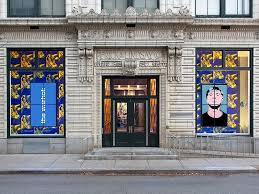
When visitors step off Sandusky Street and enter The Andy Warhol Museum, they are instantly greeted by an industrial-esque entrance hall, complete with high ceilings, exposed pipes, studio lights, metal chairs, and high top-tables, and of course, Andy Warhol’s iconic red couch from his Factory. This location was the meeting space for my recent sit-down conversation with The Andy Warhol Museum Arts Educator, Chuck Pearson, about all things Andy, the aesthetics, the artist, the artwork, and the atmosphere.
The Aesthetics

“This building, actually, this is the old Frick & Lindsay building,” Pearson stated.

“[It] was built in 1911. This was an industrial warehouse for many years during Pittsburgh’s steel era. Back in the 70s and 80s it was a music store. And then it was empty for a period of time. That of course is when the [Andy Warhol] Foundation and the Carnegie [Institute] came together, got this building, and then refit it to be the [Andy Warhol] Museum.

“It’s interesting, if you walk through this Museum and look at its structure, you’ll see that the warehouse kind of aesthetics are still in play…It’s kind of an homage to Pittsburgh’s industrial heritage, but it’s also an homage to Andy’s ‘Factory’ and being a commercial artist and having that commercial side to him.”

The Artist

Although Warhol grew up in Pittsburgh and attended college at Carnegie Tech, now known as Carnegie Mellon University, majoring there in what today may be described as ‘Graphic Design,’ after graduating in 1949 he moved to New York City.

“Back when he graduated college in 1949, Pittsburgh was still very much an industrial city. It didn’t have the same kind of cultural and artistic aspects that it has today. Back then, a Pittsburgh boy wanting to be an artist, you want to go to a place where art was thriving. At that point, New York City was the big place.

“It’s kind of ironic that even though Warhol came from blue collar roots, that Steel City background and such, when he left Pittsburgh in 1949, after he graduated college and went to New York, he did not come back to Pittsburgh very much at all. There was kind of a distance he put between himself and Pittsburgh. I don’t think he wanted to be identified with Pittsburgh necessarily. He wanted the New York scene that’s what he wanted to be identified with.”

“Even though he did make an effort to kind of distance himself from his Pittsburgh upbringing in many ways, in some ways he could never really escape it.”

One such example of Warhol’s inability to escape his Pittsburgh industrial roots was his New York studio, aptly coined ‘The Factory’ for the amount of work, specifically the artists’ silk-screen prints which were produced there almost in conveyor-belt, industry-like speed and fashion.

“There’s strong [Pittsburgh] influence in [The Factory],” said Pearson.

“Not only was [The Factory] a place to hang out and party and have fun, it was also an actual working studio.”

“The Factory, also known as his ‘Silver Factory’ was a studio, a place where he and others did art, did screen printing, made films, not only was it that but it also became some sort of a social hub. It became a place in New York where people could go to hang out, to party, to network, to make connections with other people, and it was especially valuable when members of the LGBTQ community didn’t have a lot of safe places to go to, that became one of those safe places. It became a place where a lot of people who maybe would not have normally had opportunities to get into art, to get into media, to get into shows, to do all of these sort of things. The Factory gave them an opportunity for that.
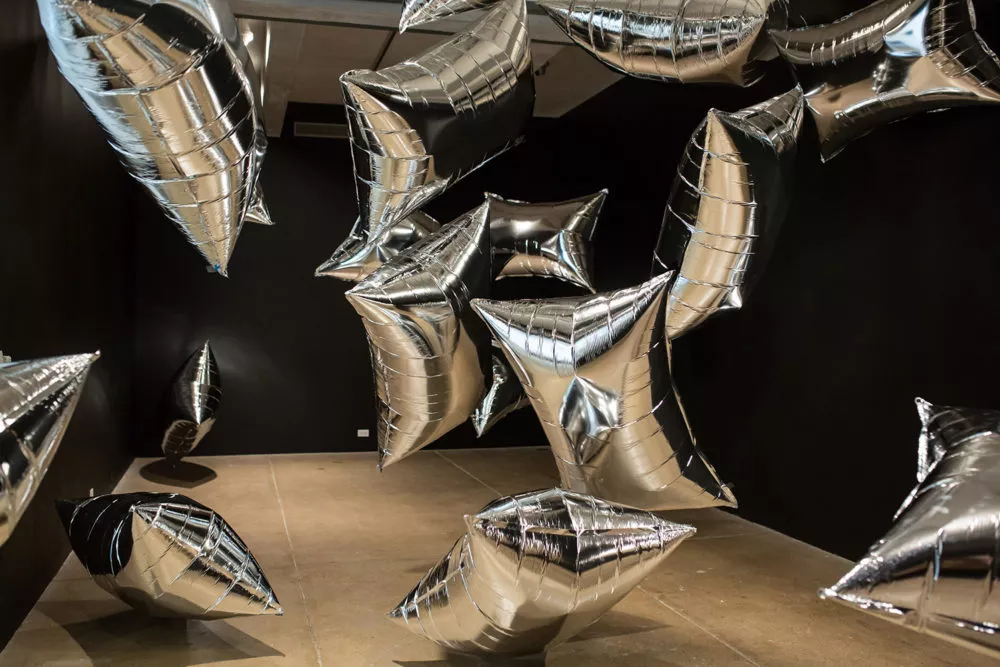
“It attracted crowds across a whole spectrum of people. Members of The Rolling Stones went there to party. The Velvet Underground, Nico, but a lot of the people who worked with Andy and kind of became a part of his circle, were a part of that Factory scene,” Pearson continued.

“The Factory went through a few different addresses over the years. It didn’t stay in the same place. Over the course of his career, in early 1964, for the next 20 years it would go through a few different places there, but all Manhattan—all the same general area.”
The Artwork

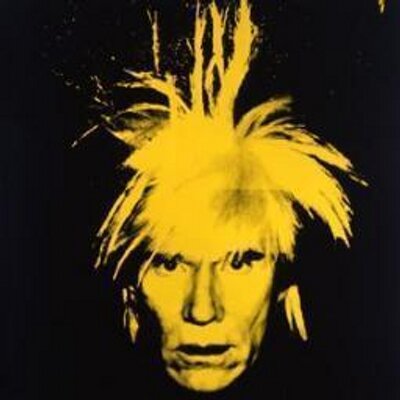
Like his Factory, Warhol’s work also moved across several iterations, styles, mediums, and expressions throughout his career.

“He spent a lot of time in the 1960s doing film, screen prints of actors and celebrities, but as he got into his commissioned portraits era in the 1970s…he moved into a period of abstract work.”

Pearson recognized, “What you’ll notice with Andy’s abstraction is sometimes it will be coupled with very realistic pieces.”

“Even when he was a commercial artist, part of what got him his success as a commercial artist was his style of commercial art was so different from what other people were doing. Most industrial artwork at that time was very ‘Norman Rockwell-ish.’ That was the norm, that was the standard, the people in post-WWII conservative America were using for commercial and professional art. Andy was not ‘Norman Rockwell-ish.’ His style of realistic expression was quite different. I think that carries over into his abstract era and his experiment with color trying to find those kind of blends.”

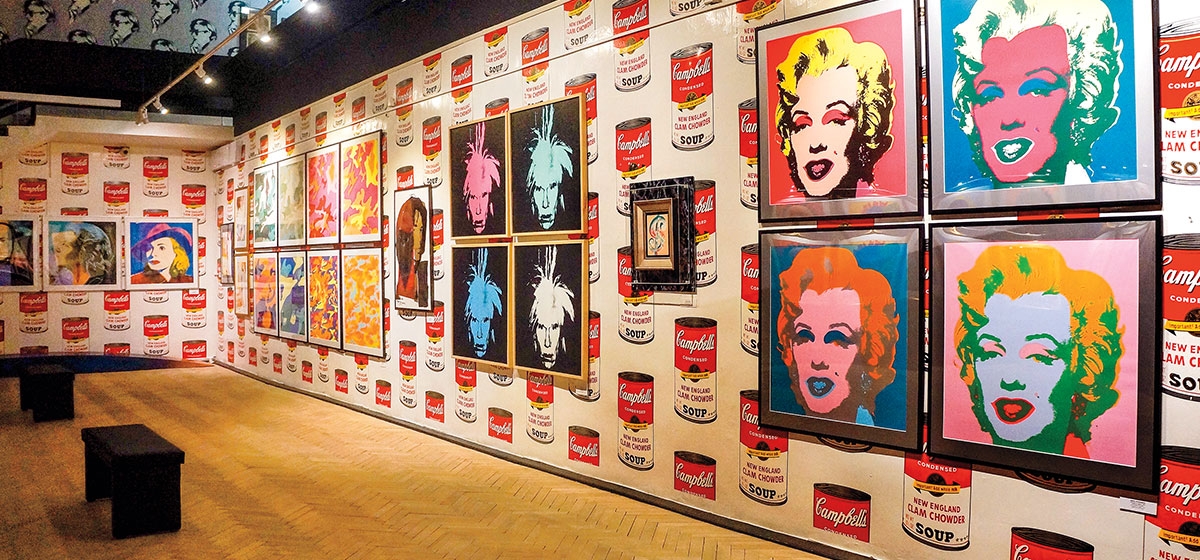
Some of Warhol’s most well-known works, like his silk-screen portraits of Marilyn Monroe, are on view at The Andy Warhol Museum. As an Arts Educator, Pearson offered a knowledgeable perspective on these iconic prints, sharing insights on the artists’ technique and timing.

“A lot of what Andy was trying to accomplish with his different series, particularly of like pop portraits [of] celebrities, was exploring through color different moods and aspects of a celebrity. The one we have upstairs of Marilyn that’s a 1967 series. The prominent feature of that, of course, is the hot pink lips and the earrings.

“Well, timing is kind of interesting in that…He did that in 1967. Well, what was going on in 1967? Summer of Love, Monterey Pop Festival, hippie movement, Haight Ashbury. And I’m thinking well maybe, but there’s also some darker backgrounds in that piece as well, but there’s that hot pink. Was he perhaps going with the contrast of the flower power movement of the Summer of Love verses also all the other stuff that was going around that the time, too. Because what else was happening? America was embroiling in the Vietnam War, the Civil Rights Movement, and such. There was a lot of light and dark going on in America. You see a lot of that contrast with many of his pieces.

“…through color the artist, Andy, is able to explore those different shades of Marilyn. And he did that with a lot of his different celebrities and pop portraits, and of course the power of screen print process.”
The Atmosphere

Continuing Warhol’s legacy of silk-screen printing process is not limited to the artworks displayed at the Museum. In fact, the Museum operates a ‘factory’ in the downstairs portion of the building which is an actual hands-on studio that visitors can participate and create artwork in, very much like Warhol’s own Factory.

This initiative is just one of the many outreach programs and projects that the Museum participates in to adhere to its mission of promoting the arts here in Pittsburgh.

Pearson noted, “The Warhol Museum is the centerpiece of the Pop District, which for last couple years has been trying to sort of create and artistic, cultural center point here on the North Shore to invite local artists to participate [in].”

Pearson also emphasized the Museums many extra-curricular activities outside the Museum’s regular business operations, “Like the Warhol Academy, youth programs, being very much in tune with the LGBTQ community here, of course that’s a part of Andy’s legacy also and wanting to provide opportunities for inclusion… We do outreach programs to schools, to shelters, to organizations, libraries. We have opportunities for schools and other organizations to do workshops here on site. We operate the print lounge, which is a part of the Pop District. It’s kind of a larger working space to be able to do projects.”


The Museum is also expanding its reach in the coming years with a brand-new structure expected to be completed in 2026 that will mirror the part of Warhol’s Factory that was known for its social activities, hosting parties, and attracting crowds like artists, actors, and musicians.
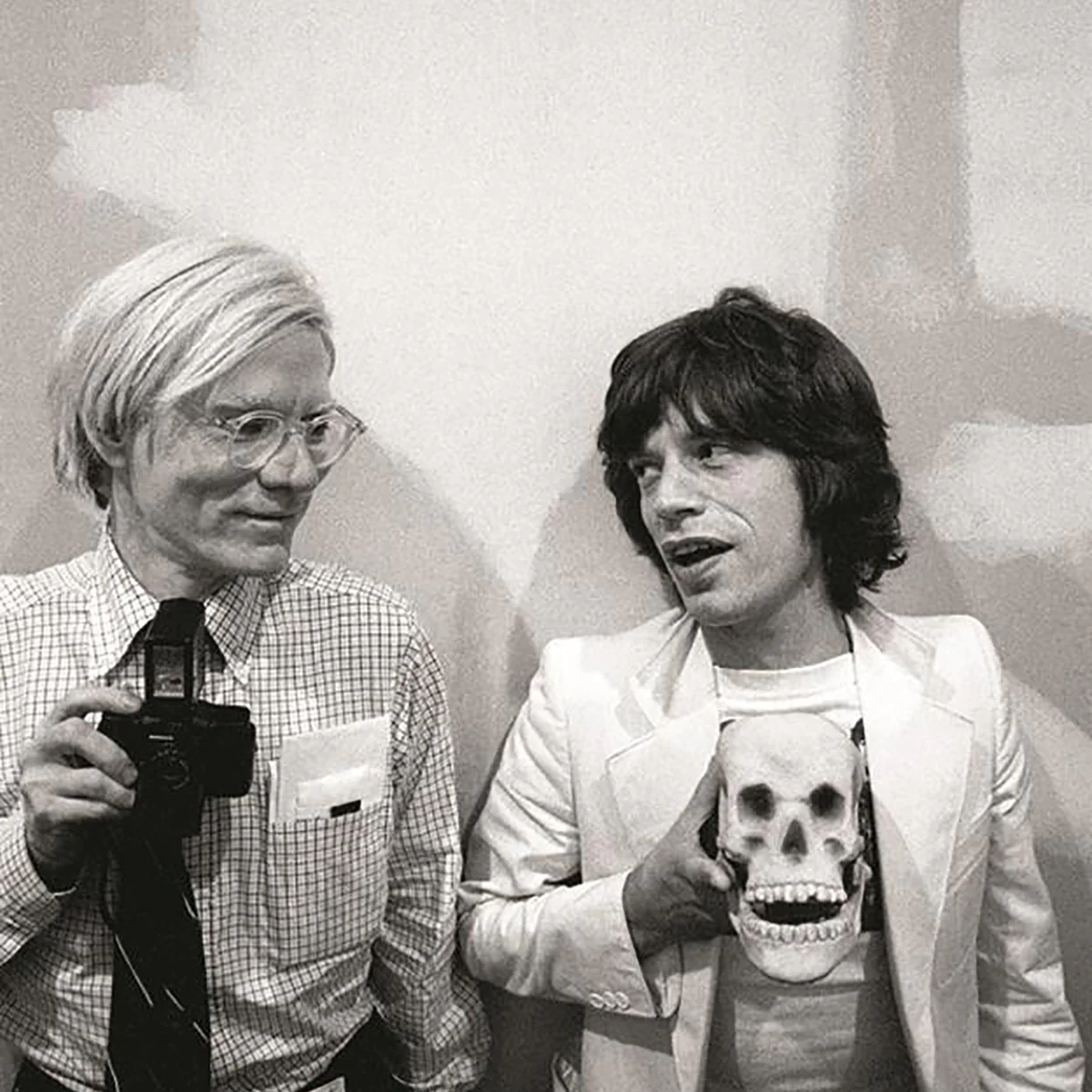
Based on Pearson’s experience with the Museum, he stated, “People love to use the Warhol for all sorts of venues and events. With the new facility, it’s mainly going to be devoted to special event venue space [for] functions and concerts, to help attract awareness to what’s going on here.”

In the next few months, the Andy Warhol Museum will celebrate its 30th anniversary since its founding.

“The Museum opened in 1994. It has been a point of cultural and artistic interest and attraction for all of those years. Especially in a time, back in 1994, when Pittsburgh was struggling to…keep afloat, and to try to find ways to keep the city going once the whole industrial aspect of the city died. But there’s been a lot of efforts in recent years to build up Pittsburgh in terms of being a progressive and 21st century city, and bringing in arts and culture has been a major part of that. The whole cultural district downtown, the Carnegie museums, all of this, the Heinz, you know tried to help to bring a renewed sense of life to Pittsburgh, which has been very successfully done. The Warhol Museum was coming in at time when that was starting to happen, so there was opportunity.”

Those opportunities have only multiplied over the years. Starting May 18, 2024, visitors will have an opportunity to see the work of artist, KAWS, in collaboration and conversation with some of Warhol’s darker themes around death and disaster. More information on this upcoming exhibit can be found here: https://www.warhol.org/exhibition/kaws-warhol/

Chuck Pearson is a California native who relocated to Pittsburgh in June 2022 after teaching high school English for many years.  A published author, Pearson’s writing credits include the Once Upon A Realm fantasy novel series (written as C.J. Pearson) and the Fate, Chance, and Choices trilogy (written under a pen name, Ariel Archer).  For the past year and a half, he has worked at the Andy Warhol Museum as a Gallery Associate and Arts Educator.

-GM

Hear the full interview here:


E(a)rnest Goes to England—A Review of “The Importance of Being Earnest”

by Joseph Szalinski

Oscar Wilde’s known for many things. Being dead is one of them. But his legacy lives on in the form of productions of his plays, ham-fisted references to books people only read the Spark Notes of in high school, and lost Jim Morrison fans at the Père Lachaise Cemetery. The first example is why I mention the expired socialite, because director/co-set designer Duane Peters is helming a rendition of “The Importance of Being Earnest” for Hobnob Theatre Company at Hobnob Studio Theatre in Butler, PA.

A classic tale of an artist and a paint—wait, no, wrong story. Ah, yes. A classic tale of mix-ups, nominative determinism, and cucumber sandwiches. Well, maybe not the last one. Seems they’re all gone. Drat.

Daniel Williams does double duty as Jack/Earnest Worthing and also as the production’s “unofficial accent consultant,” being the only cast member from “across the pond,” as it were. And I don’t mean Lake Arthur. His comedic chops, which are the highlight of his performance, are paired perfectly with those of Justin Anderson as Algernon Moncrieff, who fully embraces the bunburyist’s silliness and physicality. The scene with the cigarette case is awfully amusing.

Countering the bumbling men are Gwendolyn Fairfax (Deanna Sparrow), Cecily Cardew (Sarah Altomari), Lady Augusta Bracknell (Gail Suhr), and Miss Laetitia Prism (Amy Dittman). Sparrow and Altomari brilliantly wield sincerity in tandem with their comedic sensibilities, enabling them to have terrific chemistry in scenes together or with other actors. Suhr stokes the fires of conflict with her vexatious performance, lending a necessary intensity to the narrative. Dittman delivers a delightful portrayal as a tutor who just so happens to be infamously forgetful.

The cast also features Jud Stewart as Dr. Frederick Chasuble, Dean Weiland as Lane, and Jeff Myers as Merriman. The latter two serve Algernon and Jack, respectively. Their shared strength is being able to do so much with so little. A handful of words at certain times or some sort of simple action gets a lot of laughs. Likewise, Chasuble’s presence peppers the play with plenty of humor, which Stewart hilariously executes.

In addition to many wonderful performances, this production also showcases a great deal of technical talent. The costuming, overseen by Wynee Jenkins, David Halin, and producer Elizabeth Smith, is impeccable. Every character is adorned with an outfit that not only telegraphs their social standing and the like, but also elements of their personalities. The set, though minimal, helps immerse audiences into the world/time period, with the revolving wall piece being especially ingenious. All of this is complemented by skillful lighting and sound design by the other co-set designer, Ken Smith.

Hobnob dazzles with their inaugural production at their new home. While a great show is good in and of itself, it’s even better that this is but the beginning of a slew of shows planned for the year. And it’s not just public domain plays like they built their initial reputation on, but also original works, improv comedy nights, and all manner of live performances they can cram into their cozy space. It’s exciting what Hobnob has planned, and how it’ll not only benefit the immediate community, but the overall Greater Pittsburgh theatre scene as well.

“The Importance of Being Earnest” continues its run March 21-24 at Hobnob Studio Theatre in Butler, PA

The Big Apple in Big Appalachia—A Review of “If/Then”

by Joseph Szalinski

New York City boasts a population of 8.8 million people and around the same number of songs and plays about it. While NYC’s definitive anthem came out in 1994, sorry Jay Z, that didn’t stop Pulitzer Prize and Tony Award Winners, Tom Kitt and Brian Yorkey from throwing their hats in the respective ring with “If/Then”, a production that still gets billed as new ten years later. Did you hear about that new app, Instagram? A decade after its run on Broadway, this show is wonderfully revitalized by director Olivia Hartle and the other dedicated folks at Riverfront Theater Company.

Elizabeth (Kate Aiello) moves back to the concrete jungle after becoming disillusioned with Arizona. I’ve been there, girl. Upon moving back, she decides to get coffee with her new neighbor, Kate (Amanda Anne Leight) and her former lover, Lucas (Mike Good). They decide that the city-planner formerly known as Elizabeth needs a new name. A totally necessary change and not one done to make the splintered stories easier to follow. Kate wants to rename her “Liz,” and spirit her off to see a guy playing acoustic guitar in the park. Lucas strongly suggests that she goes by “Beth” because the guy who definitely owned multiple unironic Che Guevera t-shirts thinks she should present herself “more professionally,” and says she should meet up with him and his fellow protestors the following day. This is where the story and her identities diverge. Are we sure that there was only caffeine in that coffee?

Along the way, we meet many more characters like love-interest, Josh (Sam Brooks), a doctor and former soldier who would’ve made a good character on M.A.S.H.; Stephen (Michael Leahy), Elizabeth’s boss; Anne (Katie Springer), Kate’s girlfriend; David (Surya Ravindran), a pediatrician who causes Lucas to become a sellout by dating him; Elena (Maria Perez), a new employee in the city-planning office; as well as scores of other denizens of the sprawling metropolis who everyone seems so surprised have actual thoughts and feelings and lives of their own that there are songs about it. Did everybody drink the psychedelic coffee and gain some newfound empathy?

Writing aside, this particular production showcases wonderful performances, especially during the musical numbers, which also feature amazing choreography and are backed by awesome live musicians. Props to Caitlin Dobronz and Michael Meketa Sanchez, respectively. While each song is memorable, the two standouts happen to be Elizabeth’s “What the F**k,” a somewhat comedic meditation on circumstance, and “Hey Kid,” Josh’s touching ode to his imminent fatherhood.

Musicals are not just huge undertakings in regard to cast, but also for the crew. This show is no exception. It’s equally ambitious as it is marvelous, with dedicated crew members bringing this world to life with impeccable set design, costuming, props, sound, lighting, and even a little video. The one thing to be mindful of, though, with the stage: if you have long legs, make sure you get there early enough to snag a seat in the second row, or else you’ll feel awkward and in the way.

RTC is a marvelous company with a gorgeous space and an incredible season planned. I’m certain that anyone fortunate enough to see this musical will return to see the other incredible shows to come.

 “If/Then” continues its run at the Allegheny RiverTrail Park in Aspinwall, PA March 21-23.

Swing, Swing, Swing – An Evening with Catherine Russell

by Claire DeMarco

What a treat to listen and enjoy the legendary Catherine Russell on Monday, March 24 at the Greer Cabaret Theater as part of their Trust Cabaret Series!

The Grammy award winning Russell’s singing comes naturally as the daughter of the late Luis Russell and mother Carline Ray, both well known in various roles within the music industry.

Russell was fabulous as she took us on a nostalgic trip back in time singing many old jazz, blues songs. She has a wonderful voice and style that complemented her selections.  Russell interacted with the audience, providing history about the songs she sang and why she selected them.

Highlights included two songs made famous by Fats Waller: “You’re Not the Only Oyster in the Stew” and “I’m Going to Sit Right Down and Write Myself a Letter”.

Other wonderful songs included “Zing Went the Strings of My Heart”, “When Did You Leave Heaven?” and “Did I Remember”.

Russell delivered a song from 1923 (101 years old) “You’ve Got the Right Key but the Wrong Keyhole” that had humorous, sexual innuendoes.

Russell described what she does succinctly: “Swing music is like food and medicine to me”.

It was evident that as much as the audience enjoyed her performance, she equally enjoyed entertaining us.

Ben Paterson accompanied Russell on the piano and he was superb.  There were times when Russell completed the vocals and Paterson focused specifically and brilliantly on the instrumental side of the song.

Note:  The Trust Cabaret Series never fails to please, continually bringing talented and varied acts to Pittsburgh.


-CED

The next show in the Trust Cabaret Series is on Monday, May 20, 2024 featuring Matthew Morrison.

A Rich Boffo – A Review of “Fat Ham”

by Dr. Tiffany Raymond, PhD

City Theatre presents James Ijames’ 2022 Pulitzer Prize winning play, “Fat Ham”, a loose adaptation of “Hamlet”.

Just as “Hamlet” opens with a question, “Who is there?,” Ijames echoes with an interrogative starter. Juicy (Brandon Foxworth) asks his best friend, Tio (Jordan Williams), “Are you watching porn?” Director Monteze Freeland (also co-artistic director of City Theatre) has Juicy’s voice heighten and nearly crack with incredulity. From sentence one, this is unequivocally a modern Hamlet. However, this question also anchors the play. The porn that plays out is not just on Tio’s phone but the suggestion of impropriety with the rapid marriage of Juicy’s mom to his uncle following his father’s death.

The play is set in a Maryland backyard at a BBQ celebrating the nuptials of Juicy’s mom, Tedra (Maria Becoates-Bey) to his uncle Rev (Khalil Kain). Kain also plays the ghost of Juicy’s father, Pap, linking the brothers as two sides of the same coin. The correlation is cemented when Pap’s ghost confesses to Juicy that Rev took out a hit on Pap in prison where he was serving out a sentence for murder.

In this world, neither man is an innocent. However, Pap still wants Juicy to exact revenge on his uncle/stepdad. Tio points out the cycle of incarceration in Juicy’s lineage when Juicy shares the ghost’s request. Juicy’s family history mirrors the history of black America where nationally, black men are incarcerated at nearly 10 times the rate of white men. When Pap makes his ghostly appearance, he pops out of a wheeled, lidded garbage can, and the symbolic overtones of a man most think of as trash are overt.

At the party, Tedra karaokes a ravishing version of Whitney Houston’s “I’m Every Woman” for her new husband. She leans back and shimmies down the wall of the house, oozing sensuality. Like Houston, Tedra is also a battered woman. Becoates-Bey exudes the fevered hope of this second chance marriage being the one, even while she senses it’s not. She actualizes the undercurrent of pain caused by betrayal from those closest to you when she repeats how Juicy’s dad “used to hit me in the titty.”

Juicy follows his mom’s steamy mic drop with the equally symbolic as he sings Radiohead’s “Creep.” Foxworth captures the song’s depressive feel in a vocal performance that doesn’t deviate from flat monotonality. The lyrics of “I’m a creep / I’m a weirdo” correlate to his outsider status as a queer black man seeking his place in a world outside of the incarceration model of his ancestry.

As it turns out, Juicy isn’t the only outsider. The play broadly explores the ways in which familial expectations shape us. Juicy’s friends, Larry (LaTrea Rembert) and Opal (Elexa Lindsay Hammer) battle their own demons regarding the discrepancy between stereotypical gendered expectations from their mother, Rabby (Linda Haston) that are at odds with who they are and want to be. The familial trio of Rembert, Hammer and Haston all shine. The play’s casting is impeccable. Rabby is proud her son is a Marine, and she wants Opal to pursue a stereotypically feminine career trajectory in HR or marketing. Who our family wants us to be versus who we are is the play’s central tension.

Scenic designer Sasha Schwartz leans into primary colors, creating a detail-shy set that is reminiscent of a Fisher-Price Little People playset. Pap’s oil drum BBQ smoker keeps his presence front and center as it’s widely acknowledged Rev’s BBQ is not equal to that of his brother. Rev may have his brother’s house and wife, but it’s a reminder that not everything can be transferred with death.

Freeland is directing perfection in Tio’s stoner monologue about playing a VR video game featuring gingerbread men. Williams’ uproarious storytelling is timed precisely, and there’s unity in the audience’s shared, soaring laughter. Despite the plea for patricide, the play is raucous and comedic.

This Hamlet is ultimately a healthier world. It uses the past not as an excuse to ruminate and exact revenge but as a tool to acknowledge the stifling results of not living authentically. Ijames ultimately posits authenticity as the path to self-fulfillment and a better future. This means being true to yourself, which requires the vulnerable act of letting people know who you truly are, not serving the expectations of others. It’s a radical and affirming act in a world where conformity can feel less treacherous.

City Theatre’s production of “Fat Ham” runs through March 24, 2024.

Goodbye to Sandra Dee? – a Review of “Grease”

by Claire DeMarco

It’s the late 1950’s at Rydell High School and Danny (Davis Wayne), leader of the Greasers gang is reliving his summer adventures on the beach.  He met a girl named Sandy (Maya Santiago).  The romance ended because Sandy and her family, not from the area were moving away.  Danny was local and Sandy wasn’t.

Greaser members Roger (Michael Zak), Sonny (Payton Léger), Kenickie (Brecken Newton Farrell) and Doody (Ben Johnson) prod Danny on how far he went with Sandy.  Danny of course obliged, agreeing to every outrageous action the Greasers mentioned.

Sandy’s family didn’t move out of the area after all and Sandy, also at Rydell High is making new friends.  Her new acquaintances realize that the Danny she is talking about is the Danny they know.

When Danny and Sandy finally meet again, Danny is caught off guard.  His demeanor and behavior when on vacation is very different than his actions at Rydell.  He’s caught in a conundrum.  How does he retain the macho image he portrays at Rydell but reboot his original behavior with Sandy?

How or is their situation ever resolved?

Rizzo (Zanny Laird), Frenchy (Emily Palmer), Jan (Maddie Young) and Marty (Mia Schmidtetter), members of the Pink Ladies (the girl’s equivalent of a gang) attempt to initiate naïve and non-worldly Sandy away from her goody two shoes image.

Note:  Peer pressure, possible pregnancies, sexual promiscuity and conformity had stricter outcomes in the 1950’s.  Although today they still exist, women have more input and control over their resolutions and outcomes.

This is a wonderful production of a classic musical.

We can see the progression in Santiago’s character as she changes from a rather insecure teenager into one more confident, especially in her relationship with Danny.  Any emotional turmoil she harbored finally vanishes as her relationship with Sunny is elevated to a higher level.  Santiago’s performance of “Hopelessly Devoted” is stunning.

Wayne shows us two sides of his character.  As the Danny that Sandy met in the summer, he is sweet and tender.  As a member of the Greasers, he acts like a raging teenager full of himself.

Laird’s rendition of “There Are Worse Things I Could Do” is moving.  Rizzo plays the bad girl that most of us knew in high school but Laird also pulls out the insecurity in Rizzo.  Underneath all that bravado is a sensitive teenager.

Farrell plays Kenickie as the tough guy reluctant to express any emotions but shows a glimpse of softness when his sometime girlfriend Rizzo is in trouble.

Zak and Young deliver a funny, song and dance duet with “Mooning”.

Chris Laitta’s comedic timing is spot on.  Great facial expressions and gymnastic movements enhance her characterization of the spinster school teacher Miss Lynch. Top this off with a great singing voice and you have near perfection.

David Toole’s “Beauty School Dropout” is exceptional.   What a powerful voice!

Kudos to the entire cast of talented actors.  They sing, they dance, they act!  And they all do it well!

Shout out to Music Director Dr. Francesca Tortorello.

Scenic Designer Tucker Topel’s incorporation of a classic car in several scenes is clever and smooth.

Wonderful Direction and Choreography by Danny Herman and Rocker Verastique.

“Grease” Book, Music and Lyrics by Jim Jacobs and Warren Casey.

-CED

“Grease” is a production of Pittsburgh Musical Theater.  Performances run from March 7 through March 17 at the Byham Theater.

History is Closer Than We Think in “And Then They Came for Me: Remembering the World of Anne Frank”

Reviewed by Dr. Tiffany Raymond, PhD and Theron Raymond (5th grader)

As part of its 27th season, Prime Stage presents James Still’s “And Then They Came for Me: Remembering the World of Anne Frank”. Pittsburgh theater directorial legend Art DeConciliis has the depth of experience and range to do justice to Still’s magnum opus that tackles the Holocaust through the eyes of Anne Frank and those who were close to her.

The play is multi-media. It cuts between 1995 video footage of Holocaust survivors Eva Geiringer Schloss and Ed Silverberg remembering their experiences and actors playing young versions of them during the war. The third family in the play is the Franks as all three families lived in the same neighborhood.

The play is unflinching, uncompromising, and uncomfortable, never letting you forget the continual onslaught of horrors and suffering. The palpable discomfort one feels is a recognition of the cataclysmic layers of injustice thrust upon a population who were simply born Jewish. These interconnected familial stories are intersected by the appearance of a young German boy and member of the Hitler youth (played by Colin Bozick).

The boy is never given a name. He’s a synecdoche for the indoctrination of hatred across the Hitler youth. He reminds us hate is taught and intergenerational as he parrots his father’s hatred of Jews – a doctrine that is reinforced by the Hitler youth.

As children, we idolize our parents, and one’s environmental influence has the potential for toxicity. By including the Hitler youth, Still resists easy devolution into an oversimplified black and white world where all Nazis are automatically bad.

We learn that he joined the Hitler youth at age 7, leaving no space for reaching his own conclusions – or questioning those of others. Bozick exudes earnestness. His performance has echoes of Orwell’s 1984 as he proudly brags about how he is expected to report his parents if they do not say “Heil Hitler,” which became a public greeting at the time.

The cross-generational, widespread readership of The Diary of Anne Frank tempts us to put Anne at the center of this narrative. Still’s subtitle of “Remembering the World of Anne Frank” reminds us her experience was widely shared.

Frank is portrayed by Molly Frontz who manifests a spirited lightness and wisdom beyond her years. She is both a boy-crazy teenager and a keen observer of the world around her. When Young Ed (Ayden Freed) confesses that his family worries he’s too old for her at 16, she scoffs and retorts, “Why I’ll be 16 in 3 years!” It’s said with all of the confidence of a teenager with the world in front of her.

As her future readers, her off-handed assumption is heart wrenching. We already know she will never see 16 as Anne dies in a concentration camp at age 15. The play traces the spectrum of oppression from Hitler coming into office through the end of the war.

All three families spend time in hiding with the Geiringer family splitting up – father and son in one place and mother and daughter Eva (Sadie Karashin) in another to reduce the burden and increase their odds of survival. Eva and her mother spend two years in hiding before they’re captured on Eva’s 15th birthday.

Their mother/teenaged daughter tensions are exacerbated by the fact they must spend their days sitting at a kitchen table in silence while the woman who owns the house is at work.

Sound designer Samantha Magill highlights the tedium of survival in silence with the booming sound of a loud ticking clock as Eva talks about minutes feeling like hours.

Opening night ended with a post-show discussion with local priest, Father John Nieman. Father John started corresponding with Otto Frank in the 1970s and visited him in Europe three times.

After Otto’s passing, Father John continued his friendship with Frank’s second wife, Fritzi (mother to Eva Geiringer). When asked, Father John shared that his most significant memory of the Franks was their kindness. Despite all they had suffered as targets of antisemitism and as Holocaust survivors, they were consummately kind, positive people.

It’s an apt reminder in a world that seems to embrace polarization; it is only through light that we shine and unite.

At one point, Heinz Geiringer (Jackson Frazer) comes home from his Austrian school bloody and crying. He tells his sister he was beaten by his classmates just for being Jewish while a teacher looked on and failed to intervene.

Last month’s beating and subsequent death of 16-year-old transgender student Nex Benedict by fellow students in their Oklahoma school bathroom is an echo through time of Heinz’s experience.

Events like these highlight that this play is more resonant and important than ever. The critically important work of protecting vulnerable groups and stopping hate crimes is tragically not timebound. We don’t have to shake our heads at history; we can all help create a more just future.

TKR, Ph.D., & TR

“And Then They Came for Me: Remembering the World of Anne Frank” runs through March 10, 2024 at the New Hazlett Center for Performing Arts in Pittsburgh, PA

Cats Rule and Dogs Drool in “Garfield: The Musical with Cattitude!”

by Dr. Tiffany Raymond, PhD and Theron Raymond (5th grader) 

Stage 62 celebrates its 62nd season with “Garfield: The Musical with Cattitude!”, book by Michael J. Bobbitt and Jim Davis and music and lyrics by John L. Cornelius III. As the owners of four cats, we headed into this production predisposed with love – and weren’t disappointed.

I grew up with cats, and one of my Sunday delights was stretching out on the living room floor reading the comics. Garfield was always my favorite. This tradition has continued with Theron who also loves following Garfield’s ongoing adventures in the Sunday comics. Jim Davis’ lazy, lasagna-loving feline has crossed the chasm with multigenerational appeal.

At one hour, the show’s length is kid-friendly. Set designer Jeff Way engages the eye; his set pops with color. Green striped wallpaper provides a visually contrasting backdrop for the orange Garfield while also mirroring his stripes. The walls defer to the feline king of this castle, revealing glow in the dark paint to showcase changes in emotional depth.

Gavin Calgaro is joyful to watch as Garfield. Calgaro is an elementary school teacher, and his love for kids translates to and radiates as a children’s theater actor. From the opening scene where Garfield is waking up, director Tracy Rudzinski has Calgaro embrace and exaggerate the feline pandiculation from curled, sleeping ball to extended stretch. Garfield can be a cynic, but Calgaro never lets his character linger in that space.

The play’s action centers on Garfield’s dismay that no one remembers it’s his birthday, which triggers his impulsive decision to run away, a decision he ends up reversing in his solo number “Solioquy.” Calgaro’s voice deftly handles the vocals.

Like many of us, Garfield is known for hating Mondays. His song “I Hate Mondays” is a highly relatable homage. Mondays tend not to be a favorite, whether you’re a kid going back to school or a parent going back to work. Calgaro transforms it into a reciprocal relationship as the song ends with “…and Mondays hate me!”

Garfield’s foil is Nermal (Mackenzie Heidenreich). Heidenreich captures Nermal’s youthful kitten energy when she asks Garfield influencer-style which of her expressions is cuter. Her wide-eyed innocence is as irresistible as the kitten she plays. Costume designer Dana Schulte dresses Garfield’s girlfriend Arlene (Jess Whittington) in her signature pink. To create visual unity, Schulte has all of the animal characters wearing fingerless gloves that help read as paws from the audience.

From The Secret Life of Pets to Shaun the Sheep, animal control plays the antagonist when it comes to escaped pets. This show proves no exception. Rudzinski finds the humor in a dark alley (literally) as Odie (Zachary Holderbaum) engages the animal control officer in a dance-off that ends up getting him to release the net. While Odie isn’t known for his intelligence, Holderbaum’s eager, panting dog demonstrates he’s cleverer than he gets credit for, and cats aren’t the only brains in this operation.

Amerik Cirota plays both Jon, Garfield’s owner, and the animal control officer, hinting at a darker Dr. Jekyll/Mr. Hyde dichotomy to the happy-go-lucky pet owner. However, the affable Dr. Jekyll side quickly triumphs as Cirota captures the hapless Jon.

One thing Stage 62 makes clear is that no matter how many birthdays Garfield has, this cat and his antics never get old.

Stage 62’s production of “Garfield: The Musical with Cattitude!” runs through February 25, 2024 at the Andrew Carnegie Free Library & Music Hall in Carnegie, PA.

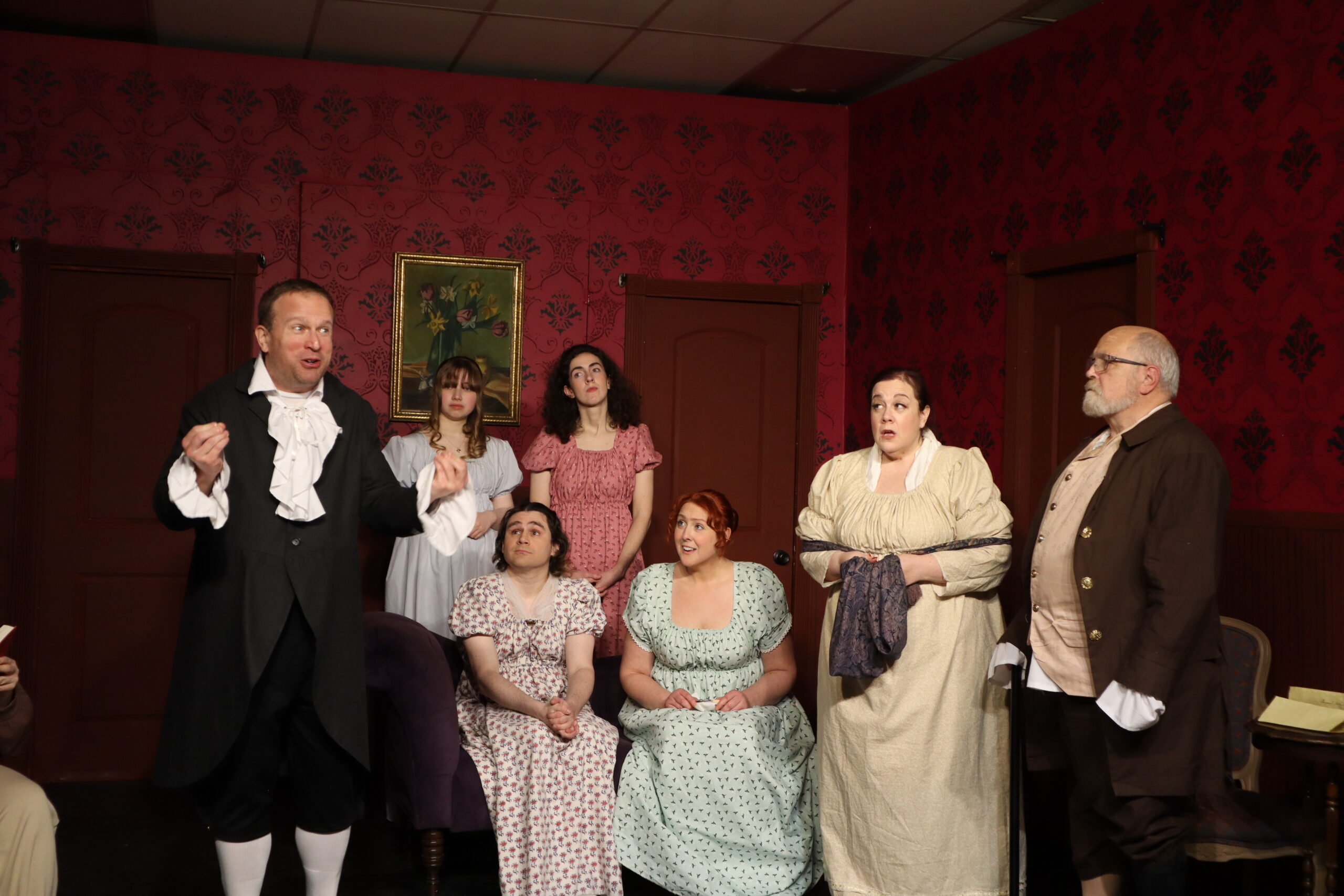
Emma Let You Finish, but the Bennets are the Best Jane Austen Characters of All Time: A Review of Pride and Prejudice

By Joseph Szalinski

If British Literature is your cup of tea, then The Pittsburgh Savoyards have a treat for you at the Margaret Partee Performing Arts Center in Bellevue. For the fourth production in their 86th season, they’ve decided to bring a classic romance to the stage with their adaptation of Jane Austen’s Pride and Prejudice, adapted and directed by Marsha Mayhak.

The OG Bridget Jones’s Diary follows Mrs. Bennet’s (Apryl Peroney) quest to become an empty nester by marrying off her daughters to well-to-do gentlemen. While Jane (Mary-Cait Cox) and Charles Bingley (Calvin Brookins) hit it off splendidly, Elizabeth (Rebecca Radeshak) and Mr. Darcy (Alex Policicchio) experience a bit of turbulence at first before becoming smitten and then engaged.

Staging a story that’s famous in various mediums, particularly film and television, can be a bit tricky. With a novel, the interior lives of characters can be probed; there’s license to explore and plod. Similarly, miniseries can take the time to touch on a multitude of plot points and ideas. Theatre can’t afford those luxuries. Even with source material provided, the act of condensing the text and converting it into a script can be as challenging as writing a play from scratch. While the runtime could be shorter for pacing’s sake, Mayhak addresses all of the crucial moments in the narrative, occasionally being bogged down by excessively wordy dialogue.

The cast of “Pride & Prejudice.”

Tasked with delivering these academic rhapsodies, with English accents, is a talented cast whose members swap in and out depending on the date of the performance. Despite the reluctant romance between Lizzie and Darcy being the focus of the show, the chemistry between Jane and Lizzie in the scenes they share together is the most palpable. In addition to the more emotional elements, there is also a great deal of comedy in the form(s) of Mr. Bingley, William Collins, and Mrs. Bennet, who all elicit chuckles verbally and physically. The dance is perhaps the scene that stands out the most. Not only is it well choreographed and executed, but the physicality is a great mirror of the battle of wits occurring concurrently.

Aside from performances, this production delights from a technical standpoint as well. The set is expertly designed, taking advantage of the space provided, with a few instances where the performers get particularly close to the audience, making the whole thing seem a bit immersive. Costumes are amazing. They evoke the sense and sensibility of those who don them, existing as set pieces and characters themselves.

Bellevue is another spot close to the city that’s experiencing a revival in art and cuisine. Its residents, and interested thespians, are incredibly fortunate to have a seasoned theatre company and a dependable venue in town, especially one that so heartily encourages all members of the community to get involved in helping to create something meaningful.

-JS

Pride and Prejudice continues its run at the Margaret Performing Arts Center in Bellevue, PA February 16th, 17th, 23rd, and 24th at 7:30 PM and a matinee performance at 2:30 PM on Sunday, February 18th. For more information, click here


A Story by the Storyteller—a Review of “Dragon Lady”

By Claire DeMarco

Sara Porkalob invites you into her world to see, hear, and feel her stories about the maternal side of her family in “Dragon Lady.” Her maternal grandmother, Maria the “Dragon Lady” is the center of this adventure into her past.

As Maria’s 60th birthday approaches, she feels the need to pass on details of her life and her confidant is Sara Porkalob. As her story unwinds, its apparent that she has quite a few secrets to unveil, from a brief career as a singer in a tawdry club to a pregnancy (the child is Sara’s mother, also named Maria), a kidnapping and a murder. But through all the drama associated with her life, Maria is a fighter and a survivor (with a sense of humor).

Maria’s life changes again as this young Filipina woman immigrates to the Pacific Northwest. Her oldest child (Porkalob’s mother) is to care for her siblings. Now, without a husband, Maria works several jobs, often leaving her young daughter in charge of not only the running of the household but also caring for her siblings. The ramifications of this situation are that young Maria often isn’t able to attend school. This situation causes the resentment and rift that exists between the young and old Maria. That tension is highlighted at Grandmother Maria’s 60th birthday party.

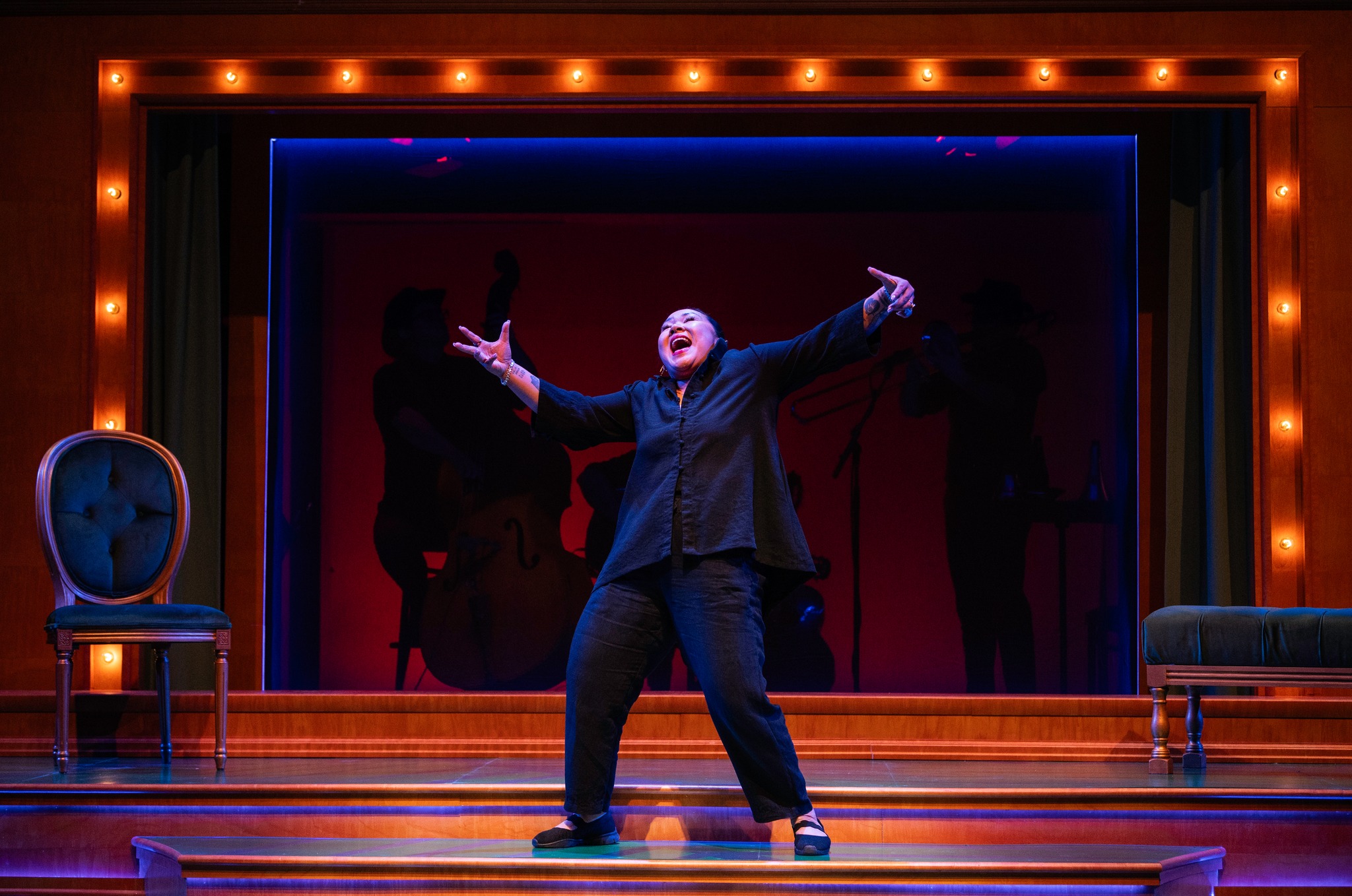
Sara Porkalob goes full throttle on stage at the O’Reilly Theater.

Porkalob’s performance is brilliant, stunning, and creative! This is not just a solo performance, but many as Porkalob plays the parts of those relatives and acquaintances who are part of her narrative.

Her timing is impeccable as she smoothly reinvents herself as her grandmother, mother, her mother’s young brothers, and any character that’s part of her story. Reinventing also includes not only the vocal pitch of those she’s portraying, but their unique mannerisms as well. Great comedic timing, excellent facial expressions, and a beautiful voice elevate those roles.

There are not enough superlatives to describe this unique, stimulating, and wonderful performance by Sara Porkalob.

Porkalob created the Dragon Cycle, a trilogy of works about her grandmother (“Dragon Lady”), her mother (“Dragon Mama”), and Porkalob herself (“Dragon Baby”–still in development).

The set is striking with a modicum of stage props. The center stage is highlighted and framed as an intricate lounge setting for musical numbers. Different stage levels allow Porkalob to move up and down, often showing a different location and/or time as her story unwinds.

Excellent music by Hot Damn Scandal: Pete Irving, Jimmy Austin and Mickey Stylin.

Kudos to Scenic Designer Sasha Jin Schwartz.

Expert direction by Andrew Russell.

-CED

“Dragon Lady” is a production of the Pittsburgh Public Theater. Performances run from February 7 through February 25. For more information, click here.

css.php