

No Bees in This Beehive – A review of “Hairspray”

By Claire DeMarco, ‘Burgh Vivant

Pretty, perky, pleasantly plump. Tracy Turnblad (Caroline Connell) is a teenager in 1962 Baltimore. Her hair reflects the times – with so much applied hairspray that even a 50 mile-an-hour wind does not move it. She loves to dance and rushes home from high school every day to watch the dancers on the local “Corny Collins Show,” the show within the show in “Hairspray.”

When she discovers that one of the permanent dancers on the show is leaving, Tracy decides to audition for a part. Her mother Edna Turnblad (Jason Newsom) is an extremely large woman – housebound due to her weight. She won’t allow Tracy to audition because she fears that her daughter will be maligned because she is heavy, too.

Not as diligent in school as she is at dancing, Tracy often finds herself in detention. She meets Seaweed Stubbs (Camara Rhodes) and a group of teens who show her different dance moves. Tracy’s father Wilbur Turnblad (Matthew J. Rush) encourages her to try out for the show. She encounters some push back from the show’s producer, Velma Von Tussle (Ashley Harmon) who is appalled that someone who is heavy would have the audacity to audition. Her daughter Amber Von Tussle (Felice Rose), blonde, thin and talentless is a reflection of her mother.

Tracy does audition, secures a position as the newest member of the show and becomes a local celebrity.

Note: The new friends that helped Tracy survive auditions and move into the spotlight are African Americans and in 1962 they weren’t permitted to become a daily part of “The Corny Collins Show.” They were only allowed to appear on the show once a month.

Tracy decides that that should change.

Underlying the fun and comedy in this musical are two inequities that still exist today but hopefully they’ve become less prevalent: body shaming and segregation. Connell owns the stage from the play’s opening with “Good Morning Baltimore” until the final curtain, singing, dancing and prancing brilliantly throughout.

Link (Matthew Keefer), Tracy (Caroline Connell), Penny (Chelsea Bartel) and Seaweed (Camara Rhodes) pose for a photo. Photo by Niki Crisson.

Newsom is a large man which makes his role even more hilarious as Edna. Light on his feet, he delivers snide remarks and side glances that would make Bea Arthur proud!

Great singing and dancing by Rhodes in “Run and Tell That.”

Johnson shines in her beautiful and moving rendition of “I Know Where I’ve Been.”

Consistently in character as the pompous producer, Harmon lets it rip in her rendition of “Velma’s Revenge.”

The entire cast of this delightful show was wonderful. Not one weak link in the chain.

Kudos to Music Director Meagan Bruno and the musical ensemble. The show was well directed by Art DeConciliis.

-Ced

“Hairspray” is a production of Stage 62 and is presented at Andrew Carnegie Free Library & Concert Hall, 300 Beechwood Avenue, Carnegie, PA and runs from November 14 – 24, 2019. For more information, click here.


 

A Change is Gonna Come – a review of “One Night in Miami”

Mike Buzzelli

By Michael “Buzz” Buzzelli, ‘Burgh Vivant

On an auspicious night in Miami, the new World Heavyweight Champion, Cassius Clay (Thomas Walter Booker), celebrates his success with his friends; football player Jim Brown (Quincy Chad), spiritual leader and social activist Malcolm X (Avery Glymph) and singer/songwriter Sam Cooke (Dwayne Washington) in “One Night in Miami” by Kemp Powers.

The next morning, Clay joins the Nation of Islam and becomes Muhammad Ali, just as Malcolm X was severing ties with the religious order.

While the four iconic figures did gather in the Hampton House Motel in February 25, 1964, no one really knows what went on that night. Powers provides his own perspective to the story.

Cooke and Brown are hoping the celebration would be more festive (with women), but only the four men are invited into the motel room, while two bodyguards Kareem (Lamar K. Cheston) and Jamaal (Brenden Peifer) stand outside surveilling the motel grounds.

Instead of celebrating the men bicker. Cooke and X argue about philosophy. X believes that Cooke could be using his platform as a famous singer to speak up about injustices against African Americans.

“One Night in Miami” contains a lot of witty repartee, arguments about race relations and vanilla ice cream.

The poster represents items from each of the iconic figures in “One Night in Miami.” Boxing Gloves for Cassius Clay, a football for Jim Brown, eyeglasses for Malcolm X and sheet music and a record for Sam Cooke.

Washington is amazing as Cooke. At one point, he flashes back to a particular performance and serenades the audience with a mellifluous rendition of “You Send Me.” It’s a spectacular moment – a real show stopper.

Glymph looks and sounds like a young Malcolm X. It’s uncanny, but his performance is more than just cosplay. While he imbues X with righteous indignation, Glymph finds the man’s boyish charm. There are some great moments when X catches himself enjoying the company of his eclectic comrades and damps down his enthusiasm.

Chad is distractingly handsome, but gives a multifaceted performance.

There’s not much to Cassius Clay, but Booker manages to shine as the Champ.

Cheston and Peifer hand in fine performances as well.

Tony Ferrieri’s set is stunning. A classic 60s motel in Miami, awash in pink and sea foam green. The two flights give us the illusion that an entire motel has been plopped onto the City stage.

Dominque Fawn Hill’s costume are retro without being over-the-top. They are simple and subdued garments but perfect choices (keeping Brown in shades of brown might have been a little cheeky, though).

Director Reginald L. Douglas does a good job with the actors. They are some great moments, especially whenever Washington sings. The play is a little preachy and, aside from a few hilarious jokes and some engaging character work, there’s not much going on. Straight talk among friends.

The point it does make is worth hearing. It’s good to get out of your comfort zone and hear a fresh perspective and see theater that challenges you. It just takes a while to get there.

-MB

“One Night in Miami” runs until December 1st 2019 at the City Theatre, 1300 Bingham Street, Pittsburgh, PA 15203. For more information, click here.


Youth is full of sport – a review of “Much Ado About Nothing”

Tiffany Raymond, ‘Burgh Vivant

Steven Wilson’s new adaptation of William Shakespeare’s “Much Ado About Nothing” at the Pittsburgh Playhouse takes risks – and reaps the rewards. Wilson not only wrote the adaptation, but he directs the production. Wilson’s adaptation takes place in World War II-era Italy after the Italians have allied with the U.S. He unites the former enemies via America’s favorite pastime: baseball.

The baseball metaphor extends beyond the stage. Wilson proves a capable manager of this theatrical team. Wilson effectively wrangles a large ensemble that lets the leads shine while enabling memorable moments for the broader cast. When the newly engaged Claudio (Jordan Marie McMillan) and Hero (Bailey Wilson) dreamily dance in center stage, Benedick (Evans Malkin) and Beatrice (Morgan Snowden) stand downtrodden on opposing sides of the dance floor, unhappy bookends. Wilson thoughtfully utilizes the stage to magnify visual contrast between the two couples. McMillan and Wilson have a slightly stilted quality to their romantic relationship, suggesting a discomfort at the gender-blind casting that pairs two women as an opposite-gender couple. They’re stronger in their non-romantic scenes, and it’s still a nice flipping of the script on Shakespearean times when the stage was occupied by solely male actors. Malkin finds just the right swagger, and the red-headed Snowden is fiery, making the pair memorably shine as Benedick and Beatrice.

The play opens memorably. The actors silently and hypnotically move behind a screen with grainy black and white World War II imagery projected onto it. Video designer Antonio Colaruotolo includes silent movie era intertitles that flash up timelines and unspoken dialogue. An Art Deco border around the intertitles adds a lighter touch. It’s a harbinger of the metamorphosis from the darkness of war to the lightness of sports. Battle scene turns ball game.

But it’s still a jump from one male-dominated world to another. When Hero (Bailey Wilson) steps up to bat, she is immediately turned away. The intertitle dialogue reads “Girls can’t play baseball!” Hero sneaks back in in disguise and subsequently smashes the game-winning home run, belying the words “girls can’t.” In this opening scene, Hero establishes herself as worthy of her namesake. She’s an independently minded woman willing to bend rules that don’t make sense. It’s also the first of many disguises within the play that literalize the metaphorical masks people wear.

The cast assembles for a rousing game of baseball in “Much Ado About Nothing.”

However, Steven Wilson’s adaptation falters as his portrayal of Hero is erratic. When her father, Leonato (Cameron Bartelt) turns on her and immediately believes false accusations regarding her sexual impurity, Hero faints. She then complies with a plan conceived by another patriarchal unprogressive, the church’s friar (Pablo J. Uribasterra), to pretend to be dead. Wilson’s adaptation is liberal. He bends gender, updates language, and reorders scenes, which makes his persistent portrayals of patriarchy and its sway problematic, demonstrating the difficulty of defining perimeters within adaptation.

Wilson adds Hero’s mother, Imogen (Mary Shay McWeeney), to the production to create more female roles. Imogen is no tigress, and after a brief opposition, she acquiesces to the male-hatched death ruse. It’s a reminder that adding female headcount is not analogous to creating female voices.

Gianni Downs’ scenic design is simple beauty. The set is highly modular, comprised of seven two-story Italian Renaissance-style towers that can be easily reconfigured. The few times when all seven need to be connected gets slightly unwieldly and does slow down the play’s action. Downs leaves no detail behind as the steeply pitched rooftops even have traditional red Italian shingles. Downs’ stately cream-colored exteriors provide a backdrop for Colaruotolo’s stunning video projections that help differentiate the scenes. When the malicious Don John (Cyrus D. Miller) meets with his coconspirators, an intricate floral pattern irregularly blooms across the wall like blood from a gunshot wound, a visualization of his cunning.

-TR

The Conservatory Theatre Company’s production of “Much Ado About Nothing” plays through November 17th at the Pittsburgh Playhouse, 350 Forbes Avenue, Pittsburgh, PA 15222. For more information and to purchase tickets, click here.

An article of importance – a review of “Or,”

Mike Buzzelli

By Michael “Buzz” Buzzelli, ‘Burgh Vivant

Poet, playwright and spy Aphra Behn (Georgia Mendes) welcomes King Charles II (Dylan T. Jackson) into her life and into her bed in “Or,” a play about England’s first female playwright by Liz Duffy Adams.

Once the king resumes his throne, after the death of Cromwell, he frees Aphra from Debtor’s prison. She becomes the king’s paramour, but also earns the affection of the foul-mouthed sex symbol, actress Nell Gwynne (Katie Sacks).

The playwright is astonished when Lady Mary Davenant (Sacks, again) comes to her home and offers her a chance to mount her play (Davenant was the first British woman to manage a theater company). Just then, her former lover and fellow spy William Scot (Jackson, again) comes to town with information about a plot to kill the king (the one in her bedroom), and all hell breaks loose.

While all the people in the story are real, there’s no evidence that anything in the play really happened, but it’s a wild romp.

Aphra Behn (Georgia Mendes) stands in the doorway as she prepares her play for the Duke’s Company in “Or,”

Mendes delivers long passages of dialogue with pluck and verve. She is a captivating lead. It’s a darn good thing, because her character, Aphra, is on stage nearly the entire show.

Half the fun of “Or,” is watching the actors switch to one character to another. Sacks is hilarious delightfully nattering away as Lady Davenant. Minutes later, she transforms herself into the gruff, flatulent maid, Maria. Her Nell is also sexy and provocative.

Jackson, too, zips around behind the scenes, exiting as one character and entering as another, in a completely different wardrobe. It’s an impressive feat with an excellent cast.

Kim Wield does a fantastic job directing all the madness. While it sounds like an Elizabethan comedy, it looks like a French farce, with characters hiding in bedrooms and wardrobes. All of the actors have to be on top of their game to pull off the comings and goings as well as recite poetry as if it were day-to-day speech.

Excellent scenic design by Dana Weintraub turns the stage into a well-appointed lover’s nest in the 17th century, with lovely cursive musings scrawled on the walls.

The costumes are stunning. Claire Mildred does a particularly splendid job adorning Jackson’s King Charles in royal vestments. She swaths him in layers of red and pink and caps it off with enormous red footwear tied up in pink bows.

In between the comedy, Adams makes some salient points about love, sex and gender identity. They sort of sneak up on you. There’s also a tremendous optimism in “Or,” and you will bounce out of the theater feeling renewed. Let’s hope for a thousand years of peace.

– MB

“Or,” runs until November 23 at the Purnell Center for the Arts, Carnegie Mellon University,
5000 Forbes Avenue, Pittsburgh, PA 15213. For more information, click here.

We’ll Have Nun of That – A review of “Over the Tavern”

By Claire DeMarco, ‘Burgh Vivant

In the 1950’s in upper state New York the Pazinski’s, a Polish Catholic family, live above Chet’s Bar and Grill, the eponymous establishment run by Chet Pazinski (Steven F. Gallagher).

Chet and his wife Ellen (Megan May) have four teenage children, Rudy (Dylan Lawton), Georgie (Ben Meyer), Annie (Delilah Hartlage) and Eddie (Aidan Cheek).

As a Roman Catholic approaching confirmation, Rudy challenges Sister Clarissa (Lynne Franks) as he decides to “shop around” for another religion. Vocalizing his frustration, Rudy decides that “God put us on Earth to have fun” and Catholicism doesn’t quite cut it anymore. He’s so adamant about seeking a new religion that he cuts off the ears of a Mickey Mouse hat, creating a Yarmulke. Rudy now declares that he is Jewish.

Constantly exasperated and frustrated, Sister Clarissa is determined that Rudy will make his confirmation. She uses her walking cane to get Rudy’s attention but is most successful by using a clicker against his ear when he doesn’t listen.

Ellen runs the household, takes care of her children, all of whom have their own issues and problems. Teenager Eddie thinks he is street wise while Annie is insecure and sensitive. Georgie is mentally challenged with unique issues. And Rudy is Rudy. Ellen oversees all her children while at the same time attempts to keep Chet as content as possible. Chet is remote, usually angry at his children and generally miserable.

Note: The Pazinski household is not like the sitcom households of the 50’s where everyone is happy most of the time and any problems that do arise are quickly and satisfactorily resolved.

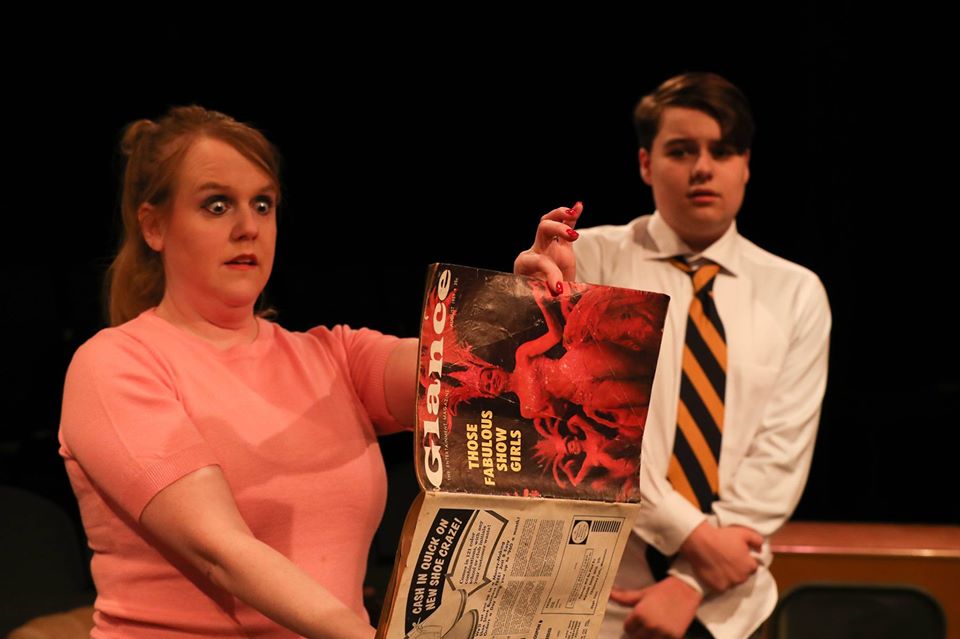
Ellen (Megan May) finds a magazine Rudy (Dylan Lawton) has been hiding in “Over the Tavern.”

Undercurrents of unfulfilled dreams and frustrations flow through this story.

Franks shines as the nun, stern when necessary, patient when the situation arises and always in control. She is adept at delivering some of the best comedic lines in the play.

Lawton is delightful as the ever-curious, questioning Rudy who never stops asking why. He is able to portray a range of emotions, especially in his conversations with Jesus which are at times pleading, angry but never subtle.

Gallagher transitions easily between an irate, angry husband and father to an occasionally softer soul. Much emotion is expressed through facial expressions and general movement.

May is sympathetic, feisty, funny, argumentative as she deals with a challenging husband and four unique kids. She has perfect comedic timing.

Hartlage is believable as she battles with no confidence, is nervous about everything with her hormones on parade.

Cheek develops his character from a young teenager worried about incurring his father’s anger to finally standing up to him.

Meyer has little dialogue as the mentally-challenged younger sibling but he brilliantly expresses himself through his controlled facial expressions and movements.

The area of the stage dedicated to the Pazinski household is realistically staged with items specific to the 1950’s.

Director Lora Oxenreiter sums up “Over the Tavern” as “a comedy drama with a ray of hope”.

-Ced

“Over the Tavern” is a production of Little Lake Theatre Company, 500 Lakeside Drive South, Canonsburg, PA 15317 and runs from November 7 – November 23, 2019. For more information, click here.

Dark Lady – a review of “The Woman in Black”

Mike Buzzelli

By Michael “Buzz” Buzzelli, ‘Burgh Vivant

Mr. Arthur Kipps (Martin Giles) hires an Actor (James FitzGerald) to help him tell a frightening story from his past in Stephen Mallatratt’s adaptation of Susan Hill’s Gothic horror novel, “The Woman in Black.”

In the prior year, Kipps sequesters himself from his family on Christmas Eve because they are telling ghost stories around the hearth. Ashamed that he could not tell his tale, he hires the Actor to help him recount the story turning “The Woman in Black” into a play-within-a-play.

After a few stalled attempts, the Actor takes over. He becomes Kipps, and Kipps becomes all of the side characters in the story as they reenact it.

Kipps, a London solicitor, is called to collect documents and other important papers from the dilapidated home of a recently-deceased, long-widowed Alice Drablow in a remote village of Crythin Gifford. Kipps makes the journey to discover he is a pariah among the townsfolk. They whisper in secret behind his back. The villagers fear the remote home that, at high tide, is cut off from the mainland.

Once inside the Drablow home, mysteries are afoot, strange noises, flickering lights and the wandering spirit of the woman in black.

The strange and seductive poster of “The Woman in Black.”

Giles does a marvelous job going from the meek Arthur Kipps to playing a variety of side characters. He’s particularly riveting as the gruff pony and trap driver.

FitzGerald transitions from the grand and pretentious actor to a younger version of Kipps – one who pretends to be strong and unafraid (until the tale becomes tragic).

Domenico LaGamba does a masterful job with an important set piece in the final act – a room that reveals all of the house’s mysterious secrets. Lighting Designer Keith A. Truax adds some additional eerie lighting with some chilling sounds by Sound Engineer Nick DePinto.

There are some unnerving special effects, but most of the fun comes from the actors, superbly directed by Alan Stanford.

There are some thrills and chills in the play, but it takes a while to get there. Mallatratt opens the play with a humorous gag, but it goes on a bit long. It’s sort of a metaphor of the rest of the show. If Mallatratt had an unscrupulous editor, “The Woman in Black” would be perfect. It scary without a gigantic body count, but the deaths have more meaning here. They matter, which makes it even more terrifying.

-MB

“The Woman in Black” runs until Saturday November 23 at the Fred Rogers Studio, WQED, 4802 Fifth Avenue, Pittsburgh, PA 15213. For more information, click here.


Love, Labor and Loss – a review of “Shakespeare’s Will”


Mike Buzzelli

By Michael “Buzz” Buzzelli, ‘Burgh Vivant

On the night of his funeral, Anne Hathaway (Sheila McKenna) recounts her love, labors and her losses in Vern Thiessen’s “Shakespeare’s Will.” She tells the tale of meeting young William Shakespeare, her future husband, at the fair in Stratford-Upon-Avon, the town where the two grew up. She details their courtship and unusual marriage.

Thiessen admits to playing ‘fast and loose” with the material, since many of the details of Will Shakespeare and Anne Hathaway’s life are obscured from history. The playwright even chooses a definitive ending for a Hamnet, their son who died at a young age (even though there is no death record for the child).

Though Thiessen’s play is mostly speculation, it is a compelling story, despite being a tiny bit longer than it needs to be. To say too much would be to spoil the surprises.

Stephanie Mayer-Staley’s set design inside the West Homestead United Methodist Church.

McKenna does a spectacular job as Hathaway. She is a commanding presence. While it is a one-woman show, she interacts with two characters in non-speaking roles, Hamnet (Simon Nigam) and violinist Dawn Posey.

Nigam is very emotive, even though his character never speaks. He’s an odd addition for the writer to throw him in, but Nigam does it so splendidly, he’s a welcome addition.

Posey plays beautifully. The violinist even composed some of the music, “On a bed of rushes,” and “It scritches and scratches.”

There is some weird choreography. McKenna moves about waving her arms as if she was Endora performing a complicated time travel spell in the seventh season of “Bewitched.”

One person shows are notoriously difficult. It’s hard to keep the momentum going when the singular star has to provide all of the material, but director Melanie Dreyer keeps things moving fairly well.

Stephanie Mayer-Staley’s scenic design is a beautiful swirling vortex of paper, the Bard’s manuscripts twisted and crumpled, flying into a bright, aqua void. McKenna splashes about in a shallow puddle, representing a tidal pool on the shore.

There are beautiful and lyrical moments in “Shakespeare’s Will.” It has a fine ending. It may not be the truth, or the truth as we know it, but there is still beauty in it.

-MB

“Shakespeare’s Will” runs through December 1 at the West Homestead United Methodist Church, 515 W. 8th Avenue, Homestead, PA 15120. For more information, click here.

http://www.quantumtheatre.com/will/


Remember Me – A Review of “Good Grief”

by Claire DeMarco, ‘Burgh Vivant

N (Elise Dorsey) lost her young, best friend MJ (Ivan Bracy Jr.) in a car accident. They grew up together, sharing dreams, confidences and aspirations. Devastated by his loss, she withdraws from med school and puts her life on hold.

N’s parents Papa (Pierre Mballa) and Nene (Mia Sterbini) emigrated from Nigeria and settled in Bucks County where N and her brother Bro (Tim Judah) were born and raised. The family is instrumental in their support of N as she deals with MJ’s death.

Old school friend JD (Alex Fetzko) offers support. MJ’s mom (Malle Winters) and N attempt mutual consolation.

But N’s way of dealing with this tragedy is by splicing pieces of her memories with MJ to fit what she needs in order to cope. Thoughts, flashbacks, remembrances are arranged in her mind non-sequentially as she envisions moments with MJ – their first meeting, his teaching her how to kiss. The kiss lesson centers on N’s interest in JD, a student she likes. Kiss training leads to what might have led to a personal relationship between N and MJ. At times her file of memories pulls folders from her past that have nothing to do with MJ’s death but bring her some solace (reliving when Papa taught her to drive).

As N struggles with her loss, she remembers something MJ told her a long time ago. “You won’t let me disappear.”

The cast of “Good Grief.”

Dorsey is powerful as she tries to deal with her friend’s death. Sometimes using humor and often enlisting anger, we relate to her turmoil.

Bracy delights as we see him develop from a young, self-conscience youth to a man full of hope. He shows unique comedic skills but also a serious side in his evolving friendship with Dorsey.

Fetzko’s bed scene with Dorsey is hilarious. He has great movements and spot on timing.

Judah transitions from the brother who lovingly spars with his sister to a common sense sibling intent on providing guidance.

Mballa is serious and wise. He’s also adroit at injecting low key humor, all with a western African dialect.

Sterbini is the perfect mom. She is willing to console at any time but gives her daughter space to mourn alone.

In a brief encounter Winters transitions from a crazed, grieving mother to a gentle woman to being mad at God.

Credit to Fight Director Shannon Donovan for the choreographed fight scenes that are physical but well-controlled.

Another Note: In this black box theater, it is sometimes difficult to hear the dialogue when the actors’ backs are to the audience.

“Good Grief” was written by Ngozi Anyanwu and directed by Reginald L. Douglas.

“Good Grief” is a production of Point Park University’s Pittsburgh Playhouse, Rauh Theatre, 201 Wood Street, Pittsburgh, PA 15222 and runs from October 18 to October 27, 2019.

For more information, click here.

Ced


Hail to thee, Blithe Spirit – a review of “Blithe Spirit”

Mike Buzzelli

By Michael “Buzz” Buzzelli, ‘Burgh Vivant

The Condomines are hosting an unusual dinner party. Charles (Eric Leslie) and Ruth (Stacey Rosleck) have invited the Dr. & Mrs. Bradman (Rick Bryant and Aleta Richmond) and the eccentric Madame Arcati (Ina Block) to hold a séance in Noël Coward’s “Blithe Spirit.”

Charles, a skeptic, is researching mediums for a new book he’s writing. He doesn’t believe in the supernatural, nor does his colleague Dr. Bradman. The moment their nervous nelly maid, Edith (Sydney Turnwald) opens the door and invites in their guests, all hell – literally and figuratively – breaks loose.

And Charles’s opinion on the existence of supernatural forces changes when the ghost of his dead wife, Elvira (Rebecca MacTaggart) shows up. Only Charles can see and hear Elvira which makes for a few awkward conversations. Mr. Condomine yells at either former or present Mrs. Condomine, both ask, “Which one are you talking to?”

It’s confusing for the haunted couple, but it’s hilarious for the audience.

Things take a misfortunate turn when Elvira decides his late wife should join him in the afterlife. But the best laid plans of specters and ghosts, of go awry.

Madame Arcati summons the spirits in “Blithe Spirit” Photo credit Carina Iannarelli

“Blithe Spirit” is delightfully directed by Rachel Pfennigwerth.

MacTaggart wonderfully brings the ghost alive as Elvira. She glides around the scenery in an ethereal way- aided by her flowing white dress constructed by Jessica Kavanagh.

Leslie is a terrific Charles. At first, the model English writer, witty and intelligent, prim and proper – until his ectoplasmic wife shows up – then, he’s reduced to a bewildered and blathering simpleton. Watching the supercilious Charles get his comeuppance is half the fun.

Block’s Arcati is a charming loon. She speaks in her own parapsychological language, which also confounds the Condomine’s and befuddles Bradman’s. It would be easy to tire of Arcati’s eccentricities, but Block does it with such style and grace you crave more of her craziness – as much as she craves cucumber sandwiches!

“Blithe Spirit” is a fantastic part for the leading lady, Elvira, but it’s also a fantastic part for her counterpart, Ruth. One can be considered the villainess and one the heroine – until it’s difficult to tell which one is which. Rosleck manages to parry and thrust witty bon mots with Leslie’s Charles and scathing jibes at MacTaggart’s Elvira. Rosleck does it with aplomb.

Turnwald does a great job as the scattered and ditzy maid.

Coward’s comedy is long, but its packed with witty repartee and rambunctious laughs. It’s a lengthy but thoroughly enjoyable evening.

-MB

“Blithe Spirit” runs till November 2 at Little Lake Theater, 500 Lakeside Drive South (across from the Mad Mex), Canonsburg, PA 153017. For more information, click here.



Don’t Rub Me the Wrong Way – a review of Disney’s “Aladdin Jr”

By Claire DeMarco, ‘Burgh Vivant

In the town of Agrabah, Aladdin (Joseph Stater) and his group of pals Babkak (Ben Heavner), Omar (Max Peluso), and Kassim (Joshua Price) verge on the edge of “badness.” Aladdin steals loaf of bread at the local market. Even though he’s hungry and has no money, he gives the loaf of bread to someone really in need. Aladdin and his friends attempt to make money in a more honorable way by singing and dancing. They are not successful.

Nearby at the palace – but miles away socially, Jasmine (Miralhi Taylor-Martin) the daughter of the Sultaness* (Emily Chambers) is frustrated. Her mother wants to select her daughter’s future spouse.

*Note: The leader of Agrabah in this production is a female! Nice touch!

Jafar (Jordan Coury), the Sultaness’ evil advisor wants to marry Jasmine. Then, he would become the next Sultan. Along with his loyal assistant Iago (Joshua Clark), they conspire to make that happen.

Jasmine is frustrated by her mother’s demands to choose a husband in 24 hours. If she doesn’t her mother will do it for her. Encouraged by her attendants to see how the other half lives, Jasmine disguises herself in everyday clothing and wonders into the market place. She in entranced with a life she’s never experienced.

The marketplace brings two worlds together – Aladdin and Jasmine meet.

Aladdin’s adventures continue as he finds himself in a cave. He unknowingly frees Genie (Adam Stater) from a small, not very impressive lamp after gently rubbing it. Genie indicates that Aladdin has three wishes but there are three wishes that he can’t fulfill: he can’t kill anyone; he can’t bring anyone back from the dead and he can’t help in finding love.

But Aladdin is looking for love, or, at least, looking for Jasmine.

Aladdin and his Genie (brothers Joseph and Adam Stater) pose before the show.

Joseph Stater is delightful as Aladdin as he grows from a penniless, unstructured individual to one more disciplined and morally mature.

Taylor-Martin plays Jasmine as both an insulated captive in an unreal world and a sensitive human as she experiences the real world.

Joseph Stater and Taylor-Martin’s beautiful rendition of “A Whole New World” was magical, along with the simplistic setting that suggests their airborne adventure.

Adam Stater has great comedy timing moves, sings well and does a great tap dance.

Coury as the bad guy is especially realistic as he throws his head back and bellows out a blood curdling laugh.

A well-done production by a multi-talented cast of young thespians.

“This production was put together in four weeks” according to Music Director, Lynne Spatafore. She also relayed that the actors are all in school (from many school districts in the area). The youngest students are in 5th grade and the oldest are seniors.

CeD

Aladdin Jr” is a production of Comtra Theatre, 20540 Route 19, Cranberry Township, PA. 16066 and runs from October 4 to October 19, 2019.For more information, click here.

 

css.php