

Our House – a review of “Next to Normal”

Tiffany Raymond, ‘Burgh Vivant

When you think of musicals, one tends to think of lighter fare. There’s nothing light about the musical “Next to Normal” (book and lyrics by Brian Yorkey). This modern-day “One Flew Over the Cuckoo’s Nest” unflinchingly delves into the world of mental illness. The most compelling thing about this musical is its refusal to over-simplify. The show doesn’t shy away from intricacy, demonstrating how mental illness is bigger than the individual. It’s also a harsh reminder that solving for mental illness isn’t just swallowing a pill. That’s easy to forget when drug company commercials portray and cure depression in the span of 30 seconds.

“Next to Normal” centers on Diana Goodman (Meg Pryor), a wife and mother who’s battled mental illness for nearly two decades. Her family has both borne witness to and been collateral damage in her struggles. The play makes you feel the weight of their constant renegotiation. In the opening song, “Just Another Day,” her husband, Dan (Ricardo Vila-Roger) sings about how he has to “hold the house together.” He seems clueless that his wife has just humored him with sex, so there’s an almost laughable quality to this utterance. In that moment, he’s easily dismissible as a dude with an overinflated perception of his centrality in the household mechanics. In fact, it’s foreshadowing how the caretaker shoulders the household burdens. Vila-Roger appropriately exudes both fatigue and hope as well as an always-on vigilance that comes with constantly gauging a mentally ill partner. Director Niffer Clarke has Vila-Roger poignantly straddle the desire to protect his wife while also helping her get the care she needs without always knowing the right path.

Treatment often seems like a spinning roulette wheel. The treatment cycle ironically mirrors Diana’s own bipolar manic-depressive episodes. There’s a renewed hope with each new treatment plan that cascades into despair as it fails. This is most tellingly captured in “Who’s Crazy”/”My Psychopharmacologist and I” as Dr. Fine (Pedar Garred) sings about various pill combinations and their attending requirements and restrictions. The ensemble chimes in with “just a few of my favorite pills,” a takeoff on the song “My Favorite Things” from “The Sound of Music.” One musical borrows from another.

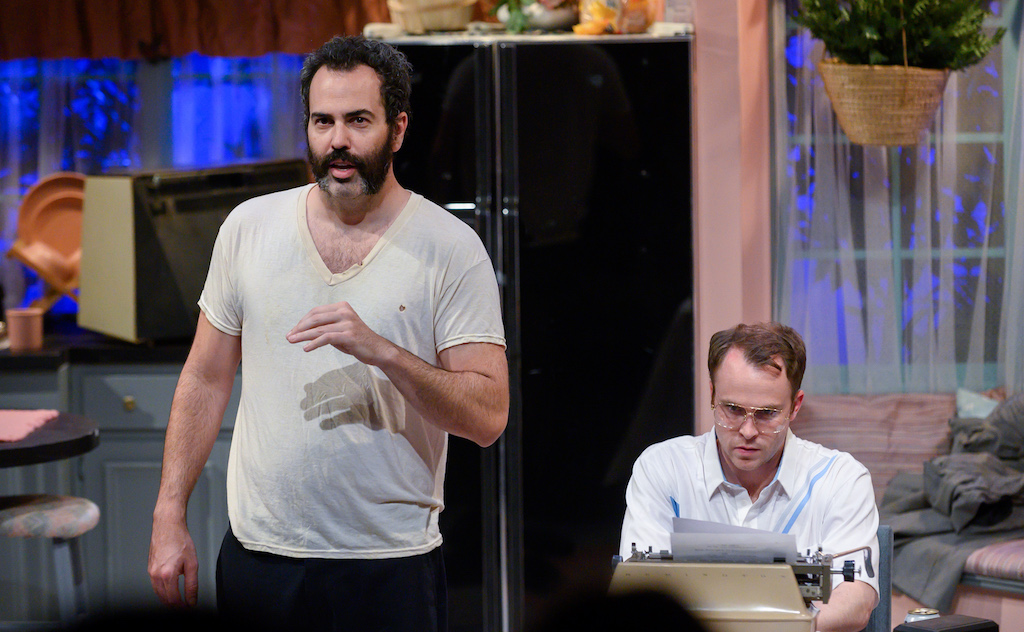
Dan (Ricardo Vila-Roger) tries to “hold the house together” as the patriach in “Next to Normal.”

Garred lacks the vocal punch of the other actors and is often drowned out by the music. This is particularly noticeable with he’s paired with Pryor who is a vocal powerhouse, but sometimes sings too loudly, even when she’s not manic. Her near-shouting at times can cause her words to lose emotional resonance. Achieving consistency around vocal projection levels ends up being a miss from Clarke. Clarke does do a stellar job of utilizing the stage. During this number, Dr. Fine’s pill catalog becomes dizzyingly overwhelming, as intended. Clarke visually reinforces that by having Pryor spin in circles across the stage on a wheeled stool.

The Goodman’s children, Natalie (Isabel Descutner) and Gabe (John A. Habib), are both adequate in their roles without being noteworthy. Descutner doesn’t feel totally authentic as Natalie, but her concerns about her mother’s behavior negatively influencing her burgeoning high school romance are genuine. It’s a reminder we’re all products of nature and nurture. Mental illness lacks contained boundaries and spills out, staining those beyond it in ways we can’t easily see.

Laura Valenti’s scenic design paired with TJ Hays’ lighting design creates a memorably remarkable stage. The set is clearly a house. However, Valenti thoughtfully chooses a color palette of sterile white and unfeeling gray that Hays outlines with harsh fluorescents to heighten the institutional feel. The uncompromising lighting makes the specter of mental illness visual and omnipresent. The house is a home, but the institutional lighting beautifully highlights the ways in which mental illness is not confined to a hospital or doctor’s office.

“Next to Normal” is an emotional journey and sometimes hard to watch as it brings light to those who suffer from mental illness. The production’s program includes a list of national and local resources for mental health, connecting the artistic to the real world. “Next to Normal” is a heart wrenching reminder that people are fighting all kinds of battles we can’t always see. It inspires empathy for our fellow humans. We can all be kinder.

The University of Pittsburgh’s production of “Next to Normal” plays through October 13th at the Richard E. Rauh Studio Theatre, 4200 Fifth Avenue, Pittsburgh, PA 15260. For more information and to purchase tickets, click here.


Fleeced – a review of “Not Medea”

Mike Buzzelli

By Michael “Buzz” Buzzelli, ‘Burgh

In 431 B.C., Euripides shocked theater-goers in Athens with a sympathetic portrayal of one of Greece’s great mythological characters, Medea, a woman who decides to enact vengeance after her husband spurns her for another woman. But playwright Allison Gregory revisits this story in a unique and unusual way in “Not Medea.” Though, Gregory’s story also shocks its audience.

The story is hard to explain without giving away huge swaths of the plot, but a Woman (Drew Leigh), who is definitely not Medea, enters the theater and settles into her seat, excited to see the play,  until she realizes what she’s about to see.

Hail the conquering hero!

Jason (Allan Snyder), returns to his hometown of Corinth with his “barbarian” wife after capturing the Golden Fleece. We get the “Behind the Music” version of the Homeric tale, and it isn’t pretty. The leader of the Argonauts isn’t the courageous captain of those Ray Harryhausen movies (in Dynamation).

Medea tells her tale. While the Woman in the audience intrudes with her own tragic tale. The Greek Chorus (Elizabeth Boyke) wails and shrieks. Is she merely the chorus? Does she know she’s in a play? It gets weird, if fun and fantastic ways.

When the Woman starts texting her ex (also named Jason), the texts get metatextual, and the events of 431 B.C. and events in the present get very, very blurry.

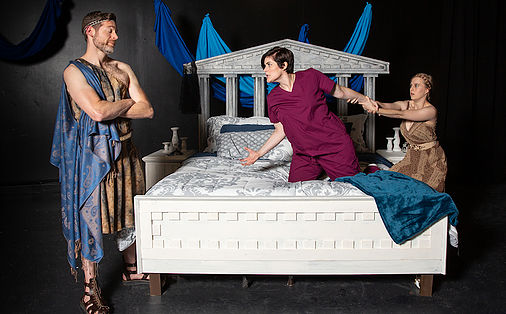
(from left to right) Jason (Allan Snyder) stands over an angry Woman (Drew Leigh) as the Chorus (Elizabeth Boyke) tries to stop her from attacking the Homeric hero.

“Not Medea” is a theatrical Mr. Toad’s Wild Ride, it starts riotously funny and ends in Hell thanks to Gregory’s meta manuscript.

Side Note: Seriously, the Disney ride starts as a whimsical drive through a magical land and ends up in frightening hellish landscape. It’s pretty twisted.

The actors excel under Allison Weakland’s direction. Apparently, it takes two talented Allison’s put on a terrific play.

Leigh is marvelous in her (still a secret) role. She commands the stage. She is bright and beautiful, harried and horrifying. Sliding up and down a scale of varying emotions.

Snyder’s character is comical and cartoonish, but some additional layers are peeled back by the end. He does a great job.

Boyke takes on several roles as the Chorus, and she does it with aplomb.

All the action is carried out on a beautiful set by Adrienne Fischer who produces spectacular scenes on shoestring budgets.

Sapphire and cerulean scarves drape over the set, creating the warm blue feeling of the Grecian isles. A king-sized bed, layered with pillows, encompasses the stage. It’s the focal point for a reason. Off to the side, a bird tweets in a gilded cage. It’s later accidentally strangled by the hero because he doesn’t know his own power (METAPHOR).

Kim Brown recreates Athenian fashion with Allan and Elizabeth’s costumes. The Woman’s costume is a maroon unisex pullover scrub top and matching drawstring pants.

-MB

“Not Medea” runs until October 18th at the Carnegie Stage, 25 West Main Street, Carnegie, PA 15106. For more information, click here.


Inked in Blood – a review of “Evil Dead: The Musical”

by Tiffany Raymond, ‘Burgh Vivant 

Pittsburgh Musical Theater brings “Evil Dead: The Musical” to life – or is that to death?

Evil Dead: The Musical” (book and lyrics by George Reinblatt) was first performed in 2003. It’s an amalgamation of the four-film series written and directed by Sam Raimi, which spanned 1978 to 1992. Not everything holds up in the modern era. There’s a reference to the Columbia Records CD club, which is either a flashback or headscratcher moment, depending on one’s age. The more troublingly dated material is Scott’s (Adam Fladd) repeated shouting at his date: “What a stupid bitch!” While it’s supposed to be humorous, the audience’s laughter falters here. This sort of demeaning sexism and verbal abuse is no longer raucous in the #MeToo era, even within the context of a comedic horror musical.

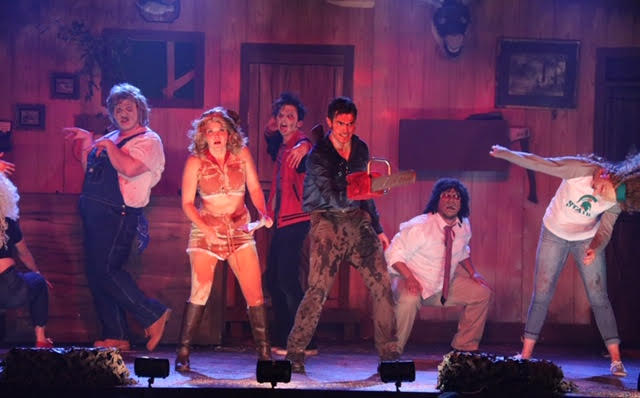
Scott’s date, Shelly (Mandie Russak), is a walking stereotype of a blonde bimbo. We learn Scott picked her up at a truck stop. Russak embraces the limited confines of her role from the onset as she deep throats a can. Director Nick Mitchell intensifies the moment by having her seek Scott’s approval with sultry upturned eyes. Costume designer Terra Skirtich amps the camp factor with Shelly’s red stripper heels, skintight jeans, and cropped buttondown that ties between her breasts. Russak lifts her top in a “Girls Gone Wild” homage as the show’s five college kids head to an abandoned cabin in the woods for spring break. What could go wrong? Plenty, of course. The vacationing quintet accidentally unleash demons they subsequently spend the show battling.

The cast has a bloody good time singing and dancing their way through the death and dismemberment. Photo credit: Melissa Wallace

The songs are full of one-liners and poke easy fun at the genre itself. Cabin late-comer Ed (Connor Bahr) gets to belt out “Bit-Part Demon” and sings that he’s “forgettable #39, the one killed by the hero.” It’s a reminder that everyone has their role in these shows. Even the taxidermy comes to life. A demonic, red-eyed Bullwinkle and Rocky bob their heads and sing, an unexpected twist. It’s the first time I’ve seen taxidermy with song credits.

Central character, Ash (B.A. Goodnack), and his girlfriend, Linda (Kait Descutner), sing a memorable ballad entitled “Housewares Employee.” It traces their love story, which commenced at S-Mart where she’s a checker, and he’s in housewares. Yet, as Ash sings, “I was the one checking you out.” Ash has a stack of one-liners, and Goodnack accentuates them without overdoing it.

As Pittsburgh Musical Theater, song and dance is their bread and butter. Not only are the acoustics poor, their sound system is in desperate need of an upgrade. The solo numbers work better, but the group numbers get a bit garbled. There is also some metallic grinding in the sound mix that doesn’t sound intended by sound designer Kevin Kocher. The vocalists, all capable, power through it, and the campy nature of the show is an asset. Stronger direction from choreographer Sarah Misko would have been useful. The actors’ movements during the songs often feel random and unguided.

The show is rife with laughable zingers, and the audience is forgivingly receptive to the kitsch factor. There’s an irresistible Rocky Horror-esque vibe to the whole production that sweeps you along, whether you want to be or not. At one point, a voice warns that the book of the dead is “inked in blood,” but that also applies to the seating. The front rows are a Sea World splash zone with fake blood spraying out over the audience. Get swept away, and wear a little bit of “Evil Dead” home!

Pittsburgh Musical Theater’s production of “Evil Dead: The Musical” plays through October 19th at the Gargano Theater, 327 S. Main Street, Pittsburgh, PA 15220. For more information and to purchase tickets, click here.
Semper Fi – a review of “A Few Good Men”

By Claire DeMarco, ‘Burgh Vivant

Lance CPL Harold Dawson (Ryan Patrick Kearney) and PFC Louden Downey (Michael Patrick Trimm) are in jail, accused of murdering one of their fellow marines, PFC William Santiago (Ryan Bergman). Santiago dies as a result of a hazing meant to “get him back in line,” not to kill him in Aaron Sorkin’s “A Few Good Men.”

Lawyer Daniel A. Kaffee (Doug Harris) is assigned to take the case. Kaffee leans toward plea bargaining. In prior case, his motto, “Let’s get this situation concluded as soon as possible” kept him from digging too deep. Lawyer and analyst Joanne Galloway (Alison Weisgall) looks at the crime in a different light, believing that there is more to this story. The investigation widens as Kaffee and Galloway dive deeper, peeling off the layers of the initial crime, looking for its core.

Sam Weinberg (J.Alex Noble) is Kaffee’s right hand man in preparing their case.

The trial involves all levels of the military, including commander, Lt. Col. Nathan Jessup (Burke Moses).

Did Dawson and Downey act on their own or were they coerced? Is this a basic case of a beating gone very wrong or is there more to this than meets the eye? Will they reveal the truth? Can they handle the truth?


Kearney and Trimm are strong as the two accused marines who stand behind “unit, corps, country and God.”

Harris evolves from a flip lawyer who uses his wit as a tool to come to an easier, faster solution to a (still flip) but grown up taking responsibility and believing in his decisions.

The first reference to Weisgall as the “lady lawyer” sets the tone for how she initially responds to the male-dominated environment she finds herself in. Her character develops as she interacts with Harris in working together on the case.

Moses plays Jessup consistently as a tough, no nonsense commander, a manipulator and controller.

Weinberg adds comedy relief during his interaction with the defense team.

An excellent production with a well-balanced, talented cast!

Scenic Designer Ryan Howell creates a subtle backdrop of a wooden wall and a few desks and tables as needed in various corners of the stage. Minimal scenery and props allow the characters to be the focal point of the production.

Note: A large sign positioned above the stage, flashing the date and location of an upcoming scene is welcome when the location and time changes frequently from Washington, D.C. to Cuba.

Kudos to choreographer Mariel Greenlee for interspersing the military ensemble drills at various points in the production. These drills provide action to the production and reinforce the regimentation and obedience inherent in the military.

Excellent direction of the first production of Public’s 45th season by Marya Sea Kaminski.

-CDM

“A Few Good Men” is a production of Pittsburgh Public Theater at the O’Reilly Theater, 621 Penn Avenue, Pittsburgh PA 15222 and runs from September 12 to October 13, 2019. For more information, click here.

Opposites attack – a review of “True West”

By Tiffany Raymond, ‘Burgh Vivant

In a city where people are oddly resistant to crossing bridges, it’s easy to wonder if a drive to Braddock for theater is worth your time. Barebones Productions unequivocally affirms the answer is a resounding “Yes!” with their newest production, Sam Shepard’s “True West.”

Their Black Box Theater is an intimate space that compactly heightens the familial tensions of Shepard’s drama, making it feel almost claustrophobic.

Shepard’s play focuses on two estranged brothers. Austin (Gabriel King) is a polished, successful Ivy League educated screenwriter. Lee (Patrick Jordan) is an alcoholic ne’er-do-well with a trendline of breaking and entering. They meet for the first time in five years at their mother’s house (Heidi Mueller Smith) in southern California where Austin is housesitting and working on a screenplay.

Patrick Jordan is both director and leading man as Lee. However, his dual roles don’t compromise the play’s quality. From the opening scene, the tension between the brothers is palpable. Lee crushes a Miller Lite can and pops another one as he rambles. King’s tight facial expressions, which play so well in the compact space, revealing his thin tolerance at the unwelcome distraction as he tries to write. Sound designer Dave Bjornson heightens sounds like the can-crushing, making it as intrusive as a wrecking ball. Costume designer Ali Roush visually reinforces the brothers as polar opposites. In the opening scene, Lee is clad in a faded trench coat with missing buttons and frayed cuffs, a foil to Austin’s fitted baby blue polo shirt and khakis.

Patrick Jordan (Lee) and Gabriel King (Austin) bicker in Sam Shepard’s True West. Photo credit: Jeff Swensen

The brothers may be opposites, but they romanticize each other lives. This is only possible because they don’t really know each other. To Austin, Lee represents a sort of unchecked freedom Austin has never allowed himself. As a chronic hustler, Lee envies the perceived ease of Austin’s college-educated life that pays him to imagine. At one point, Lee talks about a house he’s casing with “blonde people coming in and out of rooms,” and Jordan has an almost wistful expression. It’s his perception of Lee’s life, even if it’s inaccurate.

While the bulk of the play has the two brothers steeping in the maternal kitchen together, Austin’s producer, Saul (Randy Kovitz), also makes an appearance. Kovitz convincingly evokes the walking stereotype of an aging Hollywood producer, complete with faux orange tan and gold chain. With his casually smug smoothness, it’s easy to imagine a past rife with #metoo moments.

If there’s a weak link, it’s Heidi Mueller Smith as the mom, but luckily, she has the smallest role. In an otherwise strong cast, she comes across as uncertain, and Jordan could have used stronger direction to help her character find a path.

Kovitz isn’t just the smarmy Saul. Like Jordan, he also has a production role; Kovitz serves as the play’s fight director. As tensions build, the quick-tempered Lee takes a swing at Austin with one of Saul’s golf clubs. It’s a moment that takes you aback as an audience member because Kovitz makes it genuine and spontaneous. It’s both shocking and realistic, conjuring a mental reel of domestic violence stats. It’s not the play’s only hands-on fight scene, and Jordan bravely explores the precipices of familial violence without ever sanctioning it.

Set designer Tony Ferrieri does a masterful job with the small stage space. Ferrieri’s “mom” kitchen is an AARP magazine’s homage to a youthful elderly aesthetic complete with mauve paint, a braided rug, and wall-mounted plates and baskets. Ferrieri wisely includes a large bank of windows along the back of the set that opens up the small space. They’re curtained with sheers that permit a delicate range of subtle lighting. Lighting designer Andrew Ostrowski creates beautifully diffused light to convey the play’s wide-ranging early bird to night owl hours.

-TR

Barebones Productions’ presentation of “True West” plays through September 29th at the Barebones Black Box Theater, 1211 Braddock Ave, Braddock, PA 15104. For more information and to purchase tickets, click here.
Soap Opera on Steroids – A review of “A Comedy of Tenors”

By Claire DeMarco, ‘Burgh Vivant

Add three tenors, one wife, two girlfriends, and a hotel bellhop who sings. Multiply misunderstandings, mistaken identities, assumed infidelities. Divide loyalties among friends and partners. Subtract any semblance of sanity. And you have a formula for disaster in Ken Ludwig’s zany “A Comedy of Tenors!!!”

In 1936, Henry Saunders (Dewayne Curry), the producer of a lavish upcoming operatic event in Paris, is fraught with anxiety and wants this show to be a success. Max (Ryan Frank) is Saunders’ assistant (and son-in-law) and fixer – who tackles any and all of Saunders’ problems – real or imagined.

Tito Merelli/Beppo (Warren Ashburn) arrives at a plush hotel. The star of the concert is larger than life. He is an aging Italian tenor is sensitive about his advancing age and believes his wife Maria (Joyce Miller) is having an affair.

Maria, an emotional woman, is always there for her husband. Married for twenty-five years, Maria and Tito have a daughter, Mimi (Elizabeth Glyptis), an aspiring actress. Mimi has come to Paris for the concert.

When one of the headlining tenors bows out suddenly Saunders becomes even more agitated. He and Max need to find a replacement, or the show will be ruined.

Carlo (Colin Burns) saves the day. However, Tito refuses to work with him and refuses to perform. Coincidentally, a bellhop is in the hallway singing.

Enter Beppo, the bellhop. In addition to his lovely tenor voice, he looks like Tito and he’s also Italian.

To add to the mix Tatiana Racon (Candice Fisher), a famous Russian singer is also in town preparing a concert of her own.

Somehow everything is going to come together in this manic farce. But how?!

Tito (Warren Ashburn) plays music for Tatiana Racon (Candice Fisher).

Farces are notoriously difficult to pull off. The physical maneuvers and mannerisms of all the actors must be in sync in order to produce a cohesive, hilarious show. This production succeeds on all counts.

Ashburn is excellent as Tito and Beppo and he brings such nuances to each character. The audience always knows which part he’s portraying. Both characters have an Italian accent but Beppo’s is gentler, more working class than Tito’s. Ashburn’s comedic portrayal of Beppo is spot on.

Miller delights with her facial expressions and physical comedy. Her Italian accent is authentic and never falters.

Curry’s stamina as the rattled event producer and manager is impressive.

Frank nails his portrayal of the long-suffering, gentle assistant and son-in-law.

Glyptis transforms her character as she seamlessly changes from an aspiring actress to a fiercely supportive partner.

Burns makes his physical gyrations look awkward but pulling that off is difficult and requires great control.

Fisher’s facial expressions and movement in her interlude with Tito are priceless. She has great comedic presence.

Bravo Joe Eberle for fantastic direction. Eberle manages to get some frenetic movement out of the actors in a tight space.

-CED

“The Comedy of Tenors” is a production of Little Lake Theatre Company, 500 Lakeside Drive, Canonsburg, PA 15317. It runs from September 5 to September 21, 2019. For more information, click here.


Small show, big laughs: BUBBLE BOY THE MUSICAL at Arcade Comedy Theater

by Brian Edward, ‘Burgh Vivant. 


We are all of us living in a bubble.  That bubble may be our fears, our insecurities, or other such chains of our own making.  This is the theme that resounds from the fast-paced, hilarious misadventure that is Bubble Boy The Musical.

The book is by Cinco Paul and Ken Daurio, with Paul also having composed the music and lyrics.  When taking in the show’s break-neck, cartoonish pace, it’s not surprising to learn that this very team is responsible for the screenplays of the Despicable Me animated film trilogy.  After about 10 minutes in, you’re willing to forgive their invention of the yellow, goggle-faced Minions of the aforementioned film franchise and the base brand of comedy (term applied loosely) that they project, as Bubble Boy’s dialogue is razor sharp and the lyrics incredibly witty.

Bubble Boy’s story, as you may guess, focuses on a boy in a “bubble:”  Jimmy Livingston (Nathaniel Yost), who due to a hyper un-immune system, has been sealed within a sterile environment since birth, watching the world pass by from his window, vigorously shielded by his overprotective mother, Mrs. Livingston (Missy Moreno).  To pursue love interest Chloe (Alex Manalo), Jimmy sets out on a cross-country journey (in a mobile bubble unit) encountering a cast colorful characters along the way.

In the telling of the tale, Mr. Paul and Mr. Daurio send up numerous musical genres from rock to gospel, while presenting a fully realized musical, love story, and “road story,” all within a hour and a half, no intermission, block of stage time.  Not only are the results hilarious, but also a lesson in good, concise story telling.  I described it to a friend afterward as “Around the World in 80 Minutes.”  Even the most feeble of modern attention spans will be riveted the relentless action.

It’s difficult not to laugh through the deftly scripted scenarios and jokes.  However, the cast assembled by director Don DiGiulio takes the material to the very pinnacle of comedy, leaving no stone unturned in the pursuit of an inflection or sight gag that could, even potentially, elicit laughter.  Although the entirety of the cast fails to match each other in vocal prowess, they are firmly united in their comedic delivery.  Not a single member of the ensemble (Noah Welter, Jerome Fitzgerald, Laura I. Young, H. Davis Weaver, Ricardo Vila-Roger, Emily Welsh, Elise Brado, Rachel Pfenningwerth, and Maher S. Hoque – all of whom are worth mentioning) fades into the background, as each steals the show at some point or another, taking on the role of a vivid friend or foe that Jimmy interacts with on his journey.  When consolidated as an ensemble, they’re working overtime, interjecting enough micro subplots and visual jokes to make the show worth seeing a second time in order to catch it all.

Mr. Yost never tarries nor falters in his marathon performance as the show’s titular protagonist.  He carries the show exceptionally, providing Jimmy a sympathetic believability of a boy who’s never been out of doors.  His earnestness is well matched by Ms. Manalo’s Chole, whose performance remains grounded amid the chaos of on-and-off romance.  Ms. Moreno’s broad portrayal of Mrs. Livingston is compelling in its wacky and original humor, bringing together the attributes of “lovable” and “psychotic” in a manner rarely seen.  Her counterpart, Mr. Livingston (Brad Stephenson), is a man of few words, though when he summons them, their skillful and measured delivery brings a balance and welcome tenderness to the madcap proceedings.

Indeed, many of the acting choices are over the top and many of the scene transitions are improbable, but in the light of the absurd comedy, it’s immediately forgivable.  Mr. DiGiulio and company have established an environment where anything can, and does, happen – and it all works.

What is perhaps most remarkable about Arcade’s Bubble Boy is DiGiulio’s incredibly crisp and clean direction of a brisk, robust musical, consisting of a 13-person cast, plus set and choreography, on a stage that appears to be 20 feet wide at most.  It comes off very precisely, never feeling crowded, and can easily hold a candle to the lofty expectations of a blockbuster musical performing in a 1,000-seat-plus theater.  It’s like quantum mechanics: big energy, little space – and considering the current economic climate of the performing arts, I predict we’ll be seeing more and more shows like this one.

Bubble Boy The Musical continues at Arcade Comedy Theater in downtown Pittsburgh through September 21, 2019.  For tickets and more information, visit www.arcadecomedytheater.com


Return, Forgetful Muse – a review of “Welcome to Moonside”

Mike Buzzelli

By Mike “Buzz” Buzzelli, ‘Burgh Vivant

Dusk (Anna Failla) and Dawn (Saige Smith) have come with dire warnings for the Earth and beyond in Sean Collier’s “Welcome to Moonside,” an immersive theater piece staged inside the former Lava Lounge in the Southside.

The aforementioned ghosts, Dusk and Dawn, whisk a select group of humans (i.e. theater patrons) to their realm. Some bad juju is going on and these ephemeral beings need help. The humans arrive in a dark, mystical realm, and a bevy of beautiful beings introduce themselves. There’s Still (Karen Forney), Never (Ashley McKinney), Chrono (Jennifer Dallas), Eve (Vanessa St. Clair) and Midnight (Tamara Siegert). They are ruled by their queen, the enigmatic Tempo (Hazel Leroy). Wandering on the periphery, Person (Bevin Baker), who is somewhere in between human and spirit, acts as our ghost host.

Moonside is an ethereal place – somewhere between broadcast stations on a radio dial – where spirits have corporeal weight.

It’s hard to say what “Welcome to Moonside” is. It is not an escape room, but it has some familiar escape room elements. It’s not a murder mystery either, but a mystery is afoot – and bodies are disappearing. It’s more of a jigsaw with pretty puzzle pieces. Are the spirits, muses, guardian angels or ghosts? It doesn’t matter.

Chrono (Jennifer Dallas) ponders her fate. Photo credit: Erin Zima.

While patrons will garner different bits of information by interacting with the individual spirits, there is a cohesive story. The interaction, however, opens the story up to some spontaneous and surprising moments.

There’s a slow chunk in the middle where it pays to ask questions and seek answers. The experience improves if you get involved. It will slow down for those who just wish to spectate the specters.

Spoiler: Fans of Vigilance Theater Group’s premier production, “Hollow Moon” will be rewarded with Easter eggs of continuity, but “Welcome to Moonside” is not a sequel. You don’t need to have seen one to see the other.

The characters are so well defined and drawn by Collier and the actor portraying each of them. The cast is terrific.

Each member of the ensemble gets a moment to shine. McKinney gets a beautiful moment when a trinket reminds her of a school dance.

Leroy’s Tempo struts around tenacity and verve.

Smith and Failla are effervescent as Dawn and Dusk. Their sheer joy is infectious.

Siegert has a stately and commanding presence. She is a regal and charismatic Midnight.

St. Clair’s Eve is darling, and she doesn’t have it easy. St. Clair has to recite Shakespeare and sing.

Ironically, Dallas, who has little to no dialogue (depending on the outcome of the show), hands in a seamless performance, communicating non-verbally with aplomb.

Maybe it’s the set. Maybe it’s the all-female cast. But there’s something about “Welcome to Moonside” that has a bit of “The Queen of Outer Space” vibe happening.

Kudos to director Renee Rabenold for staging another enjoyable immersive experience.

-MB

“Welcome to Moonside” runs until September 8 at the former Lava Lounge, 2204 East Carson Street, Pittsburgh, PA 15203. For tickets, click here.


French Exposures – a review of Tartuffe

Tiffany Raymond, ‘Burgh Vivant

We sometimes assume classic theatre, by virtue of its age, will be stodgy or dated. However, Cup-A-Jo’s skillfully executed production of Moliere’s 1664 French satire, “Tartuffe” (adapted by Richard Wilbur), reminds us that in the right hands, the classics are just as fresh as any contemporary play.

“Tartuffe” follows the wiles of its hypocritical titular character who has wormed his way into a wealthy family where patriarch Orgon (Joe Cannito) is blind to Tartuffe’s (Everett Lowe) grossly blatant manipulations.

Cup-A-Jo reinvents “Tartuffe” without making it feel forced. “Tartuffe” is ultimately a play about exposure. Thanks to stellar pacing from director Joanna Lowe, you practically drool for the conniving Tartuffe to be undone. Lowe purposefully takes the concept of exposure a step further by having the actors exposed at almost every moment. Instead of tucking the cast away backstage for their pre-show prep, you somewhat uncomfortably walk by them on the way to your seats.

The discomfort at walking by the cast pre-show is induced by the unusualness of it, like peeking at unwrapped Christmas presents. It feels wrong, but Lowe willingly invites our gaze. The actors are simply cordoned off behind pink lines on the floor that demarcate the onstage/offstage spaces. It’s a brilliant way to visually foreshadow the play’s themes of exposure and transformation.

The household’s bifurcation over Tartuffe and the wildly opposing views of him by Orgon and his mother, Madame Pernelle (Casey Cunningham), versus the rest of the household seem more appropriate than ever in the current political climate that has bred an increasingly divided America. “Tartuffe” uncomfortably reminds us that perception is reality. Two people can witness the same thing and arrive at opposing conclusions, and Orgon is a leading indicator of that truth. Like any steadfast believer, his views do not crumble easily, and Cannito makes him credible.

Orgon (Joe Cannito) plans his next move.

Joanna Lowe casts actor Casey Cunningham as both Madame Pernelle, the loyalist to Tartuffe, and Valere, the fiancé of Orgon’s daughter, Marianne (Amy Dick). It’s a lovely case of genderbending as the male Casey initially comes onstage looking like a clone of Tweety bird’s owner, Granny, complete with comically overstuffed boobs practically grazing his bellybutton. Later, he reappears as Valere, who gets backburnered by Orgon for who else but Tartuffe. The two characters are on opposing sides, but in playing both characters, Cunningham provides hope that two disparate souls can find commonality.

Marianne’s role is thankless at best as her character is clearly poorly equipped to deal with the world at large. She is a follower and a pleaser, not a thinker or a leader. Amy Dick is able to give the role some pizzazz thanks to her foil, Dorine (Marsha Mayhak), who easily steals the show as the uproarious housemaid. She’s a brandy-chugging mistress of ceremonies who works for the greater good of the household, despite her recognition that they’re not fully deserving. She speaks combatively with Orgon, standing up for Marianne when she can’t stand up for herself, and humorously purses her lips to be kissed by him at one point, which she already knows will elicit his dismissal.

Everett Lowe as title character Tartuffe can be exasperatingly present at times, but showmanship is the core of his character, so it’s not off base. To return to the theme of exposure, Joanna Lowe peels back one more layer by keeping Tartuffe on a separate elevated stage that’s somewhat behind the audience before he appears onstage. It’s fascinating because he responds nonverbally to what’s being said, as if he’s monitoring the whole household via some invisible camera feeds in a security room. He shows us the power in the pointed raise of an eyebrow, which he mostly raises in a hand mirror as he admires himself, an early indicator of Tartuffe’s narcissism and misguided resolve in his own character.

-TR

Cup-A-Jo’s production of “Tartuffe” plays through August 31st at the Irma Freeman Center for Imagination, 5006 Penn Avenue, Pittsburgh, PA 15224. For more information, you can visit Cup-A-Jo’s Facebook page, and tickets can be purchased at the door for $20 each via cash or PayPal.

7 with Sue: JILL SOBULE

by Sue Kerr, ‘Burgh Vivant.  


Welcome to the second edition of Seven with Sue, a Q&A series with local creators and artists. Each edition will ask seven questions (plus demographics) exploring the creator’s experience and views on all things arts and culture in Pittsburgh. The questions are crafted by our in-house Q&A contributor, Sue Kerr.


Up next is Jill Sobule, American singer-songwriter who has multiple projects tied to Pittsburgh, including her one woman show F*ck 7th Grade and regular appearances on local stages. Her next appearance is at Club Cafe on Wednesday August 14 at 8 PM.  Tickets can be found HERE.

Jill Sobule

Name: Jill Sobule

Pronouns:  she/her

How do you describe your identity?

Oh boy, I’d say bisexual with left-leaning lesbian tendency. Something like that.

Describe an under-appreciated or underutilized cultural resource in the Pittsburgh region.

Most of my friends who have never been to Pittsburgh still thing of the smoggy, smokestacks Flash Dance Pittsburgh of the 70s and 80s. I try to tell them how actually beautiful the city is. Plus, there is culture and theater.

With whom in the Pittsburgh region would you like to collaborate?

I still have a world of Pittsburgh to explore. I hope to find my desired future Pittsburgh collaborator.

You’ve workshopped with City Theatre on your one woman show ‘F*ck 7th Grade’ – what is next for that particular work? 

 Well, we are still tinkering, have a Winter workshop in Atlanta, and bring the real thing to Pittsburgh in May.

How do the arts contribute to a livable city?

Oh well, it brings in freaks , geeks, artists, and generally more interesting people.

You recently participated in an event in the Twin Cities called ‘Do Re #MeToo: A Night of Sexist Songs Sung by Righteous Feminists and you’ – what did you perform and how did you reclaim the song? Will we see that concept on tour or perhaps streaming somewhere? 

I did a Neil Young Song. He’s one of my favorites. I never thought the lyrics, as a child, were egregious, but now? “A Man Needs a Maid”?

Your album Nostalgia Kills could be a soundtrack for Pittsburgh’s obsession for where (and how) things used to be. Where does Pittsburgh fall in the spectrum of nostalgia occupation compared to other places where you spend a lot of time? 

Well in NYC we wax poetically about the old dirty dangerous Times Square. We romanticize the pimps, the prostitutes, the drugs, the porno theaters, etc. It could be (was) kind of horrible, but we somehow think of it more fondly than the present Disney-ish version. Maybe folks in Pittsburgh  also find the idea of “old” Pittsburgh of smog and smokestacks more…romantic.

Please list two or three local artists to whom we should be paying attention and tell us why?

You need to tell me please.

Where can readers find you and/or your organization on social media? 

My Instagram, Twitter and Facebook


Thank you, Jill. 


Visit Jill’s website and her YouTube channel to experience more of her music for yourself. 

css.php