

Fogo de Chao Answers the Question Where’s The Beef 

By Dave Zuchowski, ‘Burgh Vivant

The things you learn on an evening out! I always thought that gauchos were found in the pampas of Argentina, which they are. But the gaucho culture spills over national boundaries into Uruguay, Chile and Southern Brazil, especially in the state of Rio Grande do Sol.

South American cowboys, gauchos are famous for barbecue, like their American cousins. They like to build fires in trenches, then place large chunks of meat on skewers, position them on poles and slowly rotate them for an amazing result.

A bit of Southern Brazilian gaucho has arrived in Downtown Pittsburgh this week with the opening of a Brazilian churrasqueira in the building that once housed Sax Fifth Avenue. Named Fogo de Chao (Portuguese for fire on the ground) the stylish restaurant is one of 53 locations worldwide including 12 in Brazil and two in the Middle East (Dubai and Saudi Arabia).

Abuzz with activity the evening of my dining experience, the restaurant is spacious with the bar to the right of the entrance followed by a wall of wines behind glass panels. Further back, the open kitchen sports three vertical rotisserie grills, each  capable of fire roasting 36 rotating skewers of meat.
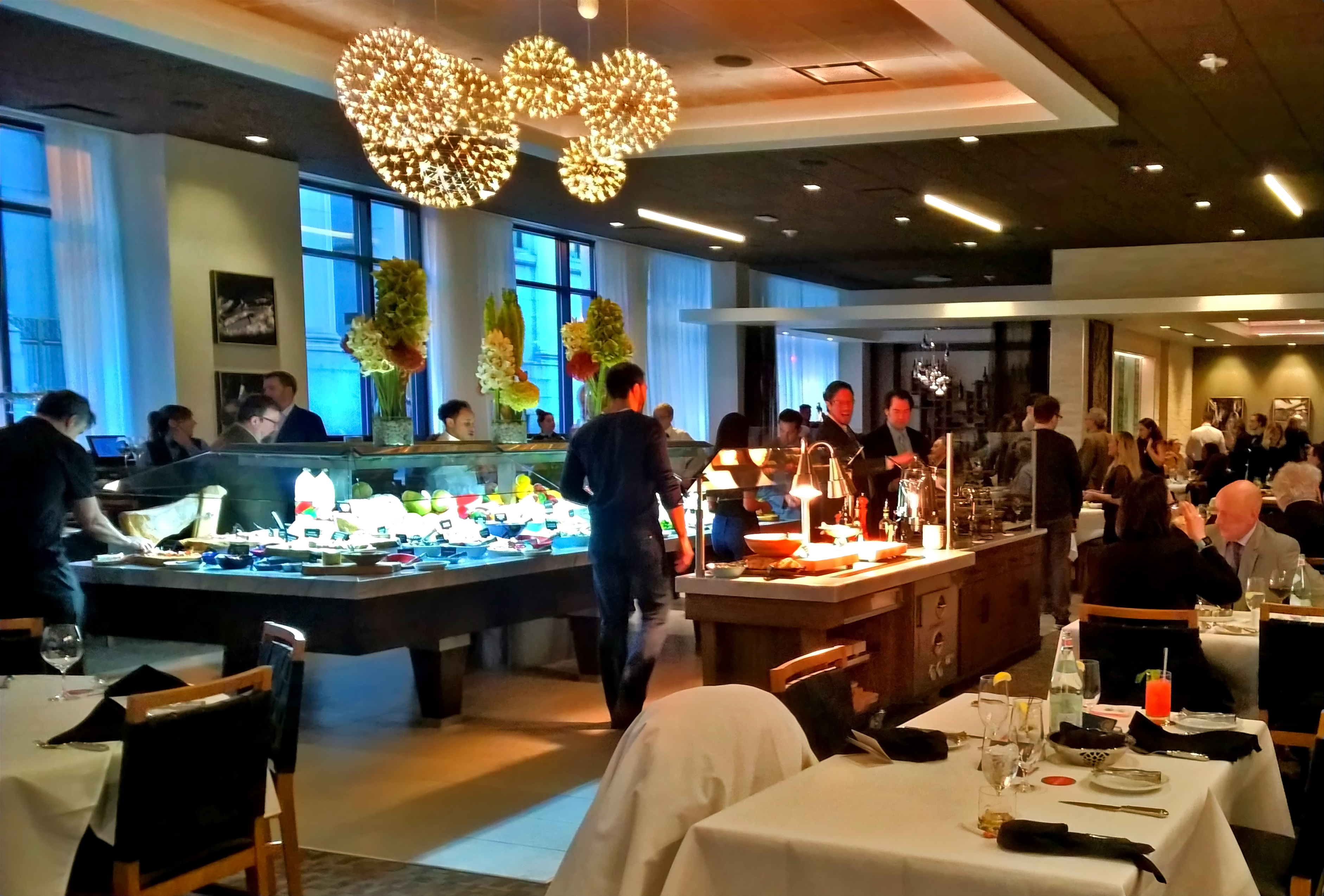
Interior of Fogo de Chao. photo: Bill Rockwell

In the middle of the room, the Marketplace, really a huge salad bar with (would you believe it?) over 60 different items and a make-it-yourself feijoada bar where you can build your own version of Brazil’s national dish. Grab a cup, spoon in some rice, ladle onto some black bean/ beef/sausage soup and finish it with a dusting of yucca flour (farofa) and hot sauce made with the malagueta chile.

Under the watchful eye of Paixao Cortes peering down from a 15-foot plaque in the center of the room replicating the statue in Porto Alegre, Brazil, of the man prominent in gaucho culture, I filled my salad plate with tidbits like smoked salmon, hearts of palm, slices of cheeses from around the world, charcuterie, lentil and quinoa salad, and quinoa tabouli – everything labeled for easy identification.

Fresh and Nutritious- Something for Vegetarians and Carnivores Alike – photo: Bill Rockwell

Once the salad course was over the real nitty-gritty begins. Simply by turning over the coaster given every diner at Fogo from the red side to green, you summon the parade of waiters who come by singly dressed in white shirts with red kerchiefs and gaucho pants that balloon from the knee up. They arrive with a long skewer of meat placed on a silver boat to catch the drippings and cut off slices you’re supposed to grab onto with a pair of silver tongs.

What makes the experience extraordinary is that you’ll be able to sample to your hearts content 17 different meats. These include three lambs (ribs, steak and leg of), several chicken, drumsticks marinated for 24 hours in brandy and beer, linguica sausage, pork ribs and Parmesan coated loin and more than a half dozen different cuts and styles of beef.
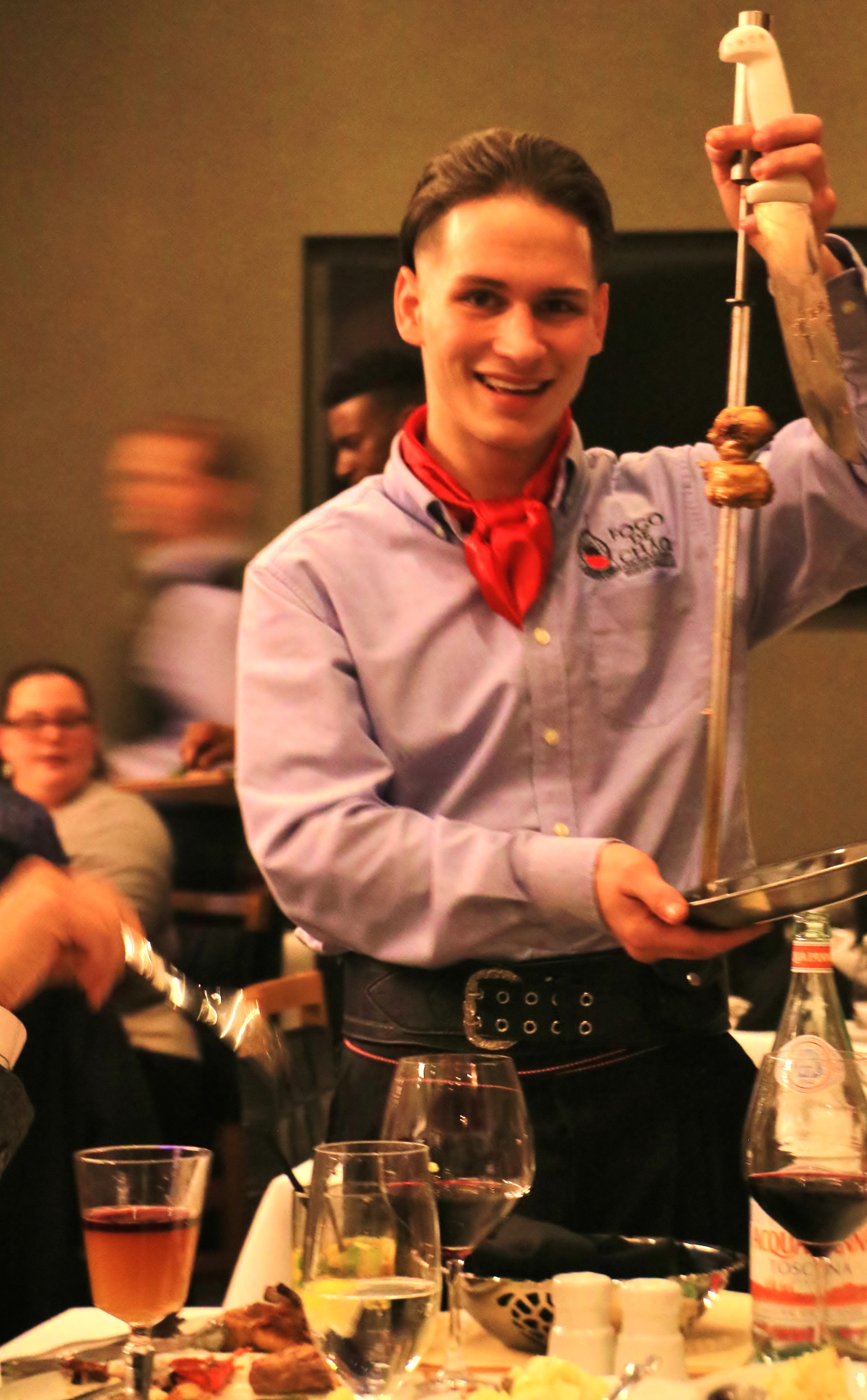
A Friendly Server/Gaucho with a Skewer of Marinated Chicken Drumsticks. photo: Bill Rockwell

To accompany the carnivorous feast, servers put down a plate of cheesy bread puffs, some caramelized plantain, polenta logs and creamy mashed potatoes. With all the red meat to consider, I opted for a glass of Fogo de Chao Malbec, a label made specially for the restaurant. Interestingly enough, there are several selections of Brazilian wines from the Serra Gauche region sold only by the bottle.

General manager, Nick Croge, says the parade of skewered meat is a show within a show or what he also calls “organized chaos.” Actually, I was quite amazed at how smoothly and synchronized everything went on preview night, three days before the official opening on April 23.

You might want to start or end your meal with a caipirinha, Brazil’s answer to the mojito, made with cachaca (a potent sugar-based whiskey), sugar cane and lime wedges. There’s also a Brazilian Gentleman, made with Knob Creek rye, passion fruit puree, gum syrup, Ramos Tawny Port, Amazon Chancho bitters and honey elixir.

And yes, there are desserts, nine of them in fact, but my tip is to try the Tres Leches Cake.

Croge said about 90% of the beef is Angus from Texas with the remaining 10% Angus from Wisconsin. The lamb hails from New Zealand. The salad bar is also said to be 90% gluten free (so watch out for the Italian bread) and the entire menu is 90% gluten free as well.

For pescatarians, there are several fish and seafood options (the seafood tower sounds wonderful and is served with mango malagueta relish). Vegetarians can comfortably and adventurously graze through the copious salad bar and even order special grilled vegetables.

Fogo de Chao, located on the corner of Smithfield and Oliver in Downtown Pittsburgh, is open for lunch and dinner 7 days a week. Brunch on weekends.. Phone 412-312-5001 or visit website.


 

More Than Just Horse Play – A review of “Equus”

 By Nick Mitchell, ‘Burgh Vivant

Few plays explore the relationship between psychiatrist and patient better than Peter Shaffer’s 1973 play “Equus.” For that very reason, it has been a go-to piece for theaters from the collegiate level all the way up to the Broadway.

Alan Strang (Evan Saunders) is a troubled seventeen-year-old male patient who speaks only in jingles. He also violently blinded six horses. Martin Dysart (John E. Lane Jr. ) is a middle-aged doctor whose fascination with his patients offsets the monotony of his mundane everyday existence.

The Red Masquers at Duquesne University selected “Equus” as a part of their “Masterpiece Season” and they, indeed, have the actors to back it up.

Alan Strang is a brooding, cryptic teen with wild eyes that cannot hide a continuous silent plea for relief. Before talking about his performance, attention should be paid to Red Masquers’ practice of casting students alongside age-appropriate faculty and professionals. This is invaluable experience for young actors and it lends even more credence to the faculty the next time they are in a classroom setting. While education is often plagued with the errant credo “Those who cant…teach.”, the students at Duquesne are surrounded by artists willing to do both. Professor Lane’s vulnerable, fiery, nuanced performance in “Equus” leaves no one doubting the fact that he can indeed do AND teach.

Such a complex play as “Equus” is not without it’s challenges. Performed in the round, director Justin Sines played his angles quite well. It did however appear that some sides of the seating area got a little more face time than others. Often this was partially due to the size disparity between Mr.Lane and Mr. Saunders. A wonderful aspect of the set was actually behind the audience. Two of the back walls of the intimate Genesius Theater were wood slats emulating the barn where much of the flashback action was set. The other two were walls of antiseptic blinds that would be found in doctors offices or hospitals.

Lighting designers Antonia Gelorme and Christina Levi subtly lit the walls to locate the action essentially enveloping the audience.  It would have been interesting if a little of that duality had also been built into the central set which lent itself entirely to accents of rustic barn decor.

“Equus” has been riding strong for 45 years. No matter how much time passes the story remains relevant. The doctor/patient dynamic affords actor, director, and audience endless perspectives. Alan Strang worships horses as his Gods. “Equus” wants you to ask yourself who your Gods are. What would you do if you felt you let them down? To whom could you even speak about it? Dr. Dysart wonders if taking pain away strips people of their humanity. Would you rather truly live with pain or simply exist painlessly? For these questions, and many others, it will be at least another 45 years before Equus is laid to rest in the glue factory

Equus continues Thurs April 19th and runs through April 29th. Thurs-Sat at 8pm. Sun at 2pm. Genesius Theater at Duquesne University. For more information, click here.

Fire and the Fuhrer – a review of ‘A Bright Room Called Day”

By Michael “Buzz” Buzzelli, ‘Burgh Vivant

Its fear and misery in the Third Reich when a group of friends witness the fall of the Weimar Republic and the rise of Adolf Hitler in Tony Kushner’s “A Bright Room Called Day.”

When contentious factions of a political party split, evil rises (we’re not talking about Hillary Clinton, Bernie Sanders and the ascension of Donald Trump, but we could be). In the 1930s, as social democrats and communists in Germany refuse to work together, Adolf Hitler climbs to the top of the dog pile. For actress Agnes Eggling (Sarah Pidgeon) and her contemporaries the escalation of his power seems swift over a two year period.

On New Year’s Eve, Agnes and her revelers celebrate the glorious New Year, unaware a dark shadow was stretching across Germany. She celebrates with her Hungarian lover, Vealtninc Husz (Will Brosnahan), and her friends including the beautiful film star Paulinka Erdnuss (Kennedy McMann), deeply red communist Annabella Gotchling (Eleanor Pearson) and flaming homosexual Gergor “Baz” Bazwald (Timiki Salinas).

Side note: Vealtninc Husz and Gregor Bazwald are double cast. They are played by Leon Schwendener and Carson McCalley respectively on alternate show times (consult the theater for their particular performances).

While Agnes and her pals watch the slow ascent of the Great Dictator, Zillah Katz (Aleyse Shannon) remains separate and aloof – watching the drama unfold from her distinct vantage point in the time/space continuum. She’s in 1980s America railing against the Ronald Reagan administration. Zillah basically points out that Adolf was the gold standard of evil. It’s hard to compare other monstrous world leaders to Hitler because of his audacious malevolence. Though she equates Regan’s silence through the AIDS epidemic with the gas chambers.

Meanwhile, several other monsters wander into the play. Cut to: stock photo of Steve Bannon. No, seriously.

Agnes is troubled by the wizened-but-voracious Die Alte (Diyar Banna), who appears to her in fevered dreams. She’s basically Agnes’ Gollum. Die Alte bends her crooked back, holds her gnarled hand inward and spouts off dark poetry about another ghoul, the Penny Man. The impish creature utters, “When the tree is black and bare, and the barren branches droop, don’t go to the kitchen where the Penny Man is making poison soup.”

There’s even a special guest appearance by the Lord of Lies. He’s been called Lucifer, Beelzebub or Mephistopheles. In “Bright Room” he’s called Gottfried Swetts (Clayton Barry), a purveyor of Spanish imports. His entrance is deliriously grand, heralded by a wolf with glowing red eyes. He is incredibly effective. Heinous and hilarious at the same time. The stuff of late night terrors.

P.S. Ten points for Gryffindor if you detect a heavy Brechtian influence.

It’s not “All’s Well That Ends Well” for the young German filmmakers, but there will be no spoilers here. Though it’s easy to surmise not everyone survives – its 1930s Germany after all.

Don’t let the daunting run time frighten you, Jed Allen Harris directs the play with verve. He’s also cast the show with exciting young actors.

Pidgeon is loaded with charisma. She is engaging and intense in the lead role.

McMann is beautiful as Paulinka Erdnuss. She is regal and commanding and could easily be mistaken for a 1930s film star.

Additional and weird side note: At first, this reviewer heard “Paul Anka” whenever her name was mentioned. I guess smoke got in my eyes…ears.

There are some very fine performances by Brosnahan, Salinas, Shannon and Pearson. There’s not a bad apple, orange or lemon in the bunch (fruit, for some reason, holds a significant meaning in this play).

Aubyn Heglie and Orlando Davis also appear in the play in smaller parts, but they perform admirably.

Even though Barry is in one scene, he’s tremendous. He shines darkly with devilish glee. He’s ominous and funny. P.S. He looks very much like 90s television icon Steven Weber, who has appeared in everything from “Wings” to “iZombie.”

Henry Blazer’s set is magnificent. It’s a gorgeously appointed apartment in 30’s Berlin, accentuated stacks and stacks of books. There’s remarkable lighting (Alex Fasciolo) and sound (Paula Halpern) design with some media design (Jessica Medenbach) to add an extra flourish.

The parallels to the present run deep in “Bright Room” even though Kusher first presented the play in a workshop version in 1985. Baz even tries to find good in members of the Nazi party. He practically says, “There’s good people on both sides.” Holy April 2017, Batman!

There’s a lot going on in this three hour drama. It’s buoyed by talented actors, a sumptuous set and incredible special effects.

If ennui has overtaken you and you’ve grown tired of marching in the streets for Women’s rights, LGBTQ rights, Parkland Survivors and science, and you need a little boost to get you back in “Resist” mode, head over to “A Bright Room Called Day.” You’ll be painting signs in the lobby by intermission.

-MB

“A Bright Room Called Day” runs through April 28, 2018 at the Carnegie Mellon School of Drama, Purnell Center for the Arts, CMU campus, Pittsburgh, PA 15213. For more information, click here.


“Vanya Has Regrets” – A Review of Uncle Vanya

By Claire DeMarco, ‘Burgh Vivant

Picture it: Russia. Late 1880’s. Vanya (Daniel Murphy) and his niece, Sonia (Kathleen Wilkinson), manage and live on an estate in the country owned by Sonia’s father, Serebriakov (Peter Brannigan), a professor who lives in the city with his second – and much younger wife – Yeliena (Allison Beauregard). The professor’s first wife was Vanya’s sister and the daughter of Maryia (Amanda Arcadia) who also lives on the estate. Serebriakov and Yeliena are currently visiting the estate much to everyone’s frustration.

We first meet physician and frequent visitor, Astrov (B.C. Gannon), and Marina the Nanny (Jessica Poje) in the garden of the estate reflecting on life. Astrov decries that “life is stupid”, “life brings you down,” and he “doesn’t love anybody.” Forestry is one of his only passions (although with an attitude like his, perhaps passion is a stretch). He is sad and worried about the scarcity of forests and the rivers drying up. As a longtime resident and helper at the estate, Marina has a more sensible take on life, talking generalities.

Vanya, also prone to depression, decries the fact that Serebriakov is visiting the estate. This visit upsets the everydayness of Vanya’s existence, and brings to the surface all the frustrations and regrets he harbors. He finds his life “meaningless”, “wasted”. “Where’d it go?” (his “woulda-coulda-shoulda” moment).

Serebriakov also has his share of depression, moaning that he is an old man and that he’s constantly in pain. His young wife, Yeliena, is not happy in the country, and she is growing tired of her marriage to a sickly, old man.

Other complications involve Astrov and Vanya who both love Yeliena and sweet, kind Sonia who loves Astrov.

Tensions increase when Serebriakov announces that he is going to sell the estate and use the money to maintain his current life style elsewhere. Vanya’s reaction is blistering.

Loves declared, angers vetted, frictions agitated… Does anything get resolved? Is the estate sold? What happens to the occupants? Does everything go back to normal or is life permanently changed for all?

Comedic comments are infrequent, sarcastic and often self-deprecating.

Gannon nails his performance, showing a wide range of emotion from sorrow to potential hopefulness.

Murphy takes Vanya from a world of indifference to expressing his frustrations concerning the estate’s potential sale.

Beauregard is forceful and insightful as the young wife.

Wilkinson portrays Sonia as a gentle soul whose emotions are often evidenced through her facial expressions.

Joan Markert’s costume designs are perfect.

– CDM

Point Park University’s Pittsburgh Playhouse ends its 85-year run in Oakland with its final Conservatory production of “Uncle Vanya,” a play by Anton Chekhov and translated by Elisaveta Fen. Play runs from April 12-15 at the Rauh Theatre, 222 Craft Ave., Pittsburgh PA. 15213. For more information, go here.


Putting on Eyre’s – a review of “Jane Eyre”

By Michael “Buzz” Buzzelli, ‘Burgh Vivant

A young woman endures a series of misfortunes as she searches for meaning and true love in Alan Stanford’s adaptation of Charlotte Bronte’s classic novel “Jane Eyre.”

There are three Janes in this bildungsroman. First, we are introduced to childhood Jane (Caroline Lucas). We follow her through to the bloom of her womanhood (Karen Baum). An older Jane narrates the story from a fixed point in the young woman’s future (Cary Anne Spear).

As an orphan, Jane (Lucas) is shuttled from her wicked aunt’s home at Gateshead Hall to the Lowood Institution for poor and orphaned girls. She is mischaracterized by a heartless preacher, Mr. Brocklehurst (James FitzGerald), but a kind teacher Miss Temple (Marsha Mayhak) befriends her. When she grows up (Baum), she becomes a teacher at the school. She leaves to become a governess at Thornfield Hall.

She meets the housekeeper, Mrs. Fairfax (Robin Walsh) and her charge, Adele Varens (Grace Vensel), a young French girl.

On an auspicious walk into town to mail a letter, Jane finally meets the master of the house, Mr. Rochester (Paul Joseph Bernardo).For him, its love at first sight. It takes Jane the rest of the first act to realize she is the object of his affection.

Unfortunately, Edward Rochester has a deep, dark secret. Even though the story is over 100 years old, there will be no spoilers here.

The entire show hinges on the outstanding performances of Baum and Bernardo. They have a marvelous chemistry together. Bernardo has a commanding stage presence. Baum is luminescent.

Meanwhile, Jane’s older self (Spear), holds the whole show together. As the narrator, she also gets some of the best lines. Mostly, because they are Bronte’s original words. She performs them flawlessly.

FitzGerald is a cunningly evil Brocklehurst. His seething anger seeps off the stage. When he shuns a sick, little girl, Helen (Abigail Gilman), you want to smash him in the face with a shovel. He’s that good at being bad. Something about FitzGerald that makes him a natural in period pieces. In character, he has a distinctive gait and pronounced mannerisms that belong to a bygone era, a je ne sais quoi perfectly fit for this Gothic story.

There are some fine performances from Paige Borak and Marsha Mayhak as the Rivers sisters. They provide the few laughs to be found in this tale.

Kaitlin Kerr (in a secret role) does a marvelous job. To say more would bring us to the edge of spoiler country.

High praise must be doled out to Joan Markert. Her costumes add depth and breadth to every scene.

The venue is also worthy of praise. It’s always a joy to be inside Fred Rogers Studio. It’s an iconic Pittsburgh space.

If you want to immerse yourself in a classic Bronte novel, “Jane Eyre” is just the ticket.

-MB

“Jane Eyre” runs from April 5 to April 28 at WQED’s Fred Rogers Studio, 4802 Fifth Avenue, Pittsburgh, PA 15213. For more information, click here.


The Monologue Project goes online with 30 original monologues

The Monologue Project announced today their online resource featuring 30 original monologues
from nationally recognized writers for theater is now available to the public.

Hosted by The Bishop Arts Theatre Center, The Monologue Projects online resource features
original works from such award-winning writers as Amy Evans, Pia Wilson, Charlayne Woodard,
Dominique Morisseau, Mfoniso Udofia, Cori Thomas and Chisa Hutchinson. Celebrating
Women of the African Diaspora and their impact on theater and the world, the monologues run
the gamut from intensely moving to fiercely funny.

By making these works available for free online as a resource, The Monologue Project aims to
increase the number of audition-length monologues for Women of the African Diaspora. Hearing
voices that have not been heard and providing greater opportunity for Women of the African
Diaspora will be of benefit to all.

Performances of The Monologue Project have taken place in Pittsburgh and Dallas over the last
year and have facilitated conversations on the essential role of black women in America by
joining in solidarity with the woman-driven activism of movements like Black Lives Matter. The
Monologue Project will have a performance in New York this July at the Dramatists Guild 2018
National Conference.

Participating Monologue Project Writers (in alphabetical order): Mando Alvarado, Chrystal
Bates, France-Luce Benson, N’Jameh Camara, Zina Camblin, Kia Corthron, Gethsemane
Herron-Coward, LeKeithia Dalcoe, William Duell, Kim El, Alesia Etinoff, Amy Evans, Rob
Florence, Imani Maryahm Harrington, Dave Harris, Yona Harvey, Chisa Hutchinson, Levi Jelks,
Christine Toy Johnson, Jewell McPherson, Dominique Morisseau, Ife Olujobi, Maxie
Rockymore, Bianca Sams, Daniel Talbott, Cori Thomas, Pamela Turner, Mfoniso Udofia, Bria
Walker, Keith Wallace, Amy Gijsbers van Wijk, Pia Wilson and Charlayne Woodard.

The Monologue Project is made possible through support from:
Advisory Committee Members: Siovhan Christensen, N’Jameh Camara, Ife Foy, Alexis Cash, Alesia
Etinoff, Sara Williams, Dominique Brock and Dave Harris.
Gab Cody, Pittsburgh Regional Representative for the Dramatists Guild
Teresa Coleman Wash, Executive Artistic Director, Bishop Arts Theatre Center
Seth Cotterman & Kyle Eberlein, Marketing and Communications, Brand It For Good!

Reginald Douglas, Artistic Producer of City Theater

Kyle Haden, Artistic Director, Ashland New Play Festival

About Bishop Arts Theatre Center (BATC):
The Bishop Arts Theatre Center is an award winning, multicultural, multi-discipline theatre that offers a full
season of theatrical performances, jazz concerts, speakers series and year round arts education
programs. Based in Dallas, Texas, the mission of the organization is to cultivate a diverse and vibrant arts
community while creating opportunities for local and emerging artists through performances and
education. Each year, the BATC impacts over 50,000 people nationwide.

For more information about The Monologue Project and the Bishop Arts Theatre Center click here.

THE SILVER THEATER PROJECT ANNOUNCES SPRING 2018 SALON PLAY READING SCHEDULE

THE MAN WHO STOPPED LOVING WOMEN by Pittsburgh playwright Michael McGovern will be presented April 8 at 7:30 pm by The Silver Theater Project at The Glitter Box Theater, 460 Melwood Avenue as part of its Spring 2018 Salon Play Reading Series.

The Silver Theater Project was founded in May 2017 by Michael McGovern as a way to provide a creative outlet for playwrights and performers age 40 and above in the Pittsburgh area.  This past Fall it produced three popular Salons, which, in addition to the readings, also featured desserts and drinks in the comfortable lounge at The Glitter Box.

“Script, actors, intimacy is what we go for,” explains McGovern.  “Our audience enjoys the small theater space and the chance to meet the actors and writers before and after the performances.  And yes, audience members always stay and chat with us after the show.”

THE MAN WHO STOPPED LOVING WOMEN was originally performed as part of the inaugural Pittsburgh Fringe Festival in 2015.  It’s a drama with comedic overtones about a writer who shuts off his emotions and the effect it has on the women in his life. During the course of an evening its four characters grapple with love, sex, and alcohol. McGovern describes the play as “Neil Simon meets Edward Albee.”

The cast features Brian Czarniecki, Lucia Metrailler, Christopher St. Pierre, and Samantha A. Camp.

The second Spring Salon presentation, THE SHORT ORDER PLAY FEST, featuring plays and monologues by Pittsburgh area writers will take place June 9 & 10.

The Sliver Theater Project is a project of New Sun Rising. THE MAN WHO STOPPED LOVING WOMEN will be performed April 8 at 7:30 PM at the Glitter Box Theater, 460 Melwood Avenue, Pittsburgh, PA 15213. More information can be found here.


Voice of Authority comes to the Pittsburgh Fringe Festival


Writer/performer Dean Temple knows what it’s like to get sued by the US government, and his new show
Voice of Authority lets you in on all the fun. The comedy solo show will be at the Pittsburgh Fringe Festival
April 6-8.

“You really don’t know what to do when you get hit with any lawsuit, never mind one this size,” says
Temple. And while he did get himself a lawyer, Temple took the opportunity to spend the next two years
– a court order prevented him from working – with family friend and mentor Zachary Solov, a former Balanchine
dancer and choreographer of the Metropolitan Opera Ballet. “Zachary’s career was just peaking at
age 23 and he got drafted into World War II,” says Temple. “What he does during the war, finding a place
in the Army as a dancer and a performer, inspires me to change my life entirely.”

Bringing this story to the stage and finding the comedy in it has proved immensely challenging. “Making
theatre from a personal and autobiographical perspective is scary. It requires vulnerability and honesty,”
says director Courtney Laine Self. “A lot of times, it means I’m asking questions of Dean that you wouldn’t
typically ask in polite conversation.”

The show, which covers the span of the lawsuit and the last years of Solov’s life, takes a humorous look
at the voice in our heads that leads us to doubt ourselves, and how giving into that voice can lead to bad
choices. Going after what you really want can be scary, but Solov’s stories teach Temple that focusing on
your dreams can get you through any adversity.

Voice of Authority makes its Pennsylvania premiere at Pittsburgh Fringe 2018 at the Allegheny Unitarian
Universalist Church. Tickets can be purchased here.

“Voice of Authority” will be held at the Allegheny Unitarian Universalist Church, Downstairs, 416 W North Avenue Pittsburgh, PA 15212

Shows are at 7:30pm Friday, April 6, 4:15pm Saturday, April 7 and 8:45pm Sunday, April 8

The show contains tense situations and bawdy humor that are not be appropriate for all ages.

Uncertainty principles – a review of “Heisenberg”

By Michael “Buzz” Buzzelli, ‘Burgh Vivant

When Georgie Burns (Robin Abramson) kisses Alex Priest (Anthony Heald) at a train station in London, a series of unexpected events are set into motion in Simon Stephens’ “Heisenberg.”

There are a lot of uncertainties once the character’s “meet-cute” in the St. Pancras railway terminus. Let’s take into account some key factors: She’s a brash, young American woman, and he is a quiet Irishman. She likes to photograph people, and he doesn’t like to have his picture taken. Then, there are the mathematical inequalities of the character’s ages, she is in her 30-40s, and he is 75.

Georgie is a whirling dervish. She muscles her way into Alex’s life, even though he rebuffs her earliest advances. Early on, he asks, “Why are you talking to me?” Alex, who seems bothered by her presence, doesn’t seem to realize he needs her. They need each other. But it is the variations of those needs that is the crux of “Heisenberg.” No spoilers, sweetie.

After a big revelation in the bedroom, the play barrels toward its conclusion. The momentum never wavers (no entropic uncertainty here).

Anthony Heald (as Alex) and Robin Abramson (as Georgie) enjoy a date after an unexpected chance meeting.

Werner Heisenberg was a German physicist whose theory states, “The more precisely the position of some particle is determined, the less precisely its momentum can be known, and vice versa.” Picture Jeff Goldblum watching water droplets slide down Laura Dern’s hand. It all has to do with chaos and uncertainty. The play deals with the same issues, but with drama not science.

Heisenberg also theorized that when you observe something you also change it. Any actor will tell you that their performance will change based on the audience. On press night, the audience rose to their feet to applaud the Abramson and Heald and deservedly so.

Abramson and Heald are a dynamic duo.

In the hands of another actor, Georgie could be seen as annoying, cloying and grating. Not so here – thanks to Abramson’s likability. She is charismatic and charming. It’s a delight to watch her on any Pittsburgh stage.

Heald’s accent is light. It’s not one of those thick, Irish brogues that will make you wish you brought a translator. There’s nary one “feckin’” or “gobshite” in the whole play, and that, as Martha Stewart would say, is a very good thing. Too many actors always try to sound like Mickey “One Punch” O’Neill in “Snatch” when they strap on their Irish. Ironic shout out to Dialect Coach Don Wadsworth for turning down the Rah Rah Erin Go Braugh!

Heald is a very young looking 73, which puts him in the perfect age bracket to play Alex Priest, however, he didn’t seem old enough. That’s more a compliment than a criticism.

Tracy Brigden returns to the Public Theater to direct, and she does a masterful job. “Heisenberg” is ninety minutes with no intermission, and once you get past the first ten minutes…the play flies by.

Brian Sidney Bembridge’s set is spare. There are four benches that are reworked into various shapes, a butcher’s case, a bed and a dining table. Four benches that are onstage the entire time. You could call it a plank constant (Planck Constant?).

Excellent lighting work from the aforementioned Bembridge, who is perfectly matched with Zach Moore’s sound design.

Keep in mind that “Heisenberg” is not a spectacle to behold like “A Funny Thing Happened on the Way to the Forum.” There is little pomp and circumstance. It’s a tight two-hander on a barren stage. It’s elegance and simplicity. Kudos to Ted Pappas for following “Forum” up with something completely unexpected.

-MB

“Heisenberg” plays until April 8, 2018 at Pittsburgh Public Theater’s O’Reilly Theater, 621 Penn Avenue, Pittsburgh, PA 15222. For more information, click here.


With fearful trill of things unknown – a review of “I Know Why the Caged Bird Sings”

By Michael “Buzz” Buzzelli, ‘Burgh Vivant

An adult Maya (Linda Kanyarusoke) reminisces about her strange and difficult journey growing up as an intellectual Black girl in the rural South in “I Know Why the Caged Bird Sings.”

Young Maya (Kendall Arin Claxton) and her brother Bailey (Malic Williams) are deposited at the doorstep of her grandmother’s store in Stamps, Arkansas. Momma (Denise Sheffey-Powell) and Uncle Willie (Sam Lothard) raise the children as their own. One day, Maya and Bailey’s biological father (Maurice Redwood) cart the kids off to their birth mother, Mother Dear (Roxie Robinson) in St. Louis.

After a series of unfortunate events that would make Lemony Snicket cringe, Maya and Bailey end up back in Stamps, Arkansas with Momma and Big Willie. A few years later, she and her brother are sent off to Oakland, California to reunite with Mother Dear once again.

Actually, the plot isn’t important in this play. There really isn’t one. “Caged Bird” is a bunch of autobiographical stories strung together to give us a sense of the narrator; Marguerite Anne Johnson – the woman who becomes one of America’s best known poets – Maya Angelou.

“Caged Bird” is a series of lovingly crafted stories by the author and two playwrights who adapted the book for stage, Myra Platt and Malika Oyetimein.“I Know Why the Caged Bird Sings” is compelling and lyrical as the poet herself.

After the tragic events in St. Louis, Maya spends a great deal of time finding her voice. When she does, she lifts that voice and sings, full of the hope the present has brought her.

Side note: The play contains an amazing rendition of the James Weldon Johnson’s “Negro National Anthem.”

Director Monteze Freeland has a strong cast and uses them wisely.

Claxton is effervescent, sparkling and joyous. She is brimming with the enthusiasm of the bright, energetic youth she portrays. Whereas Kanyarusoke is a thoughtful, logical, detached adult. It’s a clever juxtaposition. Kanyarusoke has a powerful presence, almost as much as Maya Angelou herself.

Lothard is charming as Uncle Willie and frightfully menacing when he plays Maya’s tormentor, Freeman.

Denise Sheffey-Powell, (Malic) Williams and Redwood are also charismatic, and Brenden Michael Peifer provides some much needed comic relief.

Britton Mauk’s set is simple but elegant. It’s a series of wooden panels in muted Easter egg tones; the faded turquoise of a robin’s egg to the pale, pink hues of a cumulus cloud at sunset. Even though Jason Via provides a few important props, the best set pieces are invisible. There’s a lot of good space work (miming) from the actors. The minimalism works well on the sparse stage, proving you don’t need a lot of props to convey action. There are, however, some beautiful costumes from Kim Brown.

Life hands Marguerite Anne Johnson some bitter lemons, but Maya Angelou makes sweet Southern tea with them, and it’s a joy to watch the transformation.

Note: Bring your winter coat. For some reason, the theater is ice, ice cold.

“I Know Why the Caged Bird Sings” is at the New Hazlett Theater, 6 Allegheny Square East, Pittsburgh, PA 15212. For more information, click here.


css.php