


Shelf Life – a review of “Citizens Market”

By Michael “Buzz” Buzzelli, ‘Burgh Vivant

A bright young woman from Ghana joins an eclectic group of immigrants when she takes a job as a cashier at the Super Union grocery store in Manhattan’s Upper West Side in “Citizens Market,” a world premiere play by Cori Thomas.

Soon after arriving in America, Akosua AKA Sunday (Ngozi Anyanwu) applies for a job at small supermarket. Jesus (Juan Francisco Villa) hires her, based on the recommendation of Sunday’s roommate, Ciata (Shamika Cotton). Meanwhile, a cantankerous couple, Bogdan (Jeff Howell) and Morfina (Ann Talman), cause a fracas on the street outside the store.

In an esoteric pact with a nearby church (Senior Job Program?), Bogdan and Morfina are soon stocking shelves at the store in exchange for bread and other groceries.

The lives of the Super Union employees become entangled. Jesus – mostly pronounced “Hey Zeus” – has a thing for Ciata. Sunday is fighting her fear of public speaking – stemming from an incident with a man in her village. And Bogdan and Morfina can’t stop bickering – they are George and Martha of Romania (no one ever expects an Edward Albee joke).

While the play veers off in several directions, the characters continue to come together. They are “there” for each other. E. M. Forster’s words, “Only Connect!” reverberate in the hapless lives of the Super Union employees. Their bond is strong (they have a super union!).

The cast is superb.

Sunday is the moral center of the play. It’s easy to root for the shy, foreign girl who finds her inner strength. Imagine creating a new life for yourself in a completely new country – in another language no less. Anyanwu is a joyous Sunday. She shines in the role.

Cotton’s Ciata is delightful. She is the stronger woman of the two main character. She is charismatic and charming as well.

Villa does a fine job as Jesus. His character starts out cocky and self-assured and soon his hidden vulnerability rises to the forefront.

Howell and Talman steal the show as the quarreling couple. Howell is having a marvelous year. He’s fresh from a hilarious performance in “A Funny Thing Happened on the way to the Forum” and now he’s making audiences laugh across the river.

It’s great to see Talman on the City Theatre stage. The actress has been on numerous television shows and worked on and off Broadway for years (she even starred opposite Elizabeth Taylor in “The Little Foxes”), but is originally from the area (USC).

The play moves fast at a quick ninety minutes – no intermission. Kudos to director Reg Douglas for keeping the show moving briskly.

The premiere play stumbles in a few small ways. It doesn’t pass the Bechdel Test: When Sunday and Ciata chat in the breakroom, they only talk about the men in and out of their lives. Also, there’s a happy ending that seems tacked on. It feels forced and unearned. It raises more questions than it answered. That said, you’ll still cheer for Sunday and her accomplishments. There’s wonderful symmetry between the opening scene and the final one.

The tenuous relationship the U.S.A. has with its immigrant population could be explored even more here, and – with a few tweaks –  turn “Citizens Market” from a cute, little play into an important political commentary.

P.S. Those are hot right now. See: “Hamilton.”

If you can ignore a few minor quibbles, you’ll have an enjoyable time at “Citizens Market.” Grab your shopping cart and browse the aisles. It’s the most fun you’ll ever have in a grocery store.

“Citizens Market” runs until March 25 at the City Theatre, 1300 Bingham Street, Pittsburgh, PA 15203

For more information, click here.



Mourning Sickness a review of “The House of Bernarda Alba” 


By Nick Mitchell, ‘Burgh Vivant

Bernarda Alba’s second husband has recently passed away. Mourners roam the theater freely and mingle with the audience. One plays a hauntingly solemn tune on a violin. Soon after the lights dim and the funeral hymn ends, the widow Alba appears and decrees that her household of 5 daughters shall observe eight years of mourning. In 1930’s Andalusia, that means no boys allowed until the moon has waxed and waned a solid 96 times.

Set entirely inside the confines of the house, the daughters are initially intimidated into obedience. Of course they slowly succumb to the heat of the scorching Spanish sun. Their passions manifest themselves both by lashing out at each other and in their lust for the local lothario, Pepe “el Romano.” Pepe visits the eldest daughter’s window nightly to court her…but is hers the only window in the Alba household that he frequents? In fact, is this even the only house in Andalusia where he speaks sweet words to a captive female audience?

Federico Garcia Lorca titled this play “The House of Bernarda Alba” for a reason. The fierce need of the widowed matriarch to preserve status and propriety through familial tyranny requires an actress who can demand attention and obedience simply with posture and presence. Alex Williams’ every moment on stage embodies Alba’s intangible essence leaves no question as to who is in charge. Late in the show, director Monica Payne allows us a fleeting glimpse of the widow’s vulnerability and fatigue. It is a truly beautiful moment that a lesser actor/director combo might have easily overplayed.

While all five actresses are well-cast, Lorca has clearly picked favorites as Adela (Aenya Ulke) and Martirio (Michelle Iglesius) have the bulk of the best-written scenes. The sisters are opposite sides of the same coin of love, longing, and jealousy. The raw, honest dialogue Ulke and Iglesius each speak, will make you wonder if either sister was truly in the wrong.

Thanks to Stephanie Mayer-Staley’s design, the house itself is a major character in the production. The simple placement of chairs within three confining walls make the space feel smaller and smaller as tensions rose. Cat Wilson’s light design included silhouettes of the outside world (of men) cast ominously through the walls. In fact, no men appear in the play, they are represented only as literal shadows of influence.

The five daughters range in age from 19-39. The effect was lost in a cast of all college students. Also, the positioning and repositioning of the chairs involved exaggerated, stylized movements. Such fluid choreography seemed at odds with the play’s tempo and economy of language. Fortunately, neither of these factors were distracting enough to take away from the power of the piece.

After a 90-minute whirlwind of three uninterrupted acts, the audience is released from the Casa D’Alba with more questions than resolutions. How far can one go to preserve a reputation? Does mother really know best? Could you have gone eight years without dating when you were twenty?

On the way out, another emotionally wrecked theater-goer asked this reviewer on the way out: “Where’s the closest place I can get a vodka martini?”  Lots of interesting questions arise after seeing this play.

-NM

The House of Bernarda Alba” runs to March 11 at the Ruah Theater in the Pittsburgh Playhouse, 222 Craft Avenue, Pittsburgh, PA 15213. For more information, click here

The Pittsburgh Public Theater introduces its new artistic director and new season

By Michael “Buzz” Buzzelli, ‘Burgh Vivant

On Tuesday, February 27, the Pittsburgh Public Theater opened its doors to welcome donors, actors and press into the O’Reilly Theater to introduce incoming artistic director Marya Sea Kaminski and usher in the 2018-2019 season.

Outgoing Producing Artistic Director Ted Pappas said a fond – if only temporary – farewell (Pappas will return to direct Lucas Hnath’s “A Doll’s House – Part Two” next March).

The new season is comprised of some fresh, original programming. It also features some twists on some familiar favorites.

Marya Sea Kaminski introduces the 2018-2019 season on the Public’s O’Reilly stage.

PRIDE AND PREJUDICE

By Kate Hamill
Directed by Desdemona Chiang

September 27 – October 28, 2018

Kate Hamill’s wild adaptation of Austen’s classic love story is anything but plain Jane. To save the family estate, the Bennet sisters are in a flurry to find suitable men to marry—except Lizzy who’d rather risk the family fortunes than force a second date. This madcap romance is filled with clever seductions, awkward escapes, and perhaps just enough luck to win at this wicked game called love.

SWEAT

By Lynn Nottage
Directed by Justin Emeka

November 8 – December 9, 2018

Winner of the 2017 Pulitzer Prize
The folks at Olstead’s Steel Tubing in Reading, Pennsylvania work, drink, and dream together, until layoffs and lockouts at the factory begin to drive them apart. By following the lives of nine friends between 2000 and 2008, this combustible drama unearths the brutal consequences of a battered economy and dares to ask how we begin to heal. Critically acclaimed on Broadway, Sweat was awarded the 2017 Pulitzer Prize.

The O’Reilly Theater, 621 Penn Avenue, Pittsburgh, PA 15222

THE TEMPEST

By William Shakespeare
Adapted and Directed by Marya Sea Kaminski

January 24 – February 24, 2019

Marya Sea Kaminski’s premiere production will crack open this old story to unleash a world where magic reigns, sailors sleep with fish, spirits surround us, and love can strike like lightning to brighten the darkest night. Told from a female perspective with an original score, this Tempest will swirl with vicious plots, ridiculous jokes, and the powerful pull between violent revenge and veritable forgiveness.

A DOLL’S HOUSE PART 2

By Lucas Hnath
Directed by Ted Pappas

March 7 – April 7, 2019

Remember when Nora walked out and slammed the door behind her in Ibsen’s 1879 masterpiece, A Doll’s House? Well, she’s back. It’s 15 years later and Nora confronts Torvald to demand that he officially divorce her. She navigates some hilarious and harrowing negotiations with her husband, their daughter Emmy, and their nanny Anne Marie, as we watch the woman who once up-ended the rules of marriage return to set the record straight. A must-see for theater-lovers and anyone who’s ever tried to be married.

INDECENT

By Paula Vogel
Directed by Risa Brainin

April 18 – May 19, 2019

Based on incredible true events, this story of a Jewish playwright and his resilient acting troupe unfolds with unexpected joy, beautiful stagecraft, and the contagious melodies of a live Klezmer band. In 1923, Sholem Asch’s first play opens on Broadway—a love story between two women set in a brothel—and scandal erupts when the entire cast is arrested for obscenity. Indecent unearths the perilous history of this groundbreaking work of literature, and reveals the way art can deeply connect us even in a world unravelling.

MARJORIE PRIME

By Jordan Harrison
Directed by Marya Sea Kaminski

May 30 – June 30, 2019

In the near future, “primes” are programmed to look, sound, and smile like our dearly departed. With young Walter, Marjorie recalls the good old days of their marriage despite the frustrations of her rapidly failing memory. He acts and feels like family, even as Marjorie’s own daughter seems less and less familiar. Jordan Harrison (writer for Orange is the New Black) brings us this inventive, intimate play about a world where advancing technology can lead us back to who we are and to the people we love.

The Pittsburgh Public Theater is located at 621 Penn Avenue – in the heart of Pittsburgh’s Cultural District – Pittsburgh, PA 15222. For more information, season subscriptions and more click here.


Heads Up – A review of “Marie Antoinette”

By Claire DeMarco, ‘Burgh Vivant

Everybody knows something about Marie Antoinette. There are two events, though, that first come to mind when her name is mentioned: her beheading and her comment concerning the masses “Let them eat cake” – a quote that has never been validated, by the way. Playwright David Adjmi takes Marie’s story and gives it a contemporary twist in “Marie Antoinette”.

We follow Marie (Alexis Primus) as she adapts to life at the French court and witnesses all the problems and events she and Louis XVI (Adam Nie) faced. Why did it take eight years for them to have a child? Did they have an up and down relationship? Why were they so out of touch with the dire economic conditions in France and the feelings of the French people? Why did Marie continue her extravagant excesses even when confronted with the people’s plight?

Marie is attended at court by Yolande De Polignac (Kayla Bradley) and Therese De Lamballe (Temperance Moore), her ladies-in-waiting who reinforce her frivolous behavior. They all act like schoolgirls dressed in the latest fashions, adorned with jewels, successfully balancing their wigs as they dance and prance around, oblivious to what’s happening on the Parisian streets. Semi-modern costumes (knee high dresses), rock music, today’s lingo is incorporated into this piece, along with the traditional trappings of 18th century France (huge wigs, big hooped dresses). Marie sports blue lipstick  – perhaps because she’s a blue blood?

The backdrop for all this action takes place on a simplistic platform with few props, allowing the players to constantly move around the stage.

Joseph (Langston Reese), Marie’s older brother, is sent to France by their mother to find out why she and Louis XVI don’t have any children yet. Alex Fersen (Marco Lucero) becomes Marie’s loyal friend and possible-but-not-proven lover.

A Sheep (Meg McGill) is the play’s symbolic character that acts as Marie’s harbinger, signaling that the populace is angry about her endless spending while they are suffering. Gossip is rampant and her personal reputation is also tarnished. Rumors spread that she’s engaged in a lesbian affair. Some think she’s a prostitute. Unfortunately, Marie didn’t listen to any warning signs. “Who will draw my bath?” was one of the last lines she uttered in prison. She never “got it.”

“Marie Antoinette” is a contemporary version of an historical figure’s fate. Director Le’Mil Eiland explains it best: “This play and our production is a meditation on excess.”

Primus captures the wide range of Marie’s emotions and attitude. She is at times naïve, self-absorbed, fun-loving, unthinking, belligerent and hysterical.

Nie develops Louis XVI from an indecisive, shy monarch who first appears in pajamas while playing with clocks to someone more forceful (and more appropriately dressed as a king) as his character progresses.

McGill is clever and subtly funny as the meandering sheep.

Note: Because of the constant movement on stage as the actors move from one side of the stage to the other with their backs to parts of the audience, dialogue is sometimes muffled.

– CDM

“Marie Antoinette” is produced by the University of Pittsburgh and runs until February 25th at the Cathedral of Learning, Richard E. Rauh Studio Theatre, 4200 Fifth Avenue, Pittsburgh, PA 15260. For more information, go here. 

Multiplicity – a review of “Holmes and Watson”

By Michael “Buzz” Buzzelli, ‘Burgh Vivant

Three years after his dramatic death at Reichenbach Falls, Sherlock Holmes is rumored to be alive in Jeffrey Hatcher’s “Holmes and Watson.”

Doctor John Watson (Daryll Heysham) receives a telegram insisting that the super sleuth did not perish in his deadly struggle with his nemesis, Professor Moriarty, at the scenic Swiss waterfall. The good doctor is summoned to a sanitarium on a mysterious – and mostly unpopulated – island to identify Holmes when he arrives. He travels to the island by ferry, and – only after landing – he is told that there isn’t another ferry until morning. He is also relieved of his side arm by an orderly (James Keegan). Now, Watson is defenseless on the island with violent mental patients. Three patients of the sanitarium each claim to be the Baker Street detective (Darren Eliker, David Whalen, and Gregory Johnstone).

Doctor Evans (Tim McGeever) facilitates Watson’s visit with each mental patient, each believing themselves to be Sherlock. Watson questions each man to discern the identity of the true detective. A violent game of “To Tell the Truth” ensues.

Will the real Sherlock Holmes please stand up!

“Holmes and Watson” is a theatrical Rubik’s cube. There are several twists and turns that upend the play with each new revelation. This review cannot go into the depth and breadth of the action without spoiling key plot points. Suffice to say, like all good Sherlock Holmes mysteries, it begins with murder.

Dunt Dunt Da!

Like most noir plots, there is also a beautiful woman (Gayle Pazerski) at the heart of the story. Is she the love interest or the femme fatale? Shh! Spoilers.

The first fifteen minutes is mostly set up with very little action. Even though “Holmes and Watson” starts laboriously slow, it picks up speed in the middle and then races to the finale. The play is a roller coaster tick-tick-ticking toward the top of the first hill, then hitting several loop de loops and corkscrew turns.

“Holmes and Watson” is a devilishly clever play, but not Hatcher’s best. To be fair, “Compleat Female Stage Beauty” set an impossibly high standard.

Since Sherlock is a side character (or three), there’s a Holmesian trait that is missing from this play seen in most of Sir Arthur Conan Doyle’s works. This play does not have Sherlock assembling clues and astonishing Watson with details about a person from the cuff of their sleeve or the sole of their shoe. You won’t find that Parlor Trick version of Holmes here. However, there is a slight of hand going on, but – once again – it cannot be revealed.

Reviewer’s note: I haven’t been this secretive about a plot since Nassim Soleimanpour’s “White Rabbit, Red Rabbit.”

Andrew Paul directs the show with verve. There’s a casting note that can’t divulged because it also tips the deerstalker cap in a direction toward one of the dopplegangers.

It can, however, be said that it’s a great cast. McGeever immerses himself into his role. It’s a damn fine performance from the affable actor.

Each Sherlock will have his fans. They are completely different, yet you will be rooting for each one of them at different points in the story. Bravo to Eliker, Whalen and Johnstone.

“Holmes and Watson” runs a quick 95 minutes, but it’s guaranteed to astonish and delight. It’s a long-form magic trick. Go see it and try to guess the ending.

-MB

“Holmes and Watson” runs from February 16 to March 4 at the New Hazlett Theater, 6 Allegheny Square East, Pittsburgh, PA 15212. For more information, click here.


How High Can You Fly – a review of “Up and Away”

by Claire DeMarco, ‘Burgh Vivant

What was it like to be the first super hero – before Superman, Batman or any of the other larger than life legends come along? We find out in a delightful way in the musical comedy premiereproduction of “Up and Away.”

Joe Jessup (Michael Greer) is the world’s first super hero. He is brought up in a small rural community called Farmtown and one day he realizes that he can predict future events seconds before they occur. He’s also learning (albeit tentatively at first) that he can fly. Greer and his brother, Jerry Jessup (John Wascavage), more reticent of the two, live on a farm with their widowed mother (Christine Laitta).

With his new-found powers, Joe heads off to Big City to save the world and occasionally rescue a stranded cat stuck in a tree.  He secures a meteorologist job at a radio station based on his prescient knowledge of an upcoming rainstorm. There, he meets Susie Dare (Erika Strasburg), a radio personality, and Ronak Fairchild (Quinn Patrick Shannon), a quirky billionaire.

Joe calls himself Super Saver (he sounds more like a coupon book), and outfits himself in a rudimentary prototype of a super hero in red, baggy long johns and a plaid cape that was – formerly – a table cloth. No skin-tight leggings or silk cape here!

After Joe spends some time in Big City, his mom and brother decide that he needs to come back home to Farmtown. Jerry travels to Big City, encouraging Joe to return to his roots.  While Jerry visits, he falls in love with Susie Dare, unaware his brother, Joe, is a rival for her affections.

Susie rejects Joe and from this point on the plot evolves into a physical and verbal conflict between the brothers.  Will Joe and Jerry solve their differences? Does either brother get the girl? Will we ever know the origin of Joe’s super powers?

from right to left: Christine Laitta, Erika Strasburg, John Wascavage (below), Quinn Patrick Shannon (above) and Michael Greer (far left). Photo credit: Matt Polk

The musical takes place in Farmtown and Big City. If there’s a burlap background curtain, we’re in Farmtown, if a brick wall with a large faux window, we’re in Big City.  Simplistic but clever props add to the story.  A large cloud-patterned sheet manually waved by unseen hands in the background suggests that Greer is flying. We see a silhouette of Super Saver moving behind the faux window as he’s off on another rescue.

5 actors (Greer, Wascavage, Laitta, Strasburg and Shannon) portray 50 characters in “Up and Away.” Transitions between characters seamless and smooth. No need for a dramatic costume change to differentiate the various characters.  A yellow hat, a fake mustache or a glittery jacket is enough to suggest character changes.

This musical comedy requires a unity among all the actors since it is a physical show with precise timing.  Greer, Wascavage, Laitta, Strasburg and Shannon all succeed in their interactions with one another.

Greer and Shannon’s facial expressions, double takes and comedic timing were outstanding.

Book and lyrics were written by Kevin Hammonds with music by Kristin Bair. Hammonds and Bair have collaborated on previous productions in musical comedy. This production solidifies their talents.

Director/Choreographer Marlo Hunter made the constant activity and turmoil on stage look easy and uncomplicated.

“Up and Away” is the feature presentation for SPARK, an inaugural festival of new small-cast musicals.  It is a funny, fast-paced, family friendly musical.

-CDM

 “Up and Away” runs until April 15 at Cabaret at Theater Square, 655 Penn Avenue, Pittsburgh, PA 15222.  For more information, go here.

Then came violence – a review of “In the Heat of the Night”

By Michael “Buzz” Buzzelli, ‘Burgh Vivant

In a small southern town in 1962, racial tensions run high. When Pasadena police detective Virgil Tibbs (Kevin H. Moore) passes through Argo, Mississippi, he is accused of murder in Matt Pelfrey’s adaptation of John Ball’s novel, “In the Heat of the Night.”

When wealthy entrepreneur Charles Tatum (Brett Sullivan Santry) is clubbed over the head and left for dead on the side of the road, a grumpy Chief Gillespie (Daniel Pivovar) orders his men to check the railway station for anyone who may be stupid enough to flee. Officer Sam Wood (Jonathan Visser) arrives at the station. He – – incorrectly – – believes a black passenger, Tibbs, is the murderer simply because of the color of his skin.

At the station, Tibbs informs Gillespie, that he is a police detective in Pasadena. A miscommunication between the Pasadena and Argo police stations causes Tibbs to work the case much to the consternation of the bigoted police chief, his officers and Mayor Frank Schubert (Arthur Peden).

Tibbs wades through a pile of suspects while navigating the ever-present deep injustice and racial segregation in Argo.

Note: No one buries the N word here. It’s on repeat – ad infinitum. It’s said with all the venom and hatred the actors can muster. Bring your blood pressure medication, because it will spike at each egregious slur.

Pittsburgh Playwrights “In the Heat of the Night” promo poster.

While there are a lot of scene changes, director Monteze Freeland keeps the action moving at a frenetic pace. There are several fight scenes, keenly choreographed by Randy Kovitz.

“Heat” is flawlessly cast.

Pivovar does a fine job as Chief Gillespie.

Adam Seligson plays seven different characters. He is very versatile. His portrayal of Ralph was the most interesting of the set.

Peden also plays two very distinct characters, Endicott and the mayor, with aplomb.

Visser’s Wood is the most complex character in the play. The police officer’s opinions vacillate when he tries to reconcile his prejudice with his sense of justice and morality. Visser plays the character with nuance.

Sullivan Santry is an accomplished actor but he is underutilized here. He is appropriately terrifying as a Klansman and as Noreen Purdy’s father.

Jenny Malarkey – cast in the roles of Melanie Tatum and Noreen Purdy – seems to be having the most fun on the stage. Melanie and Noreen are vastly different people and Malarkey is able to switch back and forth effortlessly. Also, Malarkey’s Noreen supplies the very few moments of comic relief in the entire evening.

The weight of the show falls on the actor who portrays Tibbs. Luckily, Moore is mesmerizing in the role. He is intense, stalwart and steadfast. The character is almost without flaw. When Tibbs reminisces about the-girl-who-got-away, we see a tiny dent in his heroic armor, which makes us even more sympathetic to our protagonist. Moore plays the moment wistfully without being melodramatic. It’s an excellent performance.

“Heat” is wonderful production, and, sadly, still relevant as fascism, racism, and homophobia are on the rise. Warning: It is hard to watch without wincing. “In the Heat of the Night” is aggravating for anyone with an ounce of empathy, but it is an extremely well-written, well-acted, well-directed. It’s an important piece of theater.

– MB

“In the Heat of the Night” run until March 11 at the Pittsburgh Playwrights Theatre Company, 937 Liberty Avenue, Pittsburgh, PA 15222. For more information, click here.
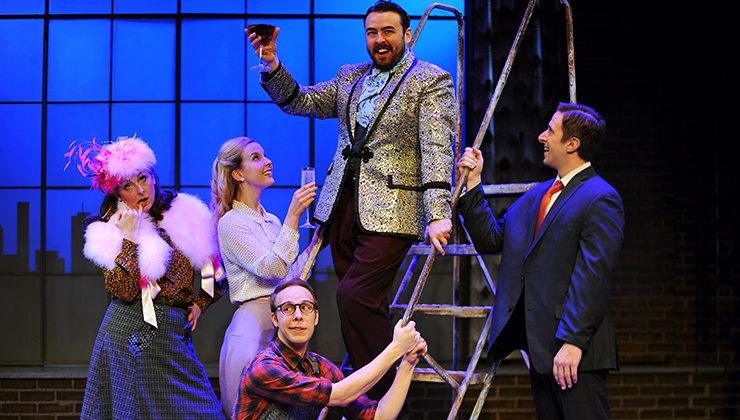


Comedy tonight – a review of “A Funny Thing Happened on the Way to the Forum”


By Michael “Buzz” Buzzelli, ‘Burgh Vivant

Love is in the air on the streets of ancient Rome in Burt Shevelove and Larry Gelbart’s rollicking musical comedy, “A Funny Thing Happened on the Way to the Forum.” It’s something familiar. Something peculiar. Something for everyone. Comedy tonight!

A quick-witted but lazy slave, Pseudolus (Jimmy Kieffer), yearns to be free. His young master, Hero (Jamen Nanthakumar), will grant him his freedom on one condition: Pseudolus must help the youth discover the identity of his lady love and conspire to unite them. Unfortunately, the object of Hero’s affection, Philia (Mary Elizabeth Drake), is promised to another.

Ain’t that always the way?

The beautiful woman is a courtesan in the house of Marcus Lycus (Jeff Howell). Lycus cut a sweet deal and sold the beauty off for a handsome sum to a handsome warrior, Miles Gloriosus (Allan Snyder). A warrior with an ego so big – he makes Camelot’s Lancelot Du Lac look meek and mild in comparison. C’est moi!

Meanwhile, Hero’s parents, Senex (Stephen DeRosa), his father, and Domina (Ruth Gottschall), his mother, have scheduled a trip to the country. The parents leave their major domo and top slave, Hysterium (Gavan Pamer), in charge. Hysterium is sort of the Cameron Frye to Pseudolus’s Ferris Bueller. Pseudolus devises a complicated plan to get Hero and Philia together, and he’s lucky that Hero’s parents are away, because the plan involves Lycus and his phalanx of comely courtesans (Stephanie Maloney, Monica Woods, Brooke Lacy, Andrea Weinzierl, Jessica Walker and Elyse Collier).

The company of A Funny Thing Happened on the Way to the Forum. Photo credit: Michael Henninger

There’s one more important plot point. Erronius (James FitzGerald) returns from his twenty-year absence seeking the whereabouts of his children, who, when babies, were stolen away by pirates. It seems like – -well – – erroneous information when it’s first presented, but, naturally, it becomes important in the final act.

The play follows in the style of commedia dell’ arte, and certain stock characters are bound to show up. We have a clever and witty protagonist, a greedy entrepreneur, young lovers and a lecherous old man or two thrown in for good measure. Shevelove and Gelbart come up with some hilarious situations for these stereotypical characters. Expect mistaken identity, ribald puns and plenty of slamming doors.

It all takes place in front of three lavish Roman homes. The actors are adorned in beautiful, bright clothing by Martha Bromelmeier and dance around the faux marble stage designed by James Noone.

Director Ted Pappas cast the play with top-notch actors.

Kieffer is fantastic as the scheming slave. He is a charismatic lead. While it’s an strenuous performance, he looks like he’s having a ball. His enthusiasm is infectious.

Pamer is a perfect foil. He is relishing his role as well.

There are fine performances from Howell, Drake and Snyder. Gottschall is divine as the shrewish mother, Domina.

FitzGerald is another stand out. He had the audience rolling in the aisle, just by strutting across the stage.

While all the courtesans were extremely beautiful, Monica Woods may be the most alluring woman on stage.

There were three clowns (called Proteans here), that were a little too clownish. In fairness, clowns should be clownish, but they were wildly over-the-top.

Also, some of the action is punctuated with sound effects straight from a Warner Brothers cartoon. It was if the climax was choreographed by Wyle E. Coyote. My biggest note to the director would be to skip the slide whistle and grating cacophony and just let these marvelous actors do their thing. It’s a small gripe in a wonderfully hilarious evening.

It’s just a bit of silly fun, really, but, honestly, don’t we all need some more silliness in our lives?

– MB

“A Funny Thing Happened on the Way to the Forum” runs until February 25 at the O’Reilly Theatre, 621 Penn Avenue, Pittsburgh, PA 15222.  For more information, go here. https://www.ppt.org

Point Park University’s The REP Professional Theatre Company presents A DEVIL INSIDE as its final production in Oakland

PITTSBURGH – Point Park University’s The REP Professional Theatre Company presents its final production at the Oakland location before the opening of the new Pittsburgh Playhouse in downtown Pittsburgh this fall. David Lindsay-Abaire’s A Devil Inside is an outrageous, gruesome, and hilarious story will surely keep you on your toes.

Directed by Kim Martin, A Devil Inside runs from February 2 – 18, 2018, in the Studio Theatre at the Pittsburgh Playhouse, 222 Craft Ave. Performances will be at 8p.m. Thursdays through Saturdays, and 2p.m. Saturdays and Sundays. Adult tickets are $24-29, seniors are $15, and students are $10 and can be purchased by calling the Pittsburgh Playhouse box office at 412-392-8000 or visiting www.pittsburghplayhouse.com.

Gene is an ordinary college student, but his world is turned upside down on his birthday when his mother reveals that his father was murdered many years ago. Now of age, he must avenge his father’s death that begins a farce that involves Gene, his mother’s laundromat, the girl he’s sweet on, the tormented literature professor she’s infatuated with, the fix-it guy, and a mysterious artist.

“Someone recently asked me why I picked this show and I told them, ‘because it entertained me,’” said Martin. “It’s funny, it’s violent, it’s bloody and hilarious – it’s all the things I love and hope others will too. I cast funny people who I love being around and if you’re lucky enough to do that – you will never work a day in your life.”

Featuring scenic design by Tucker Topel, costume design by Anthony James Sirk, sound design by Steve Shapiro, fight direction by Samuel G.C. Muñoz and light design by Andrew David Ostrowski.

Following the Thursday, Feb. 15 performance will be a Talk Back with the cast to answer questions and dig deeper into the themes and topics of the show with audiences.

A special lecture series, Freud on Forbes will be presented following the Saturday, Feb. 17 performance of A Devil Inside at 8 p.m., members of the Pittsburgh Psychoanalytic Center will analyze the script in order to help the audience get inside the mind of the playwright.

Kim Martin received a B.A. in Fine, Applied and Performing Arts in 1987 and an MBA in Sports, Arts and Entertainment Management in 2016 at Point Park University. Kim has directed, acted in, stage managed and/or produced over 300 productions. Some favorites over the years include: Playboy of the Western World, Becky’s New Car, The Lonesome West, Mojo, Killer Joe, The Birthday Party, Glengarry Glen Ross, Guys & Dolls, Drinking in America, Deathtrap, The Dumb Waiter, Annie, La Ronde, and Three Sisters.   Kim has truly made Point Park University her second home since 1999, when she returned to the Playhouse to serve as Production Stage Manager. She is currently the Producing Director at the Pittsburgh Playhouse, and functions as an adjunct faculty member instructing students pursuing a technical theatre degree.


Pittsburgh Playwrights warms the winter blues IN THE HEAT OF THE NIGHT

PITTSBURGH – Acclaimed playwright Matt Pelfrey’s adaptation of John Ball’s award-winning book In the Heat of the Night, which inspired the Oscar-winning film and the Emmy-winning television series, is still as pertinent and poignant as it was when the novel was written in 1965.  In the Heat of the Night runs February 2 – March 11, 2018.

It’s 1962. A hot August night lies heavy over the small town of Argo, Alabama. A dead white man is discovered and the local police arrest a black stranger named Virgil Tibbs. The police learn that their prime suspect is in fact a homicide detective from California. As it happens, Tibbs becomes the racially-tense community’s single hope in solving a brutal murder that is turning up no witnesses, no motives, and no clues.

Monteze Freeland (named 2017 Performer of the Year by the Pittsburgh Post-Gazette) directs a cast that includes Kevin H. Moore, Tal Kroser, Jenny Malarkey, Arthur Peden, Daniel Pivovar, Adam Seligson, Brett Sullivan Santry, and Jonathan Visser.

Matt Pelfrey’s adaptation and PPTCO’s production promise to aid in the expansion of this classic by telling this story in a way many audiences have never seen, keeping the danger, mystery and suspense at the forefront of the drama, yet also mirroring an era of power and greed that still lingers in the thread of our country.

Performance times are 8 p.m. on Friday & Saturday; with matinees on Sunday at 3 p.m. and the last three Saturdays at 2p.m. at Pittsburgh Playwrights Theatre, 937 Liberty Avenue in the Cultural District, downtown.

Tickets are $27.50 in advance, with no ticketing surcharges. Prices at the door are $5 higher than online prices. Monday February 19th is “Pay What You Can Night,” at the door only. Tickets are available for purchase at www.pghplaywrights.org/in-the-heat


css.php