

Gunplay – a review of “Rules of Seconds”

By Michael “Buzz” Buzzelli, ‘Burgh Vivant

A few drops of Earl Grey accidentally spilled on the Italian footwear of a querulous shipping magnate escalates into a frightful incident in John Pollono’s “Rules of Seconds.” Hint: There will be blood.

A meek and mollycoddled Nathaniel “Wings” Leeds (Connor McCanlus) is stricken with a disorder that – in modern parlance – would classify him as an obsessive compulsive. Fearing the touch of another, he refuses to shake the hands of Walter Brown (Cotter Smith) after sealing a business deal. Hot-tempered Brown cites the Code Duello, an Irish code of conduct that outlines the parameters for dueling.

Side note: While the play is fictitious, the actual Code Duello – with all of its odd rules – is completely real. Highlights from the original document – drawn up in 1777 – included the formal steps of an apology, proper dueling etiquette and the role of seconds.

Rule 14 (as narrated by Jack Erdie): “Seconds must be of equal rank in society with the principals they attend, insomuch as a second may choose or chance to become a principal, and equality is indispensable.”

Wings sidesteps protocol once more and reaches out to his estranged brother James (Patrick Jordan) and act as his second to negotiate with the disgruntled party. While the estrangement of the two brothers remains secret in the first act, all is revealed before the final curtain. Let’s just say, their mother, Martha (Robin Walsh) is less than thrilled to see the return of her prodigal son.

Hannah Leary (Nancy McNulty), Walter Brown’s maid, is also unhappy about her reunion with James.

Meanwhile, Wings and James try to dissuade Brown from dueling with pistols at dawn, but the combative Brown will not be charmed out of the fight. He introduces his second, Señor Jeronimo Sanchez de Carranza (Mickey Miller) and his doctor (Jack Erdie). The Leeds brothers find their own doctor in Albert Chang (Donald Chang), a man who has sparred with James in the very recent past.

Martha (Robin Walsh) pleads with Walter Brown (Cotter Smith) to spare her son…among other negotiations. photo credit: Andrew Ostrowski

Side note: The Latino Theatre Company and the Tremblors, a collective of seven Los Angeles- based playwrights produced the world premiere of Pollono’s “Rules of Seconds.” The original cast included Leandro Cano, an actor who has frequently trod the boards of the barebones stage.

While the subject matter of “Rules of Seconds” is very grim, it is a dark comedy, rife with humor. The play is laugh out loud funny.

There are snippets of dialogue that are jarring. At first, they seem like poorly placed anachronisms. One word, “redneck” seemed particularly out of place, but, on further research, it was discovered to have been used way back in 1873. The citation describes rednecks as “the poorer inhabitants of the rural districts…men who work in the field, as a matter of course, generally have their skin stained red and burnt by the sun, and [this] is especially true of the backs of their necks.” The etymology of the phrase “You’re dead to me” could not be verified.

Director Melissa Martin cast an amazing crew. The actors are superb, especially the distaff members of the cast. Walsh and McNulty are magnificent in their roles. Each of them raging against the inequities of their sex – a heavy burden of the mid-nineteenth century woman. Walsh’s Martha faces several indignities that caused the audience to collectively gasp.

While McCanlus and Jordan don’t look related at all, the brotherly chemistry between them is palpable. They are a joy to watch, especially when interacting with each other.

There is a scene with Dave Mansueto and Wali Jamal that has little to do with the rest of the play, but it is such a beautifully written sidebar that it can be forgiven for traipsing off in its own direction.

Erdie has a charismatic stage presence. He charms the audience even while reading the dry, archaic rules from the Code Duello. He shows up later in the second act in a role that won’t be spoiled here.

While Carranza is taciturn, Miller makes powerful use of each line.

Robert C. T. Steele’s costumes are exquisite – and extremely important to the plot. Remember: the play hinges on the beauty of a pair of leather boots, the infinitesimal stain and the grief it causes. The play has moody lighting from Andrew Ostrowski, excellent sound work from Dave Bjornson and authentic-looking props.

Tickets will go fast. It’s probable that Cotter Smith’s fan base will spark enthusiasm for the production. The actor has been seen in a myriad of television and film, including, most recently, David Fincher’s Netflix series, “Mindhunter.” While he may be a catalyst to get people off their couches and into the theater, he is not the primary reason to go. Go for the incredible performances of the entire ensemble. Go for the humor. Go for the message.

It’s a powerful play. Once you see it, you may go back for “Seconds.”

– MB

The “Rules of Seconds” runs until February 17 at the barebones black box theater, 1211 Braddock Avenue, Braddock, PA 15104. For more information, click here.




Naughty but Nice Christmas – a review of “Sleigh My Name” with The Skivvies

By Michael “Buzz” Buzzelli, ‘Burgh Vivant

The critically acclaimed scantily-clad Indie-pop duo, the Skivvies, returned to Pittsburgh to prove that Christmas is best when it’s both naughty and nice in their holiday offering, “Sleigh My Name.”

Nick Cearley (Off-Broadway’s “Sex Tips Straight Women from a Gay Man”) and Lauren Molina (a member of the original cast of Broadway’s “Rock of Ages”) stripped down to their knickers once again for a festive occasion, and what charming underclothes they both have!

Side note: The musical duo once starred as Brad and Janet in “The Rocky Horror Show” at the Bucks County Playhouse. They’ve been disrobing in front of audiences ever since (with nary a Magenta or Columbia in sight).

Cearley and Molina are extremely talented and probably don’t need the gimmick, however, the nearly-naked derrieres gets people into the theater. Their butts get butts in the seats. At “Sleigh My Name,” the duo sang Christmas favorites – with their own decidedly different twist.

The Skivvies sing and play a variety of musical instruments, including the glockenspiel. Mostly, Cearley plays the ukulele and Molina plays the cello, but it’s their silly “Will & Grace” repartee that will charm you. Cearley and Molina were backed up by local drummer Jacob Beck – also appearing on stage in his briefs. Can I get an “Oh myyyy!”

Cearley and Molina are kind enough to share their stage with additional local talents, such as Hope Anthony, Ryan Patrick Kearney, Becki Toth, Daina Michelle Griffith, Jason Shavers (recently seen at the City Theatre in “Wild with Happy”), Michael McGurk and HGTV’s Paige Davis. There was even an appearance from Santa – local director Stephen Santa (appropriately attired as an elf).

Lauren Molina and Nick Cearley in festive Christmas-themed chapeaus – and very little else – comprise the Indie-Pop duo, The Skivvies.

Brava to Anthony who belted out a medley of dance hits, awarding the buxom chanteuse high diva points, setting an impossibly high standard for the entertainers who followed her. As luck would have it, her follow guest stars were up to the task.

Griffith strolled down memory lane with former high school classmate, Cearley. She had an under garment designed to commemorate the occasion – their prom picture plastered on a white t-shirt. Griffith then proceeded to sing, reminding the crowd how she earned her  title as 2013’s Pittsburgh Post Gazette’s Performer of the Year

Toth was another highlight. She crushed it, giving the evening a slight operatic flair.

Kearney provided additional belly laughs. Kearney’s songs were built around him believing his father was St. Nick, weaving “I saw mommy kissing Santa Claus” into his medley.

The Skivvies served cheesecake and beefcake in equal measure, but Broadway performer and native Pittsburgher McGurk (“The Wedding Singer,” “The Music Man” etc.) was probably the most scantily-clad in an evening of scantily-clad individuals.

Before the Skivvies even took  to the stage, musical improv duo babyGRAND (Connor McCanlus and Missy Moreno) came out and wowed the crowd, creating a short musical play on the spot based on audience suggestion. They were accompanied by James Andrzej Rushin on paino and Aaron Tarnow on bongos.

Ironically, the evening was punctuated with an Ugly Christmas Sweater Contest, proving it’s better to be wearing less than more, especially if it’s sweater depicting Jesus high-fiving Santa Claus or a Christmas-clad farm animal on your person.

While the Skivvies are singing for adults, they appeal to the child inside all of us. The next time they roll into town, the Skivvies need to be on your Christmas list (or  your “Must See” list depending on the time of year).

You can find out more about them at the City Theatre website, by clicking here, or at their own website by clicking here.  

– MB

A Cut Above the Rest – A review of “The Gift of the Magi”

By Claire DeMarco, ‘Burgh Vivant

It’s Christmas time in the early 1900’s on New York’s east side. Della (Becky Brown) and her husband, Jim (Joshua Mooiweer) are in their $8.00 a week flat discussing their dire financial situation in the opening moments of “The Gift of the Magi.”

Della and Jim have been married for 171 days (as Della has happily recorded in her journal). Jim’s salary as an accounts clerk has just been reduced. As Della helps Jim remove his shoes she sees that they are lined with newspaper to help keep out the cold.

Neither of the newlyweds has enough money to buy the other a Christmas gift. However, they both sacrificed something dear to ensure their partner has a happy holiday. Della sells her hair, and Jim sells his prized watch. But the gifts they purchased in exchange for their sacrifices are no longer appropriate (a platinum chain for a non-existent watch and two hair combs for lengthy hair no longer there).

What is wealth? Della and Jim realize that it’s not an abundance of physical possessions, but the abundance of the love that’s really important.

“The Gift of the Magi” was adapted by Jon Jory from the story by O. Henry.

Brown and Mooiweer were excellent in their portrayal of the young impoverished couple – a well-balanced team.

All other actors in “Magi” with the exception of Brown and Mooiweer played multiple parts. There were noteworthy performances by Davion Heron (as the Watch Clerk) and Blake Doyle (as Madame Vodskaya). Doyle’s comedic skills were on point.

Throughout the play the narrator (Somerset Young), and a chorus of carolers sing and dance providing informative narrative and musical interludes on a simple, yet effective set.

Love and sacrifice are themes that are as relevant today as they were yesterday. As the author O. Henry once wrote, “But in a last word to the wise of these days, let it be said that of all who give gifts, these two were the wisest.”

– CDM

“The Gift of the Magi” runs until December 17, 2017 at The Pittsburgh Playhouse – Conservatory Theatre Company, 222 Craft Avenue, Pittsburgh PA.15213.   For more information, click here.

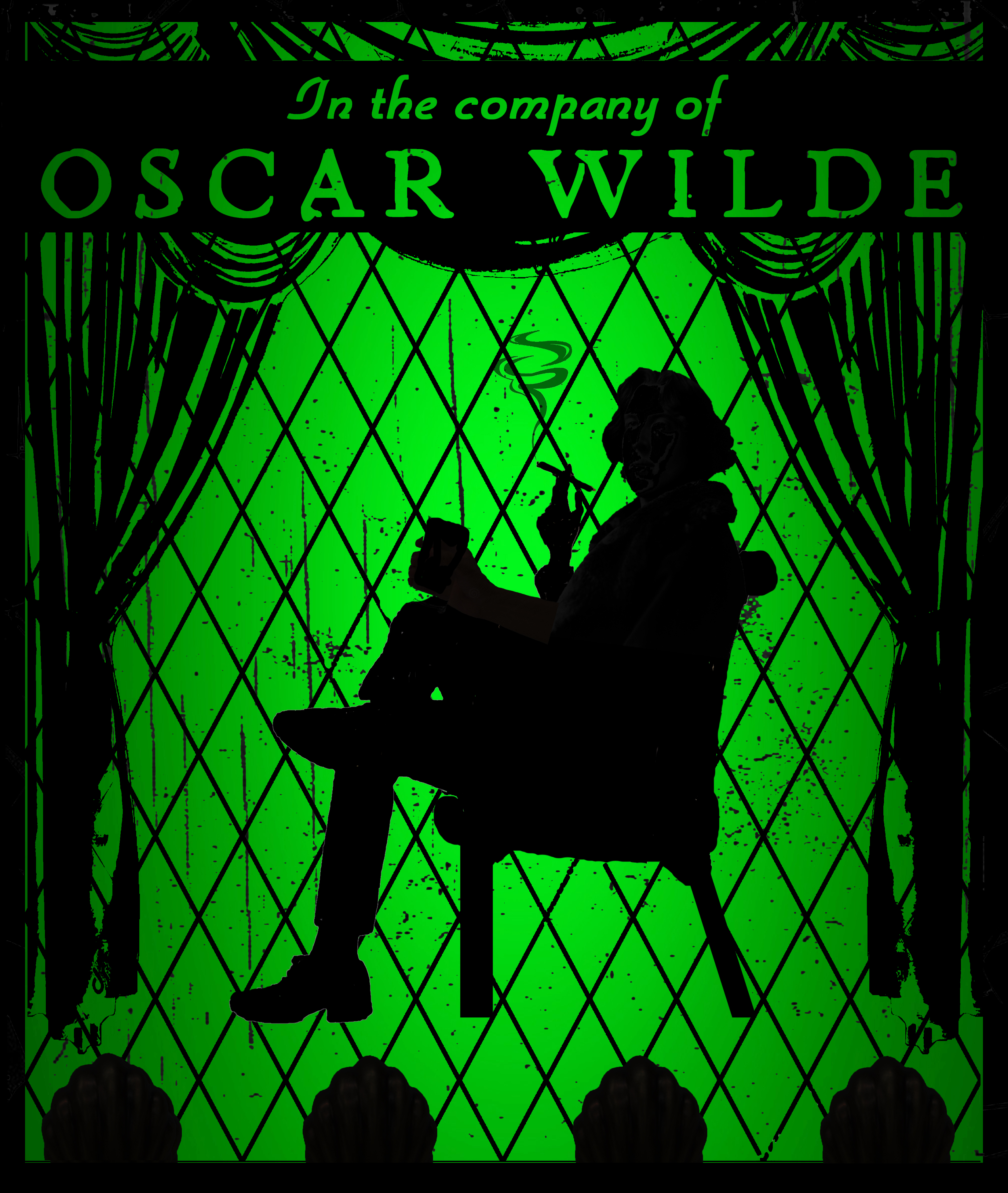
The Ballad of Reading Wilde – a review of “In the Company of Oscar Wilde”

By Michael “Buzz” Buzzelli, ‘Burgh Vivant

Bon mots flow like champagne in the venerable halls of the Frick Art Museum in the U.S. premiere of “In the Company of Oscar Wilde,” a summation of Wilde’s life in the author’s own words.

The presentation is part of a whole Wilde weekend, “Wilde at the Frick,” featuring readings of the author’s fairy tales and a presentation of Merlin Holland’s “The Trial of Oscar Wilde.”

“In the Company of Oscar Wilde,” director and narrator Alan Stanford leads some of Pittsburgh’s finest actors to join the merriment, including Marsha Mayhak, Karen Baum, Martin Giles, and James FitzGerald who fill various roles. There’s also a solid guest appearance from Ingrid Sonnichsen as Lady Bracknell.

Wilde – Oscar Fingal O’Flahertie Wills Wilde to be exact – is an Irish poet, playwright and author known for his acidic wit. “Company” offers up intriguing details of the playwright’s triumphs and tribulations. Stanford recounts important facts from the playwright’s history, from the opening of successful plays to his tawdry affair with Lord Alfred “Bosie” Douglas, son of the Marquess of Queensbury. There is even a detailed account of Wilde’s trial, a prelude to Holland’s opus presented later in the weekend.

Wilde’s story is delivered in linear fashion, from birth to death. Near the beginning of the evening, Stanford recites “Requiescat,” Wilde’s poetic tribute to his late sister, in a powerful, moving moment.

There are lengthy but brilliant excerpts of “The Importance of Being Earnest,” expertly performed. Sonnichsen’s Bracknell is a tour de force, delivering caustic observations with aplomb.

Her performance is so strong, this audience member yearned for a complete production of “The Importance of Being Earnest” on the spot.

That’s the real problem with the show. “In the Company of Oscar Wilde” is a dramatic presentation that teeters high above the no man’s land between seated reading and full-fledged theatrical production. It’s a reading with movement – very little movement.

The director and cast could have shaken things up. “Wilde at the Frick” runs concurrently with “Undressed, the history of fashion in underwear.” Stanford and company could have performed in their skivvies! Though, Michael Montgomery’s costumes were absolutely exquisite and a highlight of the evening.

Fantastic actors reading brilliant material in a gorgeous setting with lavish costumes should have placed this show squarely in the win column, but, since it was a linear depiction of the artist from birth to death, it came across as a bit monotonous.

Though the presentation ends well with a dramatic reading of “The Ballad of Reading Gaol,” Wilde’s poem about the hanging of Charles Thomas Woolridge, which took place in the prison where Wilde was serving his time for gross indecency. It’s another high point. It just takes a little bit too long to get there.

The author and playwright would never have been bothered by a slightly unfavorable review of his work. He would most likely shrug, puff on his cigarette and declare, “There is only one thing in the world worse than being talked about, and that is not being talked about.”

The good news is, more than a century later, everyone is still talking about Oscar Wilde.

– MB

“In the Company of Oscar Wilde” runs until December 10 at The Frick Art Museum, 7227 Reynolds Street, Pittsburgh, PA 15208.  It runs concurrently with “Oscar Wilde: Fairy Tales” and the “The Trial of Oscar Wilde” as part of the Wilde at the Frick weekend. For more information, click here

Casbah Celebrates Arrival of 2017 Beaujolais Nouveau with a Four-Course Dinner

 by Dave Zuchowski, ‘Burgh Vivant.

Each year, on the third Thursday of November, wine lovers around the world celebrate the release of  a very young red wine whose grapes were harvested only weeks beforehand.

These Beaujolais (bow-zjoh-lay) Nouveau wines from the region just north of Lyon, France fly in face of the accepted notion that red wines are meant to age before they’re consumed  Drinking these youngsters has become a tradition that celebrates the grape harvest and gives wine enthusiasts a glimpse of the quality of the grapes and the flavor profile of the recent harvest in the Beaujolais region.

Casbah interior. Photo: Bill Rockwell.

Fresh and fruity, B.N., as I call it, owes its early drinkability to a winemaking style known as carbonic maceration, an anaerobic fermentation that puts the focus on fruit flavors that come through without the tannins usually associated with red wines.

Made from grapes harvested in the area of Beaujolais not reserved for the more prestigious Cru Beaujolais, which command a higher price and more respect by the wine buying public,  B.N. has nevertheless become a popular seasonal wine eagerly awaited by a market that has become increasingly worldwide. 

Party-givers, restaurants, wine bars, bistros, cafes and wine retailers build festive events and dinners around Beaujolais Day. One estimate pegs consumption on the third Thursday of November at 65 million bottles across the globe.

In Pittsburgh, Casbah in the Shadyside neighborhood has been staging Beaujolais Nouveau dinners for the past ten years, perhaps longer. A one day only affair, the event spotlights a special menu of multiple courses designed to include B.N. wines in each of the dishes and feature foods that compliment the rich fruitiness of the wine.

Bill Fuller, executive chef for the Big Burrito Restaurant Group of which Casbah is a member, said that, of all the restaurants under its umbrella, Casbah best fits the bill for a B.N. dinner because it features wine and food of the Mediterranean.

This year, Casbah’s wine director, Seth Eidemiller ordered ten cases of the B.N., most of which were served as part of the dinner. The remainder of the inventory will be available for purchase at the restaurant for those who missed the dinner at a cost of $10 a glass or $40 a bottle – until the supply runs out.

Even before the four course dinner arrived at my table, I discovered that the labne, a Greek yogurt that is hung in a cheesecloth to remove excess moisture then mixed with black pepper and cream and meant to be spread on bread, paired well with the Beaujolais Nouveau which bore the Georges DuBoeuf label 

The DuBoeuf had assertive fruity notes of strawberry, raspberry, fig and orange peel and came in with 13 percent alcohol, somewhat higher than the 2016 vintage, pegged  at 12%. Interestingly, and perhaps by design, each of the four courses included a fruit component. The Seared Sea Scallop appetizer, for instance, was accompanied by poached pear along with a parsnip root puree, brioche crisps and a parsley salad.

Seared Sea Scallop with poached pear, parsnip root puree, brioche crisps and a parsley salad. Photo: Bill Rockwell.

The Duck Breast and Duck Confit Ravioli was enhanced by fresh fig along with young mustard greens, frisee and duck jus.

The Braised Short Rib was embellished by an apple salad, creamed chard and roasted carrot and celery root. The dessert course, a Pomegranate Tart, was sprinkled with pomegranate seeds, candied almonds and brown sugar crumbles and finished with a B.N. wine reduction.

Duck Breast and Duck Confit Ravioli. Photo: Bill Rockwell.
Braised Short Ribs. Photo: Bill Rockwell.
Pomegranate Tart. Photo: Bill Rockwell.

According to Eidemiller about 100 or roughly half of the evening’s 200 dinner reservations were for the B.N. dinner. The other half got to choose of the restaurant’s regular menu but could order glasses of the B.N. if they chose. Casbah’s carte des vins also lists five Cru Beaujolais which are available only by the bottle.

Ironically, Cru wine labels don’t even mention the word Beaujolais but instead are identified by the village near which the wine grapes are grown.

“Some wine drinkers disregard B.N., but I believe it is to be enjoyed for exactly what it is – a celebration of the harvest and the season and of life,” Fuller said.

If you want to serve some B.N. at home, keep in mind that’s it’s best poured at around 55-degree F. and makes a suitable match for Thanksgiving turkey. Chef Fuller also likes it paired with “rich seafood dishes” like scallops and salmon and “warm and comforting dishes” like bucatini carbonara and braised short ribs.

Overall, the opinion on Beaujolais Nouveau remains divided. Some critics call it too immature and uninteresting. Others like its freshness, exuberance, and pleasant and easy drinkability. 

If you’d like to give it a try of your own, the 2017 B.N. is available at select stores in the Pennsylvania Liquor Control Board System. And, of course, if you want to enjoy next year’s Beaujolais Nouveau Day at Casbah, be sure to circle the third Thursday of November as a reminder when you get your 2018 calendars.

Casbah, exterior. Photo: Bill Rockwell.

Labor of Love – A review of “Love’s Labor’s Won”

By Claire DeMarco, ‘Burgh Vivant

Scott Kaiser, playwright and director of “Love’s Labor’s Won”, envisioned a sequel to a comedic “Love’s Labor’s Lost” that picks up from its dark ending and sets it in a post-World War I environment.  The play is written in verse which adds to its intensity.

The characters in this imagined sequel have all been changed because of the war and are trying to piece together lives with lovers/suitors that were interrupted or changed because of the conflict.

Ferdinand (Christoper Essex), Isabelle (Kennedy McMann), Dumaine (Chase Del Rey), Katherine (Myha’la Herrold), Berowne (Christian Strange), Rosaline (Aubyn Heglie), Longaville (Kyle Decker), Maria (Eleanor Pearson), Costard (Jordan Plutzer) and Jacquenetta (Rayquila Durham) are the couples impacted by the conflict and its ramifications for their country and their future. The war has changed them.  But will they be able to rekindle the relationships they enjoyed previously and overcome the impact war has had on all of them?

Did William Shakespeare write “Love’s Labor’s Won” as a sequel to “Love’s Labor’s Lost”?  No physical copy of the play exists, just the title.  Some pundits think that perhaps the play was simply renamed and performed under another name, but it may be much ado about nothing.

The actors’ performances in :”Love’s Labor Won” are strong and well-balanced with Plutzer providing comedy relief. Durham touches our souls with her singing.

The set is stunning. Out of proportion-covered and partially covered portraits hang in the background above a central staircase, indicating that this grand home was also prepared for war.  When actors seamlessly segued to two garden benches, two pillars and/or a statue (also protectively wrapped), the action occurs outdoors.

Kaiser’s erudite work moves us forward many centuries, bringing the characters introduced in  Shakespeare’s “Love’s Labor’s Lost” into the 20th century, finishing a journey that ended long, long ago.

There’s much to love about “Love’s Labor’s Won.”  It’s a winner!

– CDM

 “Love’s Labor’s Won” runs from November 28 to December 2 at the Purnell Center for the Arts, Carnegie Mellon University School of Drama, 5000 Forbes Avenue, Pittsburgh PA 15213. For more information click here.


By the light of the silvery moon – a review of ‘The Old Man and the Old Moon”

By Michael “Buzz” Buzzelli, ‘Burgh Vivant

After the Old Woman (Alex Falberg) takes off in the middle of the night, an Old Man (Ryan Melia) sets off on a perilous mission to find his wife in Pigpen Theatre Company’s lively, lyrical lullaby, “The Old Man and the Old Moon.”

In an ode to the moon, Percy Bysshe Shelley wrote, “Art thou pale for weariness, of climbing heaven and gazing on the earth? Wandering companionless among the stars that have a different birth, and ever changing a joyless eye that finds no object worth its constancy.”

It turns out the moon isn’t weary, but its operator is. The Old Man’s job is to fill Earth’s satellite with its silvery glow nightly, but he is weary of climbing to heaven and filling up the moon.

His wife, however, is driven by wanderlust. She wants to see the world, but the Old Man can’t get too far from his post or the moon will empty of its liquid light. One night, she takes off without him. Suddenly, he realizes she is more important to him than his lunar assignment, and he sets out to retrieve her.

The play hits all the high notes from Joseph Campbell’s Heroes’ Journey as the Old Man embarks on his epic quest. He encounters many people to assist him with his mission, but his path is fraught with danger.

The Pigpen Theatre Company gathers around a model of their ambitious wooden set.

The Old Man assumes the identity of an illustrious naval captain and commandeers a military vessel to search for his beloved. He encounters the crew, including Llewelyn (Curtis Gillen), Callahan (Ben Ferguson), Matheson (Matt Nuernberger) and more. He also travels by foot and, at one point, via dirigible.

He, literally and figuratively, sails to the ends of the earth to reunite with his wife.

Pay attention. Every word spoken in the story is important. Seemingly throwaway bits and casual lines of dialogue return – like “Chinatown” for children.

The musical folktale is written by the production team at Pigpen Theatre Company, a cadre of former Carnegie Mellon University students returning to Pittsburgh to perform. The show contains song, feats of derring-do and shadow puppets.

It’s a kid’s show for the kid at heart. The folktale is bright and imaginative. It’s a sophisticated children’s show. While it can be enjoyed by younger audiences, Pigpen never panders to the lowest common denominator. It’s more of a mishmash of “Chitty Chitty Bang Bang” and “Charlie and the Chocolate Factory.”  It is a quantum leap from “Disney on Ice” or “Sesame Street Live.”

Stuart Carden directs it with verve.

The actors bounce around the stage like pinballs ricocheting off bumpers in an aggressive arcade game. They also sing and play musical instruments. Its great fun from a magnificent cast.

Falberg, Ferguson and company do a splendid job of filling the show with their own brand of liquid light, wit and magic. You may never gaze upon our lunar companion in the same way again.

-MB

“The Old Man and the Old Moon” runs through December 3 at the City Theatre, 1300 Bingham Street, Pittsburgh, PA 15203. For more information, click here.


Close Encounter of the Familial Kind – a review of “The Humans”

By Michael Buzzelli, ‘Burgh Vivant

When the Blake family gathers for the Thanksgiving holiday in Stephen Karam’s comedy/drama “The Humans,” hearts and peppermint pigs will break.

Parents Erik (J. Tucker Smith) and Deidre (Charlotte Booker) visit their daughter Brigid (Valeri Mudek) and her live-in boyfriend Richard (Arash Mokhtar) in their new apartment in New York City’s Chinatown. They bring their other daughter Aimee (Courtney Balan), Erik’s wheelchair-bound mother, Momo (Cecelia Riddett), cleaning supplies, care packages and plenty of family drama.

Everyone is working through their own problems. Aimee has just broken up with her longtime lover, and contemplating a life-changing surgical procedure on her colon. Brigid receives a misdirected email that rattles her, making her question her career choices. Deidre is losing a battle of the bulge, even though she’s allied with long-time fat-fighters, Weight Watchers. Momo is in the final stages of dementia. But it is the family patriarch, Erik, who is struggling with darkest of secrets.

Richard tries to keep things convivial, desperately clinging to his duties as host, and trying to make a good impression on his girlfriend’s family. It’s an impossible task.

The Blake’s have a rich set of family traditions, including Irish music and the aforementioned peppermint pig ritual, where they go around the room expressing gratitude. Afterward, they smash the candy and eat the pieces.

The play does not follow the usual rules. It’s as if the audience is peeping in on maladjusted family; peering through a window observing them. There is no main character in “The Humans.” It’s an ensemble cast, with each member getting the spotlight, like a feast of side-dishes.

It strays rather far from Norman Rockwell’s Saturday Evening Post version of the holiday with bright plastic bowls, paper plates and copious amounts of wine.

Tempers will flare. Brigid and her mom have it out. As mother and daughter fights go – this squabble falls somewhere between the Violet/Barbara Weston blow-out in “August Osage County” and a much funnier skirmish between Eunice Higgins and Thelma Harper from “The Carol Burnett Show.”

A stellar cast makes “The Humans” shine.

Balan and Mudek have the sibling chemistry down. The duo is able to mine the humor from the text without making it sound too hokey or jokey.

Mokhtar ekes out a strong performance from an underwritten character. He gives Richard a nice depth.

Riddett’s performance as Momo is haunting. The character is a constant reminder of death and loss.

Booker is the main reason to see the show.  Deidre is a helicopter mom who strafes the charges she was meant to protect. Karam loaded the character up with the best lines.

Director Pam Berlin keeps it moving along deftly, excavating depth from the flimsiest of characters.

Michael Schweikardt’s set is a work of art. It’s a cutaway of the duplex. It’s a giant doll house. Picture Barbie’s Malibu Dream Home with much less pink. He’s backed up by terrific lighting and sound, John Lasiter and Zach More, respectively.

“The Humans” is laugh out loud funny, with poignant glimpses into some deep, dark crevices. It will never be a holiday classic, but it is a welcome change from the traditional holiday fare.

– MB

“The Humans” runs until December 10 at the O’Reilly Theater, 621 Penn Avenue, Pittsburgh, PA 15222. For more information, click here.


Love is a Battlefield – a review of “You on the Moors Now”

By Michael “Buzz” Buzzelli, ‘Burgh Vivant

When heroines from classic literature rise up, and shed their romantic shackles, it’s a battle for the Brontë’s in Jacklyn Backhaus’ irreverent play, “You on the Moors Now.”

Louisa May Alcott’s Jo March (Shannon Donovan) from “Little Women,” Jane Austen’s Elizabeth Bennett (Julia Small) from “Pride & Prejudice,” Emily Brontë’s Catherine “Cathy” Earnshaw (Madeline Watkins) from “Wuthering Heights” and the titular Jane (Aenya Ulke)  from Charlotte Brontë’s “Jane Eyre” flee their romantic interests in search of new lives. The heroines push through brambles of heather and meet on the moors.

They are being pursued by their respective beaus, Laurie (Austin Trynosky), Mr. Darcy (Bryan Gannon), Heathcliff (Micah Stanek) and Mr. Rochester (Evan Wormald).

In the moors, the blanket bog becomes a battlefield of broken hearts. Laurie is crushed by the highly-spirited Jo. Elizabeth really starts to see Darcy’s pride (and prejudice) as his marriage proposal is rife with backhanded compliments. Poor Cathy is a victim of a misunderstanding and her Heathcliff is too bullheaded to see the truth. Jane gives up everything, including her name, to run free.

Proto feminism blooms into full blown feminism when these women finally, inelegantly take their destiny into their own hands. Not everything goes as planned. Soon, our distaff troupe of merry singletons are living on ‘smores in the moors. Where they found the Hershey bars is anyone’s guess. The play takes place in a nonlinear limbo where all things are possible, including Jane Eyre beating astronomical odds (literally and figuratively).

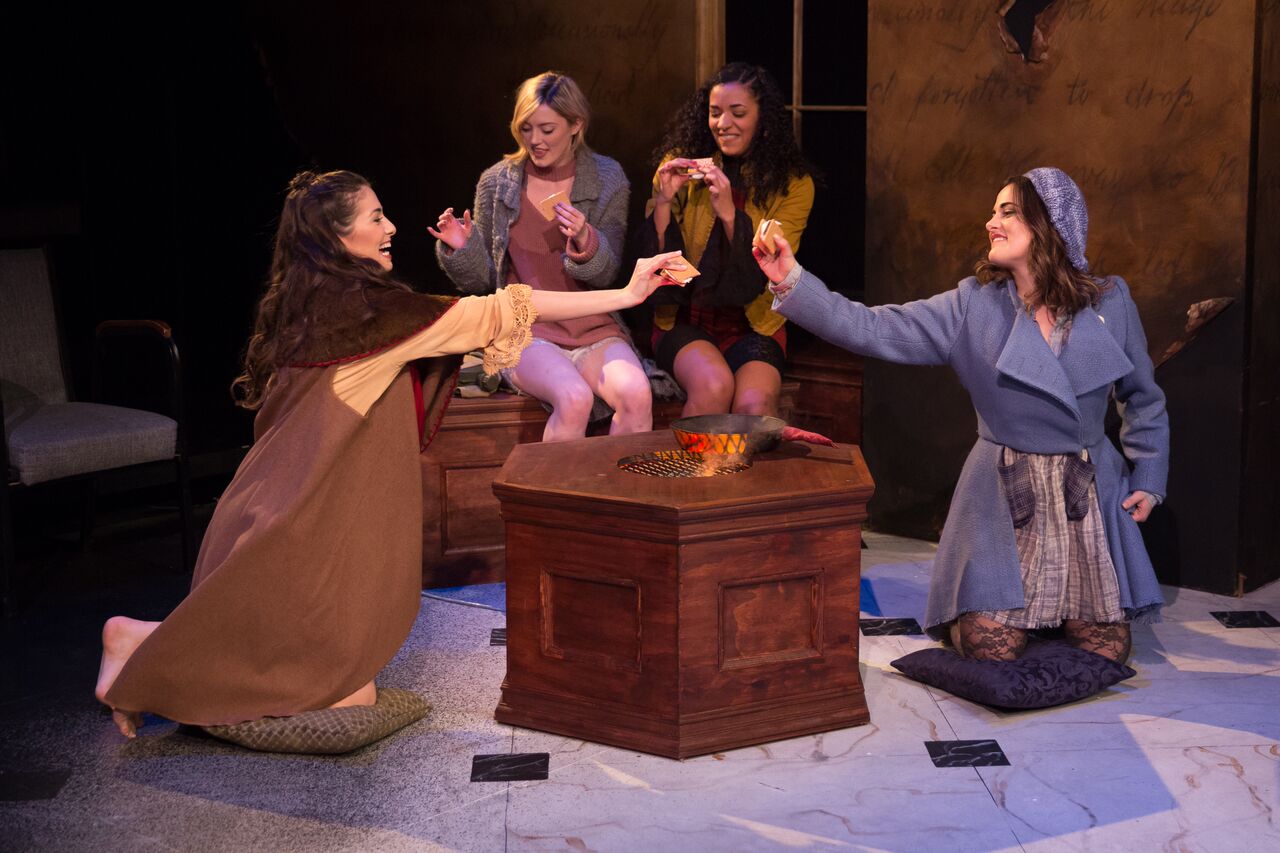
From left to right; Elizabeth (Julia Small), Cathy (Madeline Watkins), Jane (Aenya Ulke) and Jo (Shannon Donovan) celebrating their newfound freedom with marshmallow treats.

Characters from the aforementioned books show up, including Mr. Bingley (Wesley Ehle), his sister, Caroline (Jenna Lucht), St. John Rivers (Daniel Murphy), his sister (Ashley Williams) and quite a few additional surprises.

The final conflict of the play rushes to a conclusion (earlier than expected), and it’s a dizzying battle that is also like a dance. It’s also like Teenage Mutant Ninja Turtles. It’s also like Star Wars. It’s also like a whole host of iconic pop culture similes.

Unfortunately, in love and war there are winners and losers. The comedic play turns deadly serious when a beloved heroine becomes the first casualty of the divisive war between the sexes.

“On the Moors Now” is a lyrical story about women’s roles in society. It’s a treatise on equality. It has some laugh out loud moments and a painful sucker punch at the end of the second act. The third act, is a dreamy fairytale ending, with far too much exposition – like Where-Are-They-Now closing credits to “Animal House.”

Director Sheila McKenna does and inspired job of casting these characters. The cast is superb. Donovan’s Jo March and Watkins’ Cathy look as if they stepped out of the beloved books.

Watins is luminescent as Cathy. It’s a beautiful, poignant performance.

Stanek’s Heathcliff is another standout. He is brooding, boisterous and bold.

Ulke’s Jane was particularly feisty. She had excellent comic timing.

The stage is dark. The walls are lined with persimmon-colored parchment with burnt and blackened edges. It’s as if a love letter was hastily thrown on a campfire, salvaged at the last possible instant and tacked to the wall. Kudos to scenic designer Tucker Topel.

The gothic romantics were lavishly adorned by Terra Marie Skirtich. The costumes were ethereal and timeless, much like the play itself. It looked as if the characters stepped out of a Dr. Who episode, each player wearing clothes that were mixed and matched from various eras throughout history.

Note: A comprehensive knowledge of the female authors of the 19th century is desired but not required.

“You on the Moors Now” is a funny yet poignant story of female empowerment. It’s for anyone who has ever wished to rush into the vault and stay Romeo’s hand when he attempts to kill himself before Juliet wakes. Or better yet, waiting for Juliet to rise and say, “He’s not worth dying over.”

– MB

“You on the Moors Now” is at the Studio Theater in the Pittsburgh Playhouse, 222 Craft Avenue, Pittsburgh, PA 15213. For more information, click here.

 

Let’s get busy, baby – a review of “The Busy Body”


By Michael “Buzz” Buzzelli, ‘Burgh Vivant

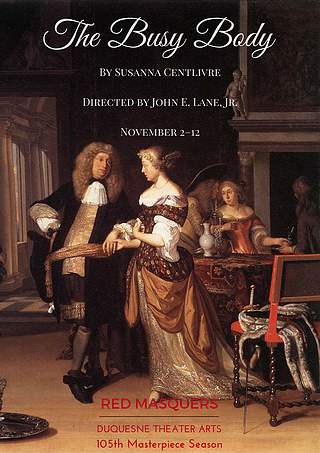
Marplot (Tim Colbert) constantly confounds his friends with his interference into their affairs in Susanna Centlivre’s eighteenth century comedy, “The Busy Body.”

Sir George Airy (Nathaniel Yost) is in love with Miranda (Amy Dick). His friend, Charles (Evan W. Saunders) is in love with Isabinda (Sadie Crow). A couple of obstacles stand in their way. Miranda’s guardian Sir Francis Gripe (Jay Keenan) is in love with his ward and won’t give her up without a fight. Isabinda’s father, Sir Jealous Traffick (Nathan Freshwater), has promised his daughter’s hand to another.

George and Charlies plot against Gripe and Traffick to win the hands of their fair maidens, but a well-meaning buttinsky, Marplot, gums up the works. He inadvertently foils his friends whilst trying to learn their secrets, causing chaos in his wake.

George and Charles are aided by Isabinda’s right-hand-woman, Patch (Nancy Bach Love) and Charles’ servant, Whisper (Tyler Jennings).

Side note: The names are a bit on the nose. Traffick wants to give his daughter to a Spaniard – he’s literally trafficking her overseas. When Whisper speaks – he is all but inaudible. Marplot – by definition – is a meddler.

Greek philosopher Theophrastus once said, “In the proffered services of the busybody there is much of the affectation of kind-heartedness, and little efficient aid.”

Take the Theophrastus quote, crank it up to maximum volume and you have “The Busy Body.”

Marplot blunders into more mischief than Lucy Ricardo, Jack Tripper and Willy Gilligan combined.

The show was produced in 1709, long before the invention of the sitcom. The show, however, is very much a situational comedy (except “The Busy Body” has better costumes).

The characters are gloriously adorned by Kim Brown at Spotlight Costumes. The rich pageantry of the clothing really elevated the play, making it something special.

Director John E. Lane, Jr. is also credited as set designer. His set is elegantly appointed with sparse, but perfectly appropriate scenery. Note: too much scenery can be overbearing. Not enough can make actors look lost on stage. This fell into the Goldilocks zone.

The show is very tongue-in-cheek. It’s silly bit of cotton candy, a fluffy ball of nothing. There are also a lot of characters running around. It’s easy to get lost if you’re not familiar with the work.

There are a few funny moments. The inaudible buzzing of Whisper and the reactions from the other characters who were out of earshot were laugh out loud funny.

While the show is named for Marplot, he isn’t really the central character and there was no strong point of view.

The show did use an ancient theatrical contrivance: characters had asides, wherein the characters spoke directly to the audience about their plight. However, the frequent asides by various characters placed the protagonists farther back into the shadows.

“The Busy Body” did have some very fine performances from the distaff members of the team. Dick shines as Miranda. There’s a familial chemistry between Isabinda (Crow) and her servant (Bach Love). The actors display a moving mother/daughter relationship between the characters.

Kudos for the Red Masquers and John E. Lane, Jr. for bringing this eighteenth century playwright into the spotlight (into Spotlight’s sumptuous costumes).

Sophisticated palates may want to stray away from this production. If, however, you’re in the mood for a silly romp, go get busy with “The Busy Body.”

– MB

“The Busy Body” runs till November 12 at the Genesius Theatre, on the Duquesne University campus, 600 Forbes Avenue, Pittsburgh, PA. For more information, click here.

 

css.php