Inside dish on interviews, editorials, events listings, musings from the minds of BV’s contributors, viewer mail, and other bits of fabulousness — It all goes into The Shaker, ‘Burgh Vivant’s bacchanalian bulletin board. Saddle up to the bar, and get ready for another round of what’s shakin’!
Blanche DuBois (Ponny Conomos Jahn) finds herself at the end of the line (literally and figuratively) when she steps of the trolley in search of her sister, Stella (Jena Oberg) in Tennessee Williams’ classic tale, “A Streetcar Named Desire.”
The faded southern belle leaves her plantation Belle Reve and enters a small, ramshackle neighborhood – just outside of the French Quarter in New Orleans – named Elysian Fields. It’s a far cry from poetic Elysian Fields of myth and memory. In a tenement – in this ironically named parish – Blanche reunites with Stella. There, in the squalor of her new surroundings, Blanche finally meets her sister’s husband, Stanley Kowalski (Buddy Wickerham).
Blanche finds him boorish and brutish. Stanley does not receive his sister-in-law with open arms. They are wary of each other, like cats circling one another, fighting for the same patch of sunlight.
It’s a big adjustment for the downtrodden DuBois sister as she goes from antebellum to urban. She has fits of panic and needs the occasional glass of liquor to soothe her nerves. Lying! She goes through bottles and bottles of it. Her only salvation comes in the form of a gentleman caller, Mitch (Gregory Caridi), or so it seems.
While Blanche has a tragic backstory, she twists it to her advantage, particularly in the presence of younger men. She obfuscates, prevaricates and humiliates Kowalski. Stanley, however, is determined to destroy her.
Spoilers – even though the play is nearly seventy years old – Stanley does triumph. He pins her down on the mat like a studio wrestler. It’s one devastating blow after another. He destroys her relationship with Mitch, damages her relationship with her sister and finally…rapes her on his marriage bed. She has a psychotic break with reality and both of the Kowalski’s agree to ship her off to a sanitarium. It’s a bitter end to the bitter queen of Belle Reve.
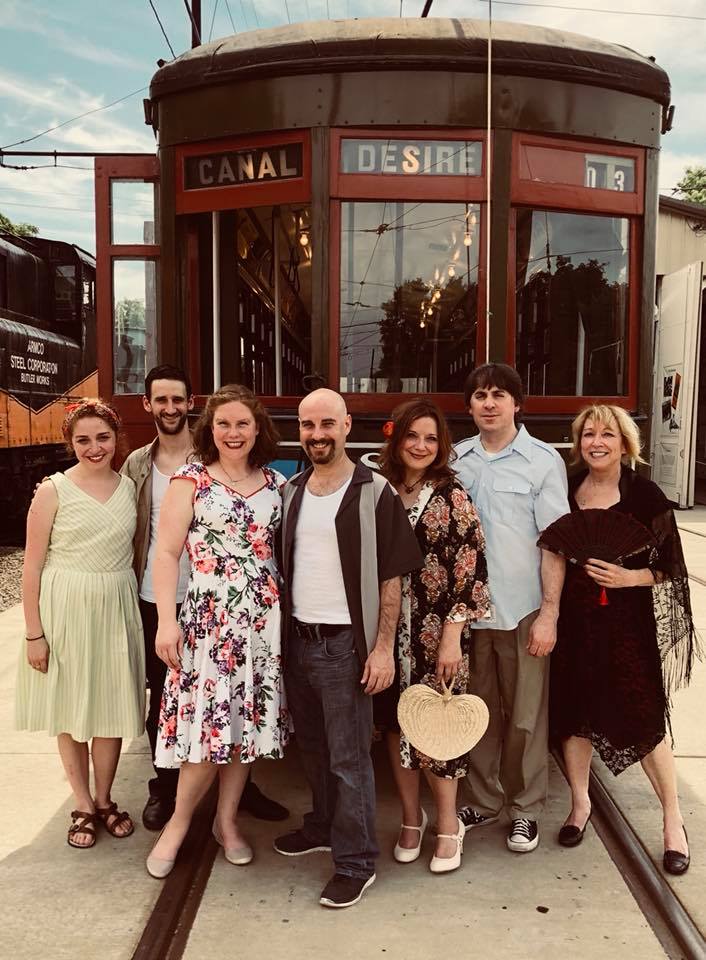
A portion of the cast gathers in front of a streetcar named Desire (the now defunct line that ran through New Orleans, LA is now housed at the Pennsylvania Trolley Museum).
While there were a few shaky lines on opening night, Conomos Jahn does a spectacular job as the sultry and sullen southerner. She delightfully dominates in every scene – as any Blanche DuBois should.
Like Stanley everyone should be shouting Stella, or in this case Jena. Oberg does an amazing job. Make no mistake, Stella is culpable for Blanche’s fate as well. Oberg shows an incredible range of emotion making the final scene heart-wrenching.
Wickerham burns with intensity.
There’s a stellar(STELLA!) job from the rest of the cast: Aleta Richmond, Sadie Crow, Jared Pfennigwerth, Arjun Kumar, Shawn White (not the flame-haired snowboarder) and Dewayne Curry.
Art DeConciliis does a fine job directing his menagerie of actors.
There is an overabundance of scenery that obscures views of this bright and energetic cast. Almost all Little Lake Theatre productions are performed in the round, and that’s always going to be an issue, but a little bit less scenery could have mitigated the problem.
Also, the music and sound production overpowered the dialogue in some critical moments. I want to hear these wonderful lines spoken by this cast!
Note: On opening night, a set of rowdy theater-goers decided to make their own merriment and performed their own spoken word pieces through the majority of the second act, even after being shushed. If you can’t keep your trap shut, stay home and watch the movie version. It was Stanley Kowalski’s night to handle all the rude and uncouth behavior. Don’t overshadow his barbarism with your own!
“Memories,” by Panic! In the Disco, goes, “And it was beautifully depressing, like a streetcar named Desire. They were fighting for their love that had started growing tired.” Williams’ story is exactly that; beautifully depressing. Melancholy – artfully done.
“A Streetcar Named Desire” runs until July 28 at the Little Lake Theatre, 500 Lakeside Drive, Canonsburg, PA 15317. For more information, click here.
The Pittsburgh New Music Ensemble has been a mainstay of the Pittsburgh music scene for many years. Now ready to begin its 43rd year on July 6 with a 4-week series, the Ensemble will perform at the City Theatre on Pittsburgh’s South Side.
The first two weeks alone will feature five world premiere commissions, a not unusual occurrence considering the Ensemble’s legacy of performing more than 300 world premieres. Interestingly, the season spotlights topics as varied as “the tragedy of infertility to the need for remembrance, from the five stages of grief to a genre bending tribute to Bernstein, Gillespie, and Monk, and all the way to the goofy but poignant remarks of children around the dinner table.”
The series of concerts will include not only music but also visual art, poetry, shadow puppetry, and animation – and Week 4 will reprise “The Gray Cat and the Flounder,” which enjoyed two performances during PNME’s 40th season to a packed house in 2015 and a closing night SELL OUT performance – the first in the Ensemble’s history.
Below artistic director, Kevin Noe discusses the upcoming performances with Burgh Vivant’s Dave Zuchowski. A detailed account of the upcoming season can be found on Dave’s blog www.pittsburghowlscribe.blogspot.com
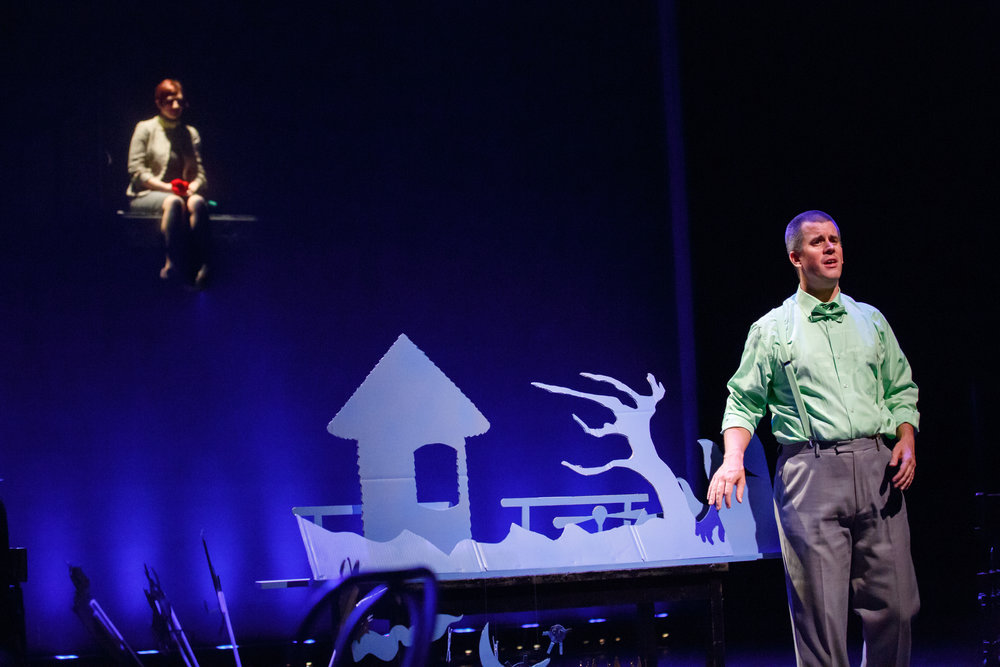
The Gray Cat and the Flounder. Kevin Noe, Right. Photo: Alisa Garin Photography.
DZ: Does the Ensemble have a regular corps of musicians that are augmented by soloists when needed? If so how many are regulars and how to you go about selecting them and the appropriate accompanists for each work? Are they mostly local talent or do they come from much further away?
KN: The PNME Theatre of Music is made up of a core ensemble flute, clarinet, percussion, piano, violin, cello, soprano, bass-baritone, lighting designer, and sound designer. This is what we consider to be the “lime green dream team”. There are three members of the ensemble that have been with me for 17 of my 18 years, and most have been together for 10+ years. Every once in a while, we have a team member move on, but it takes us years to replace them! The type of intense work that we do in working with brand new compositions incorporating staging, lighting, theatrical elements etc… the important thing is trust! We all trust each other implicitly and it’s the only way we are able to create the art we do in the timespan that we have. When we commission works, composers know of our instrumentation, but sometimes can’t help themselves but to write also for a double bass or a trumpet for example. We have only a few (if any) guests per year that perform with us. It all depends on the season.
The only one of the team who live here in Pittsburgh is Andy Ostrowski, our lighting designer. Everyone else is spread throughout the country and the world. Our pianist was born in Sweden but lives in Vienna, our violinist was born in London but lives in Paris. The rest of the team is spread all around the country throughout the rest of the year and we all convene just once a year in Pittsburgh and bring the best of all worlds together for our audience.
DZ: The program for Week 1 lists three world premieres by American Composers Forum national competition winners chosen from 474 applicants. Each one has a specific theme with a broad range of inspirational fodder. The selected compositions vary in thematic content from dinnertime conversations between the composer and his 2 and 4 year old sons to a touching tribute to the 100th birthdays of Thelonius Monk, Dizzy Gillespie and Leonard Bernstein (three artists who have influenced jazz bassist and composer to Rufus Reid’s work) and Elizabeth Kübler-Ross’s classic model of the Five Stages of Grief – Denial, Anger, Bargaining, Depression and Acceptance – woven into words and music by composer, Jung Yoon Wie. How did these three particular pieces end up on your program and will the aural experience be as wide ranging and sundry as their thematic referents?
KN: These three compositions are commissions – and incredible ones at that! The competition was set up so that we chose three composers to write us a piece for PNME. Last summer they came to Pittsburgh with us during July and saw the vibe, met the musicians, experienced the type of art that is possible in our Theatre of Music and then left to composer during this last year having a real understanding of the possibilities for their composition to be premiered this weekend! Thematically the three compositions may seem very disjunct on paper but wait until you see how we pull all the threads together this weekend. It is really going to be a strong concert – one of our strongest all-commission concerts ever in our history. Throughout the organizations 43 years we have commissioned over 300 new works, not all of them successful, but this weekend we lucked out. These three composers created stunning pieces and we’re so honored to be working with them this week. Shout out to the incredible American Composers Forum for making this concert possible.
DZ: Several of this month’s series of concerts involve a collaboration between the Ensemble and visual artists, puppeteers, poets even a cartoonist. Has the Ensemble had an extensive history of working with artists outside of the musical arena? How are they and their work woven into the upcoming performances and how do they affect the overall audience experience?
KN: Yes! We call ourselves the PNME Theatre of Music because truly anything goes! We pride ourselves on using music for the vehicle for larger ideas, but if the story is best told through dance or slam poetry as well, we will make it happen. Our audience is incredible. They all show up not knowing what to expect, but having real trust that the experience, no matter what is it, or how it is realized, will be worth being there for.
DZ: I see that you’ve been credited with developing a presentation style for the Ensemble now known as “Theatre of Music.” Could you explain what is meant by this term?
KN: When I came to PNME in 2000, there was a lot of great commissioning happening, but it was all concert style, and to me, lacked guided listening. The audience in 2000 was the typical new music audience – composers, musicians, etc, and was not accessible to a broader group of listeners. Once I started truly focusing on the audience, a lot of things started to take shape for me. We started to incorporate lighting and sound design as fundamental tools for expression. We also put storytelling, no matter the media, at the forefront. Our audience is mainly made up of NONmusicians now, and I couldn’t be prouder that they trust us to bring meaningful experiences to them year after year even if they have no base for understanding how.
DZ: Any advice for newcomers who may not be familiar with New Music? How should they approach the concerts, what should they expect and what do you hope they will take with them when they leave the theater?
KN: A Theatre of Music concert isn’t a typical New Music concert. Yes, commissioning new work is a big part of our mission, but audience members come having no expectations because they have learned over the years that one weekend’s concerts at PNME are completely different than the next and the following. One may lend to Music Theatre, the next hard core New Music, the next jazzy with poets or dancers etc. You never know what you’re going to get at PNME. As for walking into any New Music concert, even if it’s not something that is necessarily your favorite composition… it is still great to always keep in mind that the page was blank, and the composer sat down and decided what you are hearing is what they wanted to express. The page was BLANK! I am so grateful to have worked with so many truly extraordinary composers and it has given my life so much meaning.
DZ: What drew you to New Music and, as someone who is also immersed in theater, opera, writing, stage directing and playing the trumpet, how much time do you devote to it? How do you balance all these different areas of interest in your life?
KN: I’m not sure I’m necessarily drawn to new music – per se. I am drawn to deep artistic experiences shared with an audience. The artistic media itself isn’t actually that important to me, but the connection to the audience means everything. Working in New Music means working on creating new work – of our time – for our generation – born of today. It also means getting to work with some of the most talented musicians I’ll ever have the honor of working with as many of the finest musicians in the world today focus on new music and early music.
I devote as much time to it as I possibly can, but certainly it is never enough. Since my life and career have always been divided into two parts as a dedicated teacher who believes passionately in working with younger people, and as a professional performer/creator who is focused on creating new experiences for audiences, I’ve continually juggled those two identities. Perhaps at some stage I’ll wind up focused on just one, but I will always have a heart in both camps.
DZ: As an avid advocate of the arts, what do you see as the value of art for either a creator or consumer and for individuals as well as society at large?
KN: When art is impactful it positions us to better understand our world and our unique place within it. Art gives form, identity, and perspective. It gives us time and place. This broadened and color filled awareness gives art its power. Even during the most divisive period we’ve been in during my lifetime, we are all more similar than we are different. Art of all mediums has a way of bridging the gap between us and reminding us what being human is all about. This is why I go. I need that. And on the nights that it really hits – there’s nothing better. I leave knowing my world is always bigger than I could have ever imagined.
For tickets and more information on Pittsburgh New Music Ensemble’s 2018 Season, visit www.pnme.org.
Hark! Listen! Pay Attention! Something funny this way cometh!
“William Shakespeare’s Long Lost First Play (Abridged)” is based on an imaginary discovery of the Bard’s first play. Found in a hole in a parking lot in Leicester, England, this fictitious find is the first play written by a seventeen-year old William Shakespeare (and in his own hand). Tallied at over 100 hours of play time and approximately 1639 characters, this “masterpiece” contains every character Shakespeare ever created, every plot ever developed, every mistaken identity ever devised, every set of twins envisioned; an imagination gone wild!
Puck and others (Reed Martin), Hamlet, Shakespeare and others (Austin Tichenor) and Ariel and others (Teddy Spencer) take this hypothetical discovery and trim it down to a reasonable output.
The audience is also involved intermittently on how this huge work will be reduced from at one count, Act IV, Scene 2079 to something more reasonable.
Shakespeare finally concludes that there are perhaps 39 or more plays contained within this giant undertaking. Hamlet should be a standalone play, Puck and Ariel will not be paired together, Lady Macbeth and Hamlet did not have “a thing.” Perhaps more thought was also needed for some of the character names. Romeo and Ethel may need rework, fine tuning.
The stage is unadorned with a backdrop suggesting an outdoor façade with two open doorways.
Martin, Tichenor and Spencer transition from one character to another, changing costumes that reflect their new identity (whether male or female) to dialogue delivered in verse to natural conversation.
Their efforts are seamless and smooth. Comedic timing is perfect. Martin, Tichenor and Spencer’s actions are fast paced, but not frenetic. They segue easily between changes in character and costumes and deliver a potluck of innuendoes, puns, sarcasm and double takes.
Hilarious, amusing, farcical and even silly. Silliness is a wonderful sensation and should be succumbed to as often as possible.
It doesn’t matter if you love Shakespeare or not, funny is funny.
“William Shakespeare’s Long Lost First Play (Abridged)” is written and directed by Reed Martin and Austin Tichenor.
CED
Performed by the Reduced Shakespeare Company, “William Shakespeare’s Long Lost First Play (abridged) runs through July 1, 2018 at the Pittsburgh Public Theater, 621 Penn Avenue. For more information, go here.
“Building the Wall” is based on a combination of factual events interspersed with hypothetical situations. It’s 2019, President Trump has been impeached, and Rick (Tom Kolos) is in prison.
How did this happen? In 2017, several blocks of Times Square are nearly destroyed from a terrorist attack in response to the effects of edicts from Homeland Security on immigration. From this attack, problems escalate over much of the year. Martial law is declared. It’s aimed at detaining anyone deemed a risk to national security. Containment centers overflowing with people ultimately spin into chaos and disaster. Rick was involved in one of these centers.
Gloria (Lauren A. Bethea), a history professor, meets Rick in prison. Rick has been charged with a series of crimes at a containment center. Gloria wants to engage Rick in an unfettered interview that would detail his point of view. Rick’s involvement in this tragedy began as a seed that grew from “If you don’t control your borders, you don’t have a country” to a participant in a series of evil happenings.
Even after his admissions are divulged (and they are horrific, reminiscent of the Nazi horrors during World War II), there is still a wall that divides Gloria’s world view from Rick’s. Although this wall is not a physical one built with brick and mortar, it is a microcosm of the division in the country.
The setting takes place in a prison room – one table, two chairs, two plastic cups on the table.
Kolos runs the gamut of many emotions – from a seemingly sensitive person recalling his wife and family to an argumentative, indifferent player in the tragic events. His body movements express many of these emotions – leaning forward and getting in Bethea’s face to make a point, slouching in his chair, pacing around his side of the table.
Bethea is believable as she cleverly seduces Rick with the right tone and words to bring out the truth. She transitions easily from a calm interviewer to a challenging and sometimes aggressive interrogator.
“Building the Wall” is a thought-provoking play written by Robert Schenkkan and brilliantly directed by Ricardo Vila-Roger.
CED
“Building the Wal” runs May 24-June 10. All shows at The Richard E. Rauh Studio Theatre at the University of Pittsburgh Cathedral of Learning, 4200 Fifth Avenue, Pittsburgh, PA 15213. For more information, click here.
Lyle Kessler’s comic drama, ORPHANS comes to Lawrenceville’s Aftershock Theater, 115 57th Street, May 31 through June 23rd.
ORPHANS is a dark and devastating family comedy centered on two orphaned brothers and their life-changing encounter with a wealthy and mysterious businessman.
The standalone production of 16 performances is directed by Ingrid Sonnichsen and produced by and starring Max Pavel, Dylan Marquis Meyers, and Ken Bolden. Sonnichsen has taught acting at CMU for decades and has staged such acclaimed productions as THE PINK UNICORN and BYHALIA, MISSISSIPPI. Pavel, Meyers and Bolden are familiar to local audiences from their extensive work at PICT Classic Theatre, Quantum Theatre, and Pittsburgh Public Theater.
The production team includes Cotter Smith (Netflix’s MINDHUNTER and RULES OF SECONDS at barebones), who consults on the production around a new rehearsal technique based on Active Analysis.
Playwright and Philadelphia native Lyle Kessler saw ORPHANS first produced in 1983 at The Matrix Theater Company in Los Angeles. It has been produced at companies such as Stepphenwolf in Chicago with a production that moved to Off-Broadway. In 2013, ORPHANS played on Broadway, garnering a number of award nominations and an enthusiastic fan base.
It’s one thing to get up on the wrong side of the bed, but it’s especially troubling when there’s someone else in the bed who doesn’t belong there.
That’s the dilemma Bill (Michael Greer) faces on his wedding day. Problem is that the woman in the bed is not his bride-to-be.
Fibs, untruths, lies, misleading conversations, exaggerations, role playing, mistaken identities unfold as Bill and his unwilling friend, Tom (Tim McGeever) attempt to create a charade, keeping bride-to-be Rachel (Hope Anthony) from finding out about Bill’s errant behavior. Pulled into the ruse unwittingly or under duress is “bed partner”, Judy (Julia Geisler), Julie the maid, (Julianne Avolio) and Rachel’s mom, Daphne (Christine Laitta).
This frenetic comedy takes place in the honeymoon suite of a fancy hotel; with a sitting room on half the stage, and the bedroom on the other. The actors make the acrobatics look effortless. The slapstick comedy is flawless and is essential to the success of “Perfect Wedding.”
As the play progresses, each character’s anger level and comedic characterizations increases as the fibs are unraveling and new fibs are created in their place. The chaos and conniving finally comes to a surprising conclusion.
Julie Geisler grabs Tim McGeever and drags him off the wedding cake in the promotional art for “Perfect Wedding.”
All the actors have great comedic skills and as an ensemble and they are uniformly talented, complementing one another. This is a comedy with complex scenarios that would not work without a coordinated group of actors.
McGeever is brilliant as Bill’s friend who gets pulled into the ruse. His melt down scene when he discovers that his girlfriend has been unfaithful is spot on.
Greer’s character initiates an entire scenario of events. He is a talented physical comic.
Anthony grows from an unaware bride-to-be to an effective, vocal, and determined bride-to-be.
Avolio’s delivery is excellent, her facial expressions are priceless. She is a natural comedienne.
In one of the only calm scenes, Geisler transitions from the agitated “bed partner” into a thoughtful, caring person.
Laitta is on mark as the overexuberant mother of the bride.
Michael Barakiva brilliantly directed Robin Hawdon’s script.
“Perfect Wedding” is an energetic romp designed to tickle your funny bone.
CED
“Perfect Wedding” runs through August 12 at Cabaret at Theater Square, 655 Penn Avenue, Pittsburgh, PA 15222. For more information, go here.
Everyone – or nearly everyone – has read a poem or two in their lives. Some of us may have even written one. Picture your angsty teenage reflection toiling over a line about the hunky high school football star or the unfairness of an allowance reduction by the despotic leaders of your family circle.
Poetry is cathartic. It releases the primal feelings of love and hatred, loneliness, poverty, desperation – all the feelings that come very naturally with being human and all the situations that we sometimes fail so gloriously to articulate. Spoken words have even greater power; thrusting-out the emotions that lie two dimensionally on a page.
Pittsburgh is home to some amazing poetry slammers. These are men and women who serenade us with the same passion, the same intensity that forced their pens to move. Slam poetry is performance poetry, and some refer to it as three-dimensional poetry. The participants get to experience the feelings in the moment by hearing the words spoken with the same unadulterated passion the poet felt at the moment they were drawn write.
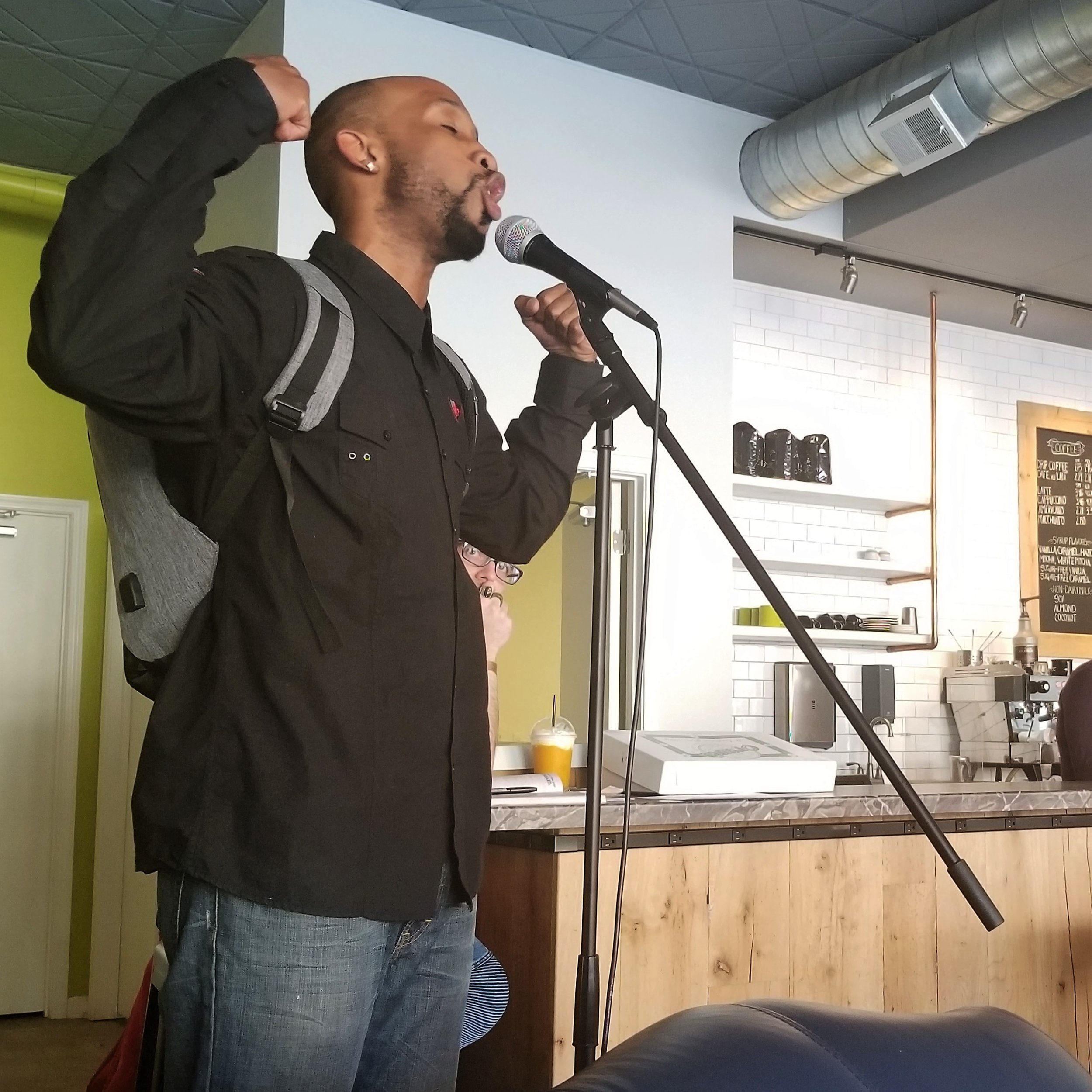
“Backpack” Jeff Young demonstrates his poetry prowess at the mic. Photo Credit: Stacey Christe (Coraopolis Business Association).
Coraopolis is the newest home to one of these poetry slams. Financially sponsored and organized by Christopher and Tiffany Myler, who are the owners of a local holistic healing business, Raion Zou Holistic Healing, the Coraopolis Poetry Slam came to life on January 13th. Some people may ask how you make the connection between the business and the poetry slam. To Christopher Myler, who spent his formidable years slamming around Pittsburgh, the connection is simple – anything that allows us to express ourselves, who we are, and how we feel in the present moment is healing.
The rules are simple: all poets must bring three original poems. Being a competition, it is a three round elimination. Judges are selected randomly from the audience, and poets are scored on a 0 – 30 basis founded in how the poem moves each judge. The mean of each score is used to determine who advances to the next round. In the final elimination round, the poet with the highest score wins a cash prize.
The Coraopolis Poetry Slam has attracted the attention of slammers from all over the Pittsburgh area, and as far as Uniontown, PA. It is hosted by Andy Theobald, owner of Anchor Anvil Coffee Bar in Coraopolis. Anchor Anvil was proud to be the host site for the poetry slams. The Coraopolis Poetry Slam occurs on a bi-monthly basis, and it is free and open to the public.
The next slam is June 23rd beginning at noon, and sign-ups are open. If you wish to participate or observe, for more information, click here.
A lyricist collapses from an arteriovenous malformation in his brain, and needs a craniotomy in William Finn’s semiautobiographical musical, “A New Brain.”
While trying to compose a song for a children’s show, Gordon Schwinn (John Wascavage) starts to unravel. He’s writing pabulum instead of producing great work and the frustration is wearing him down. At lunch with his agent, Rhoda (Meredith Kate Doyle), he gets dizzy and hallucinates. He pictures Mr. Bungee (Matthew J. Rush) the tyrannical puppet master and puppet from the kid’s show he works on. Before his entrée arrives, he slumps over. Soon, paramedics arrive and he’s off to the hospital. His mother, Mimi (Becki Toth) rushes to his side, trying to whole-heartedly convince herself that everything is going to be A-Okay in show-stopping number, “Mother’s Gonna Make Things Fine.”
Gordon is attended by two nurses – one mean nurse, Nancy D. (Lauren Maria Medina), and one nice nurse, Richard (Brady D. Patsy). Dr. Berensteiner (Pierre Mballa); and the Minister (David leong) also tend to his needs – medical and spiritual (though Gordon has little use for the padre).
Before going under the knife, our hero is awaiting the arrival of his boyfriend, Roger (Jeremy Spoljarick), who is off sailing. Roger docks before the operation. The boyfriend pleads for one last night together before the operation, but Gordon chooses to work on peppy kid’s tune, “Yes” for the TV show instead.
Snarky side note: They won’t be doing this one at the Palisade Playhouse.
As Gordon awaits his operation, the audience gets a glimpse into the lives of the people around him, Roger, Mimi and even the flamboyant, nice nurse, Richard. We also peer into the life of Lisa (Drew Leigh Williams), a homeless woman looking for change – monetary and…perhaps some physical, spiritual or mental change as well.
Additional snarky side note: Drew Leigh Williams is very attractive and the production team dressed her down in jeans and flannel to portray Lisa, but she still looked too lovely to be homeless. Her look is reminiscent of Lucille Ball, when Lucy Ricardo would dress up like a bum but still wear her famous matte red lipstick and Max Factor eye shadow.
There are a lot of peripheral characters in “A New Brain” and they all get some nice moments. A Waitress (Mei Lu Branum) sings about the specials of the day. Homeless Lisa gets a song (HomeLisa). Big Gay Richard gets a song. Everybody gets a song! It’s like an iPod set to random. It’s a bit disjointed. Luckily, they are all glorious little tunes, and they are all sung beautifully.
The cast is perfect. Every single one of them.
Wascavage is a delight as the neurotic composer. Finn’s Schwinn is hard to like. There’s an edge to Gordon’s acerbic personality; Wascavage softens it, but never dulls it.
Toth is outstanding. She belts out every tune, and hits every note. She’s Pittsburgh’s very own Ethel Merman. Mimi is very much like every Merman character from Rose in “Gypsy” to Mrs. Marcus in “It’s a Mad, Mad, Mad World!” She’s a joy to watch in every scene and every song.
Spoljarick does a fantastic job as well.
Rush is (literally and figuratively) armed with the world’s cutest despot, Mr. Bungee, the Anti-Kermit, who is more martinet than marionette. Rush is magnificent as the malevolent Muppet (say that three times fast).
Patsy gets some great moments to shine with “Poor, Unsuccessful and Fat” and “I’m Eating Myself Up Alive” are really fun songs delivered beautifully with his rich, deep voice.
Williams gets several bright moments as well. Her duet with Spoljarick, “A Really Lousy Day in the Universe” is stunning.
A live orchestra led by Deana Muro is seated somewhere below the stage, invisible but invincible.
There’s a wildly imaginative set by Frank Blackmore. Picture it, a piano with pages and pages of music sheets flying upward toward the ceiling in a tornado of potential melodies.
Director Connor McCanlus does a marvelous job directing. The pace is quick and the wit is served very dry. It’s a very brisk and kinetic.
Side note: There is no intermission: watch your fluid intake and plan accordingly.
While “A New Brain” is a heavy subject for a musical, and the characters and plot are scattered like the sheets of music on the set, but it’s still a wonderfully fun work of art.
“A New Brain” is at the New Hazlett Theater, 6 Allegheny Square East, Pittsburgh, PA 15212. For more information, click here.
When a military man returns home after a three year absence, he learns that his family unit has undergone radical changes in Taylor Mac’s “Hir.”
Isaac (Tad Cooley) might not expect hero’s welcome home after being dishonorably discharged for a drug violation, but he does not expect his family home to be completely upended. When he arrives, the formerly pristine home is in chaos, piles of clothes on the floor, dishes in the sink, nothing in the cupboards. It’s a pigsty, squalid and disgusting. However, it’s nothing compared to the changes his mother, father and sister have made.
Isaac’s father Arnold (Douglas Rees) is a lumbering Frankenstein monster with make-up, a clown wig and a house dress; a stroke made the violent dad a docile creature. Now that she’s no longer under his thumb, Isaac’s mother Paige (Helena Ruoti) has freed herself from the shackles of her unhappy marriage and jumped into the driver’s seat. And, to top it all off, Isaac’s sister Maxine is now Max (Liam Ezra Dickinson), transitioning from female-to-male.
Paige explains the alphabet soup of the LGBTQQIAAP community to Isaac who is struggling to make sense of all the bizarre changes his family has undergone. The eponymous title comes from the Trans community vocabulary, a combination of his and her. There is another word, ‘Ze’ that is morphed version of he and she that is bandied about in the play.
Isaac’s head spins at the profound developments. Suddenly his crystal meth addiction seems tame in comparison to the new family dynamic.
Sympathies for the characters in “Hir” shift constantly like tectonic plates in the San Andreas Fault line. Sometime you’re fully on Paige’s side – until you’re not. Sometimes Isaac seems like the most reasonable normal one – until he isn’t. You can love and hate all four at the same time, but you will never feel indifference. Their passions consume them and it’s easy to get swept up in the pandemonium.
The play is about gender fluidity, toxic masculinity, physical abuse, drug abuse and more. It’s remarkably funny and tragic at the same time. There’s a lot to absorb. The first act is funny, but a little preachy. The second act hits you like a punch in the face. Like Hawaii’s Kilauea, “Hir” bubbles beneath the surface until it explodes, producing fissures in multiple directions.
A bizarre family photo; Arnold (Douglas Rees), Paige (Helena Ruoti), Isaac (Tad Cooley) and Max (Liam Ezra Dickinson). Photo Credit: Duane Rieder.
The play is perfectly cast and the performances are brilliant.
Ruoti is a firecracker. She embraces Paige with gusto. Every line reading is special. At one point, she tells Isaac that his father – after working thirty three years for the same plumbing company – lost his job to a Chinese-American woman she announces, “It was fantastic!” She’s slap-happy with schadenfreude.
Rees lumbers and shambles around the room like the Addams’ Family’s stoic butler, Lurch, on Quaaludes. Deep down, however, Arnold is a swirling miasma of brutality. It’s incredibly nuanced performance from an actor with so few lines of dialogue.
Isaac’s reactions are comical at first, but the character gets progressively darker. Cooley handles the role with aplomb.
Dickinson is Trans playing Trans. Not to overstate it, but it feels like a defining moment in the Pittsburgh theater scene, considering that, in larger American cities, Cisgender performers were cast as Max. It’s not just stunt casting, Dickinson is marvelous in the role.
Kudos to director and barebones founder Patrick Jordan for producing a subversive and funny play.
Special shout out to fight director Randy Kovitz for realistic and unnerving scenes of brutality.
“Hir” is disturbing in all the ways theater should be. You may love it or you may hate it, but it will move you. The play stays with you long after you leave the theater. It’s a winning production.
-MB
“Hir” runs until May 26 at the barebones black box theater, 1211 Braddock Avenue, Braddock, PA 15104. For more information, click here.
A hotshot marine regrets his participation in a misogynistic competition when he starts to fall for the allegedly unattractive woman he brings to an Ugly Date Contest in “Dogfight.”
In 1963, Birdlace (Adam Speers), Bolland (Ryan Hadbavny) and Bernstein (Michael Tarasovich), AKA the Three B’s, are given shore leave in San Francisco one night before they deploy to Vietnam. On their one free evening, they – along with a few other marines – decide to fuck with some ugly women by holding the aforementioned unseemly competition.
P.S. If you’re offended in the use of the F word in the review, the show is definitely not for you. The men curse more often than they break into song in this musical.
Birdlace meanders into a diner where he hits on the proprietor Mama (Stephanie Ottey) and then moves in on to the daughter, Rose (Kristin Welch). Rose is by no means unattractive. She does have one unfortunate handicap. Rose was born without any fashion sense. She wears a big poufy dress with a bright yellow bow in her hair.
Birdlace lies to her, cajoles her and then invites her to the party. On the way to the main event, Birdlace begins to have doubts about inviting this shy, awkward girl to the heinous affair.
Rose reveals, in song, that it’s her first date. She’s excited to be on the muscly arm of the marine.
There’s one rule to this soiree: The men are not allowed to use prostitutes to participate. Bolland breaks the rule and invites Marcy (Ashley Harmon), a hooker with a set of false teeth, who spills the beans to Rose in the ladies’ room. Rose is crushed and runs out.
The Three B’s decide to continue their carousing, drinking and hiring prostitutes. When a weary hooker (Candice Fisher) wants to call it quits for the evening, the troupe…um…insists she assist Bernstein with his rite of passage to manhood, literally ‘twisting her arm’ into it. Birdlace realizes how awful his comrades are and rushes back to apologize to Rose and tries to win her back.
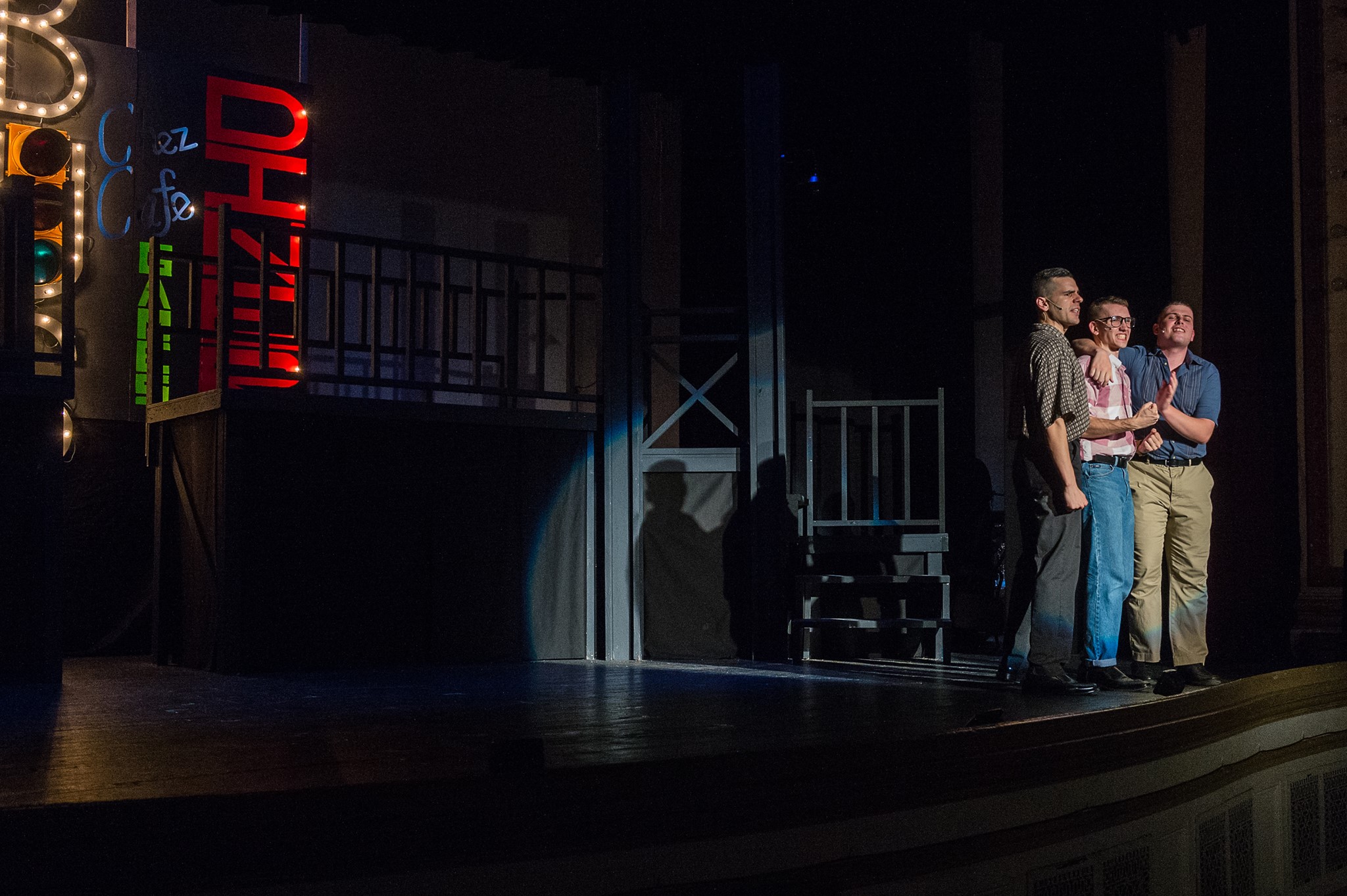
The Three B’s – Bolland (Ryan Hadbavny), Bernstein (Michael Tarasovich), and Birdlace (Adam Speers) – are out on the town. Photo credit: Friedman Wagner Dobbler.
Way inside theater reference: “Dogfight” is like “Violet” told from Monty’s perspective.
Welch is the shining star here. She looks like Sally Field in “Gidget.” She’s cute, perky and lovable – even in the poufy dress. The girl can sing! She is a powerhouse, and the number one reason to see this show.
Tarasovich is also wonderful. He’s the most nuanced of the Three B’s. He makes Bernstein likable with a few deft gestures and a bright smile.
Fisher is hilarious in three different roles. The actor made each character unique and distinct. It’d be challenging to pick a favorite of her character roles, but the nearly silent and comical Ruth Two Bears is way up there.
Jeff Way is delightful as a snooty Maître D of a high-priced San Francisco restaurant.
“Dogfight” is tough to watch in our #metoo world. Women are treated extremely badly and the men brush it off in song (Hometown Hero’s Tickertape Parade), and excuse it away with, “Your dad did it. Your grandfather did it” as if reprehensible behavior should be considered a tradition. It’s important to shine a light on the subject, but it is tough to watch, especially in a musical.
When Birdlace returns from Vietnam, a hippie spits on him. You’re supposed to pity his sad welcome home, but he kinda deserves it.
Jeremy Eiben’s costumes and Cara Walkowiak’s hair and wigs will bring you back to the 60s.
There’s some fun music in “Dogfight.” Benj Pasek and Justin Paul have a few repetitious lyrics but they are catchy, and Cara Walkowiak does some brilliant work with the choreography. Director Rob James also does a remarkable job with a troupe of community theater actors.
It won’t be long before Welch levels up to Equity. You should see her just so you can say, “I knew her when…”
“Dogfight” runs through May 20 at the Andrew Carnegie Free Library & Music Hall, 300 Beechwood Avenue, Carnegie, PA 15106. For more information, click here.