
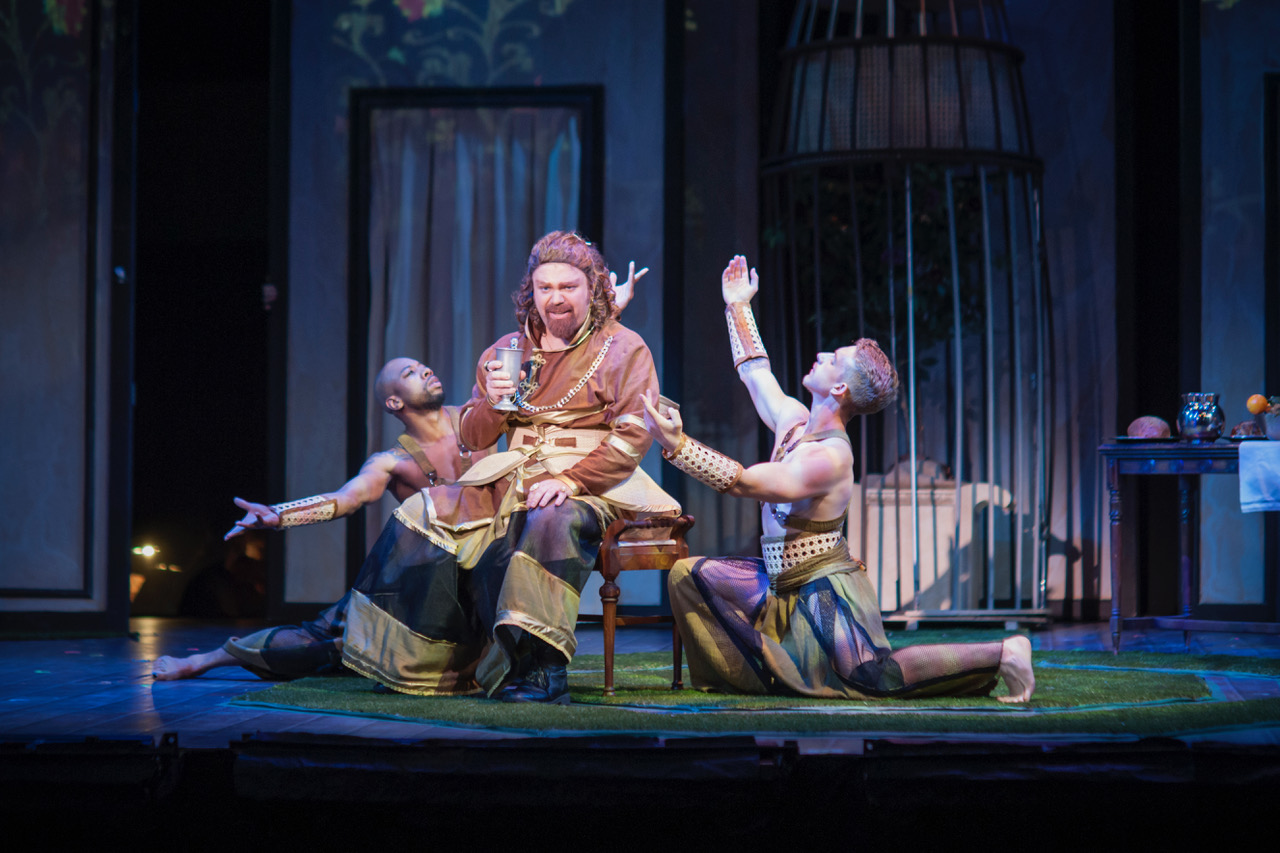

Pittsburgh Festival Opera opens Handel’s Comic Opera XERXES

by Dave Zuchowski, ‘Burgh Vivant.

George Frideric Handel’s opera “Xerxes” defies some of the preconceived notions audiences might have about the great Persian ruler, often billed as the “king of kings.” For one, who would have thought to create a comic opera about so august a historical figure?

Most times, persons of Xerxes rank are given the demigod treatment. Who would dare to tarnish the heroic image of one so high in the Pantheon of human history with such banal and cavalier treatment? 

Pittsburgh Festival Opera’s XERXES. Photo by Patti Brahim.

With this in mind, the plot also takes an astonishing, unexpected turn in its unfolding of the multiple romances and complicated intrigues that take place between the king, his brother, two sisters and a foreign princess. One would probably bet on Xerxes, an absolute ruler of the ancient mold, to come out on top in any amorous tug-of-war that pits him against less powerful suitors. Surprise! Such is not the case.

Another iconoclastic moment comes from the casting requirements. You’d probably expect so powerful a king and ruler to be sung by an alpha male voice such as a tenor or baritone. Instead, Handel’s opera calls for not one but two castrati, one of which portrays Xerxes, the other his brother, Arsamene.

In the Pittsburgh Festival Opera production which opens on the evening of July 14th at the Falk Auditorium in Shadyside, the cast is blessed by what director Daniel Rigazzi calls “two world class countertenors” (who sing in the same vocal range as their Baroque predecessors) who also happen to be two of the best regarded in the nation.

Pittsburgh Festival Opera’s XERXES. Photo by Patti Brahim.

“In the day of Baroque opera, countertenors were the pop stars of their era,” Rigazzi said. “There’s a place for this sort of masculinity in our own culture. Just look at the adulation commanded by the lead singers for Journey and Queen. As Baroque opera has come back into popularity, there are a lot more countertenors now – along with a lot more work for their talents.”

Starring in the title role, countertenor Andrey Nemzer has performed in each of the Festival Opera’s six summer seasons. Winner of the 2011 Mildred Miller International Voice Competition, Nemzer performed the role of Handel’s Julius Caesar last year for Pittsburgh Festival Opera and has made appearances at the Metropolitan Opera, Opera San Antonio, the Pittsburgh Symphony and more.

Cast in the role of Arsamene, countertenor Daniel Moody, a graduate of the Peabody Conservatory with a Master’s from the Yale School of Music and Institute of Sacred Music, has sung in several Early Music festivals and with numerous symphonies and music venues across the nation.

Pittsburgh Festival Opera’s XERXES. Photo by Patti Brahim.

Early on in the opera, be sure to listen for one of Xerxes’ aria highlights, “Ombra ma fu,” the only operatic love aria I know that’s sung to a tree. The fact that the tree is sacred only slightly diminishes the foolishness of this bit of regal eccentricity, which also turns out to be one of Handel’s best-known (and beautiful) melodies, often referred to as “Largo”

“Xerxes” is one of Handel’s later operas penned at a time when his career as a composer of opera was on the wane,” Rigazzi said. “At the time, he was experimenting with the aria form and rethinking convention.”

In his composition, Handel incorporated short, one-movement arias into the work in an era when audiences were accustomed to long, three-movement, de capo arias. This innovation plus his mix of comic elements into the work may have contributed to the opera’s early failure with his 18th century audience.

First performed as an oratorio in March 1738, “Xerxes” made the stage of the King’s Theater as an opera seria two weeks later but lasted for only five performances. For nearly 200 years, the work fell into obscurity until it reemerged onto the stage in the mid-1920s, along with a resurgence of interest in Baroque music. Today, it is one of Handel’s most popular operas, second only to “Julius Caesar.”

In preparing to direct to opera, Rigazzi said that a fascinating aspect of 18th century opera is the fact that the singers performed in front of painted roll drops with very little movement on their part, a practice not to the taste of modern audiences.

“Baroque operas are open-ended,” he said. “In more contemporary operas, the stage movements are almost always spelled out. For ‘Xerxes,’ I had to do a lot of research and investigation and study how each character changes through the arias.”

The opera’s libretto, written by Giovanni Bononcini, had been used multiple times before Handel set it to music. Rigazzi said, in the 18th century, librettos were frequently passed around and that composers were free to make any adjustments they deemed necessary.

“Handel had an amazing sense of drama,” Rigazzi said. “He really knew how to pace the story and was a master of theatricality.”

Befitting a Baroque opera, Pittsburgh’s beloved Chatham Baroque ensemble forms the core of a 14 musician ensemble under the baton of Walter Morales. Set in Persia, “Xerxes” treatment by scenic designer, Hank Bullington, has, according to Rigazzi  “one foot in that ancient middle eastern country, one foot in the 18th century, but still retains a modern feel.” To add even more visual ambiance, Bullington incorporates a series of vibrant projections onto the set.

“A lot of different elements go into creating a fictitious world, an almost fairy tale  world of delight but one that realizes a unified whole,” said Rigazzi, who’s directed theater and opera for 25 years – everything from Shakespeare and Puccini to contemporary plays and musicals. Since 2008, he’s also been on the directing staff at the Metropolitan Opera of New York.

“While I am a Handel enthusiast, I don’t consider myself a Baroque opera specialist,” said Rigazzi, who also directed last summer’s “Julius Caesar,” another Handel opera.

With a period orchestra, Handel’s glorious music and a cast of exceptional singers including two of the nation’s most respected countertenors, Pittsburgh Festival Opera’s “Xerxes” is a not-to-be-missed production.

Handel’s “Xerxes” is at the Falk Auditorium at the Winchester Thurston School, 555 Morewood Avenue in Pittsburgh (Shadyside) at 7:30 p.m. on Friday, July 14 and Saturday, July 22 and at 2 p.m. on Sunday, July 16. Tickets and more information can be found HERE.

– DZ.

Scarlet Billows – a review of “Sweeney Todd: The Demon Barber of Fleet Street”

By Michael “Buzz” Buzzelli, ‘Burgh Vivant

When Benjamin Barker – now using the non de guerre Sweeney Todd (Andrew Cummings) – returns to London, his mournful cries of retribution and revenge fill the streets in Stephen Sondheim’s “Sweeney Todd: The Demon Barber of Fleet Street.” Based on the Victorian Penny Dreadful, “String of Pearls” from 1847-48, “Sweeney Todd” is a reimagining of the tale. It is a story of a vicious killer told – not in murky gothic tones – but with light comic touches. It is a wickedly, dark comedy with a haunting romantic heart beating at its center.

There are no spoilers here, since the tale is told in the opening number, “The Ballad of Sweeney Todd.”

After being exiled on trumped-up charges, Todd returns to England with Anthony Hope (Adam Hollick) in tow. The shipmates separate but their lives are inexplicably tied together by fate.

Todd plans his revenge on the men who destroyed his marriage, the villainous Judge Turpin (Adam Cioffari) and his sycophantic lackey, Beadle Bamford (Robert Frankenberry). Fate brings Todd to Mrs. Lovett (the aptly named Anna Singer), purveyor of putrid pies – made from lesser quality meat (Hello, Kitty).

Lovett offers him a place to dwell. She tells a lurid tale of the barber who used to live there. A man named Barker who lived there with his wife Lucy (Lesley Baird) and their baby Johanna until Judge Turpin tore their happy home to shreds with his lust for Lucy. The contemptable Judge sent Barker off to a penal colony on the other side of the world and ravaged Barker’s beautiful wife. When Lucy went mad, Turpin took the child as his ward. Lovett retells the tale to Todd, all the while knowing that Barker and Todd are one in the same.

The full cast of the Pittsburgh Festival Opera of “Sweeney Todd: The Demon Barber of Fleet Street.” Photo by Patti Brahim

Meanwhile, the handsome sailor, Anthony, spies the fully-grown Johanna (April Amante) on her balcony, and falls madly in love with her. But as the bard would muse, “The course of true love ne’er did run smooth.” The vile Judge decides that his ward, whom he raised as a daughter, should now be his wife (Someone get Jerry Springer on the phone…stat!).

Back at his barber shop on Fleet Street, Todd begins dispatching his clients with his straight razor. As the aforementioned ballad goes, “Sweeney Todd kept a shop in London Town, of fancy clients of good renown, and what if none of their souls were saved? They went to their maker impeccably shaved.”

Mrs. Lovett decides she wants a piece of the action, and begins grinding the victims into meat for her pies. The idea comes forth in a dark, delightful ditty, “A Little Priest,” where the duo sing about the former occupations of the once and future pies. Business in the pie shop is booming, and Lovett hires Toby Ragg (John Teresi) to scuttle about, aiding her in the restaurant.

Where will the loathsome tale end? If you guessed in “blood and gore,” you’ve won the big money prize! Luckily, director Tome Cousin handles the carnage artfully. When Todd slices a throat, scarlet billows forth from the victims neck like an explosion of rose petals. It is beautiful and macabre.

Cummings does an incredible job as the demon barber, and Singer is a joy to watch and listen to on the stage. They do wonderful work together, with devilish chemistry.

Hollick is a dashing romantic lead with powerful voice. The audience has no problem rooting for the hero named Hope.

Frankenberry is a charismatic villain. Picture Jonathan Pryce in “Adventures of Baron Munchausen” or in any of the Pirates of the Caribbean movies, mix in a little bit of Robert Helpmann’s Child Catcher from “Chitty Chitty Bang Bang” and add a mellifluous voice.

He is a slick villain, slicker than Turpin. Though the Judge is sinister and creepy. Even though his actions will make you squirm, Cioffari humanizes Turpin with a modicum of sympathy. The Judge knows he’s evil and he can’t help himself, and it makes him a terrific baddie.

Special attention should be made to Teresi. The petite blond man – who plays a child of indeterminate age –  has a potent voice.

Hank Bullington’s set is saturated in dark blues and deep purples. Scene changes are deceptively simple affairs; a grouping of chairs are reordered and the names of the shops and restaurants are projected on the walls.

Kudos to costume designer Rachel Wyatt for time-traveling back to Victorian London for the wardrobe.

The two hour and twenty minute run time breezes by.

“Sweeney Todd: The Demon Barber of Fleet Street” is a must-see for any Sondheim fans in Southwestern Pennsylvania.

“Sweeney Todd: The Demon Barber of Fleet Street” runs a series of dates through July 22 at the Falk Auditorium in the Winchester Thurston School, 555 Morewood Avenue, Pittsburgh, PA 15213. For more information, click here.

– MB

Will work for food – a review of “One Man, Two Guvnors”

by Michael “Buzz” Buzzelli, ‘Burgh Vivant

Take Carlo Goldoni’s “The Servant of Two Masters,” add English accents and blend in some fourth wall breaking bits with the audience and you have Richard Bean’s “One Man, Two Guvnors,” a twentieth century piece of commedia dell’arte.

Francis Henshall (Tom Protulipac) doesn’t like to skip a meal. His pockets are empty and he’s starving. Knowing his boss, Roscoe Crabbe (Jenny Malarkey) won’t pay him until the end of the week, Francis takes on a second job with Stanley Stubbers (Connor McNelis). All he wants to do is grab some haddock and chips with mushy peas or whatever English grub he can grab at the pub in Brighton.

But having two guvnors is a tricky business, and Francis learns it the hard way.  He must keep the two men from meeting, or the jig is up. Unfortunately, unbeknownst to Francis, Roscoe Crabbe is really Rachel Crabbe and she’s in Brighton to rendezvous with her fiancé Stanley Stubbers. Stubbers is fleeing from the law after killing Rachel’s twin brother, Roscoe. Even though Stubbers slew her brother, Rachel is in love with him (family reunions must be extremely awkward). Basically, Francis must keep the two from meeting, even though the only reason they’re in town is to meet. Whew! That’s not even the tricky part.

For Rachel, posing as her dead brother has an unusual set of complications. Roscoe was betrothed to Pauline Clench (Marsha Mayhak), but she’s in love with Alan Dangle (Craig Ketchum). To snatch the dowry from Pauline’s dad, Charlie (Keith Zagorski), Rachel (still disguised as Roscoe) must marry her – and since the action is set in Brighton, England in 1965 (well before Marriage Equality) that’s just not gonna happen.

Of course, Francis mucks everything up.  The comedy picks up steam in the second act after Francis is finally fed – in a hilarious scene involving an ancient accident-prone waiter (Neil Donaldson), flaming Crepe Suzette, a mousetrap and an unfortunate audience member. Once sated, Francis pursues two new deadly sins; lust and avarice – pushing gluttony off to the side like parsley. He promises Dolly (Erin Bock), Charlie Clench’s voluptuous bookkeeper, that he’ll whisk her off to Spain. The passionate pursuit leads to additional complications.

Director TJ Firneno keeps a lot of plates spinning in this riotous production. There is a balletic choreography to the comedy. Protulipac has the lion’s share of the plate-spinning, seizing the stage with gusto. He is happily chewing the sparse scenery, excelling in the aforementioned bits involving audience participation. He’s a whirling dervish.

There are several fine performances. Malarkey’s androgynous Roscoe and Bock’s lusty Dolly stand out.

Between scene changes, the cast provides some interstitial material singing songs or otherwise entertaining. Side note: there is some technical tomfoolery afoot.

It’s a madcap, crazy show. Not all of it works. Some of the material seems dated – and must have felt dated even in the first performance in the National Theatre in 2011 (since the show is set in 1965). When it does work, it’s hilarious! There are several bust a gut moments.

Special mention to Jill Spear, Little Lake’s volunteer coordinator, who does a lot more than keep the volunteers busy.

“One Man, Two Guvnors” is wacky, whimsical evening out.

“One Man, Two Guvnors” runs through July 15 at the Little Lake Theatre, 500 Lakeside Drive South, Canonsburg, PA 15317. For more information, click here.


Wrestling with the Devil – a review of “The Christians”

By Michael “Buzz” Buzzelli, ‘Burgh Vivant

Pastor Paul (David Whalen) is proud to announce that the congregation’s brand new megachurch is paid off in full. He’s also proud to announce that he no longer believes in the devil or the Christian concept of Hell in Lucas Hnath’s play, “The Christians.”

What happens when a popular pastor decides to change the rules? All hell breaks loose (figuratively speaking, of course).

In mid-sermon, Associate Pastor Joshua (Joshua Elijah Reese) challenges Pastor Paul’s newfound beliefs. Joshua believes in the fire, brimstone and all the horror that goes with it. A division in the congregation begins to open a crack. Parishioners fall away. At first, it’s a manageable amount. Jay, a Church Elder (Robert Haley), tells him the board backs him. Then, Jenny (Gayle Pazerski), a congregant, questions him. He invites her up to the pulpit and they have a discussion that tears open the rift between the two sides of the congregation. The faithful begin to fall further away. Pastor Paul’s megachurch bleeds out like the blood of Christ on the cross, slowly, painfully, inevitably.

Things get extremely dire when Elizabeth (Mindy Woodhead), the pastor’s wife, decides she disagrees with her husband. She can’t reconcile his beliefs with her own and it begins to tear away at their marriage.

Daniel Patrick Moynihan once said, “You are entitled to your own opinions, but not your own facts.”

But in religion, are there facts? What separates truth from fiction when everyone is relying on faith? It’s the core issue of Hnath’s play, and it’s sure to start a conversation among audience members. There were several interesting discussions on opening night.

Director Andrew Paul picked a perfect cast for “The Christians.”

Whalen is charismatic as the preacher. He commands the stage with a powerful presence. His character is multifaceted. He is bold, brash and bellicose, while preaching love and tolerance. Whalen makes the dichotomy work. It’s fascinating to watch the pastor who is preaching about tolerance, but doesn’t tolerate opposing viewpoints. Pastor Paul expects his congregation to follow no matter where he leads them, and he’s devastated when they don’t.

Reese delivers a spectacular performance as the leader of the dissent. His voice is strong and equally commanding. It’s easy to see the congregants unite around him.

Pazerski does a terrific job as a woman in conflict with her own beliefs. Jenny is tormented when her church fails her, and Pazerski portrays that pain realistically and thoughtfully.

Whalen’s scenes with Woodhead pack the most punch. It’s painful to watch them wrestle with their deeply held spiritual beliefs and the passion and joy of their marriage. They go through their own personal hell.

The megachurch has a mighty choir consisting of Monteze Freeland, Natalie Hatcher and Missy Moreno. Their three superb voices blended together beautifully. Each of them is given a moment in the spotlight, and each of them gloriously raised their voices to God.

Set designer Johnmichael Bohach puts the mega in megachurch. The room feels like the Crystal Cathedral with an enormous post-modern cross towering above the pulpit, suspended in mid-air on wires. It looks like it’s floating above Pastor Paul’s head, like the sword of Damocles.

Caution: The play, while called “The Christians,” may be upsetting to people who are firmly rooted in their faith. The play wrestles with abstract ideas, but, underneath, it’s really about our interactions with one another, and how we treat those who have alternative ideas on the afterlife.

It’s a hell of a good play.

“The Christians” runs till July 2 at the New Hazlett Theater, 6 Allegheny Square East, Pittsburgh, PA 15212. For more information, click here.

– MB


Hear ye, the word of the Lord  – a review of “An Act of God”


By Michael “Buzz” Buzzelli, ‘Burgh Vivant

God (Marcus Stevens) comes down to Earth speak with humanity in David Javerbaum’s comedy, “An Act of God,” and all hell breaks loose.

The Creator, accompanied by two of his best buds, Angels Gabriel (John Shepard) and Michael (Tim McGeever), complete with white linen robes and feathery white wings, trek down to Terra Firma to enlighten us mere mortals. God has got a lot on his omnipotent, omniscient mind.

By the way, the Supreme Being looks like Marcus Stevens for a reason. The Almighty is using Stevens’ body as a Holy Sock Puppet, speaking his words of wisdom through the beloved Broadway actor (and Point Park graduate). You see, God thinks middle men like Moses, Muhammad et al. have mucked up his holy message. The Lord is here to set the record straight.

It’s Life, the Universe and Everything in a brisk 90 minutes (no intermission). Jehovah’s perspective is decidedly different. Papa’s got a brand new bag. The Most High might refer to Javerbaum when he wrote the show. It’s pretty out there, and it’s sure to offend the most devout of any religion, be ye Christian, Muslim or Jew.

Picture Fractured Fairy Tales of the Old and New Testament. Things do get real when God does express remorse for the life and death of his middle child, Jesus. Though, the Christ child comes off like Jan Brady in God’s version.

Javerbaum started the story with a Twitter handle called, TheTweetOfGod, and morphed those tweets into a full-fledged Broadway play.

The actors are fantastic. Stevens is effervescent as the Eternal Father. He bounces around on stage filled with spirit (Holy or otherwise). His gap-toothed smile lights up the theater. He’s a joy to watch.

Shepard is an actually dressed like a shepherd…of God (with the aforementioned heavenly wings). The actor has a commanding voice and a big presence. Though his role is small, he makes it big.

Nerd Note: His character is similar to Gwen DeMarco/Lt. Tawny Madison (Sigourney Weaver) in “Galaxy Quest,” repeating words that flash on an overhead projector.

McGeever is only performing in plays with God in the title this year. He went from City Theatre’s “Hand of God” to the Public’s “An Act of God.” Ironic, don’t you think?

McGeever’s Michael is sort of the every man angel. His character says the things we’re thinking; and voices the questions we want to ask. He performs with precision and aplomb. It would be hard to imagine any other actor in the role after seeing McGeever’s interpretation.

Director Ted Pappas keeps things moving along with sharp pace (no intermission helps the evening move along nicely).

Sound Designer Zach Moore and Lighting Designer Andrew David Ostrowski bring in thunder and lightning to the stage. Scenic Designer Michael Schweikardt’s stage is walk in the clouds with some tasteful white furnishings. It’s an absolutely heavenly combination of sight and sound.

The only drawback, and it’s a rather large one, is that “An Act of God” is more thoughtful than humorous. It’s billed as a raucous comedy, and it is, at best, mildly amusing. Not nearly as funny as “Buyer & Cellar” or even as witty as “Tru,” past Public productions (say that three times fast).

It may, however, challenge your world view. The play may either enlighten you or piss you off. You get to make the final judgement.  It might not be the funniest comedy, but it is certainly a revelation, and the cast is worth the price of admission.

“An Act of God” runs through Sunday, July 2 at the O’Reilly Theater, 621 Penn Avenue, Pittsburgh, PA 15222. For more information, click here.

– MB


Artistic Director Tracy Brigden Departs City Theatre

Pittsburgh, PA (June 7, 2017) – Driven by a passion for new plays, City Theatre Artistic Director Tracy Brigden has been at the helm of the South Side performing arts organization for 16 seasons, producing notable works and world premieres by exceptional talents. Ms. Brigden has announced that, with the culmination of the 2016-17 season, she is stepping down as artistic director.

“The 2016-17 season was one of City Theatre’s best ever, with two hit shows that extended, one world premiere production that is moving to off-Broadway, and myriad accolades and glowing reviews,” said Ms. Brigden. “It is on this high note of triumph and after 16 years as the artistic leader of City Theatre that I believe it is an opportune and ideal time for me to move on. I am so proud of all that the staff, board, artists, and I have accomplished during my tenure, and wish the company all the best in their next chapter.”

Continuing this high artistic standard will be a primary goal of the Board of Directors, according to City Theatre Board President Beth Newbold.

“Tracy is an exceptional artist. Her passion and energy brought exciting new and contemporary plays to life for our audiences,” said Ms. Newbold. “Tracy, and the entire artistic team, consistently produced works of substance and ideas that engaged and challenged us, earning praise from audiences and critics alike, both at home and around the country.”

Under Ms. Brigden’s leadership, the organization cemented a national reputation for new play development, producing more than 25 world premieres in 16 years and creating the Momentum Festival. Highlights of Ms. Brigden’s tenure at City Theatre include directing the world premiere of Some Brighter Distance, this season’s hit Hand to God, the world premiere of Hope and Gravity, the American premiere of The Monster in the Hall, and many others.

The Board of Directors will be evaluating the organization’s operations in the service of a new strategic plan to fulfill City’s mission. The Board will also appoint a task force to manage the upcoming transition, which will include a national search for a new artistic leader in Fall 2017. Managing Director James McNeel will take on additional leadership responsibilities in the interim while Director of New Play Development Clare Drobot and Artistic Producer Reginald L. Douglas will ensure that the company maintains its high quality of programming until a new artistic director is seated.

“While change is inevitable, it opens up the opportunity for reflection and growth for our organization,” Ms. Newbold said. “We know that Tracy’s artistic journey will continue to be successful. The Board and staff at City Theatre are committed to building on her legacy, and we will move forward together with a shared vision of our role and impact on the Pittsburgh community.”

City Theatre annually produces a six-play subscription season of new plays, with City Events, education programming, and various audience engagement activities from its South Side home. The company is entering its 43rd season.


Cabaret for a good cause

by Michael “Buzz” Buzzelli, ‘Burgh Vivant

When you think back to Christopher Isherwood’s “Cabaret,” you might think that Germany’s cabarets were all about the songs, sex and wild times. But the cabaret was more than a just a place to eat, drink and be merry. It was a place of resistance. It was more than just fun times. It was a movement.

There’s a new cabaret in town, and you can resist and be entertained at the same time.  On Thursday, June 1st, you can attend “Existence, Persistence, Resistance, ” an evening showcasing women that is also a special benefit for Planned Parenthood. A roster of local talent will be performing songs written by award-winning female artists, as well as several new works by local writers. Hear local talents such as Cassidy Adkins, Elizabeth Boyke, Hilary Caldwell, Cynthia Dougherty, Catherine Gallagher, Natalie Hatcher, Caroline Nicolian, Gena Sims, Monica Stephenson, Katie Trupiano and Sandy Zwier belting out some tunes for an important cause.

Caldwell, who organized the event, chose the Off the Wall Productions at the Carnegie Stage for specific reasons. She said, “Off the Wall Productions is one of the theaters in this city consistently taking risks with their seasons. [Executive Artistic Director Virginia Wall Gruenert] picks shows that are extremely topical, heart-wrenching, soul-searching, visceral and funny. All the shows, ultimately, explore what it means to be human. Their mission is so clear, and the dedication they have to the promotion and welfare of female theater artists is admirable. They understand, at the heart of what they do, the importance of inclusiveness in the community, and I responded so immediately and instinctively to that.”

Catherine Gallagher (“A Pirates Tale”) said, “When Hilary [Cadwell] invited me to join this cabaret, I knew I immediately I had to get involved. It is an extraordinary experience to share the stage with such powerful, driven women, but to do so for such a relevant and universal cause made my decision a no-brainer. I think in the current political climate, we are all looking for a way to help. You may feel overwhelmed or like you can’t make a difference, but you don’t have to protest on a large scale. Start small. Lend your talents, lend your time.”

Gallagher added, “Imagine what we can do if every woman in this country took those steps. I am proud to support Planned Parenthood, and I am honored to perform on June 1st for such an impactful organization.”

Caroline Nicolian (“Toxic Avenger: The Musical”) is also thrilled to be participating in the cabaret.

Nicolian said, “Planned Parenthood has helped me out when I didn’t have any health insurance. It is an absolute necessity to keep them thriving in the community.” She added, “I am so happy to support them in any way possible.”

All of the proceeds will go to Planned Parenthood.

You can join the resistance, by going to “Existence, Persistence, Resistance” on Thursday June 1 at 7:00 pm at the Carnegie Stage, 25 West Main Street, Carnegie PA 15106. For more information, click here

– MB

Lost Boy Found – a review of “Peter and the Star Catcher”

By Michael “Buzz” Buzzelli

Land ho! The Tony award-winning show, “Peter and the Star Catcher,” just came ashore in Carnegie. The play is based on the young adult novel by Dave Barry and Ridley Pearson of the same name. Think of it as tall tales with tall sails. The YA novel was adapted into a play by Rick Elice. Barry, Pearson and Elice add to J. M. Barrie’s original stories about the boy who doesn’t want to grow up.

Batten down your hatches, there’s a lot of plot to cover. When Lord Leonard Aster (J. P. Welsh) sets sail for Mollusk Island on the H.M.S. Wasp, he is charged with protecting very important steamer trunk for the queen of England (God save her!). A nefarious game of bait-and-switch causes the cargo to fall under the care of his daughter Molly (Casey Duffy) who is on a separate ship, the Neverland. The trunk contains a precious treasure, and on the high seas, treasure is often plundered by pirates. In the immortal words of Oda Mae Brown, “Molly, you in danger, girl!”

Molly and her nanny, Mrs. Bumbrake (Cody Sweet), have been consigned to their cabin (for their own safety), but that doesn’t stop the free-spirited girl from abandoning Bumbrake and exploring the vessel. The girl meets a Boy (Nate Willey). He is a capital B Boy since the orphan has no name of his own.  He and his companions, Prentiss (Jake Smith) and Ted (Charles Buescher Rowell) are captives on the ship (paired down to two from the swarm of boys in the novel version). The boys are destined to be crock meat once Bill Slank (Jim Froelich) hands them over to the natives on Mollusk Island.

Enter Black Stache (Brett Goodnack) and his band of unscrupulous-yet-incompetent pirates. Molly and her newfound friends must triumph over the pirates and keep the treasure safe.

In case you were wondering the trunk contains starstuff, magical dust from a comet’s tail. The starstuff’s magical properties turn a fish into mermaid, a bird into a pixie and a Boy into a legend.

If you haven’t guessed by now, “Peter and the Star Catcher” is Peter Pan’s origin story. There are some wonderful and magical moments from Messrs. Barry and Pearson and Elice, but all three of them are no match for J. M. Barrie. It doesn’t have the heart and soul of Peter Pan, but there are some nice moments. Blame the overabundance of scatological jokes in the play. There are so many jokes about flatulence that body odor is practically a subplot.

While there’s a plethora of juvenile jokes, a gem sneaks in every now and again. There are a few particularly hearty laugh out loud moments. Guffaws are especially robust when the second act opens to a kick-line of dudes dressed as mermaids. P.S. Once all the exposition is out of the way, the second act sails along smoothly.

Not everyone is made of starstuff in this show, but I came to praise Peter not pan him. Willey does a great job as the Boy who believes in fairies. The real hero in this story is Molly and Duffy does a marvelous job as the lead.

Smith and Rowell do a fine job as Molly’s accomplices, and Sweet is hilarious as the nanny in bad drag.

But it’s the black-mustachioed villain who takes the cake, and whatever else he can lay his hand on (ten points for Gryffindor if you can guess the pirate’s true identity).  The show sparkles when Black Stache is afoot, and Goodnack chomps the scenery like it’s a Primanti’s Cap & Cheese sammie after a bender. The role is meant to be wildly over-the-top and it plays to the actor’s strengths. He is boisterous, brash and silly.

Director Spencer Whale does some fun things with the bare bones stage, using actors to set the scenes with bits of rope and twine.

There is one trivial gripe of this show since it premiered at the La Jolla Playhouse lo those many years ago. There’s every indication that the show is a musical but it really isn’t. It’s a play with very few songs. Very few. Also, “Peter and the Star Catcher” should be marketed more effectively to children. It’s clearly a kid’s show trying to act older than it is. Make sure you bring the tots.

“Peter and the Star Catcher” runs till May 21 and it can be found at Stage 62, at the Andrew Carnegie Free Library and Music Hall, 300 Beechwood Avenue, Carnegie, PA 15106. For more information, click here. And if all else fails, it’s the second star to the right, and straight on till morning.

-MB

The Buzz from Buzzelli: Pittsburgh’s Top To Do’s (5/18 – 5/21)

by Michael “Buzz” Buzzelli, ‘Burgh Vivant

A rare breed

Elise Forier Edie’s “The Pink Unicorn” returns to the stage. It’s a riotously funny play about a mom who loves her child, regardless of the kid’s gender identity. Suddenly, she is a reluctant warrior for LGBT issues in a small Texas town.  It’s at the Carnegie Stage, 25 W. Main Street, Carnegie, PA 15106. For more information, click here.


Purple Haze

It’s not the color purple, it’s “Violet.” A young woman goes on an emotional journey through the segregated American South in the 60’s.  You can find “Violet” at the New Hazlett,  Allegheny Square East, Pittsburgh, PA 15212. For more information, click here.


Bound but not down

Martyna Majok’s “Ironbound” opens this week. It’s the story of Darja who is waiting for so many things, like love, for a break, and for the bus she relies on to get to and from cleaning jobs in blue-collar New Jersey. You can go on the journey with her; first stop; The Pittsburgh City Theater, 1300 Bingham Street, Pittsburgh, PA 15203. For more information, click here.


Abbey Normal

It won’t be business as usual at the Abbey this weekend.  It’s the Abbey Arts Festival and the popular coffeehouse/restaurant/bar will be filled with live music and all sorts of wild and wacky stuff. There will be a Tarot card reader, face painters, vintage clothing and more. It’s at the Abbey, 4635 Butler Street, Pittsburgh, PA 15201. For more information about the event, click here. For hours, the menu and location, click here.


Hog Heaven

Stick around Lawrenceville for “Hogwash,” true stories about drinking told by Moth racontuers, comedians and assorted alcoholics. Belly up to the bar with host Derek Minto and get your drink on while you listen to people tell their wackiest drinking stories. It’s at Hambones, 4207 Butler Street, Pittsburgh, PA 15201. For more information, click here.

Hope Rains Eternal – a review of “Hercules Didn’t Wade in the Water”

by Claire DeMarco, ‘Burgh Vivant

Hurricane Katrina struck in 2005, leaving a path of destruction and death through many parts of New Orleans. “Hercules Didn’t Wade in the Water” presents this tragedy as the national and local disaster that it was, but with several sub plots involving people in Chicago and in New Orleans specifically affected by it.

Much of the stage is set in an apartment in Chicago. Seamless transition between Chicago and New Orleans occurs through lighting cues. There are mini-sets on the stage that represent the action taking place in New Orleans.

An over-sized TV screen in the background is pivotal and vital to the play, consistently presenting reports on the status of Hurricane Katrina, relaying the horror which is to come, building tension as each storm update grows.

Tupelo (Sam Lothard) and Char (Shaun Nicole McCarthy) portray a Chicago couple. Lothard finds himself in New Orleans when Katrina strikes. He is there to make more money so that he and McCarthy can purchase a home and marry. Maxine (Shanita Bivins) and Eugene (Corey Lankford), also in Chicago, have more serious, possibly unsolvable issues. New Orleans resident Youngblood (Lamar K. Cheston) has life-threatening financial problems. He owes money to the wrong people.

Lothard and Cheston are isolated on a New Orleans rooftop, trapped by the hurricane.

In the program, Director Wali Jamal spoke highly of his actors. The director said, “All that remained for me as a director was to assemble the right actors to give breath and a pulse to these well-written entities. I must say that I could not find a better cast if I tried.”

The play is well cast. Lothard is particularly strong as a man determined to better his circumstances, to reach his goals. His actions when he and Cheston are trapped on the rooftop continue to show strength and the confidence and perseverance that they will survive.

So, why is “Hercules” part of the title? Perhaps it is Cheston’s unorthodox knowledge of Biblical characters that “passeth all understanding,”  providing comic relief in an otherwise dramatic, serious play.

“Hercules” is ultimately about hope and forgiveness. A play powerfully written, directed and performed.

“Hercules Didn’t Wade in the Water” runs through May 21st at the Pittsburgh Playwrights Theater, 937 Liberty Avenue, 3rd floor, Pittsburgh PA 15222.  For more information, click here.

css.php