

Mum’s the word – a review of “Mumburger”

Mike Buzzelli

By Michael “Buzz” Buzzelli, ‘Burgh Vivant

Tiffany (Jessie Wray Goodman) and her father, Hugh (Ken Bolden) are each struggling with loss in their own- and very different – way until a mysterious package of hamburger patties arrives in a brown paper bag in Sarah Kosar’s “Mumburger.”

Tiffany’s mother, Andrea, was a very committed vegan. She believed in sustainable food sources. Ironically, she was killed by a Bird’s Eye frozen food truck on the highway. Apparently, Andrea is prepared (literally and figuratively) for her death and choses a bizarre method of being with her family a little while longer.

Ahoy, matey! Spoilers dead ahead.

Andrea decides to become a sustainable food source for her family, by being ground up and turned into hamburger patties. While the play is most assuredly about the titular mumburgers in “Mumburger,” it’s really a coal black comedy about grief.

The central question of the play is: If you’re loved one had a dying wish – would you honor it? What if that wish was disgusting and bizarre?

Tiffany (Jessie Wray Goodman) consoles her father (Ken Bolden) in “Mumburger”

“Mumburger” is a two-hander and needs two strong actors to do all the heavy lifting. This production has got it.

Goodman’s Tiffany is buoyant and effervescent even in bleak circumstances, making her eventual collapse of grief difficult to watch. The despair she exhibits in several scenes is electric.

Bolden is spectacular as an ineffectual dad who is lost without his wife. There is a manic scene (we’re not spoiling EVERYTHING) where he just goes for it. He’s 100% all in and it’s fantastic and gross at the same time.

Director Robyne Parrish makes some smart choices with Kosar’s absurd premise. There’s seems to be a lot of extraneous walking in the very beginning of the show when character’s stomp around the house, but it furthers the story in story in a subtextual way – the father and daughter are very distant from one another even in the same small location. It works.

Adrienne Fischer’s set is creepy and off-kilter in all the right ways – like the set from one of villain’s lairs from the 1966 “Batman” TV show –  with eerie sound design by Shannon Knapp.

Side note: It’s noted in the show that Andrea’s favorite movie is “The Father of the Bride” and Hugh watches it on a loop – thanks to some great projection design by Taylor Edelle Stuart – to both poignancy and comedic effect. Kosar picks the Steve Martin remake and not the original with Spencer Tracy. It might be her only misstep in this highly unusual play.

Its Sweeny Todd meets Ronald McDonald by way of Bear Grylls and Eull Gibbons. Its “Alive” meets “Harold and Kumar Go to White Castle.” It’s wacky, wild ride.

Warning: Audience reaction was split between love and hate. There was no middle ground. It’s worth the risk.

-MB

“Mumburger” runs until March 16 at the Carnegie Stage, 25 W. Main Street, Carnegie, PA 15106. For more information, click here.

 

Review: FUDDY MEERS, The Theatre Factory

by Brian Edward, ‘Burgh Vivant.

Monday mornings are bad enough.  When the harsh, unsympathetic blast of the digital alarm clock pierces your ears at 5am, imagine having your life and identity explained to you by a stranger who introduces himself as your husband, just as he’s done every morning prior, because a traumatic incident has left you with a case of amnesia that erases your memory each time you fall asleep.  You may sensibly opt for the snooze button, though any such thoughts of reprieve are dashed when a manic man in a mask appears, tells you that you’re in great danger, and steals you away in his vehicle to destinations yet unknown.  You’re in for quite a day, to say the least, an no amount of Folgers is going to turn this one around.  This is the premise that ignites the peculiar tale of David Lindsay-Abaire’s Fuddy Meers, directed by Jeff Johnston.

Beth Minda as amnesiac Claire convincingly navigates the complexities of uncovering the truth about her life among a series of colorful circumstances and even more colorful characters.  To share too much about their background may spoil the unraveling mystery that Lindsay-Abaire has laid forth, though much can be said of the performances that bring us the story.

Especially prominent are the performances by Kevin Bass as Limping Man and Tom Protulipac as Millet.  Each handles their part with an expert dexterity, despite the manic and outrageous personality traits required to portray them.  Neither character can boast many redeeming qualities, though in in the hands of Bass and Protulipac, they are entirely authentic and compelling to watch.

Kathleen Regan takes on the monumental task of portraying Gertie, who speaks gibberish and is only barely coherent due to having suffered a stroke.   It’s an absurd situation on top of all the other improbable plot elements, and could easily have come off as an absurd portrayal, though Regan gives the role an endearing spirit that translates clearly, even when the words do not.  Extra points are due here for a process that I assume involved memorizing nonsense words, internalizing their meaning, and then spouting them off with 100% confidence that you’re making sense to those around you.

Joe Eberle as doting husband Richard, Jared Lewis as angsty son Kenny, and Kaitlin Cliber as the volatile Heidi round out a strong ensemble cast that keeps the play moving.

It’s a difficult piece to tackle.  Aside from requiring a skillful balancing act on the fine line between psychodrama and dark comedy, Lindsay-Abaire’s script calls for frequent scene changes, often with little or no “cliffhanger” element to drive the play’s energy through the pause.  The running crew handle the transitions as efficiently as possible, made all the more manageable by the dynamic set design by Matt Mylnarski and Evan Hauth.

You’ll be entertained, you’ll be disturbed, and for a night out in Trafford, it’s most definitely worth the admission price.

Fuddy Meers performs at The Theatre Factory, 235 Cavitt Ave, Trafford, PA 15085 through March 3rd, 2019.  For tickets and more information, visit www.thetheatrefactory.org


Season of the Witch – a review of “Vinegar Tom

Mike Buzzelli

By Michael “Buzz” Buzzelli, ‘Burgh Vivant

In 17th Century England, Alice (Ciera Harding) and her mother Joan (Markia Nicole Smith) are accused of witchcraft in Caryl Churchill’s feminist drama, “Vinegar Tom.”

Alice has a passionate rendezvous with a mysterious man (Micah Stanek) in the woods. After their brief encounter, she becomes obsessed with him. She’s constantly pining for him and describing his lascivious actions to her friend Susan (Allison Svagdis).

Her neighbors, Jack (Daniel Murphy) and Margery (Bridget Murphy) are vexed with a multitude of problems. Their cows are diseased and their marriage is a disaster. Jack is in love with Alice and blames her for his impotence with Margery (he has no problem rising to the occasion when he’s with Alice).

There’s another subplot involving Betty (Caroline Travers), a young woman from the gentry who doesn’t want to marry. Her reasons become obvious when she meets Ellen (Jamie Rafacz), a cunning woman (who studies herbal cures).

By the way, the titular character in the play is Vinegar Tom, Joan’s old tomcat. It’s a familiar story (get it?). The name Vinegar Tom comes from the witchfinder general himself, Matthew Hopkins, in his pamphlet “The Discovery of Witches” written in 1647, wherein an alleged witch calls out the names of her familiars (creatures that help her with her dark magic).

Of course, “Vinegar Tom” isn’t really about witches. It’s about pride, poverty and prejudice. At one point Witchfinder Packer (Stanek) says, “Though a mark is a sure sign of witch’s guilt, having no mark is no sign of innocence.” It’s the Kobayashi Maru – no win scenario.

The ending is pretty cut and dry. It won’t leave you hanging (if only the same could be said for half of the cast). Oh come on now. It’s a play about witches in the 17th Century – it can’t be considered a spoiler to know that some of them are not going to survive.

Promotional photo for the show.

Harding is a joy to watch as Alice. Though a lot of her dialogue is repetitive, she finds new and exciting ways to say it.

Daniel Murphy (there are two Murphy’s in the show and they play husband and wife) plays Jack with desperate intensity.

Rafacz’s Ellen is so subdued and likable she seems as if she wandered into “Vinegar Tom” from another play, making her fate more tragic. Rafacz does a magnificent job portraying her.

Stanek’s male characters (he plays several) are all villains, and he’s very good at being bad.

There’s a light-hearted scene with Kramer (Erin Hyatt) and Sprenger (Zetra Goodlow). The authors of the “Malleus Maleficarum” are presented like sideshow carnival barkers or snake oil salesmen. It’s a whimsical prologue after a gruesome finale. Kudos to director Daras for casting women in the roles.

There are a lot of scenes (twenty-one in all), even though Daras and scenic director Gianni Downs have come up with brilliant ways to get us from one scene to the next, the transitions add needless length to the run time.

Luckily, many of the aforementioned scenes are punctuated with songs by the Tomcat band, enhanced by the mellifluous voices of Liron Blumenthal, Elise Dorsey and Caroline Bachman. It’s an unfettered joy to watch those women rock out. They are gloriously supported by their bandmates Emmeline Jones, Braxton McCollum, Chris Knudsen and Tim Judah.

Downs has created large cotton swaths – like bed sheets – scrawled with quotes from famous women in history all over the theater from Thatcher’s “If you want something said, ask a man. If you want something done, ask a woman” to the Elizabeth Warren meme “Nevertheless, she persisted.”

“Vinegar Tom” seems overly long (much like “The Crucible”). It takes a long time to get to the end, but the ending is emotional and powerful.

During the opening and closing scenes, the actors gyrate wildly to the band. They are so exuberant – you’ll want to get up and dance with them.

-MB

“Vinegar Tom” runs until March 10 at the Point Park, 350 Forbes Avenue, Pittsburgh, PA 15222. For more information, click here.


A perfectly marvelous show – a review of “Cabaret” 

Mike Buzzelli

By Michael “Buzz” Buzzelli, ‘Burgh Vivant

In the early 1930s, an American writer, Cliff Bradshaw (Jonathan Norwood), moves to the decadent, free-wheeling city of Berlin to write a novel, just as the Nazi’s rise to power in the iconic Kander and Ebb musical, “Cabaret.”

On the train into town, Cliff meets Ernst Ludwig (Trevor Clarida) who regales him with tales of Berlin’s salacious pleasures. Ludwig finds him a place to stay and becomes his first pupil (Cliff tutors English to supplement his income). Ludwig also tells him about a low-down, libidinous little nightclub where he can “unwind.”

After settling into his apartment, Cliff takes off for the carnal carnival known as the Kit Kat Club… where anything goes.

The Emcee (Zach Herman – alternately played Ramsey Pack) introduces the cabaret boys and girls (the ensemble featuring Daniel Neale, Ben Cherington, Allison Ferebee, Georgia Mendes et al.) and the Kit Kat Club’s star performer, Sally Bowles (Safiya Harris – alternately played by Caroline Mixon).

Sally is fascinated by Cliff. She has high hopes for their relationship, even though Cliff shares a romantic past with a decidedly different member of the Kit Kat Club’s staff.

Backstory: Bobby (Daniel Neale), one of the male dancers, had a romantic liaison in London with our hapless hero.

On his way backstage to meet up with the boy, Cliff runs into the girl. The misinterpretation leads to complications. When the club owner Max (Dylan T. Jackson) fires Sally, she runs off to meet with Cliff and finagles her way into his apartment. Sally becomes his roommate – – with benefits.

Meanwhile, Fraulein Schneider (Gena Sims), Cliff’s landlady, falls for Herr Schultz (Patrick V. Davis), a Jewish fruit vendor. Unfortunately, many of Fraulein Schneider’s friends are in the Nazi party, complicating her relationship unnecessarily.

In the next apartment over, Sally is pregnant, and Cliff discovers he could be the father of Sally’s baby (though they’d be quite a few contestants on that Jerry Springer episode). If Facebook existed in the 30s, Cliff and Sally’s relationship status would definitely be “it’s complicated.”

The apartment building has one other notorious tenant, Fraulein Kost (Cate Hayman), who is turning tricks in her abode, but the good times are coming to a screeching halt as the Nazi’s goosestep into town.

Spoiler: This musical does not have a happy ending.

The Kit Kat Club danceers are ready to entertain you.

Harris is luminous as Sally Bowles. She takes over every moment she’s on stage. Then, when she belts out the titular number “Cabaret,” it’s a showstopper. Her voice is powerful.

Herman’s Emcee is equally engaging. He exudes a sexy magnetism. He plays off the audience’s energy superbly, ribbing and needling the front row with a sly wink and a wry smile.

Norwood is an attractive lead who manages to get his character’s conflicted subtext perfectly.

Then, there’s Fraulein Schneider.

Personal pet peeve: There’s always this weird thing that happens when young actors play old people. They almost always hunch over like Quasimodo and wag their fingers excessively. They almost always look grumpy as if about to say, “Hey you kids, get off my lawn.”

Sims, however, nails it. It’s a beautifully nuanced portrayal. Plus, the woman can sing her heart out. She is brilliant throughout the show. You would not expect a woman to sing about a pineapple with such exuberance…but you can catch Sims doing it.

“Cabaret” captures the public zeitgeist in turbulent times. Director Tome Cousin does a fantastic job reminding us that art can propel us forward. Whenever you shine a light, the cockroaches scurry.

Cousin was the choreographer as well, and the dancing is kinetic and frentic. There are some lovely transitions with graceful movements to catch your eye between scenes. He also has the performers doing some audience work  at the top of act one and act two. Its beautifully done.

This “Cabaret” has everything, including lusciously decadent costumes by Jake Poser (though there are a few wardrobe malfunctions on preview night, they didn’t hinder the production one iota).

Beautiful moody lighting from Alex Gibson and excellent sound design by Scott McDonald on a whimiscal set designed by Jamie Phanekham.

“Cabaret” is a perfectly marvelous show.

-MB

If you’re looking for tickets, the entire run is completely sold out, but if you want to know more about the show, click here.


About Face – a review of “An Octoroon”

Mike Buzzelli

By Michael “Buzz” Buzzelli, ‘Burgh Vivant

A Black playwright, Braden Jacobs-Jenkins (Ananias J. Dixon), AKA BJJ, attempts to revive Dion Boucicault’s melodramatic and grossly-outdated 1859 play, “An Octoroon,” with a fresh, contemporary spin.

In the opening monologue, BJJ explains his desire to remake the original play. He does it in a witty, metatextual way while slathering white makeup over his face. Soon, Boucicault (Martin Giles) enters. He is loud, boisterous and equally amusing. This time, however, the Caucasian actor is spreading red make up on his face to play an Indian, Wahnotee.

Side note: Wahnotee is referred to as an Indian or Injun and never as a Native American. This play purposely eschews politically correctness (to the Nth degree). Of course, the word used for the African American characters is much, much worse.

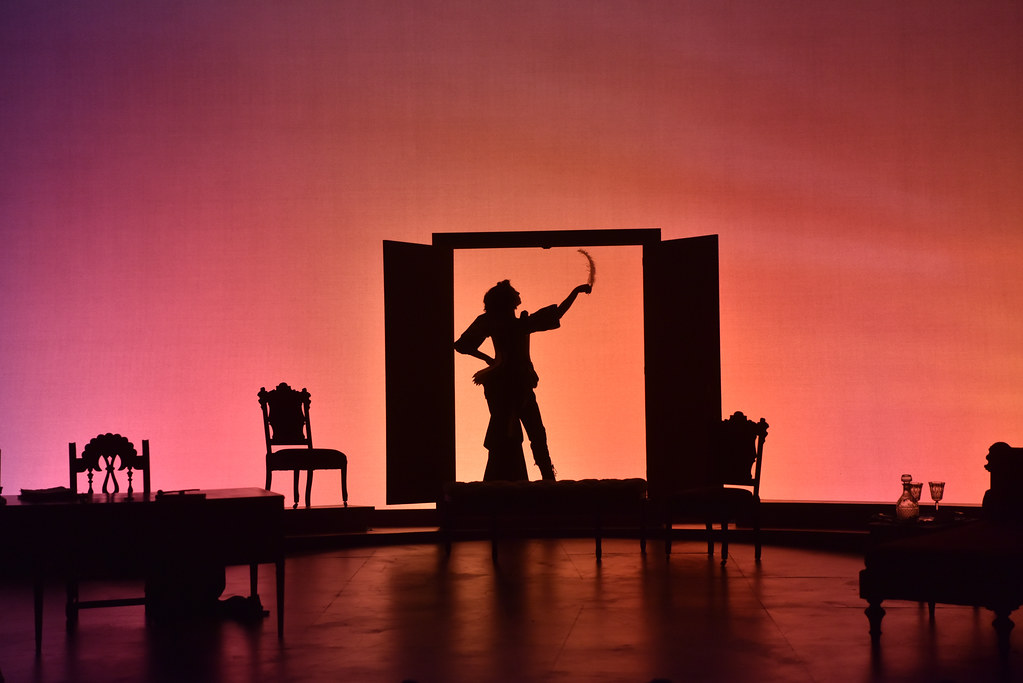
In a classic feather duster scene, two slave women, Minnie (Melessie Glack) and Dido (Kelsey Robinson) sweep the front porch while providing additional exposition. The audience quickly learns that the Terrebone Plantation in Louisiana is in transition. The owner has passed away, and his property has been handed over to his nephew George (Ananias J. Dixon). The two slaves also spend a little time gossiping about another female slave, Grace (Dominque Brock) who yearns to run away, even though she is pregnant.

At the heart of the show is an intriguing love triangle. George is being romantically pursued by Dora (Jenny Malarkey), a vapid, white daughter of a neighboring plantation, but he falls for Zoe (Sarah Hollis), the titular Octoroon, instead. At the time, it’s illegal for a white man to knowingly marry a Black woman.

Side note: An Octoroon is a person one-eighth black by descent. Technically, with a white father and Black mother, Zoe would have been called Mulatto. In modern times, she would just be called mixed race and there would be no reason to quantify the precise mix of melanin.

Meanwhile, the villainous M’Closky (Dixon again), seeks to purchase Terrebonne and its slaves, particularly Zoe. M’Closky lusts over the Octoroon. During a photography session, M’Closky finds papers that would grant freedom to the attractive and intelligent Zoe, but absconds with the documents and kills a young slave boy (Parag S. Gohel) to hide his deceit. Since he uses Wahnotee’s tomahawk as the murder weapon, the Indian is blamed for the homicide.

After a brief intermission, the action picks up pretty quickly. George is forced to sell off property…i.e. actual human beings…to keep Terrebonne.

A rich sea captain, Ratts (John Reilly) buys Minnie and Dido, but refuses to purchase Grace because she has a baby and another one on the way.

When Zoe heads to the auction block, things get messy. George and M’Closky fight over her.

Additional side note: If you were paying attention, you may have realized that George and M’Closky are both being played by the same actor. Their subsequent wrestling match is something that has to be seen to be believed.

It’s a delightfully loony adventure that, by the second act, barrels to the end.

Captain Ratts (John Reilly) decides to buy two slave girls, Minnie (Melessie Clark) and Dido (Kelsey Robinson) in “An Octoroon.”

Things don’t really get moving until after a prolonged but important prologue. The prologue first delivered by BJJ and later by Bouccicault (Martin Giles), sets up the entire piece. It’s necessary and entertaining exposition, even though it slows the action down. When Act I finally begins, the stage explodes with dynamic characters in interesting situations.

Director Andrew Paul has picked an excellent cast.

Dixon is wild over the top as the moustache-twirling M’Closky. He’s a cross between Harriet Beecher Stowe’s Simon Legree and Hanna Barbera’s Dick Dastardly sans Muttley.

Gohel is masterful as the servant, Pete. He’s the mewling, House Man sycophantically cowering before the white slave owner, and brimming with contempt for his fellow slaves in the field (the common pejorative for this type of character will not be used here). Gohel makes comedic use of this type of character. He is hilarious in every scene.

Clark and Robinson are dynamic together. While most of their dialogue is exposition. It’s delivered joyously, exuberantly. Both women are electric.

Giles gives another great performance.

The colorful costumes provided by Kim Brown are extraordinary.

The play is thought-provoking but laugh out loud funny. It’s easy to squirm at the humor in “An Octoroon.” Uncomfortable laughter is a unique sensation. It bubbles up in unexpected circumstances. If you’ve ever felt guilty laughing at a funeral, in a church or at a job interview, you’re familiar with the feeling. This play gives you permission to express this unusual emotion.

“An Octoroon” is meant to shock and cajole, but it doesn’t do it in a mean-spirited or condescending way. It helps that the melodrama is over the top, and that white actors are playing Black roles and vice versa.

At any percentage, “An Octoroon” is an amazing piece of theater.

-MB

An Octoroon runs until February 24 at the New Hazlett Theater, 6 Allegheny Square East, Pittsburgh, PA 15212. For more information, click here.
 

The Rules of the Game – a review of “Six Characters in Search of an Author”

Mike Buzzelli
By Michael “Buzz” Buzzelli, ‘Burgh Vivant

Characters from a play come to life to befuddle a director/theater manager in Luigi Pirandello’s play, “Six Characters in Search of an Author.”

A troupe of young actors are rehearsing a play when a strange family steps out of the mind of a playwright and on to their stage. All hell breaks loose. The Father (Mark Yochum) insists their story be told; much to the chagrin of the Manager (Max Begler).

The actors (Julie Loesch, Heather Due, Dominic Deluca and others) hang out and listen to their metaphysical and meta-theatrical tale.

The Step-Daughter (Liz Venesky) doesn’t like how the actress is playing her. The Mother (Nupur Charyalu) doesn’t want the tale to be told. The Boy (Griffin Sendek) skulks in the background. His sister, the Child (Hannah Schmidt) quietly awaits her fate. The Son (Liviu Reynolds) hangs back and tries to distance himself from the group – – but he cannot.

The Manager goes over a bunch of theatrical rules. He insists that all of the action take place in one common area, like the garden, even though the characters are insisting the action took place all over the house. He teaches them about the mechanics of telling a story on stage.

The Father (Mark Yochum) walks out on to the stage, followed by the Step-Daughter (Liz Venesky), and the rest of the Characters in “Six Characters in Search of an Author.”

Side note: There’s a gun in the first act, and Pirandello adheres to Anton Chekov’s theatrical rule…i.e. expect a bang!

Pirandello’s play feels a lot like Playwriting 101 (except it’s from the character’s point of view).

A lot of thoughts and actions are described, but very little action takes place until the very end of the play and then…it literally explodes into pieces.

Yochum manages to make a silk purse out of a sow’s ear. He handles a lion’s share of the work here. His prowess as an actor elevates the weakly written character. He also gets the biggest laughs with a raised eyebrow or a sly smile. At one point, the Manager orders him about and he fulfills his duties robotically, with his mouth agape. It is hilarious.

Begler does a terrific job of being exasperated by the newcomers who present themselves on his stage.

Venesky also does a fine job. She is a very charismatic young woman. Her personal charms overcome the character’s more grating personality.

A lot of characters in “Six Characters” stand around and don’t get much to do. It would be unfair to judge their ability on their brief snippets of dialogue.

In the “Bewitched” season two episode, “And Then I Wrote,” Samantha Stephens writes a play for her community theater’s American Civil War centennial, and, for inspiration, brings the characters in the play to life with a twitch of her nose. In the thirty minute television episode, the characters refuse to go back into the script until they get the ending they desire. It’s quick, funny and magical. Everything this play is not.

“Six Characters in Search of an Author” is, of course, a lot deeper than a 60s sitcom. It is, however, definitely not as good as a Beckett or Ionesco.

“Six Characters in Search of an Author” feels too long, even at ninety minutes. It is, however, a treatise on theater, stagecraft, the willing suspension disbelief, and the rules of making an absurdist/existential drama.

-MB

“Six Characters in Search of an Author” runs until February 24 at the Genesius Theater on the Duquesne University campus in Pittsburgh. For more information, click here.



Bullet Points  – a review of “The Gun Show (Can we talk about this?)

Mike Buzzelli

By Michael “Buzz” Buzzelli, ‘Burgh Vivant

An actor (Andrew William Smith) speaks for a playwright (E. M. Lewis) and her relationship with guns, both positively and negatively, in E. M. Lewis’ “The Gun Show (Can we talk about this?).”

The actor shines a flashlight on the playwright sitting in the audience, claiming he is speaking her words. From that moment on, her multi-layered relationship with firearms unfurls in five personal stories throughout the course of the evening.

The actor shares her story, recounting it as if it is her own. It is a tale told with humor and honesty.

Lewis tries to move past the pundits on the issues, claiming that the talking heads on CNN and Fox can only shout at one another from their extremely distant corners. She lambasts the ultra-conservative gun owners on the right and the granola-crunching hippies on the left. She tears into the problem discussing the very real division between liberals and conservatives on the issue.

She ponders, through the actor’s voice, “What about the rest of us? What about the people in the middle?”

Growing up in rural Oregon, she makes a clear case for the need to own a gun. While, on the other hand, she tells a deeply moving story about how a gun changed her life forever.

After the performance, there is a talk back session wherein the audience can engage in the conversation.

Andrew William Smith shows off the script in “The Gun Show.”

Some of Lewis’s stories connect to the larger whole – some feel like tangents, but it is a bold and thoughtful 60 minutes on stage. The show is designed to provoke.

There is an unusual dynamic between the actor and the writer. There’s an homage to Nassim Soleimanpour’s “White Rabbit Red Rabbit” where the actor seems to be reading instructions for the first time, making the show feel very “in the moment.” Here, however, it’s a scripted trick, but it feels authentic. It works because Smith does a magnificent job pulling it off.

There is an awkwardness as the very male Smith expresses Lewis’ romantic feelings for her husband. It is a moment that is meant to convey unease, It is a separate conversation we need to have about masculinity and femininity.

Sequel?

Sheila McKenna keeps the story moving – literally and figuratively. The director allows Smith full use of the theater (stage and auditorium), instead of planting him behind a desk or on a chair the whole time.

There are a few props from Tucker Topel and the playwright. Lewis shares photos and other memorabilia for her life.

Another author named Lewis – C.S. Lewis – once said, “I seemed to hear God saying, ‘Put down your gun and we’ll talk.’”

It’s time to talk.

-MB

“The Gun Show (Can we talk about this?) runs through March 3 at various locations. For more information, click here.
 

An Interrupted Life – a review of Etty

Mike Buzzelli

By Michael “Buzz” Buzzelli, ‘Burgh Vivant

During the Nazi occupation of Holland, Esther “Etty” Hillesum (Susan Stein) is encouraged by her unconventional therapist, Julius Spier to keep a diary of her innermost thoughts in Susan Stein’s “Etty.”

Etty spills her life out in her journal. She is very forthright in describing her passions on the page. She writes about her lover Han and her affair with the very therapist that recommended that she write the diary in the first place; the brilliant and eccentric Julius Spier.

Her life takes an unfortunate turn when she is shipped off to Westerbork, a transit camp where Jews were interned before being deported to concentration and extermination camps in Eastern Europe.

As her rights are slowly stripped away, Etty finds her strength and power through her writing. It’s a powerful piece of the Holocaust literature.

Esther “Etty” Hillesum looking off wistfully, surrounded by her beloved books.
Etty (Susan Stein) writes in her diary.

Stein is the actor and playwright in “Etty.” She has been working with the diaries for years and is deeply invested in Etty’s story. She immerses herself in the part.

She embodies the writer. It’s a moving portrayal of the interrupted life of Etty Hillesum.

There is practically no scenery. It’s Stein on a stage with a suitcase (she sometimes uses as a chair). She doesn’t need anything else. She paints a very vivid picture of Etty’s life without props or scenery.

It’s a very educational piece of theater.

Austin Pendleton directed the sparse one-woman show.

Side note: There is a milder, PG-rated version that Stein performs for middle-school and high school kids. Like “The Diary of Anne Frank,” the play seems like a perfect educational tool to engage children in learning about the horrors of the Holocaust.

The play is a brisk 52 minutes with a talk back at the end of each performance. In the talk back, Stein becomes herself again, freely chatting about all the things she wanted to tell us about Etty, but didn’t get into the actual play.

She lights up discussing the woman and her art. Stein speaks of her meeting with Hertha, Julius Spier’s finance. Though the elderly woman is in the throes of dementia, she vividly recalls her encounters with Spier and Hillesum. It was fascinating to hear about Stein’s moments with the survivors of that horrible time in our history.

Stein’s conversation with the audience was even more brilliant and exciting than the show itself. She shines when casually chatting about the woman and her work. It’s rare for any reviewer to claim that they loved the talk back even more than the show, but here we are.

The Holocaust is a shameful period of human history, but as philosopher George Santayana said, “Those who do not learn history are doomed to repeat it.” Sadly, it seems as relevant and important as ever.

“Etty” runs through Sunday, February 10 at the Carnegie Stage, 25 West Main Street, Carnegie, PA 15106. For more information, click here.


Warren Peace – a review of “Run the Rabbit Path”

Mike Buzzelli

By Michael “Buzz” Buzzelli, ‘Burgh Vivant

A father wants his adult children to become their best selves before moving away from them forever in Ray Werner’s world premiere play, “Run the Rabbit Path.”

Pop (James FitzGerald) sits in the kitchen as noodles dry on the table before him. His daughter, Patty (Karen Baum), stirs a vat of chicken noodle soup.

She’s not really ignoring him, because he’s not really there. Pop died the day before, a few feet away from where he sits in the kitchen, waiting.

As her father’s caretaker, the last few months of Patty’s life have been a blessing and a burden. She plans the funeral as her family rolls in.

Patty’s brothers Charlie (Reed Allen Worth) and Tommy (Tony Bingham) make their way home.

They bring little physical luggage (Charlie carries his guitar, and Tommy comes only with his cell phone in hand), but they bring heaping piles of emotional baggage. Charlie is sort of adrift, and Tommy is harboring a dark secret.

None of them can see or hear Pop. Sometimes the ghost makes suggestions that nudges them along in the right direction. They don’t see him or hear him, but they do feel his presence.

As in all stories, a secret will out. This particular skeleton in the cupboard has the potential to irrevocably change the lives of all the siblings forever.

Hint: The secret involves the hill behind their home where Pop and Tommy once hunted rabbits with their faithful hunting dog along the rabbit path.

Alan Stanford gathered four exceptional actors for the play, and each one of them elevates the work.

Baum is magnificent as the tough but tired older sister. She has a daunting task in this production. She has to be stubborn but sweet, cranky but conciliatory, frazzled but firm. It’s a high wire act, and she’s a flying Wallenda.

Bingham’s character Tommy has a lot of work to do. Tommy isn’t very likable. On paper, he comes off as smarmy business dude, but Bingham imbues him with a certain charm.

Worth is newer to the PICT stage. He performs perfectly alongside some of Pittsburgh’s best actors.

FitzGerald’s character is unheard and unseen. It’s a tough spot. It’s as if two shows are happening simultaneously. A family drama with a one man show hanging out on the same stage. FitzGerald pulls it off with aplomb.

“Run the Rabbit Path” is a world premiere and Werner has some kinks to work out if he plans on taking the show elsewhere. Even at 90 minutes, it feels a little long. There is no central hero or central villain, just four people coping with life and death. It’s a familiar subject and will touch each person differently. It’s especially moving if you’ve ever lost a parent.

It’s “This is Us” meets “Topper” with a little “Law & Order: Special Victims Unit” thrown in. It’s a serious drama and has very few laughs. There is, however, some lovely poetry woven in.

“Run the Rabbit Path” has a sweet, poignant ending, but it takes a little too long to get there.

-MB

PICT Classic Theatre’s “Run the Rabbit Path” runs through February 16th at WQED’s Fred Rogers Studio, 4802 Fifth Avenue, Pittsburgh, PA. For more information, click here.

Brave new world – a review of “The Tempest”

Mike Buzzelli

By Michael “Buzz” Buzzelli, ‘Burgh Vivant

A woman, in a hospital bed in Pittsburgh, is dying from late-stage breast cancer. She dreams of a magical island where she can exact revenge on her enemies and protect her daughter from the outside world. Nearing the end of her life, the audience is whisked away to the stormy isle inside her cavernous imagination in a beautiful retelling of William Shakespeare’s “The Tempest.”

Is the story just a dream?

To quote legendary comic book writer, Alan Moore, “This story is imaginary…aren’t they all?”

All stories are as real as we want them to be. And Shakespeare’s tale is simultaneously very real and very fantastical.

Prospero (Tamara Tunie) wields powerful magicks to protect Miranda (Kerry Warren). When she spots a boat carrying her sibling and rival, Tonio (Rami Margron), she summons a storm to sink the ship. Lightning flashes! Thunder strikes! The ship wrecks! The crew is scattered about the isle, marooned, grieving for their compatriots, unaware that many of them still live!

Pospero has two magical creatures in his service, a nymph, Ariel (Janelle Velasquez) and an unexplainable humanoid creature, Caliban (Shammen McCune).

On the isle, one cluster from the shipwreck includes the queen, Alonso (Deena Aziz), her advisor, Gonzalo (Laurie Klatscher), Sebastian (Aryana Sedarati) and the aforementioned Tonio. The shipmaster, Trinculo (Jamie Agnello), and the boatswain, Stephano (Bethany Cuputo), are marooned elsewhere on the island. The queen’s contingent is menaced by Ariel. While the shipmates Trinculo and Stephano encounter the woeful Caliban.

Meanwhile, the queen’s child, Ferdinand (Rad Pereira) is similarly marooned, but Ferdy isn’t tortured by sprites or dealing with monsters. Instead, the queen’s first born happens upon Miranda and a romance blossoms.

The situation gets desperate for all of the castaways until Prospero has a change of heart and vows to no longer use magic, even though the magic is keeping Prospero alive.

Tamara Tunie as Prospero Photo credit: Michael Henninger
Shammen McCune as Caliban Photo credit: Michael Henninger
Janelle Velasquez as Ariel. Photo credit: Michael Henninger

Marya Sea Kaminski directs the thrilling adaptation, casting women in all the roles. Correction: Casting amazing performers for each and every role. Every. Role.

The stage crackles with energy and vitality throughout the entire show.

For hundreds of years, from the ancient Greeks through Shakespearean times and beyond, actors were male. Holy Peg Hewes! This production is long overdue.

We might not ever need men on stage again. It is, indeed, a brave new world!

Tunie is dynamic. She plays Prospero not as a wizened wizard but a powerful conjurer, more Storm of the X-Men than Gandalf of Middle-Earth.

Kaminski abbreviated several scenes, especially the ones with the Trinculo and Stephano, but a truncated Trinculo and a shortened Stephano served the show well. The clowns were never funnier. Caputo and Agnello kept the audience in riotous fits of laughter nearly every moment they were on stage.

Pereira and Warren were a sweet pairing, reminding us that it doesn’t matter if it’s a man and woman…love is love.

Klatscher and Aziz have a different kind of chemistry. You can feel the affection from the back row. It’s Philia instead of Eros, but it was just as palpable.

McCune is remarkable. Caliban is a creature whose soul is crushed by years of servitude, desperately yearning for freedom. Her anguish is visceral.

There were other incredible elements that made “The Tempest” magnificent.

The O’Reilly is magically transformed by L.B. Morse’s scenic and multimedia design. Craggy gray rocks jut skyward with Prospero’s parapet (say that five times fast) peeking out on top. At the very beginning of the play, a Fast-Mo Pittsburgh cityscape is gloriously projected onto the slate backdrop. It is breathtaking.

Morse was aided by Nicole Pearce’s lighting design and sound design by Andre Pluess and stunning costumes by Nephelie Andonyadis.

There were some mind-boggling visuals in the show, including a fierce harpy that issued out a dire warning, with flaming red eyes and billowy wings. It was Julie Taymor-esque (that’s a thing now).

“The Tempest” is not one of Shakespeare’s finest plays (come at me). “Hamlet,” “MacBeth,” “Romeo and Juliet” and “Midsummer Night’s Dream” get the top honors. “The Tempest” has several flaws. Prospero has a sudden change of heart that comes out of nowhere. There’s a lot of extraneous plotlines that seemingly go nowhere. And blah, blah, blah.

That said, it’s a spectacular production. Kaminski frames the story in a unique way enhancing the pathos.

“The Tempest” was the stuff that dreams are made on.

-MB

“The Tempest” runs through February 24 at the O’Reilly Theater, 622 Penn Avenue, Pittsburgh, PA 15222. For more information, click here.
 

css.php