
MOLLY RICE – Angelmakers: Songs for Female Serial Killers

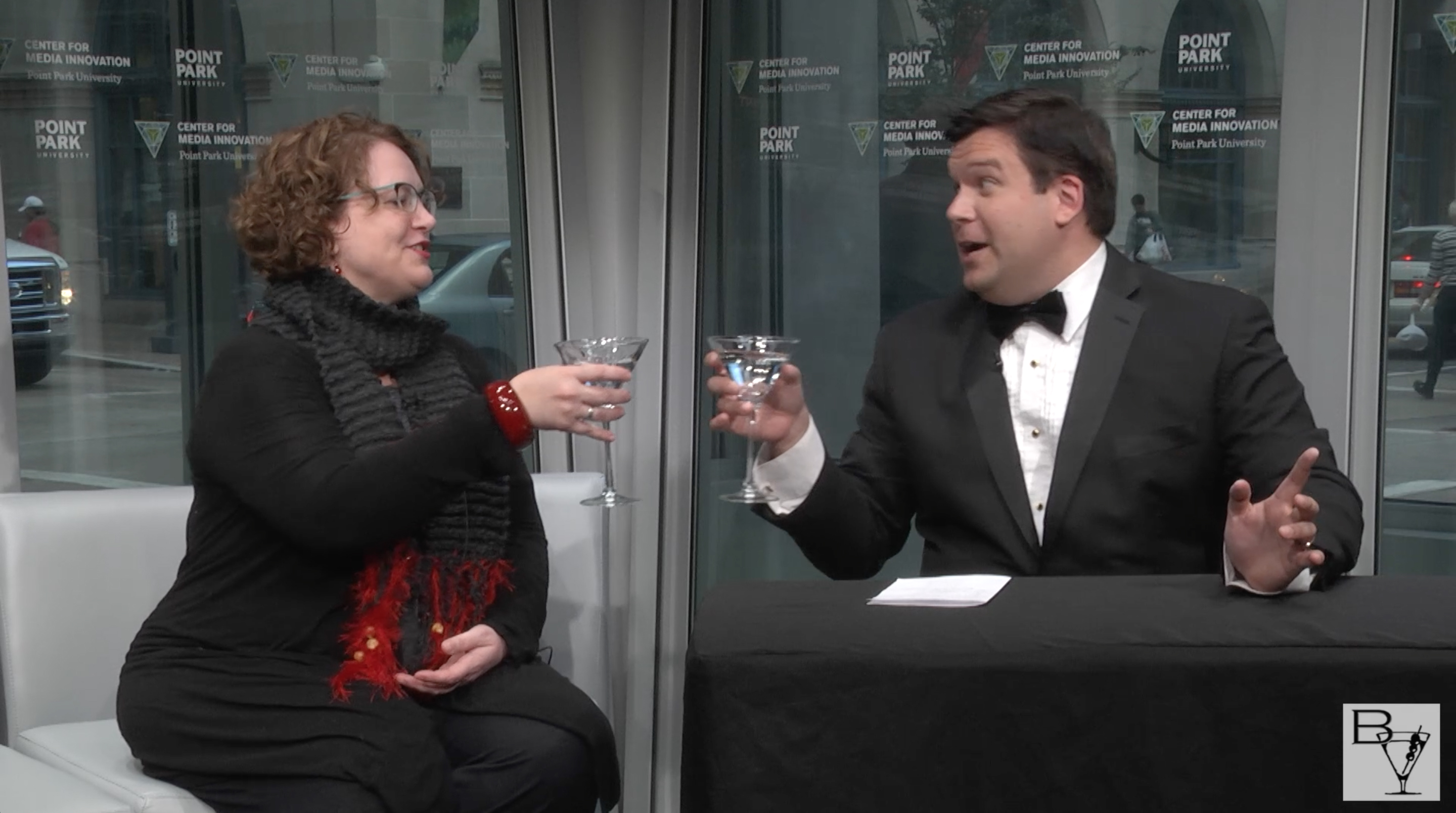
Molly Rice is back on ‘Burgh Vivant tonight to talk about the latest project from Real/Time Interventions, ANGELMAKERS: SONGS FOR FEMALE SERIAL KILLERS, playing through November 11, 2017 at the Aftershock Theater in Lawrenceville. For tickets and more information, email realtimeinterventions@gmail.com. ‘Burgh Vivant films weekly at Point Park University’s Center for Media Innovation in beautiful downtown Pittsburgh.  Continue reading “MOLLY RICE – Angelmakers: Songs for Female Serial Killers”

Featured
Featured
MOLLY RICE - Angelmakers: Songs for Female Serial Killers
Loading
/

Little Lake announces sizable cast for Arthur Miller’s THE CRUCIBLE

CANONSBURG, PA – Little Lake Theatre Company announces The Crucible, a play by Arthur Miller.  Salem, Massachusetts is ablaze with accusations of witchcraft after a group of young girls are found dancing in the woods. The line between reality and fable blurs as long-held grudges and humiliating secrets are put on trial in order to root out the evil plaguing the town. Revenge replaces reason and soon no one is safe. Still astoundingly relevant today, The Crucible is both a gripping historical play and a timely parable of our contemporary society. 

The Crucible runs from November 2-4, 9-11 & 16-18 at 8 pm. $18 – $20, $12 for children. For tickets and information: www.littlelake.org or (724)745-6300.

The Crucible is directed by Jena Oberg, with choreography by Melissa Tyler.

Cast
(in alphabetical order)

Reverend John Hale………. Josh Antoon
Giles Corey……………………. Warren Ashburn
Abigail Williams……….……. Elizabeth Bennett
Rebecca Nurse………….……. Ina Block
Hopkins……………………..…. Dylan Blussick
Judge Hathorne………….…. Bracken Burns
Mercy Lewis……………….…. Amanda DeConciliis- Weber
Ruth………………………….…. Heather Dressel
Alice……………………….……. Isabella Englesberg
Susanna Walcott………..…. Sophia Englesberg
Margaret…………………….… Moriah Hathaway
Francis Nurse………….……. Jeff Johnson
John Proctor……………..…. Eric Leslie
Thomas Putnam………..…. Joe Macerelli
Martha……………………..…. Martha McElligott
Sarah Good……………….…. Pam Pasternak
Mary Warren…………….…. Kayleigh Peternel
John Willard……………..…. Jared Pfennigwerth
Mrs. Ann Putnam…….…… Kathleen Regan
Deputy-Governor Danforth………. John Reilly
Tituba…………………………. Fatu Sheriff
Elizabeth Proctor…………. Jennifer Sinatra
Betty Parris…………………. Lindy Spear
Ezekiel Cheever……………. Stephen Toth
Reverend Samuel Parris……… Terry Westwood


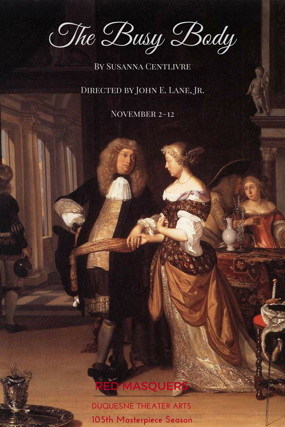
Duquesne Red Masquers Performs THE BUSY BODY as the Second Show of the 105th Masterpiece Season

PITTSBURGH, PA – The Busy Body, staged at Duquesne University, will be offered as a part of The National Conference of 18th Century Women Writers. The Busy Body by Susanna Centlivre is directed by John E. Lane, Jr., who directed Death of a Salesman (starring: Mark Yochum, Nancy Bach Love, Jay Keenan, and Curt Wootton – The Pittsburgh Dad) during the Red Masquers’ inaugural performance at the Genesius Theater.

The Busy Body (starring: Jay Keenan and Nancy Bach Love) is a fast-paced, witty comedy. A laugh-out-loud, one-of-a-kind, social satire about people who can’t mind their own business from one of the great female playwrights of the 18th century.

The production runs November 2 through November 12. Thursday through Saturday performances begin at 8 PM. Sunday matinees are at 2pm. All shows will be performed at the Genesius Theater at Duquesne University, adjacent to the Mary Pappert School of Music. Ticket prices are $16.50 for general admission, $11.50 for senior citizens, and $6.50 for students. Group rates are also available. Tickets can be purchased at the door or online at www.duqredmasquers.com

Review: EQUUS, Pittsburgh Public Theatre

Nick Mitchell fills in for host Brian Edward tonight on ‘Burgh Vivant as Lonnie the Theatre Lady stops in for a cocktail and a chat about EQUUS, by Peter Shaffer, directed by Ted Pappas, playing at Pittsburgh Public Theatre through October 29, 2017. For tickets and more information, visit www.ppt.org. ‘Burgh Vivant films weekly at Point Park University’s Center for Media Innovation in beautiful downtown Pittsburgh.

Continue reading “Review: EQUUS, Pittsburgh Public Theatre”

Star-Crossed – a review of “Romeo & Juliet

By Michael “Buzz” Buzzelli, ‘Burgh Vivant

When two young lovers defy their warring households, both alike in dignity, they set out on a perilous journey that can only lead toward their inevitable, undeniable deaths in William Shakespeare’s iconic masterpiece, “Romeo & Juliet.”

We lay our scene in the Neapolitan village of Little Italy, subbing for fair Verona (and briefly, Mantua). The time is 1930, on a moon-drenched Mulberry Street. The gangs of New York, in this case, are the Montague’s and the Capulet’s. The longstanding blood feud between the two families has made civil hands unclean.

When Romeo Montague (Dylan Marquis Meyers) crashes a masquerade ball at the Capulet manse, he has a faithful encounter with Juliet (Adrianne Knapp). After clever word play on the maiden’s balcony, they kiss, and, from that moment on, parting becomes sweet sorrow.

The two are secretly wed by Friar Lawrence (James FitzGerald), and things get chaotic quickly. Juliet’s parents, Lord (Martin Giles) and Lady (Shammen McCune) Capulet have promised their daughter to Paris (Jonathan Visser). Meanwhile, Romeo is embroiled in a battle between the families. When a knife fight escalates, Romeo’s friend, Mercutio (Alec Silverblatt), is slain. In retaliation, Romeo kills Juliet’s cousin Tybalt (Daniel Pivovar).

The situation is dire and Romeo is banished from his home town, just as Juliet is set to wed Paris. Friar Lawrence cooks up a cockamamie plan involving a potion that simulates death. His plans gang agley, as the best laid plans often do.

The story is a sad but familiar one.

Side note: Since the play’s first folio was published in 1623 (and performed nearly a century before that), the spoiler shields are not engaged. Matter of fact, the first stanza, gleefully orated by the director, Alan Stanford, states, matter-of-factly, “A pair of star-cross’d lovers take their life.” It’s not about the destination. It’s about the journey.

The play is perfectly executed, performed by some of the city’s most notable actors, alphabetically from Cheston to Visser.

Meyers is a quixotic Romeo, filled with flights of fancy. He brought a lighthearted mirth to the tragic teen. He is buoyant, ebullient and effervescent.

Knapp is a luminescent as Romeo’s brief bride. She is, indeed, a bright angel.

Lamar K. Cheston’s Benvolio is excellently cast. He is the lone voice of reason on the Montague side. Cheston has a commanding stage presence.

Silberblatt is a mercurial Mercutio, strutting about the stage with loutish swagger, chewing the sparse scenery, preening with puerile bawdiness, relishing his part (literally and figuratively) with gusto. It is performed for the groundlings as originally intended by the author – in other words, it’s a bit PG 13 (and might not sit well with the Sunday matinee crowd).

McCune’s performance as Lady Capulet is compelling. She owns the stage every time she appears. She is perfectly matched with Giles as her husband (another impressive performer).

Special mentions to smaller roles: PICT favorites, FitzGerald and Karen Baum are brilliant as the friar and the nurse. It’s hard to come up with new compliments for these old favorites.

Johnmichael Bohach’s set is stunning, bedazzled by the backdrop of twinkling lights on sheer black curtains in the Fred Rogers Studio. The lighting by Keith Truax sets the mood; deep indigo hues are illuminated by an almost ever-present moon.

There might never have been a story of more woe; than this of Juliet and her Romeo, but it’s a damn good time and you should go.

“Romeo and Juliet” runs until November 4 at the Fred Rogers Studio, WQED, 4802 Fifth Avenue, Pittsburgh, PA 15213. For more information, click here.

Pittsburgh Festival Opera’s Mildred Miller International Voice Competition heats up this weekend

By Dave Zuchowski, ‘Burgh Vivant

Pittsburgh Festival Opera announces Semi-Finalists for the Mildred Miller International Voice Competition. Emerging vocal artists between the ages of 18 and 35 who are accomplished but not yet able to sustain themselves in their profession, will compete for cash prizes as well as be given a chance to be cast in solo roles for the company’s 41st season.

The competition is named for the company’s founder, opera diva Mildred Miller, who firmly believes in supporting young singers. This year’s Seventh Mildred Miller International Voice Competition is scheduled for October 21 (the Semi-Final Round) and October 22 (the Final Round). According to Joel Goodloe, associate artistic director, 250 singers applied for the competition from 18 countries.
Eight singers, selected by the judges from Saturday’s Semi-Final Round pool of 20 candidates, will present arias during the Final Round. From these eight finalists, three will be selected as winners and a fourth will be chosen as “Audience Favorite.” Winners receive cash prizes ranging from $4,000 to $6,000 as well as offers for resident artist contracts in Pittsburgh Festival Opera’s 2018 summer season.
Besides Ms. Miller the other judges on the panel include Robert Chafin, Assistant Professor of Voice, West Virginia University School of Music Jonathan Eaton, Artistic Director of Pittsburgh Festival Opera and Professor of Music/Margot and Bill Winspear Chair in Opera Studies, University of North Texas Timothy LeFebvre, Associate Professor of Singing, Oberlin College Conservatory Jane Eaglen, Professor of Voice, New England Conservatory, Internationally acclaimed Wagnerian soprano.
Candidates for the Semi-Finals are featured in this mosaic.
In addition to being a member of the judging panel, Rob Chafin also serves as the Young Artist Program Director for Pittsburgh Festival Opera. He took time out of his busy schedule to answer a few questions about the competition:
Q: Rob, I understand that each of the contestants get to pick five vocal selections for their audition and start off with one of these as their first choice. After listening to the first selection, the judges then confer and pick a second selection from their list.
A: Each contestant is given roughly ten to 15 minuets before the panel of judges and accompaniment is provided by Pittsburgh Festival Opera via James Lesniak, associate coach at Pittsburgh Opera and Stephen Varianes, head coach for Pittsburgh Festival Opera. At the end of Day One, the judges pick 8 of the 20 singers who go on to the finals the following day. One Day Two, they will again perform two songs from their pre-selected list. Cash prizes of $6,000, $5,000 and $4,000 are awarded the first, second and third place winners, with another $1,000 going to the winner of an Audience Favorite Award. On day two, the singers again select their first piece, then the judges will ask for another selection. Sometimes, the panel might chose to request a third piece, or a part of an aria or song, depending on time, to help with evaluating the singers. The judges try to ask for contrasting selections to help narrow down the field in the semi-finals and to award the prizes at the finals. Cash prizes for first, second and third are awarded to the winners during the competition, with an extra $3,000 given to those winners who come to Pittsburgh Festival Opera and sing a role with the company. The Audience Favorite Award is determined at the conclusion of the final round by the people in attendance and is then given at the Award’s Ceremony following deliberation by the judges. Sometimes the Audience Favorite and the judges’ decision are not the same, and that is what makes a competition so exciting. In order to assure fairness and clarity, the judges use a point system, listening to the singers and then ranking them based on many factors . We want to select complete musicians that would be ready to accept a leading role in a company, looking at such things as vocal color and beauty of tone, language skills, musical and artistic expression, dramatic energy and engagement to the text.
Q: As a judge, what do you look for in a singer and how does the panel finally manage to arrive at their final decisions?
A: Of course, a beautiful voice, produced in a healthy way, and the ability to sing with musicality is important, but I look for that singer who can make me put down my pencil or pen and just listen to their story. A chance to just sit back and relax and experience the talent they bring to the competition.
Q: In the same vein, how do you judge 20 singers, all of whom have great voices and are different performers, different genders, different voice types? What are some qualities a successful singer should have? What is the “it” factor?
A: As a competitor in these situations, it is often difficult to relax and be spontaneous, but that is something that makes a difference between winning and doing well. And, these days, singing is getting better and better, and the competition is fiercer. So my suggestion to emerging artists is to find YOUR voice and sing without pressure, because it is that unique talent and sound that will help you move forward in your career path. A successful singer needs a solid technique, nerves of steel and the ability to act without being over-the-top. In other words, be so prepared that you can forget all of that when you go out and announce your first piece and just show what you can do. Mesmerize us – make us laugh – make us cry – but, make concrete choices that will show us where you are. I think the thing that younger singers need to realize is that the judges are there and WANT you to do your best.
 Q: How does Pittsburgh Festival Opera connect rising singers with professional opportunities through the competition and to its season through training, roles and more?
A: During the summer, we try and connect the young artists with the directors, conductors, pianists and singers through coaching and different sessions. But, the networking happens all summer. As we come together at the first “death-by-aria” meeting, when all young artists arrive, we listen to each other, and the teaching and directorial staff have a chance to get acquainted to the singers again. Then, we make decisions on what the singers need and who would work better with the different young artists.
The Semifinal Round is scheduled from 11 a.m. and 1 p.m. and from 3 p.m. to 6 p.m. on October 21 at the Kresge Theater on the campus of Carnegie Mellon University, and the public is invited to attend free of charge although advance reservations are strongly recommended.
The Final Round is from 2 to 5 p.m. on October 22 at the Frick Art and Historical Center, 7227 Reynolds Avenue in Pittsburgh’s Point Breeze neighborhood. WQED-FM’s Jim Cunningham will  host the Final Round.
For more information about the Pittsburgh Festival Opera, click here.

Set sail with the “Belfast Girls”

Over 4,000 Irish “orphan” girls were shipped to Australia under the pretense of a better life during the Irish Famine.  Lord Earl Grey the Protectorate of Ireland during the 1840’s arranged to ship young orphans as potential brides to the wilds of Australia.  However, many of these orphan girls were not who they seemed to be.  The story is one that resonates even now 150 years later. A story of misogyny, human trafficking and abuse of women’s rights.

Ghostlight Theatre Troupe will present the Pittsburgh premiere of award-winning playwright, Jaki McCarrick’s “Belfast Girls,” with Cassidy Adkins, Elizabeth Glyptis, Jenny Malarkey, Sara Williams and Val Williams. Directed by Rich Kenzie and co-directed by Samantha A. Camp.

Escaping the Irish Famine in 1850, five young women seek passage on a ship to Australia.  For many of the “orphan girls” on board, the voyage offers a fresh start.  But some girls find they cannot escape the memory of the lives they have left behind – and the closer they come to Australia the more powerful the past becomes.

“We are thrilled that we were able to obtain the rights to this wonderful production” stated Rich Kenzie, Founder and Artistic Director of Ghostlight Theatre.  “This is a true story that has been lost to history, and the themes still ring true today.  It is an important story to tell and hopefully learn moving forward.”

“Belfast Girls” runs from October 25 through Sunday October 29 at the Carnegie Stage, 25 W. Main Street, Carnegie, PA. For more information, click here.

Extinction event – a review of “Dodo”

By Michael “Buzz” Buzzelli, ‘Burgh Vivant

When you sign up to partake in an immersive theatrical event with Bricolage, you must expect the unexpected. “Dodo,” co-created by the uber-imaginative team of Jeffrey Carpenter, Gab Cody, Tami Dixon and Sam Turich, is a feast for five senses.

It is far easier to explain what “Dodo” is not – – than what it is. It is not a typical evening at the theater. You can’t just sit back and watch actors do their thing. Participation is key. Wear sensible shoes. You will be meandering through the vast expanse of the Carnegie Museum of Art and Natural History.

In this particular piece of immersive theater, ‘donors’ tour the museum in the dark. Any kid who has read E.L. Konigsburg’s “From the Mixed-Up Files of Mrs. Basil E. Frankweiler” will tell you that walking around the museum at night is both thrilling and terrifying.


Yukon Ho!

On the tour, you’ll meet a variety of unusual individuals, such as the Explorer (Michael McBurney). McBurney’s Explorer is reminiscent of a crazed Colonel Crittenden (Bernard Fox from TV’s “Hogan’s Heroes”). He’ll show you polar bear, some Eskimo’s and a herd of muskox. He’s delightfully loony.

Flowers in the Attic

You may meet Marvin (Tyler Ray Kendrick) and Maeve (Kelsey Robinson) in the labyrinthine attic above the museum. They will regale you with song and tempt you to stay with them. Robinson’s Maeve will strum the ukulele and sing softy. It’s a beautiful moment, but not everyone who attends “Dodo” will get to experience it. There are several different pathways in “Dodo,” but it’s about the journey and not the destination.

“This Parrot is no more!”

You may get to watch a museum employee, Hannah, remove the brain of a local bird, who, she claims, smacked into the glass window of a building in downtown Pittsburgh. You may also get to see the museum’s vast collection of dead birds neatly stacked in shelves in, what appears to be, an avian mausoleum.

Random Factoid acquired on the tour: An albatross can have a wingspan up to 11 feet. The birds are gigantic.

Spoilers, sweetie, spoilers!

The tour culminates in a rather bizarre sequence that has been redacted from this review. In the end, you’ll find yourself standing among gems and minerals mined from all over the Earth, sipping hot tea.

Bizarre observation: A deposit of stibnite found in Upper Mongolia looks a lot like a silvery version of Superman’s Fortress of Solitude. All the colors of the Earth can be found in the earth.

If you’ve guessed that the experience is more Dadaist than “Dodo,” you should win a prize; perhaps said prize can be a preserved butterfly under glass, a fossilized egg or smooth, white pelvic bone from a long dead animal.

“Dodo” is an intriguing, mystifying evening that frees your inner child (especially if you have a little Claudia or Jamie Kincaid in there).

There is some excellent sound and lighting design work from District 5 Sound and Clear Story.

Warning: “Dodo” isn’t for everyone. If you’re afraid of the dark, or don’t like roller coasters (seriously), you might want to skip the show.

If you’ve never been to an immersive theatrical event; “the time has come.” The Bricolage name typifies their vision: making artful use from what’s at hand. This production makes artful use of art and natural history. It’s a magnificent experience.

“Dodo” runs until November 19 at the Carnegie Museums of Art and Natural History, 4400 Forbes Avenue, Pittsburgh, PA 15213. For more information, click here.

 

Those who came before me lived through their vocations – a review of “I won’t be in on Monday”

By Michael “Buzz” Buzzelli, ‘Burgh Vivant

When Nikki (Anne Stockton) is grilled by a police detective, she turns the interrogation into her own personal therapy session in the world premiere of Anne Stockton’s “I won’t be in on Monday.”

Two expensive rings go missing in a large corporate firm in Manhattan, and administrative assistant Nikki Davis is among a short list of prime suspects. Nikki’s not worried. She knows she didn’t  pinch the precious possessions. She is, however, quick to dish the office dirt. She’s also more than glad to discuss her sex life with the handsome detective.

Note: You have to imagine the detective as handsome as he is not physically represented in the show. He is unseen and unheard. It’s an odd conceit of the show that you cannot hear or see James or his partner, Detective Adams, but you can hear an occasional sound effect.

The play starts slowly, but ramps up rather quickly. As the story unravels, so does our protagonist. Her grip on reality loosens, and full-on crazy takes over. But did she do the crime? That is the central mystery to the plot.

Director Austin Pendleton (“What’s Up, Doc?”) has directed Elizabeth Taylor on Broadway and has been featured in films opposite big stars in the Hollywood pantheon, like Barbra Streisand and Shirley McLaine. He has previously collaborated with Stockton on her other one woman show, “Speed Queen,” that also premiered in Pittsburgh (at the very same venue). While there are some similarities between “I won’t be in on Monday” and “Speed Queen,” they are vastly different characters. There is more humor in “Monday. Nikki sits in a chair on a desolate stage, and there is little movement, leaving Pendleton to concentrate his talents on the nuances of the actor.

Stockton wrote and performed “I won’t be in on Monday.” The playwright and actor, who is a also practicing psychiatrist by day, knows crazy. “Monday” is smartly written. It’s a complex examination of a woman with serious deep-rooted problems. There’s something vulnerable about the crazed admin. She’s desperate for love and affection. Stockton conveys that desperation with her eyes. There are some powerful moments to her performance.

Pet Peeve: It’s an actor’s job to create a physical world on stage. Whether they have props or not, space work is an important ingredient to making an audience believe that world. It’s distracting when the actor haphazardly flips and flops her fingers down on the iPhone, hastily jamming them into the device.  It’s a minor quibble but it breaks the willing suspension of disbelief.

Aside with a few minor complaints, its an intelligent piece of theater. Lighting Designer Betsy Chester adds another layer of whimsy to the show, especially when Nikki reminisces about her trip to the casino.

“I won’t be in on Monday” is an intense character study. If you loved “Speed Queen,” you can’t miss “Monday.”

“I won’t be in on Monday” runs this weekend at the Carnegie Stage, 25 W. Main Street, Carnegie, PA 15106. For more information, click here.

css.php