

By Timothy Ruppert
For well over two millennia, in myriad remakings and retellings, Orpheus has attempted to save Eurydice from Hell. Almost invariably, he fails. The story of this miraculous singer, whose music could charm stones to dance, and his lost beloved has inspired artists for generations: over the last century or so alone, the myth has figured into major works by the poet Rainer Maria Rilke, the composer Igor Stravinsky, the filmmaker Marcel Camus, the novelist Margaret Atwood, and the playwright Sarah Ruhl. More recently, the ever-relevant, ever-heartbreaking narrative has received a further afterlife in Anaïs Mitchell’s Hadestown, a 2019 Tony Award winner now playing at the Benedum Center in a PNC Broadway in Pittsburgh production. The show builds a world of thresholds, suspending lovers and lives between places and fates, thus occasioning a drama in which the stakes and mistakes (a backward glance, say) have the highest consequences and every step occurs on an existential highwire.
The liminality of Hadestown accommodates contrast and synthesis with equivalent ease. The set hovers between Bourbon Street jazz tavern and Metropolis-like infernal factory, a mix of fun and terror accentuated by coppery hues alternating with intense greens and reds (David L. Arsenault’s scenic design and Aja M. Jackson’s lighting design, based on Broadway originals, are superlatively effective). Our concierge is Hermes (Rudy Foster), dapper and charismatic, and our conveyance between realms is a sinisterly whistling train (though a footpath to Hell exists as well). The miseries of a devastated land in which spring and autumn no longer occur are as real as the love between Orpheus (Jose Contreras) and Eurydice (Hawa Kamara), so much so that the latter accompanies Hades (Nickolaus Colón), lord of the underworld, to his wretched kingdom to escape the nightmares of the mortal sphere. Orpheus commits himself to rescuing Eurydice at all costs, applying his lovely voice and remarkable heart to this interdimensional challenge.
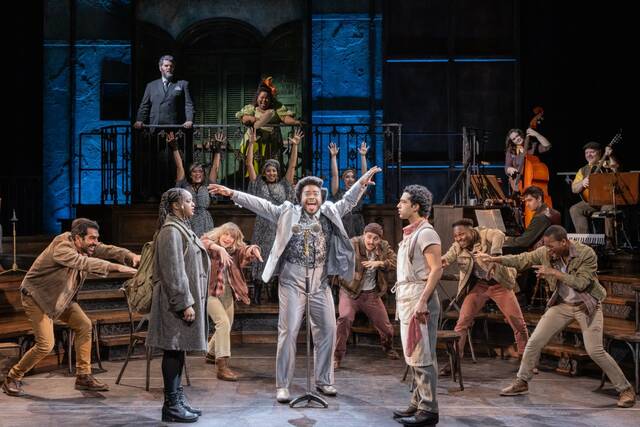
While the principals—Contreras especially—make the show special, the performers who play the Fates steal the evening. Gia Keddy, Miriam Navarrete, Jayna Wescoatt, and Julia Schick enthrall as the destiny-weaving sisters (Schick joined the trio for act two on Tuesday night after a mid-show cast change placed Navarrete in the role of Persephone, played powerfully in act one by Namisa Mdlalose Bizana). Standouts on an immensely talented team, these actors help significantly to elevate a particularly good show to a distinctly memorable event.
The show’s musical numbers encompass an impressively diverse selection of genres, and the orchestra proves up to the tasks set by a score that moves from blues to ballad as effortlessly as Hermes darts between the living world and perdition. Not surprisingly, “Wait For Me” and “Why We Build the Wall” linger in the mind, but note to the artistry with which the instrumentalists, under the direction of Arman Wali Mohammad (piano) and Analuna Chahine (violin) and conducted by Keith Levenson, deliver songs such as “Come Home With Me,” “When the Chips Are Down,” “Nothing Changes,” and “Promises.” Keenan Tyler Oliphant demonstrates insight and humaneness in directing Rachel Chavkin’s reimagination of the Broadway original.
Hadestown looks to deep antiquity to tell a moving story of longing, despair, and foolishly beautiful valiance in a new production well worth crossing the threshold to see.
—TR
“Hadestown” runs through November 1, 2026, at the Benedum Center, 7th Street and Penn Avenue, Pittsburgh PA 15222. Please visit www.trustarts.org for information and tickets.
