Trapped during a storm, Mary Shelley (Stacia Paglieri playing multiple roles), her husband and friends take refuge in a Swiss mansion. Perhaps due to boredom or the raging storm outside, those inhabitants think it would be fun to each write a “scary” story. Mary’s imagination triggers during that fateful night, she conceives the idea of one human creating life (not in the traditional way).
Writing a story so creative with such an unusual theme in the early 19th century is not novel. But considering the time frame, it is unusual and rather refreshing that this piece of science fiction was written by a woman.
Note: Mary, Mary. Quite contrary!
The theme of Frankenstein has gone through many variations, from a serious, frightening movie with a monster stitched, sewn together and bolted in some places to a dark comedy interpretation.
Lawrence C. Connolly’s adaptation takes the original basis of the book and incorporates the author, Mary Shelley and her cohorts into the play, interspersing Mary’s comments to her sister, Claire Claremont (Maddie Kocur playing multiple roles) as the play progresses. At different stages of the production, Mary and Claire engage in conversation on how Mary’s story develops from conception to play solution.
The parallel story line of “Frankenstein” involves following Victor Frankenstein (Isaac Miller playing multiple roles) as he creates the creature (Everett Lowe) with the sole purpose of constructing another life that defies death. Once created, Victor doesn’t know what to do with what he has created.
Fleeing from Victor the creature resides with Monsieur Delacey (David Nackman playing multiple roles) and learns to read and write. His obvious intelligence makes him more of a threat.
The creature has a mind of his own, acts irrationally, commits crimes for no apparent reason. He is smart enough that he allows others to take the blame for those crimes.
Realizing what he has created, Victor’s main purpose is to stop the creature. Obsessed with finding him, he trails him across the country and beyond.
As pursuit continues, one questions whether it’s Victor or the creature that is the actual villain?
Lowe is outstanding as the creature. He is not one-dimensional but clever, cunning, cruel and confused.
Miller as Victor displays a range of emotions from a stable, normal human wanting to create a perfect human to an almost crazed individual as he pursues the creature.
Kocur as Justine Moritz is effective as the pitiful woman convicted of a crime she didn’t commit.
Paglieri as Mary is confident and exciting as she continues to develop the play. She easily conveys Mary’s independent nature.
Nackman does a wonderful job as the only person who provides the balance and support that the creature needs.
Excellent lighting by Lighting Designer Hope Debellius with effective sound by Sound Designer Mark Whitehead.
“Frankenstein” was adapted by Lawrence C. Connolly and is based on the novel by Mary Shelley.
-CED
“Frankenstein” is a production of Prime Stage Theatre Co, performed at the New Hazlett. It runs from November 4 – November 13. For more information, click here.
A group of thirteen-year-old dancers, raging with hormones, enter a series of dance competitions that will propel them to their personal Mecca, Tampa, Florida for the National competition known reverently as Nationals.
Clare Barron’s absurdist play, “Dance Nation” is a combination “Dance Moms” and “Hunger Games.” Amina (Miya Gaines) may be the star pupil, but all of the characters in this ensemble shine.
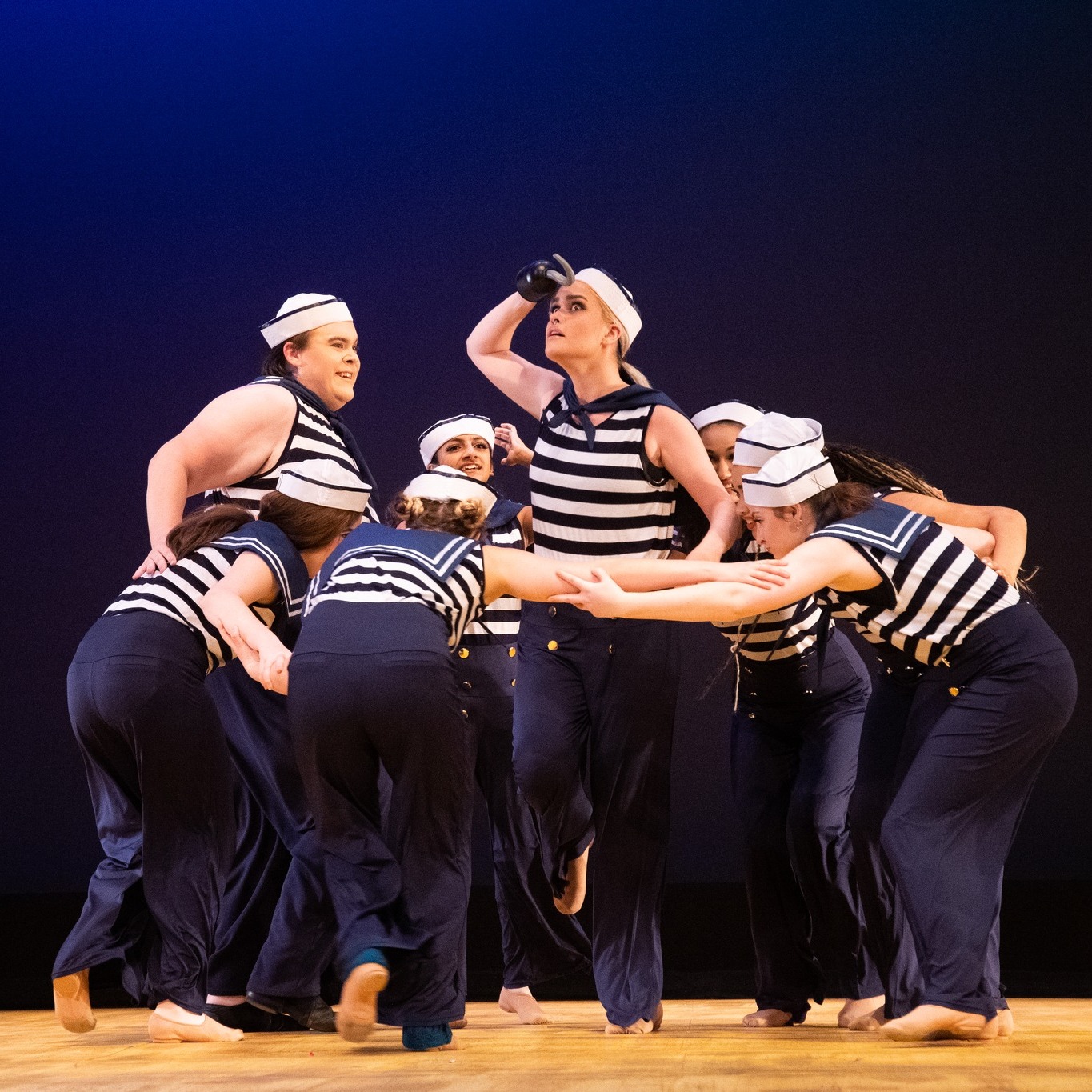
After a boisterous sailor routine, Dance Teacher Pat (Ricardo Vila-Roger with a magnificent mane of a wig) decides to switch up the routine and go with a dance about freedom leader Mahatma Gandhi. He claims everyone will get a chance to audition for the role, while the lone Indian girl, Connie (Nandita Mahesh), is screaming “Cultural Appropriation” with every shrug, eye roll and glare of disdain.
Eventually, Connie is cast as the holy man, though Dance Teacher Pat creates a new character, the Spirit of Gandhi, and casts Zuzu (Gabby Wilson) in the role, usurping Connie’s chance to be noticed. Instead, her “starring” role keeps her seated in the lotus position for most of the routine. The Spirit of Gandhi is the real lead.
It becomes clear that Dance Teacher Pat picked Zuzu to teach Amina a lesson, and Zuzu suffers for it, mostly by biting and tearing at her own flesh like a braying wolf caught in a bear trap.
Maeve (Olivia Wick) plays a hook-handed sailor as the ensemble circles her in “Dance Nation.”
Director Kelly Trumbull keeps her cast, literally and figuratively, on their toes. “Dance Nation” has some great choreography, supplied by Tome’ Cousin, but it’s never really about the dance. It’s about the inner moments; the jealousies, the pettiness, the power and the imagination of this crazed batch of thirteen-year-olds. Children who are waiting for their lives to start, unaware they are living each moment and those moments are creating their lives.
Ashlee (Paige Wasserman) delivers the first of a series of unhinged monologues that is an alternatively hilarious and shocking rant on her self-confidence. She is magnificent.
Maeve (Olivia Wick) is another stand-out, oozing charismatic charm with pitch-perfect comic timing.
Molly Twigg makes several appearances throughout the show, first as Vanessa who sustains a career-ending injury. Then, she appears throughout the show as the girls’ moms (all of them with different wigs). She shocks in the first scene but lightens every other scene after that.
Luke (Cade Teribery), the lone male member (hee hee…”male member”) of the troupe, contorts his face into a variety of reactions as his teammates reveal their strengths and weaknesses.
Barron’s story is more than a story about competing thirteen-year-olds on a path to self-discovery. It’s about all those stray thoughts that live in your head. The moments you get to be as weird as you want to be. It’s about how imperfection makes you perfect.
To paraphrase from the show, albeit in a less vulgar vernacular, “Dance Nation is perfect, and it will stay that way forever.”
– MB
“Dance Nation” runs from until November 13 at Pitt Stages’ Charity Randall Theatre, 4301 Forbes Avenue, Pittsburgh, PA 15213. For more information, click here.
Little Lake Theatre continues its 74th season with Kate Forgette’s 2008 play, Sherlock Holmes and the Case of the Jersey Lily. Forgette’s rollicking return to the Victorian era of 1894 imaginatively unites fictional and real characters. The former with Sherlock Holmes (Arjun Kumar) and Dr. Watson (Ernesto Sanchez), the latter with flamboyant playwright Oscar Wilde (Ryan Frank) and famed stage actress Lillie Langtry, aka the Jersey Lily (Danette Levers).
Director Gretchen A. Van Hoorelbeke harmonizes all of these larger-than-life personalities, allowing each to shine without letting them overpower each other. Forgette’s dramatic collision of fictional and historic figures makes for fun imagining. For instance, we learn Holmes helps Wilde title his works. Wilde’s current play in progress, The Importance of Being Forthright, is of course what we know as The Importance of Being Earnest thanks to Holmes’ retitling. Hoorelbeke shepherds the play’s rather madcap plot without letting the snappy dialogue run ahead of the action.
Langtry was legendary for her beauty and string of lovers. Watson is immediately smitten by her, and Hoorelbeke has Sanchez emphasize the impact by staring beseechingly at the door long after she departs Holmes’ residence. Langtry’s love life is at the heart of the play. She’s being blackmailed for her salacious correspondence with the Prince of Wales, and Holmes is tapped to uncover the blackmailer. Kumar captures the intensity of Holmes’ active mind with continual pacing and movement.
Sherlock (Arjun Kumar) presents evidence. Photo credit: Hawk Photography and Multimedia LLC
If anyone does steal the show, it’s Frank with his jaunty portrayal of the flamboyant Oscar Wilde. Frank’s just above the shoulders haircut lends itself to dramatic hair tosses that heighten the playwright’s magnetic personality and wit that Frank makes manifest. Costume designer Barbara Burgess-Lefebvre’s choice of a drab olive green suit for Wilde misses the mark as it fails to amplify Wilde as a cultural icon of the time who was well-known for his ostentatious dress. Her red and gold costuming for the stunning Langtry is reminiscent of holiday wrapping paper. However, neither Levers nor Frank are hampered by the muted costume choices.
As a woman of the stage playing a woman of the stage, Levers commands the helm as Langtry. She is fully aware of her command over men and repeatedly dials it to her advantage while playing the innocent. She leads with her chest out, literally leaning in to Watson’s flirtations in the hopes he will persuade Holmes to take the case. Later, she demurely tells a captor about her working-class upbringing to gain his sympathy so he sees her as socially aligned, not socialite.
The play is a layering of stories and deceptions, and ultimately, Holmes is just as real as Wilde. Forgette blurs the lines and reminds us we are all performers while letting us ride along in her literary time machine.
– TKR
Sherlock Holmes and the Case of the Jersey Lily runs through October 30th at Little Lake Theatre. For more information and to purchase tickets to the show, please visit https://www.littlelake.org/sherlocklily
Richard Hannay (Hayden Bobbyn) brings Annabella Schmidt (Shea Sweeney) home after meeting her at a Mr. Memory presentation. She warns Richard about the 39 steps. She never explains what the 39 steps represent, but as a spy she knows she is in danger. Annabella encourages Richard to travel to Scotland to pursue the leader of this spy ring. She is convinced that someone will harm her. She is correct. She is murdered.
Probably not the climax Richard was anticipating.
Richard is the primary suspect in the murder, and he begins a wild escape from London to Scotland to find this mysterious spy. As he journeys to Scotland, he encounters wild circumstances and weird people along the way. All this while the police are in hot pursuit.
He meets Pamela (Shea Sweeney) who plays an important part in his adventures. She will be part of the solution when the enigmatic spy and murderer is identified.
Mr. Memory reenters the picture and also helps to solve the case.
The cast of “39 Steps.”
Bobbyn is effective as he grows from a rather boring fellow who is agitated as he attempts to find the murderer and clear himself to a man who thoughtfully and deliberately contributes to the crime’s resolution. All of this done in almost constant gymnastic movements.
As Pamela, Sweeney develops from a prim and proper lady who softens as the play progresses. She is particularly funny in the scene where she and Bobbyn are cuff linked and in a compromising position.
Clown 1 (Austin James), Clown 2 (El Giaudrone), Clown 3 (Cadence Reid), Clown 4 (Joshua Reed), Clown Swing (Daria Lapidus) and Clown Swing (Rachel Pronesti) carry out multiple roles with various accents and props while maintaining critical timing.
Reid is effective as chameleon-like Professor Jordan, changing from smooth talker to aggressive attacker, sometimes with a German accent.
Reed’s comedy is highlighted in his portrayal of Professor Jordan’s wife and as the fumbling, near comatose presenter at a Scottish event.
Murder is not something to laugh about! But this is one exception in an extremely hilarious, ridiculously funny play.
A farce involves taking a serious situation and exaggerating it to the extreme. “The 39 Steps” overachieves with an emphasis on physical movement and contortions, miscues, mistaken identities and extreme facial expressions.
The set is simple with all of the props stacked neatly at the back of the stage. They are retrieved by the cast and crew as needed without any pretense of hiding that function from the audience.
Note: The actors are very fluid, rapidly speaking and moving from all parts of the stage. There are times when facing the back of the stage that their dialogue is sometimes muffled.
Directed by Mikki Monfalcone.
“The 39 Steps” was adapted by Patrick Barlow from the novel by John Buchan.
-CED
“The 39 Steps” is a production of Pitt Stages Productions – University of Pittsburgh, Henry Heymann Theatre. It runs from October 21 through October 30. For more information, click here.
Listening to the works of Stephen Sondheim, whether it’s lyrics he wrote in collaboration with other composers or those works where he did double duty, writing both lyrics and music, is a joy.
Sondheim’s lyrics stretch beyond the norm of prior lyricists, suggesting themes and ideas not often expressed in previous musicals.
A new world of musicals emerged when he combined lyrics with his original musical compositions. The words and music were just as equally important, one complementing the other.
When you have a revue of many of his works within a limited time frame, it’s almost like eating an entire box of candy at one sitting instead of just one piece. What a sugar high!
Interspersed among the musicals are video clips of Sondheim in his own words that span his career. They provide a personal and professional look at the man whose music and lyrics continue to be in the public eye.
A profile of the prolific songwriter, Stephen Sondheim. “Sondheim on Sondheim” does not include all of his works but rather a selection. This snapshot includes his first composition titled “I’ll Meet You at the Donut” written while he was a high school student to universally known musicals like Company and A Little Night Music.
Alexandra Kinsley wows with “Take Me to the World” from Evening Primrose. Evening Primrose was an episode from a TV series titled ABC Stage 67.
Sara Reynolds highlights her beautiful voice and comedic talents in “Now You Know” from Merrily We Roll Along.
Brandon C. Andrew delivers with “Good Thing Going” from Merrily We Roll Along.
Jordan Threatt lets loose with a powerful performance of “Epiphany” from Sweeny Todd: The Demon Barber of Fleet Street.
Will Cobb is passionate as he sings “Is This What You Call Love”, a powerful song from Passion.
Austin Taylor Dunn delivers a clear solo in “Multitudes of Amys,” a Sondheim song that was originally selected for Company but ultimately rejected.
Alondra Trinidad-Colon struts her stuff with “Ah, But Underneath” from Follies.
Gabriela Garza sings a lovely rendition of “In Buddy’s Eyes” from Follies.
“The Gun Song” from Assassins is beautifully performed by Hunter Trstensky, Elijah Corbin, Leo Bochicchio, Claire Ferguson, Kaley Bender, Riley Nevin, Jenna Clover and Cammi Caldwell.
Jordan Threatt, Will Cobb, Braden Andrew, Austin Dunn, Gabriela Garza, Alondra Trinidat-Colon, Sara Reynolds and Alexandra Kinsley show a different side to “Happiness” from Passion. Comedy at its best!
The entire ensemble is well-balanced with all around talent in song, dance and comedy. They reinforce one another.
The backdrop is elegant with nuances in color and subtle, visual effects.
Music Direction by James Cunningham. Direction and Choreography by Zeva Barzell. “Sondheim and Sondheim” conceived by James Lapine.
-CED
“Sondheim on Sondheim” is a production of Point Park University’s Conservatory Theatre Company. It runs from October 19 through October 23. For more information, click here.
Most people have dreams. Dreams of career success, a lasting relationship, a long life with good health. There are many more possibilities, some more grandiose like fame and fortune, others less so.
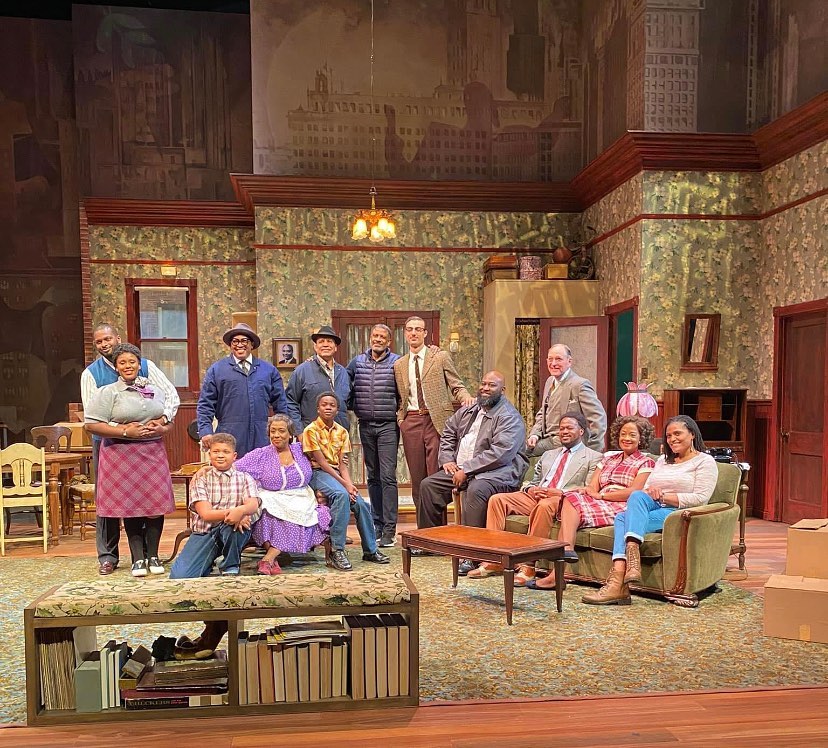
In 1950s Chicago Lena Younger (E. Faye Butler) has a dream. She wants to own a home. Currently her nuclear family consisting of her son Walter Lee (Rico Parker), his wife Ruth (Dedra D. Woods), their son Travis (Ty Gilliam) and Lena’s daughter Beneatha (Hope M. Anthony) live in a tiny apartment that has one bathroom and not much privacy for all those residents.
When an important family member dies. Their insurance money enters the equation, and members of the family have very different ideas on how to spend it. They all are expecting an insurance check that could satisfy those dreams. Some wait patiently. Walter is more intent on getting the money quickly and is often asking if the mail came, did the check arrive?
Mama always dreamed of having her own home and one that has a large backyard so she can have a garden. Walter Lee wants the money to invest in a small business. Beneatha knows that part of that money will contribute to her education to pursue a medical degree.
Beneatha’s energy right now is not on the anticipated check. She is befuddled between two suitors who couldn’t be more diametrically opposed. Brenden Peifer (George Murchinson), a college student is intent on a business career and achieving the American dream. Kevis Hillocks (Joseph Asagai), a student from Nigeria is intent on educating Beneatha on her African heritage, an essential part of her persona.
When the check finally arrives a series of events quickly accelerate.
Mama announces that she bought a house in the Clybourne neighborhood, a predominately white area of the city.
The full cast of “Raisin in the Sun.”
Thinking some of the money is out of reach, Walter is distraught but Mama comes through and gives him a small portion of the proceeds with the recommendation that he open his own checking account and deposit money specifically and separately for Beneatha’s tuition.
Ken Bolden (Karl Lindner), a white “welcoming” member from the Clybourne neighborhood association visits the family. Condescendingly he suggests in a sugary voice that perhaps it would be best if the organization buy them out. He thinks it would be best for them. He is asked to leave.
How is the money finally spent and what does Walter do with his share?
Does the family move to Clybourne or back off and stay in their small apartment?
Is the potted plant still in the apartment’s window sill or is it ready to be moved along with the furniture to a new home?
Butler’s performance is brilliant. She captures the essence of a loving, yet stern (when needed) mother. Add in a dash of comedy and common sense that is sometimes overshadowed by despair, she helps guide the family to its final decision.
Parker transitions from a man feeling insecure, mostly impatient and angry with his circumstances to a more rational, emotionally sensible person.
Anthony shines as the younger sibling still child-like at times but whose womanhood and African ancestry evolve and grow.
Hillocks’ passion for Nigeria and his enthusiasm for his future there is captivating.
Woods grows her character from the serious hard-working wife into a hopeful, more joyful and independent person.
Peifer plays the know-it-all college student perfectly.
Bolden portrays the character that one loves to hate and he succeeds.
A beautiful production with a superb cast!
Lonnie the Theater Lady said, “It was an exquisite production. Just beautiful!”
Hats off to Jennifer J. Zeyl for an intricate setting in the Younger apartment and kudos to Director Timothy McCuen Piggee.
-CED
“A Raisin in the Sun” is a production of Pittsburgh Public Theater. It runs from October 12 through October 30. For more information, click here.
Wednesday (Victoria Buchtan) is full of woe. She’s fallen in love with the very sweet, very normal Lucas Beineke (Palmer Masciola), and has invited him and his parents, Mal (Nate Copeland) and Alice (Kristin Pacelli) to dine with her family at their ancestral home on One Cemetery Lane (not to be confused with the Munster’s who lived over on 1313 Mockingbird Lane), somewhere in Central Park.
Wednesday’s worried about this particular dinner meeting because her family is a bit different from most folks. You could say….they’re creepy and they’re kooky. They’re mysterious and spooky. They’re altogether ooky!
Yes. It’s THAT Addams Family.
Unless you’ve been living under a rock, or you’ve just been freshly dug up by Fester (Randy Dicks), you should be familiar with the titular family. There were iterations ad infinitum, starting with the original comic strip by Charles Addams that appeared in the New Yorker. There was a TV show starring John Astin and Carolyn Jones in the 60s. From there, the eponymous first family of fright went to the movies with Raul Julia and Angelica Huston. Then, on to Broadway with Nathan Lane and Bebe Neuwirth (you are here). More recently, there are two feature-length cartoon movies, too. Much like their undead relatives, the Addams Family keeps coming back.
Wednesday is afraid of disappointing her parents, Gomez (Brandon Keller) and Morticia (Carina Iannarelli).
She is surrounded by a “not-so-normal family” that includes her aforementioned Uncle Fester, her brother Pugsley (Trisha Holmes), her Grandmama (Jeanne Kmetz-Donovic) and family butler Lurch (Dylan Baughman).
Meanwhile, Pugsley is plotting to administer a vile vial. He wants to pop a potion in Wednesday’s drink at the dinner table, an acrimonious brew that sours the victim suitably titled Acrimonium (not to be confused with the Steelers new stadium). It turns out – that after years of being tortured by his sinister sister – he’s afraid he’ll miss it, because she’ll be spending all her time with Lucas.
All that, and Uncle Fester confesses that’s he’s mooning…over the actual moon. Does the moon feel the same way? Does Fester know what makes Luna tick, or is he just a lunatic?
The musical comedy version was developed by Andrew Lippa, Marshall Brickman and Rick Elice more than ten years ago, but, the Addams Family, is ageless. The cast drops in a COVID-19 joke, just to keep up with the times.
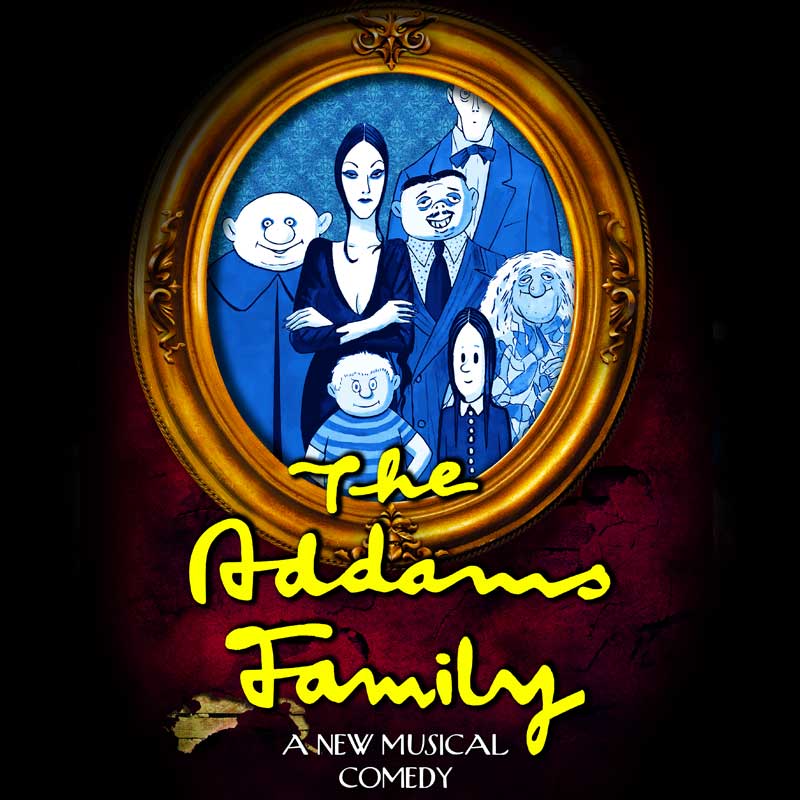
The poster with art from Charles Addams, the original creator.
“The Addams Family” is a delight. They manage to sing and dance their way into our hearts – instead of stabbing them with a crossbow as per their usual modus operandi.
Comtra produces an amazing version of this Broadway hit. The music was great, but, as it does in most smaller venues, it occasionally overpowers the singers, except Buchtan, who projects past the rafters.
Buchtan is amazing as the Goth girl gone good. She and Masciola belt out “Crazier than you,” and it’s a showstopper!
Keller and Iannarelli get a chance to shine in the darkness. Their voices are superb.
Dicks is a wonderful Fester, channeling Jackie Coogan from Beyond. He gets a chance to pine for his lunar love, surrounded by his undead ancestors.
The dead can dance!
Side note: The Cave Man (Ayden Freed) steals every scene he’s in. He never breaks character, even his bio in the virtual program is full of ooga bungas (now that’s some Method Acting right there!).
The entire cast is terrific. The show is done on a shoestring of a budget, but it doesn’t matter. The cast will win you over with a literal and figurative snap of a finger.
– MB
“The Addams Family” runs through October 23 at the Comtra Theatre, 20540 Route 19, Cranberry Township, PA 16066. For more information, click here: https://www.comtratheatre.org/
Every year the locals of Ligonier, Pennsylvania light-heartedly quip that George Washington must have signed a treaty with Mother Nature when Fort Ligonier was built to always provide perfect fall foliage, crisp cool temperatures, and clear skies during the town’s annual Fort Ligonier Days festival. This year, forecasts show Mother Nature is once again expected to hold up her end of the bargain during the annual three-day festival which will begin at 9:00 AM Friday, October 14th and end on Sunday, October 16th at 5:00 PM.
Over the course of these three days, the town expects to draw in crowds larger than 100,000 visitors to enjoy its over 200 juried craft vendors, more than 30 food vendors, annual Saturday parade, 5K run/walk, and live entertainment. At the forefront of this year’s Fort Ligonier Days festival, however, is its history. Jack McDowell, Chairman of the Fort Ligonier Days Committee, announced the 2022 theme of “Honoring Historical Traditions,” which includes both the history of Fort Ligonier and the traditions that locals and visitors to Ligonier have made over the years.
The decision to focus on the history of a place and the traditions passed down from generation to generation is something artists in this area are acutely trained to depict and preserve. Moreover, understanding these histories and traditions is a large component of the cultural preservation efforts among museums, public monuments, and other historic sites in our modern era that are increasingly conscious of the generational impact and legacy they wish to chart into the future.
A brief history of Fort Ligonier
A view of the fort.
The road which today connects Pittsburgh to Ligonier was forged many years prior, in the 18th century, as a part of the British military effort to eventually overtake Fort Duquesne from French forces during the French and Indian War. At the time, two simultaneous military efforts were underway, each led by two separate British generals, General Edward Braddock of the unsuccessful Braddock Expedition, and General John Forbes of the successful Forbes Expedition. As the British military traversed across Pennsylvania through its thick wooded wilderness, they built a series of forts established at key 50-mile intervals. Fort Ligonier was the last of these forts built in the late summer of 1758 before the British eventually captured Fort Duquesne, completing the Forbes Expedition, later that same year. During those late summer months into early fall, British soldiers continued to build up the Fort, adding storehouses, a hospital, and trenches.
On October 12, 1758, while Fort Ligonier was still being built, a militia of French forces from Fort Duquesne attacked the British soldiers there, resulting in a four-hour battle that the British eventually won, but not without suffering numerous casualties. This Battle of Fort Ligonier is what Fort Ligonier Days seeks to commemorate every October.
Creating a fort for the arts
Each Fort Ligonier Days, the authentically reconstructed Fort Ligonier welcomes visitors during its normal hours of operation to witness historical battle reenactments including several firings of the cannons. Visitors can also explore the recently renovated museum, including its esteemed Fort Ligonier Art Gallery which features portraits of former British monarchs, local landscapes, and historical paintings.
For Mary Manges, the Executive Director of Fort Ligonier, these opportunities to experience the Fort are intended to be accessible to everybody—past, present, and future generations.
“Not everyone thinks history is interesting, so we want to give that opportunity to see it in a different light. It’s not the textbook version that they learned in school, it’s so much richer and deeper than that and more interesting than just the one paragraph you read about.”
“Anytime we can instill a passion for history, whether it’s art history or some other area in history, just to spark that interest and get someone to see there’s so much more beyond history class and a textbook.”
She sees the purpose of Fort Ligonier, and Fort Ligonier Days by extension, as two-fold: being both a place to educate people who already have an intense interest in history and engaging those who may not have the same passion but can still learn something new as well as being an economic partner in the local community.
Living Quarters inside Fort Ligonier
Although Manges does not lead tours as often as she used to in her new role, she says focusing on the organization’s “why” helps keep her grounded. “I want these kids to know this is also a career path. Places like Fort Ligonier are great places to work someday, and they can pursue their passion and make a living doing that.”
One Ligonier-born artist, Chas Fagan, who’s historical painting, Flash Point, is now included among the Fort Ligonier Museum’s world-class collection, remembers his early years attending Fort Ligonier Days with fond and influential memories.
“Flash Point” by Chas Fagan is a Friendly Fire Incident.
“Fort Ligonier Days had a tremendous variety of artists that were inspirational for me.” Specifically, Fagan recalls seeing an artist who created artworks using an old engraving technique called scratchboard when he was about 10-years-old. “He was amazing. I’d never seen anything like it. Never seen it before in my life and it was just wonderful.” Later in his career, Fagan was searching for a new, but old inspired-look for a series of magazine illustrations. He remembered the technique he saw in his childhood at Fort Ligonier Days and ended up making several scratchboard pieces, “all because some guy who had a booth in Ligonier.”
Now, Fagan himself is the guy at Fort Ligonier inspiring the next generation of young artists and historians.
“Art was always something I liked as a kid. I liked to draw. I loved the pencil. Somehow, I just knew it. It was just in my head. Then you start growing up and try to be serious.” So, Fagan found himself enrolled in university, earned his degree in Soviet Studies, and studied in Leningrad in 1988, which was a challenging experience that altered his professional path.
After returning to the States, he began creating political cartoons that opened the door to his professional art career. In addition to political cartoons, Fagan is also a portrait painter, a landscape painter, and a sculptor. He has created portraits of the 45 prior Presidents, the official White House Portrait of First Lady Barbara Bush, and the official portrait of Mother Teresa at St. Peter’s Basilica in Rome. His sculptural works include historical figures like his Ronald Regan statute housed in the U.S. Capitol building and his Rosa Parks statute in the Washington National Cathedral.
“I am that guy that digs and has a ball diving into the historical detail and trying to bring some of that out. If it’s a sculpture, I try to slip some visual clues in the sculpture that no one will find until they do. Because I love fleshing out that story.”
The story depicted by Fagan’s Flash Point painting is an incident that occurred just a month after the Battle of Fort Ligonier, on November 12, 1758, where two groups of British soldiers, unable to see through the dense fog, began firing at one another because they mistook each other for the enemy. A young George Washington, realizing the soldiers were shooting at their own men, rode his horse through the crossfires to stop the groups from firing at one another.
The level of detail in Flash Point, Fagan calls the “basic core facts,” some of which come from George Washington’s own letters that are a part of the Fort Ligonier Museum and were the result of a decades long research endeavor, lead in a large part by Fagan’s father.
“I had a huge advantage because of my dad. This was a story that stuck with him for decades.”
While the history of this incident was generally known, Fagan’s father kept digging and collecting information from all sources including historians from colleges and the military to figure out the details. Eventually, he discovered in the clearing of the woods, the original Forbes Road.
“To physically be there is one thing, to hear of it and see where it should be on a map, but then to walk it, walk all the way down into the valley and visualize the progression of the events of that day in 1758 and trying to imagine, ‘What would happen if?’ Having witnessed that, I was able to ride in the wake of all the discoveries and the history and if I didn’t know the history all I’d have to do is call dad.”
Although Fagan’s father contributed to the groundwork in discovering the history of Fagan’s painting, the artistic development of Flash Point was guided by all the old paintings Fagan would see displayed in museums across Europe and the United States, including “The Painter of the Revolution” John Trumbull, who could summarize entire battles in rather small, historically accurate paintings. Before Flash Point, Fagan’s historical paintings were mostly Native American scenes with not a lot of figures, so the challenge for this painting was how to populate the painting in a way that engages the audience.
“Compositionally the challenge is to tell the story, to show the story, but still have people get involved in it. The goal with this was more to engage the viewers, especially to bring the younger boy or girl, to bring them into the scene.”
Much like his father before him, Fagan is focused on sharing his passion for history and the arts with the younger generations. He remembers during one of his visits back at Fort Ligonier an energetic young boy buzzed through the Fort Ligonier Art Gallery and promptly stopped in front of Flash Point, completely amazed staring up at George Washington on his horse riding through the crossfires. “He was stuck there for the longest time. It was the greatest personal reward because that’s exactly what I wanted. If that can be the legacy of the painting, I’ll be happy.”
Manges says that reaction, especially from young people and school groups, is one she hears all the time. “They are taken away by it. They are just amazed. It’s so fun to hear that repeatedly because if an 8th grader is getting that and is having that reaction to that giant painting on the wall, that’s impressive. And that’s something a textbook is not going to do. You could have that same painting in a textbook, but it’s not going to impact that kid in the same way as coming to a museum and seeing it in real life.”
Lasting impression for local vendors
The museum at Fort Ligonier is not the only place to experience the arts at Fort Ligonier Days. A number of local artists will be featured vendors in the various locations around the town and their works similarly leave lasting impressions.
Zack Landry, who graduated from Ligonier Valley High School in 2014 and started his own art business, White Sage & Sapphire, in 2017 will be returning to Fort Ligonier Days as a vendor for his third year.
Zack Landry of White Sage and Sapphire
“I never intended to become a jeweler, it just kind of fell into my lap. I was always the kid that was out collecting rocks and crystals. Now I’m just a bigger kid that still collects rocks except I just make things with them.” The things Landry makes include an array of earrings, necklaces, bracelets, and rings all handmade meticulously and curated personally by the artist.
“Right now, I’m working on bicolored sapphire stackers. There are some really soft muted fall colors like oranges and yellows. And because they are bicolored, they have some banding to them where there’s multiple shades within a stone. They feel like fall.”
Having grown up in the area, Fort Ligonier Days is also a nostalgic time for the 26-year-old business owner. “For me, Fort Days is the start of fall. It’s the weekend the trees all magically change and there’s magic in the air.” As one of the festival’s younger vendors, Landry remarks how as a high school student interested in the arts, he would have loved to see someone like him with a booth because he felt continually dissuaded from pursuing a career in the arts. Now, he has former classmates supporting his business and is even getting recognized for his work in public. “Last year felt like I was stepping into my own. While it was just my second year there and we had a gap year because of COVID, I had multiple people that came back and were repeat shoppers from 2019 to 2021.”
“This year, I’ll have some items with 14 karat gold accents, so this will be the first time I’m doing a large mixed metal release. The statement I tell everyone who comes into my booth is that all my metals will be sterling silver or 14 karat gold-filled, so customers are investing in a piece that is not going to irritate their skin and something that could potentially last a lifetime with the proper care. With that, everything in my booth is a natural gemstone as well. A large portion of what I use has not been dyed, treated, or enhanced.”
Landry emphasizes the physical properties of metal and stone that do not decompose, which make his pieces capable of being passed down for generations. “One of my favorite things about jewelry is the storytelling that goes along with it. There are themes in jewelry that transcend cultures and transcend generations. You think of people who have their grandma’s diamond and take it to have it reset into something new, they reconnect sentimental value to pieces. I love that my story becomes your story and then gets to live on.”
Andrew and Rachel Skovira, like Landry, have spent the past five years growing and developing their family owned and operated business, Mountain Top Engraving. The Skoviras are a husband-and-wife team who grew up in Western Pennsylvania and are familiar with region’s craft festivals like Mount Pleasant’s annual Glass Festival. The past few years Mountain Top Engraving has carved out its spot at the Ligonier Country Market selling personalized products like mugs, magnets, cutting boards, earrings, signs, décor and so much more, but this year will be the couple’s business debut at the Fort Ligonier Days festival.
A Christmas Cutting Board from Rachel Skovira at Mountain Top Engraving.
Andrew is a seasoned tradesman. Having worked in manufacturing plants that deal with all kinds of materials from glass to steel, he is well acquainted with the mechanical operations of the business. “I worked with machines for my full-time job, and now I’m in an office all day. Neither of these involve a ton of creativity, so this business is my creative outlet. A way to decompress after a long day at work.”
Like many family businesses, Mountain Top Engraving is operated out of the couple’s home with a set up comparable to most professional workshops, but with the convenience of working from home. This set up allows the whole family to get involved, including the couple’s three young kids, who are learning entrepreneurship at an early age because of their parents.
“The kids love to get involved and help at the markets. They’ll help Rachel paint some of the magnets and our oldest is learning how to run the machines.”
For Andrew and Rachel, the business is also about showing their kids how to continue to pursue their passions.
When reflecting on how much Mountain Top Engraving has evolved in the past five years, Andrew gets more excited about the direction the business is headed. “You never know where the next project might come from. But I hope we’ll do more commissions for businesses. I’ve been enjoying working with our glassware engraving and it’d be nice to do more commissions like that in the future.”
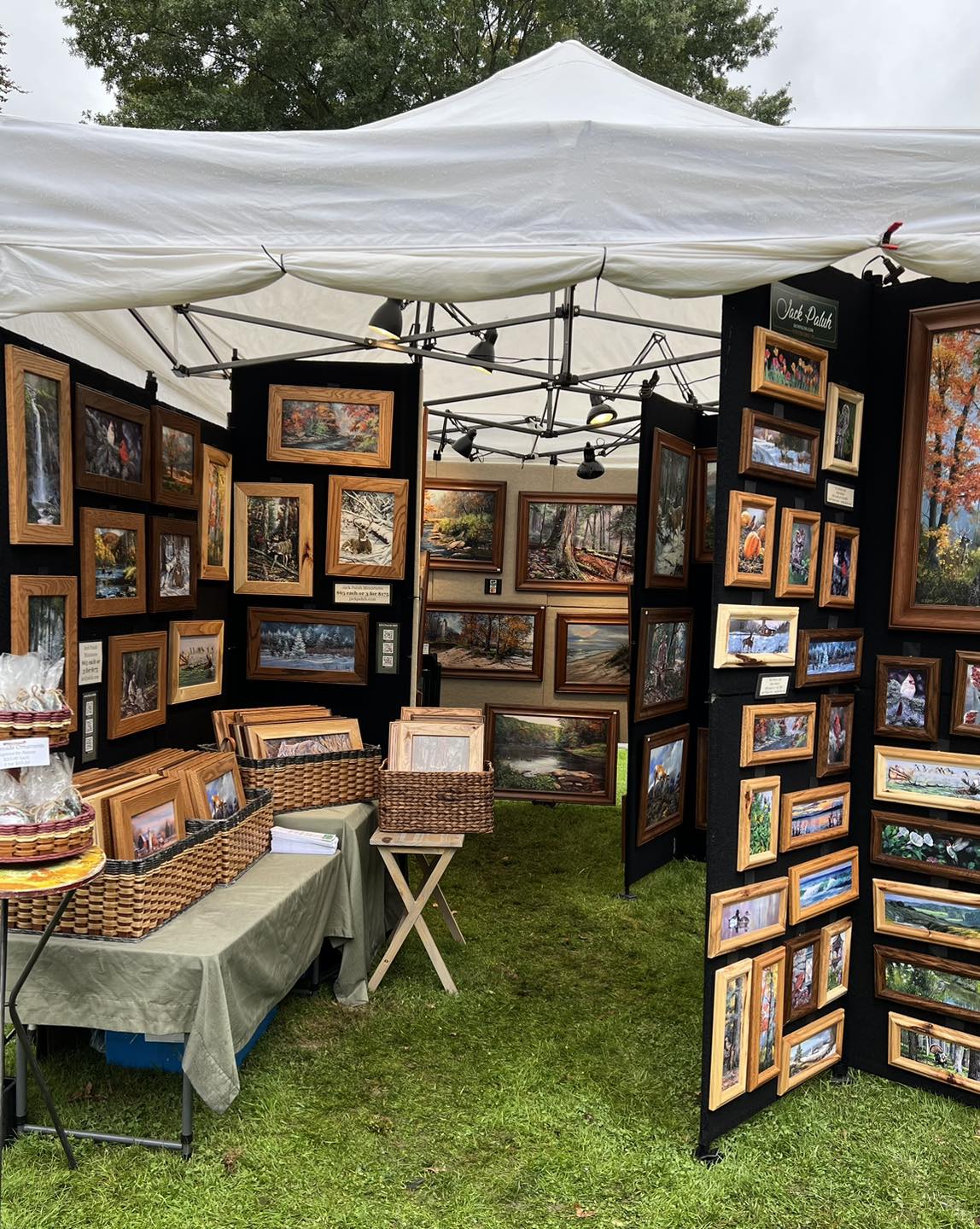
Jack and Marian Paluh of Jack Paluh Arts, Inc. are another husband-and-wife duo making their debut at the Fort Ligonier Days festival this year. However, Jack and Marian have been in the business of making and selling art for nearly 40 years. Still, the couple is always looking for new venues and opportunities to exhibit their works.
Jack and Marian Paluh’s Booth at Fort Ligonier Days.
“I’ve been painting 43 years, full time.” Jack says. He started his career at a trade school and after graduation he started to take plein-air painting courses with other artists from all over the country. “I would travel out West and plein-air paint with those groups. We still travel, so I’ll paint ocean scenes, too. But when it comes to home, I bring works with the landscape that’s here with the hardwood forest and wildlife.”
Depicting home for Jack means capturing those places in Plein-air. “I am an outdoors man. I am a hunter and I live here in Pennsylvania, so I try to depict my environment where I live with everything that I put on canvas. In Plein air you see colors better with your eye than with photographs.”
Marian adds that she paints with Jack and is amazed at his ability to capture a scene in his paintings. “It’s amazing how he builds his paintings dark to light and how he sees color and how color relates to each other, how some colors will bring out other colors. His is a talent that has been honed over the years.”
For Jack, “It’s a lifelong career. I want to paint until I can’t paint anymore. I enjoy it. I love it. It’s been a blessing and a wonderful job.”
No matter the age or the stage of life or career, the history and the arts have something for everyone.
– GM
For more information on Fort Ligonier Days, including an event schedule visit: https://www.fortligonierdays.com/
Dario (Vivica Genaux) and Idaspe (John Holiday) have been defeated, their women, Mandane (Zoie Reams) and Berenice (Pascale Beaudin), have been captured by a warring clan led by Artaserse (Karim Sulayman). All is lost! And that’s just the first five minutes of Claire van Kampen’s “Idaspe.”
Arbace (Shannon Delijani), Artaserse’s right-hand-person, summons the guards, his Matrix Mafia, elegant cavaliers and ballerinas in suits and sunglasses, and they rush out to arrest Dario, Idaspe and their compatriot, Ircano (Wei En Chan).
When they go before Artaserse, Dario (a Jerry Springer twist! He’s secretly Artaserse’s brother) disguises himself as Arbato, a general, in a desperate hope to get close to Mandane and trick his sinister sibling. Idaspe disguises himself as Arcone and claims that Idaspe is dead on the battlefield.
Mandane sees through Dario’s disguise, but Berenice does not recognize Idaspe and mourns her “dead” lover. It’s hard not to yell out, “You’re looking right at him!”
The soapy elements are frothier than a foam party in gay nightclub in Ibiza.
The opera, a reimagining of Baroque composer Riccardo Broschi’s classic story of warring kings. It’s set in Naples, Italy in the psychedelic 60s, with warring clans (read: Mafioso) standing in for the kingdoms. The story is really a tangled five-sided love triangle (love pentagram?), with a fickle Artaserse trying to woo both women away from their betrothed, Dario and Idaspe.
Artaserse (Karim Sulayman) captures Berenice (Pascale Beaudin) and promises to marry her after he kills her lover. Photo Credit: Jason Synder.
Confused? It’s okay. The plot is heavy and complicated in the first five minutes, but it thins out and gets easier to understand as it rolls along.
It’s a lot like “Days of Our Lives,” or, rather, “Giorni della nostra vita” as the grand melodrama is sung in Italian with English subtitles. Even though it gets silly, especially when Berenice is right up on Idaspe and doesn’t recognize him, or when Artarserse quickly throws over Mandane for Berenice because it suits the plot, it all works. Thanks, mostly, to van Kampen and Chatham Baroque’s imaginative retelling of Riccardo Broschi’s opera from 1730.
There are acrobats tangling in silks, fancy masquerades, show-stopping dance numbers and bright lights. It’s a dazzling spectacle filled with pomp, circumstance and some tongue-in-cheek humor.
Ilona Somogyi’s costumes are grand, with stylish dresses, ornate headpieces with hilarious accoutrement such as Mandane’s studded leather harness draped over her elegant canary-colored evening gown.
Mandane (Zoie Reams) in chains. Photo Credit: Jason Snyder
The orchestra provided by Chatham Baroque with Andrew Fouts (violin), Patricia Halverson (viola da gamba), Scott Pauley (theorbo) and an assortment of added musicians, including two oboe players, Fiona Last and Julie Brye, a celloist, Ezra Seltzer, a harpsichordist, Justin Wallace, and more combined blissfully for this stunning collaboration between Chatham Baroque and Quantum Theatre.
Antonia Franceschi’s sharp-yet-fluid choreography was extraordinary. The movements were crisp and clean. The suits gave the dancers a Fosse-esque “Rich Man’s Fugue” vibe.
Lighting designer Mary Ellen Stebbins uses kaleidoscopic colors and blinding bright whites to mesmerize the audience.
van Kampen’s 115-minute show moves along briskly, even with a 15-minute intermission, after the first act, and a brief pause between the second and third acts.
“Idaspe” is an extravaganza! A delight for your eyes and ears. It swelled with beautiful music and stirred the imagination.
– MB
Quantum Theatre’s “Idaspe” runs from October 7 until October 15 at the Byham Theater, 101 Sixth Street, Pittsburgh, PA 15222 at 7:30 PM. For more information and tickets, click here: https://trustarts.org/production/81475
Little Lake Theatre Company ascends with their production of “Captain Louie Jr. ” Anthony Stein adapted this musical from Ezra Jack Keats’ book “The Trip,” with music and lyrics by Stephen Schwartz. Little Lake’s former artistic director, the stunningly fabulous Jena Oberg, flies high in directing this youth production. Oberg stages this production in partnership with the Western Pennsylvania School for the Deaf. The entire production is performed in both American Sign Language and spoken English, and Oberg creatively unites the two youth groups, achieving an effortless flow.
The play centers on Louie (Roderick Mihoerck) who has just moved and is facing all the challenges of new kid life: missing and longing for his old home and friends while worrying about finding new friends and his place in a new town. We’ve all been Louie at multiple points, trying to figure out where we fit, whether that’s from a childhood move, starting college, beginning a new job, or joining a new friend group.
Mihoerck is deaf and communicates via ASL as well as via his favorite toy, a plane named Big Red (Madeline Dalesio). Dalesio provides the voice for Mihoerck’s signing, and the two of them unite in seamless harmony that mirrors that of a child with his favorite toy. Mihoerck never misses a beat, and his red-headed Louie sharply commands the theatre without saying a word. Dalesio’s stunning voice soars to perfection in the musical numbers. Big Red transports Louie to his old neighborhood for a Halloween night of trick or treating with his old friends.
Oberg’s creativity is compelling. She pairs speaking and signing kids for dual casting of roles like Archie (spoken by Colin Bozick and signed by Ben Vinzani), a friend from Louie’s old neighborhood. Bozick and Vinzani complement each other perfectly in their portrayal of Archie. Older kids who can speak and sign perform a single role. Roberta (Ava Arnold) signs as she speaks and sings, and her signing adds a fascinating visual to her performance.
Oberg cannot be praised enough. During the production, she was sitting on the floor facing the stage and signing to the kids to ensure they were all following along. However, she was clearly there for enhanced comfort as the kids were so well-rehearsed that her presence was more security blanket than instruction.
Carly Trimble-Long’s set was appropriately homespun sweet with kid-painted clouds, and prop designer Chris Martin’s Big Red plane was exactly what a kid would imagine.
With an ensemble cast, Oberg takes advantage of simple costume changes like gloves and finger lights. These elements from costume designer Jessica Kavanaugh all draw attention to the signing hands.
As I was leaving the theatre with my 10-year-old, another boy of roughly the same age ran up and asked if my son was in the play. Before we could utter a reply, he rushed on saying that he “loved it, and it made him cry” and then dashed across the theatre. We all know kids are honest critics. They lack the trappings of artifice and filters that make us adults speak more circumspectly.
This moment of pure heartfelt sentiment from one stranger to another that was sparked by the community of theatre makes one unfailingly hopeful and confident in a better future. Just as the deaf and speaking communities come together seamlessly to create a better together production, so too can the world positively evolve forward. A line in one of the final songs is “I’ll keep your smile inside me when I’m home again,” and one leaves the theatre smiling both inside and out, ready to climb aboard Big Red and ascend to a more inclusive future.
– TR Captain Louie Jr. runs through October 9th at Little Lake Theatre. For more information and to purchase tickets to this unforgettable, one-of-a-kind show, please visit https://www.littlelake.org/captainlouiejr