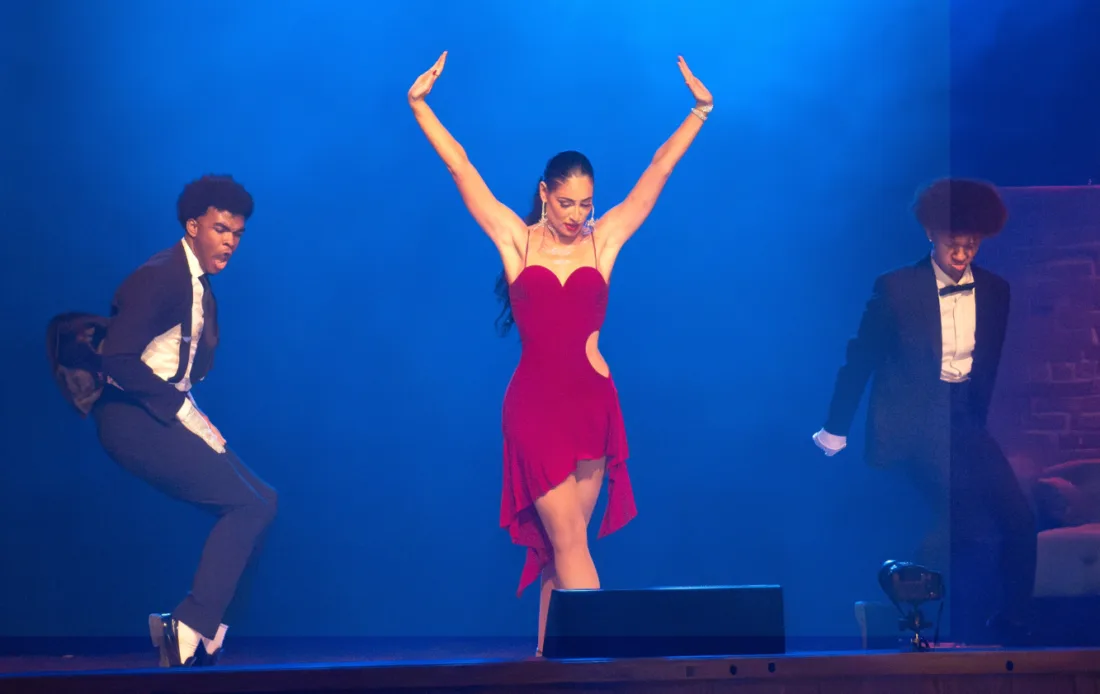
Andalusia 15222 – A Review of Duende: A Flamenco Journey

By Timothy Ruppert

After a memorably hectic few days during which the 2026 NFL draft attracted thousands of people to the downtown area, Pittsburgh needed to catch its breath—and then Duende: A Flamenco Journey took the city’s breath away.

Presented at the Original Pittsburgh Winery, Duende: A Flamenco Journey inaugurated Flamenco Pittsburgh’s second season with a stellar seventy-five-minutes of artistic virtuosity, an evening of music and movement that left no heart (or toe) unmoved. This season-launching show epitomized what the word duende promises: heat, passion, a dynamic enchantment rendered as the artist engages human emotions without compromise. Naturally, achieving such intensity demands exceptional skill, élan, and vision—and the performers of Duende: A Flamenco Journey possess talents that elicit magic. From the opening Sevillanas to the closing tangos, these artists astonished. Vocalist Alfonso Cid sings from the heart of the world, capturing the depth, breadth, and scope of the feelings that he finds there with a studied spontaneity as eminently fitted to capturing nuance as to articulating universal emotional experiences. Ricardo Marlow’s guitar proved brilliantly companionate with Cid’s haunting voice. Marlow plays beautifully, and his contributions to the success of Duende: A Flamenco Journey are nothing less than inestimable. Together, singer and guitarist achieved so thoroughly lovely a collaboration that one felt somehow in two places at once, as if Penn Avenue, for just past an hour, were also Andalusia—a strange and unforgettable effect.

A solo performance from Duende: A Flamenco Journey.  Photo: Beth Barbis Photography

The show’s dancers, whether solo or in ensemble, may also lay claim to unforgettability. Featured artist Edwin Aparicio performed his solos de baile with the precision of a surgeon who moonlights as a watchmaker. Within the framework of Cid’s vocals and Marlow’s playing, Aparicio’s dancing unremittingly awed the attendees lucky enough to witness the joyful intricacy and intricate joyfulness of this superb performer’s art. Valentina Beltrán created just as electric an atmosphere during her solo appearance later in the show, exhibiting grace and charisma with every flawlessly executed step. And while Aparicio and Beltrán shone like supernovas, Artistic Director Carolina Loyola-Garcia and the ensemble performers, including Abha Bais, Susan Englert, Rachel Klipa, and Athicha Muthitacharoen dazzled as well. Especially praiseworthy was the performance of the baile a palo seco, during which the dancers create rhythms through foot movement, hand clapping, and stick tapping. The immensely gifted artists of Duende: A Flamenco Journey together created an incomparable experience, bringing stories of celebration, anger, lament, and affirmation to life with unique beauty and distinct power.

In an event that lit the flame for the company’s new season, Flamenco Pittsburgh mystified the eye, mesmerized the ear, and revivified the spirit fatigued by days of closed streets, interminable queues, and absurd parking rates (the like of which I doubt Franz Kafka at his best could have imagined). With the spotlight just fading on the draft festivities, the real show took place at the Original Pittsburgh Winery as Flamenco Pittsburgh, a group to watch for in future, presented its exceptional Duende: A Flamenco Journey.

-TR

For further information on Flamenco Pittsburgh and their current season, please visit www.flamencopittsburgh.org or contact susan@flamencopittsburgh.org.


Murder, Mayhem, & Mirth – A Review of The Musical Comedy Murders of 1940

By Timothy Ruppert

When a play features a cowled maniac committing a murder within the first two minutes, one gets the impression quickly that the evening will not tiptoe forward either in rendering suspense or in escalating the stakes. The Stage Door Slasher is loose in Westchester County, and a profound blizzard makes it impossible for the spirited cast of The Musical Comedy Murders of 1940 to escape the killer. Stopping the Slasher becomes even more sinister a task given the labyrinthine layout of the mansion owned by Elsa Von Grossenknueten (Katy Chmura); with a hidden passage behind every bookcase, Frau Grossenknueten’s estate provides as welcome a site for peril as anywhere you may visit in an Agatha Christie work. And the Slasher has plans for a busy night.

A mirthful love letter to old Broadway (with Xs and Os for Golden-Age Hollywood as well), John Bishop’s charmingly parodic play opens South Park Theatre’s 2026 mainstage season with a delightful production that finds every moment of fun in Bishop’s nimble, allusive script. Helga Terre’s incisive direction allows the delightful ensemble to explore the piece’s humor without losing the thread of the mystery at the show’s heart. Along with Terre’s guidance, Chmura’s fight choreography merits praise for enhancing the physical comedy without abandoning a sense of menace entirely, as in the scene when the Slasher pursues the wisecracking Eddie McCuen (Mike Hamilla) with a blade sharp enough to pierce a copy of Melville’s Moby-Dick (literally). As theatre makers portraying theatre makers, the cast performs together smoothly, and their collaborative efforts create a cogent illusion. Led by Hamilla and Madison Bosler as the intrepid Nikki Crandall, the actors are vivacious to a person. A new show from the musical-writing team of Roger Hopewell (Eric Leslie) and Bernice Roth (Misty Challingsworth) occasions the fateful gathering that brings, along with Eddie and Nikki, the long-winded director Ken (Joe Eberle), the saccharine producer Marjorie (Naomi Grodin), and the Irish baritone Patrick (Bob Rak) to within inches of the Slasher’s knife. NYPD officer Michael Kelly (Dewayne Curry), Benoit Blanc-style accent at the ready, is present to investigate, and housemaid Helsa Wenzel (Adrien-Sophia Curry) proves invaluable to keeping the energy high.

The cast of “The Musical Comedy Murders of 1940.” Photo credit: Carina Iannarelli

Like the ensemble, the behind-the-scenes creative team contributes immensely to transporting us through time and space to prewar New York. Lilly Brown’s costuming impresses, as do Matt Lisiak’s sound design and Sabrina Hykes-Davis’s work as technical director, with the lighting package especially noteworthy. Amy Farber deserves congratulations for a wonderfully realized set that evokes the era while functioning flawlessly as the nexus of a palatial home devilishly devised by a World War One spymaster.

One need not be a student of the period, though, to enjoy South Park Theatre’s The Musical Comedy Murders of 1940. This group’s collective alacrity makes the best of individual talents, and the result is a terrifically entertaining visit to the past—beware the Stage Door Slasher!

*Please note that all name spellings were taken from the biographical section of the playbill.

-TR

“The Musical Comedy Murders of 1940” plays through Sunday, May 9, at South Park Theatre, located at the corner of Brownsville Road and Corrigan Drive, South Park Township, PA 15129Visit here or call South Park Theatre at 412-831-8552 for tickets.

The Last One You’d Expect – a review of “A Gentleman’s Guide to Love and Murder”

By Michael Buzzelli

Why are all the D’Ysquiths dying?

Monty D’Ysquith Navarro (Noah Koons), eighth in line for the title of Earl of Highhurst, wants to tell you why the D’Ysquith’s are dying. He’s been murdering them to gain the lordship in “A Gentleman’s Guide to Love and Murder,” emphasis on the murder.

When Miss Shingle (Joyce Miller) tells Monty about his lineage, the near destitute young man decides to work his way up to a higher station by knocking off his royal relatives to capture the castle. To fuel the flames of his murderous mind, his girlfriend, Sibella (Delaney Molnar), a pretty in pink narcissist, rejects him because of the size of his wallet.

Monty meets one D’Ysquith after another (almost all of them played by John Herrmann), and each member meets their end, except for Phoebe (Hannah Garry, one of the few D’Ysquiths NOT played by John Herrmann). Phoebe, who is not in line for the title, agrees to marry Monty.

He goes about kissing and killing cousins. Meanwhile, Sibella, now unsatisfied with her dull husband, begins an affair with Monty.

From left to right: One of the D’Ysquith cousins (John Herrmann) takes an…um…instant liking…to his newly revealed relative, Monty (Noah Koons).

Koons, a newcomer to the OSP (Old Schoolhouse Players), does a fantastic job as the plotting protagonist. With the sheer force of his charm, he keeps the murdering Monty sympathetic. The audience roots for him as he offs his rich relations.

Garry hits some high notes as Phoebe. She can belt with the best of them.

Molnar gets a few solo songs, which she handles with aplomb.

“A Gentleman’s Guide to Love and Murder” is a showcase for Herrmann, who plays a wide range of crazy characters, the D’Ysquiths, including Reverend Lord Ezekial, Asquith Jr., Henry, Lady Hyacinth, Major Lord Bartholomew, Lady Salome, Earl Lord Adalbert, Lord Asquith Sr., and Chauncey.

Herrmann’s Lady Hyacinth is part Harvey Korman’s Mother Marcus (in the Carol Burnett sketch, “As the Stomach Turns), and part Dame Edna.

The orchestra, conducted by Music Director Ruth Ann Fox, does an amazing job with the melodies, synching marvelously with the singers. Shout out to Scot Harvey on drums, who also provided a drum roll during the 50/50 raffle at intermission (the raffles are an added incentive to drive out to Hickory, PA).

Choreographer Chelsea Contino Eicher creates some fun movements for the cast. During the dance scenes, keep your eye on Jeffrey LaPorte, his small gestures are precise, and he mines each movement for comedy. He embraces all of the wackiness of the show with verve.

There is a plethora of costume changes in “A Gentleman’s Guide to Love and Murder,” especially for Herrmann. Cindy Berg and Briana Gamret Ryan decorate the cast with an amazing array of costumes. Berg pulled double duty as costume and set designer, creating castles with cardboard and plywood. It’s an impressive feat.

Director Michael Van Newkirk manages to garner some great performances out of his cast. OSP is becoming a proving ground for community theater, a great place to get a start on local stages.

“A Gentleman’s Guide to Love and Murder” is a fun distraction from the woes of the world. It has a pretty happy ending, unless you’re a D’Ysquith.

-MB

“A Gentleman’s Guide to Love and Murder” runs to May 3 at the Bud Allison Memorial Auditorium at Mount Pleasant Community Center, 20 Wabash Ave, Hickory, PA 15340. For tickets or additional information, click here

Quite a Captivating Capsized Crew—A Review of Disaster!

By: Joseph Szalinski

Tragedy is perfect fodder for drama and comedy, depending on what you find funny. As the saying goes, humor is in the eye of the hurricane. In an era when misfortune is earnestly exploited for entertainment by podcasts and the like, why not yuck it up when luck sucks? Never forget that such an approach will garner a fair share of challengers who will explode in fits of rage, shaking like Californian fault lines, though. However, if you’re someone who gets their jollies from acts of God, you’ll enjoy Butler Musical Theatre Guild’s production of Disaster!, directed by Patrick Erkman, now running at the William A. Lehnerd Performance Hall & Production Center in Butler, PA.

Created and conceived by Seth Rudetsky and Jack Plotnick, Disaster follows a colorful cast of characters aboard a floating casino that’s caught in the crossfire of a couple of calamities. The stranded lot onboard must band together to survive, suffering several setbacks, singing all the while. There’s romance, suspense, and a plethora of clever references. Irwin Allen would’ve loved it.

Much like the Cocoanut Grove, the cast is on fire! Phillip Ball is phenomenal as Professor Ted Scheider, the brainiac whose warnings go unheeded. What else are scientists for? Ball is not only equipped with great delivery but also impressive physicality. His fancy footwork on the balance beam is commendable. Contrasting Scheider’s morality is the sleazy casino owner, Tony Delvecchio, who oozes through scenes in his greasy glory, portrayed tremendously by Jerry Johnston.

Caught in the middle is the delightful Heather Check as Jackie Noelle, a lonely lounge singer and single mother who only wants what’s best for her family. And her love life. Liliana Morgan fantastically flip-flops between siblings Ben and Lisa. Despite the demanding task of playing two characters, Morgan does so with ease. The scene where the siblings sing a song with their mother is side-splitting. Katy Wayne and Bill Fisher delight as the dynamic duo of Shirly and Maury, respectively. They can perfectly balance sincerity and comedy, eliciting empathy one moment and laughter the next. Shirley is even plagued by an unusual condition, which Wayne leans into with gusto. Adding to the madcap campiness are a slew of other characters. Marianne Wilson, an ambitious reporter, is brilliantly brought to life by Sarah Dailey. Cory Pfahl goes all in as Marianne Wilson’s former beau, Chad, the woebegone waiter who sings his heart out. Liam Kilbourn terrifically tags along as Chad’s coworker and friend, Scott. Sister Mary Downy, a guitar-playing nun with a penchant for slot machines, is splendidly depicted by Tammy Erkman. Shelly Spataro is a trip as Levora Verona, dog-toting disco star who’s lost her shine. Rounding out the cast as Casino Guest and Staff are Sue Ann Aiken, Liam Kilbourn, Jim Klein, Rebekah Klein, Denise Johnston, Barb “BJ” Osche, RoAnn Romeo, and Liza Wick. Performances are heightened by the choreography of Patrick Erkman and Jade Klamer.

Cast rehearsal photo: From left to right: Tammy Erkman, Katy Wayne and Bill Fisher.This show wouldn’t be what it is without its soundtrack. Assisting the cast’s vocal stylings is an array of instrumentalists. Jessica Sanzotti and Ken Smith lead the band as music directors and keyboardists. The remainder of the outfit is comprised of bassist Marina Smith, drummer Karen O’Donnell, guitarist Joel DeMary, trombonist Jake Smith, and trumpeter Delaney Hindman. They are a ceaseless force sonically supplementing the onstage shenanigans.

Technical elements of this production are on point, with Barb “BJ” Osche overseeing things as technical director. Patrick Erkman. Erkman and Osche have designed a spectacular set, enlisting Tammy Erkman, David Halin, Jerry Johnston, Chip Marra, Vince Sanzotti, Eric Snyder, and Katy and Rachel Wayne to help with set construction and painting. Complementing the set are all the props, courtesy of Terri Cammisa and Gloria Lewandrowski. While they are employed ingeniously throughout the entirety of the show, there’s a scene near the beginning of the second act that is really gut-busting.

Costumes by Patrick Erkman and Lois Eury make things even groovier, with Tony’s security guard, Jake, having an exceptional get-up. Illuminating the stage is light operator Eric Snyder, who designed the lighting alongside Glen Bittner and Patrick Erkman. Rick McClean and Cole Trieste lend their talents as spotlight operators. Aside from his duties as a performer, Philip Ball managed sound design, peppered with sound effects masterminded by Mallory Lohnes and executed by sound operator Carl Floyd. Of course, all of this couldn’t operate as smoothly without the assistance of the running crew, comprised of Tracy Boyle, Bethany Kennedy, Barb “BJ” Osche, Rachel Rastall, and Lee Sparks.

William A. Lehnerd Performance Hall & Production Center is quite a quaint venue to see a play. Even though physical space is limited throughout the building, it doesn’t quell any decisions to stage expansive and ambitious events. Situated in the beautifully wooded Butler Memorial Park, it is a space worth visiting, even if parking can be a bit tricky.

Butler MTG is a wonderful company. While they have a monopoly on musicals in the area, aside from the occasional Hobnob production, they offer a selection of shows that can stand up to any staged elsewhere in Pittsburgh. Always a joy to attend, their shows demonstrate meticulous attention to detail that can only be executed by those totally in love with what they do. Featuring female-forward fare, the remainder of their season is set to be as entertaining as years past.

-JS

Disaster! continues its run April 24th, and 25th at the William A. Lehnerd Performance Hall & Production Center in Butler, PA.

Dueling Dualities—A Review of Jekyll & Hyde: The Musical

By Joseph Szalinski

Well before the United States used the production and distribution of a “certain stimulant” to help fund Nicaraguan Contras and decimate disenfranchised communities domestically, Scottish authors used it to write books. Eh, just Robert Louis Stevenson. Still, his indulgence bore a prodigious output. One such novel was Strange Case of Dr. Jekyll and Mr. Hyde, a classic allegory for many things, including substance abuse. However, it’s the more sober and romance-laden stage adaptation, Jekyll & Hyde: The Musical, which serves as Paragon Theatre’s latest production, directed by Deborah Metzger and Mark Spondike, now running at Paragon Theatre in Coraopolis, PA.

Taking some liberties with the source material, the script includes new or swapped-out characters, as well as a spicy love triangle instead of a gothic mystery. Inspired by his father’s deteriorating cognitive health, Dr. Henry Jekyll devotes himself to delving into the depths of the human mind and distilling people’s good and evil qualities, despite repeated warnings from everyone in his life. Polite society finds his inquiries repulsive, his friends/family feel he’s a bit too obsessive, and his wife wants him to focus on their impending wedding. Eschewing all suggestions, Jekyll determines it’s a good idea to drink some mysterious concoctions, which unleash his darker side: Mr. Edward Hyde, a dashing deviant who targets his wealthy detractors like a Victorian Luigi Mangione. Featuring book and lyrics by Leslie Bricusse and music by Frank Wildhorn, this show boasts a slew of songs that illustrate the inner turmoil of key players in such a sordid story. A tense first act escalates into a second half rife with violence, intrigue, and excitement: plenty to ponder and even more to enjoy.

The cast of “Jekyll and Hyde.”

Populating this twisted world is a sprawling cast that is teeming with talent. Not only are they tremendous actors, but they all can sing and dance well, effortlessly executing choreography by director Deborah Metzger. Jordan Nofziger amazes as Henry Jekyll, the scientist who brings a DIY ethos to his experiments. John Utterson, Jekyll’s more level-headed foil and companion, receives a powerful portrayal by Jason Spider Matthews. Grace Phillips beguiles as the wild Lucy, Jekyll’s disadvantaged muse who schmoozes with him in a seedy haunt, which prompts an ill-advised companionship to take root. Phillips does a tremendous job delving into the character’s complexity. Niki Slaven-Rettig tugs on heartstrings as Emma Carew, Jekyll’s bride-to-be. She sees the best in him and champions his pursuits even when others do not. Selfless and kind, she lends much-needed humanity to a tale that lacks it in some respects. Delivering a rousing rendition of Mr. Edward Hyde, the assassin of the affluent and abrasive, is Adam Speers. Wielding impressive physicality, he dominates the stage during his appearances, towering over the terrified souls who get in his way. His introductory song is boisterous and one of the best of the show.

Peppering the plot is a bevy of brilliant performances featuring Mark Spondike as Sir Danvers Carew, Alex Kerr as Simon Stride, Adam Bolette as Sir Archibald Proops, Kathy Ciesielski as Lady Savage, Todd Allman as General Lord Glossop, Lisa Cavlovich as Lady Beaconsfield, Josh Plowman as The Bishop of Basingstoke, Addy Hildenbrand as Nellie, Kirk Peters as Spider, and Donna Singleton Poole. Rounding out the cast are Jacqulyn Fyock, Donna Singleton, Marina Varvaro, and Jack Mangold as Ensemble/Various Roles, and Bethany Tonarelli, Samantha Cox, Angie Griffo, Kate Giger, and Elli Vallow as Ensemble/Dancers.

Technical elements are astounding. The set and props have so much personality and charm, they’re glorified members of the cast. Similarly, the gorgeous costumes by Alison Marschke and Chris Yakicic help the actors further realize their onstage personas. Providing deeper immersion into the fictional world are the sound by technical director Scott Metzger and facility coordinator Adam Bolette (the latter even serving as music technician), with light design courtesy of Harry Bolette. Executive/Artistic Director Deborah Metzger oversees that every facet of this production, down to the layout of the programs, is meticulously considered.

Although Paragon Theatre has been around for quite some time, over twenty-one seasons to be exact, they’ve only been in their current space for a year or so. The venue is beautiful. It is a repurposed church. Attached to it is a house where patrons can use the restroom(s). While a bit unorthodox, such a feature really accentuates the experience of attending a show there. Plus, as someone who’d cut his teeth performing spoken-word and comedy at house shows back in the day, the setup is super familiar and nostalgic. My favorite part of the theatre is the seats. My god! Many people discount the influence of comfort on enjoying art, particularly live performance, but it could be a make-or-break factor for shows that are a little longer. Shoot, I’d buy tickets to any show just to sit in those seats. I’d give them a standing ovation, but that seems counterintuitive. Hopefully, other companies and venues will take the hint. Beyond Paragon’s physical properties, their ability to curate a season is also commendable, with some solid shows slated for the future.

Jekyll & Hyde: The Musical continues its run April 23rd-25th, in Coraopolis, PA. For additional information and tickets, click here

Children of the Corn – a review of “Shucked!”

By Michael Buzzelli

Two Storytellers (Maya Lagerstam and Joe Moeller) introduce us to the slightly bizarre citizens of Cobb County in the musical fable, “Shucked.”

Cobb County is a strange little place where the farmers worship the Lord Almighty and corn (they also love a good pun… and a bad one), but rarely leave the city limits.

Right before the silver queen, Maizy (Danielle Wade) walks down the aisle to marry her beau, Beau (Nick Bailey), a problem crops up, a literal and figurative crop problem. The blight on the corn crop leads Maizy (Danielle Wade) to seek answers out of town.

Maizy wanders down to Tampa, Florida, where she meets a city-slicker named Gordy (Quinn VanAntwerp), a con man podiatrist. Maizy mistakes his sign, Corn Doctor (calloused skin on a foot), for a corn doctor (the yellow grain known as Maize).

When Gordy sees Maizy’s bracelet, made from a local Cobb County mineral, the corn doctor develops a get-rich-quick scheme to pose as a corn doctor (the other kind). Maizy mistakes his con man charm for affection and kisses him.

When Gordy comes back to Cobb County with Maizy, a love triangle forms between Gordy, Maizy, and Beau. When Maizy’s cousin, Lulu (Miki Abraham), kisses Gordy, the triangle becomes a love rectangle, possibly even a dodecahedron.

Shenanigans ensue.

A photo from the national tour of “Shucked.”

Bailey is a vocal powerhouse. He belts out some beloved ballads, delivering searing lyrics in  “Somebody Will” and “OK” with a gut punch to his heart.

Abraham crushes it as a fiery and spirited Lulu, especially in her solo number, “Independently Owned.” Abraham’s comic timing is also flawless. She gets the best, bawdiest lines.

Wade is a shining star here. Her blond hair, naivete, and incredible singing voice are reminiscent of a young Dolly Parton.

Lagerstam and Moeller deliver some dumb lines with such honesty and heart that it’s easy to forgive them their pun-laden trespasses.

Mike Nappi’s Peanut is a delight. He plays the fool, but not like Shakespearean fools, wherein he says the wisest of bon mots, including, “Politicians are like diapers. They should be changed frequently. For the same reason.”

Sarah O’Gleby’s choreography is spectacular. The ensemble dances over chairs, tables, and wooden beams. The whole cast hand jives with ears of corn in a riff that would make the troupe from “Stomp!” proud. The dancing is joyous!

The playwright, Robert Horn, sacrifices the emotional heart of the story for the jokes (good jokes, bad jokes, one-liners, puns, and groaners get equal attention). The keyword of his book is “corny.”  There are some clever lines, but don’t look for sophisticated humor. Tuesday’s opening night audience was howling at the Hee-Haw humor of the show. Some lines will stay with you long after the show is over. Case in point, “Remember grandpa’s final words, ‘You boys still holding that ladder?'”

The songs by Brandy Clark and Shane McAnally capture the emotional moments when Maizy, Beau, Lulu, and even Gordy pour out their souls. The music and the dancing are the main reasons to see this gloriously performed show.

If you’re looking for mindless fun, put your brain on pause, sit down, and enjoy “Shucked!”

-MB

“Shucked!” runs until April 19 at the Benedum Center, Seventh & Penn Avenue, Pittsburgh, PA 15222. For more information, click here.

Falling Head Over Heels for Head Over Heels

Reviewed by Dr. Tiffany Knight Raymond, PhD, and Theron Raymond (seventh grade)

Head Over Heels is the finale in Pitt’s transformations-themed 2025-26 theatre season. Consciously or not, this season’s theme and rainbowed logo carry political valence.

This 2015 musical is, aptly enough, comprised of strange bedfellows. It combines Sir Philip Sidney’s 1580 work, Arcadia, with the 1980’s smash hit oeuvre of The Go-Go’s.

While separated by four hundred years, both Sidney and The Go-Go’s endure as trailblazers, making this multi-century-spanning pairing complementary rather than clashing. I still remember reading Sidney as an undergraduate English major in Brit lit I and being impressed with how contemporary this Shakespearean contemporary was. Sidney’s 1580 Arcadia was genre-bending. It was both prose and poem, and it’s considered the precursor to what we take for granted as the novel. In fact, Sidney invented the name Pamela in Arcadia. Author Samuel Richardson subsequently chose this name for his 1740 work, Pamela, which is considered the first modern novel.

As for The Go-Go’s, they burst from L.A.’s 1970’s punk scene and emerged as the first all-female band to write their own songs and play their own instruments. They skyrocketed to fame with hits like “We Got the Beat.” Their agency over their careers as women was gender-bending.

With Head Over Heels, director Kelly Trumbull consciously pulls Sidney and The Go-Go’s into the 21st century while paying homage to a past that pre-dates them both by a millennium. The plot is Oedipal in the sense that it centers around the attempt to evade a prophecy – or rather, four prophecies.

The opening song is “We Got the Beat,” which establishes an ensemble energy that choreographer Dr. Amanda Olmstead expertly guides and never diminishes. Gianni Downs’ set design is elegantly modern and symmetrical. It towers upward, and steps sweep up the opposing sides that are connected by a bridge. In the opening number, the in-sync ensemble fills the stage while Queen Gynecia (Ellie Tongel) and King Basilius (John Papadimitriou) participate from above. They look down on their subjects, reinforcing hierarchy and societal norms. The bridge is narrow while the stage is wide, visually reminding us there is only so much room at the top.

The cast. Photo Credit: Ceili Schiller

King Basilius’s confidence that he can beat the prophecies is an eyeroll-worthy textbook stereotype of royal male hubris that John Papadimitriou brings to life without making the king a caricature. Papadimitriou ventures with his manservant, Dametus (Ben Stolarz), to consult with the Oracle. The visit is sparked by the receipt of a message delivered by a serpent. Props manager, Bridgette Dona, and her team of artisans construct a snake puppet that’s worthy of a Lunar New Year parade with multiple people personing the serpent’s movement. A scrolled message drops from the serpent’s unfurling red tongue. The message is a harbinger that the kingdom’s “beat” is under threat.

Ava Kobulnicky effortlessly commands as the oracle, Pythio. When the king inquires about the oracle’s gender, Kobulnicky assertively snaps back with “How is gender germane to this discussion?” Costume designer KJ Gilmer establishes Pythio’s dominance with costumes that wow. Pythio evolves from luminescent serpent to an owl-inspired assemblage to a glimmering Emerald City-appropriate ophidian mosaic with statement sleeves that mirror the hooding of a cobra. Kobulnicky brings them to life with an indomitable, unrushed stage presence.

Like all prophecies, Pythio’s are vague but are interpreted negatively, inspiring a frenzied panic. While the king chooses not to share the specifics, he immediately shuttles his family from the city of Arcadia into the woods. The woods often symbolize freedom from regular constraints, and this musical takes that to an extreme, making the king’s attempt to escape the prophecies the very thing that allows them to flourish.

The play also opens with the king’s attempt to marry off his eldest daughter, Princess Pamela (Olivia Tran-Speros). Tran-Speros exudes a withering disdain as she scans season five of suitors, dismissing them with the flick of a royal wrist and pronouncing, “suitors do not suit and now must go.” The attempts to dodge the prophecy allow each character’s evolution without feeling forced, and Pamela’s one-dimensional spoiled princess of renowned beauty proves to be deeper.

If one sister is the beauty, the laws of siblings say the other must be plain, and such is the case with the younger sister, Philoclea (Holly Egbert). She is in love with the shepherd, Musidorus (Seamus McGroary), whom the king deems beneath her station and therefore an unsuitable suitor. After he’s denied, McGroary memorably belts out “Mad About You” with his sheep as backup dancers, affirming his resolve to pursue his love. He takes on a disguise to follow the royal family into the woods. This disguise becomes a lynchpin in the unfolding of the prophecies, and the dropping of literal and metaphorical disguises becomes a key theme of the play.

Head Over Heels ends not as a rainbowed logo, but a queer-inclusive affirmation of human storytelling. What we like to think of as modern is in fact ancient. Humans of all genders have been finding and exploring ways to love each other across time and space, and this story celebrates love in all its forms. We are as modern as we are in the past and future, and there’s comfort and solidarity in that continuity. Or, to summarize Sidney (via The Go-Go’s), “Beautiful is all I see when I look at me.”

-TKR, Ph.D. & TR

The University of Pittsburgh’s production of Head Over Heels runs through April 19, 2026, on the Pitt campus at the Charity Randall Theatre, 4301 Forbes Avenue, Pittsburgh, PA 15213. Purchase tickets online here.

Hour House—A Review of American History in 60

By Joseph Szalinski

History is written by the winners, whereas the losers write theatre criticism. At least in my case. And what better medium to teach people about history than theatre? Get lost, Ken Burns. To help get into the patriotic spirit for the U S of A’s 250th birthday, Community Theatre Players want you to catch their production of American History in 60, directed by Mace Porac, now running at Community Presbyterian Church of Ben Avon in Ben Avon, PA.

Written by playwright Jeremy Desmon, American History in 60 attempts to chronicle the story of the United States within an hour. Give or take. Who knows for sure? Time isn’t real. Farmers made it up to sell almanacs or something. I didn’t pay attention in school. Anyway. This show has the unfortunate distinction of being an American History play that’s produced in the shadow of Hamilton. Trading songs for sketches, American History in 60 seconds covers a lot of similar territory, which is the focus of most of its runtime. However, scenes that deviate from that formula really stand out, most notably: the opener about Christopher Columbus, the first Thanksgiving, the Louisiana Purchase, the beginnings of the Civil War framed as couples counseling, and a game show about the Great Depression/Dust Bowl. The ending is a bit rushed, which I guess is the point, but we’re not here to discuss the script. Just the production. Which is thankfully a frantic delight, courtesy of the cast and crew.

The cast.


True to the medium, this show would be nothing without its cast, who perform at breakneck speed to cram in the mountains of history it covers. Everyone is responsible for numerous roles, which they navigate with ease. Samantha Carpin, Tim Davis, Jenny Louise Deigan, Todd, Ellen Kalik, Shiloh Massey, Kate Miller, Mace Porac, Jenn Rian, and Jennifer Welch all work well together in their various iterations, as well as having plenty of opportunity to stand out amongst the goofiness—a gut-busting cluster of talent.

Technical elements heighten the onstage action. Lighting and sound are handled expertly by Jeff Cieslak and Patrick Trimble. Kate Miller, a member of the cast, handles the props that elevate hilarity. Director Mace Porac and Mary Witul’s handiwork in set construction helps flesh out the world, with the latter in charge of the program featuring Amy Sikora Baschnagel’s awesome poster design.

Community Presbyterian Church of Ben Avon is a relatively unassuming venue. Between its atypical façade and the quaint auditorium, one wouldn’t think that entire theatrical seasons are hosted in the hallowed space. However, after catching a few productions, it’s easy to recognize why audiences and creatives keep coming back. Whether it’s generous refreshments or the stellar people inside, it’s incredibly welcoming.

Community Theatre Players is a group of thespians committed to entertaining their audiences. Between the energy they bring to their productions and the shows they choose, they are certainly a memorable outfit amongst the dozens of other community theatre practitioners in the Greater Pittsburgh Area.

-JS

American History in 60 continues its run on.April 17th and 18th at Community Presbyterian Church of Ben Avon in Ben Avon, PA.

An Evening with two unique characters played by two XXtraordinary Actors – Review of “Breadcrumbs”

by Claire DeMarco

Alida (Virginia Wall Gruenert) talks to herself as she meanders around the stage, intent on picking up Post-it notes scattered on the floor.  She reads them, then speaks the word on each note.  Sometimes she furiously writes a new word and just as rapidly crumbles it and tosses it aside. Each word doesn’t connect with the others, but to Alida, they are remnants of a world she is slowly losing, yet trying fervently to hold on to.

Alida is in the early stages of dementia.  She is a writer and is attempting to complete what will probably be her last work.  She is naturally reclusive, not outgoing or social.

She is evaluated for dementia by Beth (Erika Cuenca), who works at a clinic.  Beth is Alida’s opposite – she’s social, vibrant, youthful, but also has her own baggage.  Both women’s problems stem from their respective pasts.

Alida lives alone and likes it, insisting she doesn’t need anyone.  She also indicates that she writes for herself, not for others.  Her life is and always has been structured.

On the other hand, Beth doesn’t like to be alone and seems to need someone at all times, especially a man.  Her life is fluid, with frequent changes (in both jobs and personal relationships).

When Beth quits her job at the clinic, she approaches Alida, proposing to help her finish her book.  And so begins a questionable union of two unique women.

At times, the women can maintain a semblance of normalcy, but as Alida’s mental acuity diminishes, Beth’s frustration rises.

Dementia affects many individuals and is devastating.  Although this is a serious play, it is not without its humorous moments.

Virginia Wall Gruenert and Erika Cuenca in “Breadcrumbs.” Photo Credit: Heather Mull Photography,

Gruenert is superb as the flawed Alida.  Her facial expressions whether it be anger, confusion, frustration or at times, a bit of happiness are excellent.  Physically she doesn’t move much on stage, walking slowly with a gait suggestive of an older woman mentally slipping away.

Cuenca shines as the young woman whose life is definitely not structured and, at times, is out of control.  She is physically active on stage, in stark opposition to Gruenert.  Her enchantment with helping Alida finish her book is evident.  Cuenca transitions easily from her usually upbeat, high-energy personality to a more subdued one when she faces intermittent confrontation with Alida.

Note: Both Gruenert and Cuenca have worked together many times, and their rapport and onstage interaction are exciting to watch. A dynamic duo excellently directed by Ingrid Sonnichsen.

The set is simple with a desk and two chairs.  It is the backdrop that provides an emblematic symbol of Alida’s decline.  Several rows of airy, see-through.  Material resembling leafless tree stumps provides a backdrop that Alida often meanders through, symbolizing her declining mental health. Tree leaves are scattered on the stage.

This production is a farewell from Virginia “Ginny” Wall Gruenert.  Many theater productions were produced by off the Wall at Carnegie Stage.  “Breadcrumbs” is a personal thank you from Ginny to all those patrons who have supported her over the years.  Now residing in Iceland, she is planning new adventures there.

-CED

“Breadcrumbs” is a production by Wall Stageworks dba off the Wall & Viva Holding, Iceland. Performances run from April 10th to April 18th at Carnegie Theater, 25 W Main Street, Carnegie, PA. For more information, click here.
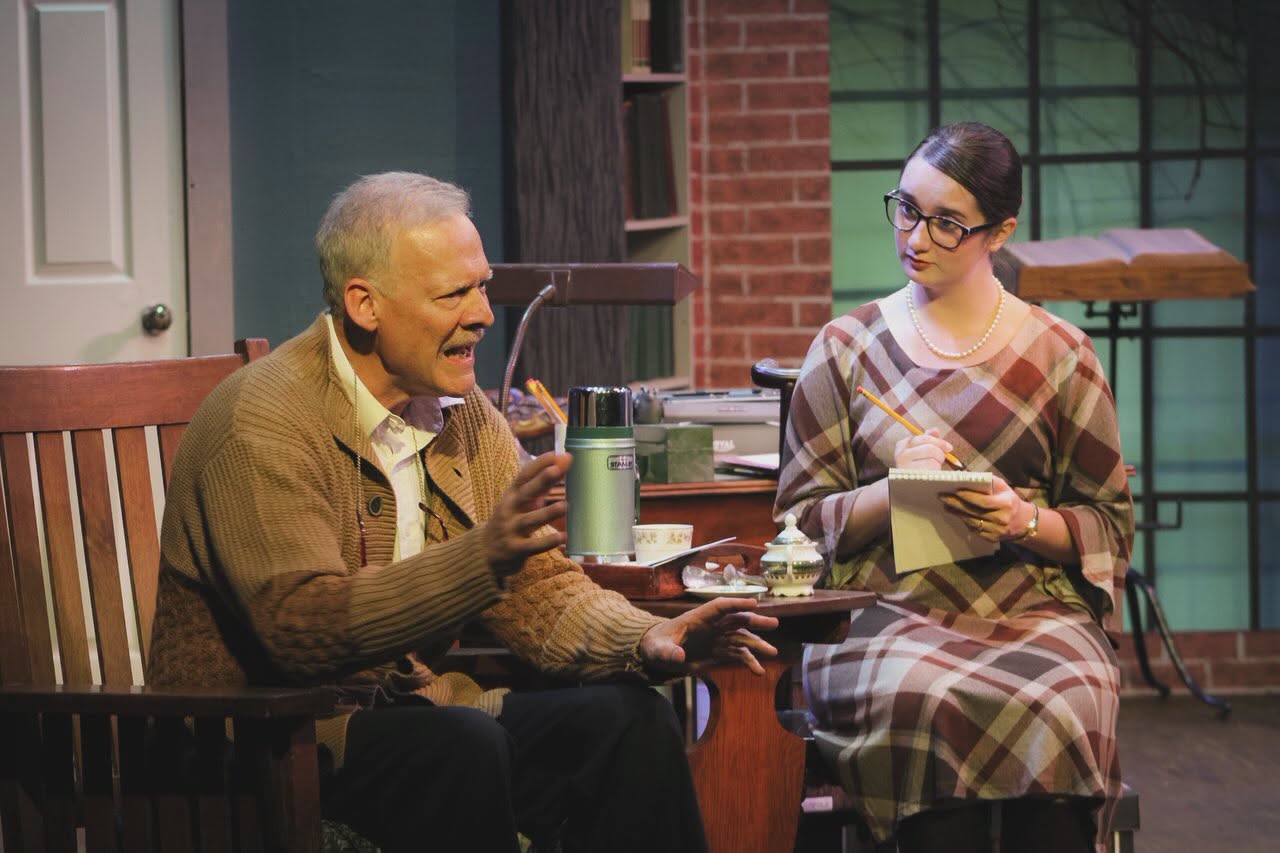


Thornton gets Wilder – a review of “Our Town”

By Michael Buzzelli

The Stage Manager (Cecilia Staggers) welcomes us to the burgeoning burg of Grover’s Corners at the turn of the century in Thornton Wilder’s “Our Town.”

The omniscient and omnipresent Stage Manager acts as the god (small g) of Grover’s Corners, citing facts and statistics, and even gathering local experts, Professor Willard (Nathan LeSane, III) and Editor Webb (Gabriel Hammesfahr), to pinch-hit with historical and anthropological data.

The aforementioned Stage Manager introduces us to two local families, the Webb family and the Gibbs family.

Mrs. Gibbs (Emilee Edick) is having trouble with her son, George (Rayhan Khimji), who has been playing baseball and ignoring his chores. George also has a crush on the neighbor girl, Emily Webb (Emma Delaware).

Even though “Our Town” follows many of its citizens, George and Emily’s romance is the centrifugal force around which the play rotates. The audience is invited to their most significant interactions, including their hesitant courtship, first date, and wedding day.

On the wedding day, Mrs. Gibbs is reluctant to let George go. She’s afraid he won’t be able to get on without his mother at his side. Later that same morning, Mr. Webb has an excruciatingly awkward chat with George.

Things move along happily for George and Emily, but “Our Town” has three distinct acts:

      • Daily Life
      • Love & Marriage
      • Death & Eternity

Suffice to say, life has a bad habit of ending.

The townspeople gather for a wedding. Photo Credit: Kgtunney Photography
George Gibbs (Rayhan Khimji) gets ready to walk down the aisle. Photo Credit: Kgtunney Photography
Mrs. Gibbs (Emilee Edick) and Ms. Webb (Ocean Chang) reveal secrets while shelling peas. Photo Credit: Kgtunney Photography

The cast is enormous, but there is no weak link. Each player seems to have an integral part to play in the small-town life of Grover’s Corners.

Because Director Ricardo Vila-Roger lets the actors lean into the humor, he lets Thornton get wilder.

Staggers (no stranger to Pittsburgh stages) is, much like her character, a force of nature. She is a warm, inviting host, filled with the gravitas of the role. She also manages to deliver humor with a wry smile or a subtle gesture.

Khimji is a breakout here. He is charismatic and charming in every scene, playing a younger George very differently from the older George (even though the age is only a few years apart). Young George is earnest and innocent. Older George stands up for his convictions and is passionate about his interests, especially his betrothed.

Delaware’s Emily also grows up between acts one and two, but learns the most during act three (even though the play is nearly a century old, there will be no spoilers here). Delaware has to hold Act Three together nearly by herself, but she does it with aplomb.

Hammesfahr figuratively and literally, leans in hard. The actor matches the kinetic and comedic spirit of a young David Hyde-Pierce. He is magnetic to watch. Each line is delivered with his own remarkable style.

Edick’s Mrs. Gibbs is a sympathetic character. She and Chang have a heartfelt scene together, shelling invisible peas. It’s superb acting from both actors.

Other standouts include – but are not limited to –  Ocean Chang’s Mrs. Webb, Devin Claudio’s Howie Newsome, Kennedy Hawthorne’s Rebecca (“I love money) GIbbs, LeSane’s bespectacled Professor Williard, and Allie Wahl’s Mrs. “I love a wedding” Soames.

Damian Dominguez’s costumes are Abner Doubleday meets Edwardian elegance. Stiff collars and long dresses, perfect for the era.

There isn’t much to the set until a third-act reveal, which is a stunning work by Scenic Designer Johnmichael Bohach.

When the play starts, it’s dawn in Grover’s Corners, and Lighting Designer Piper Steffek brilliantly illustrates that morning light.

One note of improvement: Actors need to get a little better with their space work, the placing and replacing of imaginary objects. An actor sets down an imaginary cup of coffee on a table, and then glides his hand right through the space where the cup was last placed. If it were a real mug of coffee, it would have splattered all over the floor.

This is not your father’s “Our Town.” It bursts with energy. Because it’s so alive with humor, the third act’s impact is devastating. If you’ve seen “Our Town” and didn’t like it, now is the time to give it another try. And if you love the show, you must go!

-MB

“Our Town” runs through April 12 at the Highmark Theatre, inside the Pittsburgh Playhouse, 350 Forbes Avenue, Pittsburgh, PA 15222. For tickets or more information, click here

css.php