

Somewhere over the rainbow – a review of ‘The Wonderful Wizard of Oz”

Mike Buzzelli

By Michael “Buzz” Buzzelli, ‘Burgh Vivant

When Dorothy Gale (Julianne Avolio) pines for a more colorful existence away from her drab Kansas farm life, a cyclone hits and the girl (and her little dog) are carried off to “The Wonderful World of Oz.”

But first, let’s pause for station identification…

Bricolage brings back “Midnight Radio,” a radio teleplay that is not on the radio (or at midnight). The actors perform as if they’re in an old-timey broadcast, standing at microphones, making all the sounds.

Side note: The actors  do their own sound effects; a large tin sheet for making the sounds of thunder, shoes crunching in a sandbox to sound like footsteps…etc. In a radio play, every footfall is heard and every door creaks (there is no WD40 to be found).

Dorothy’s story might sound familiar. TCM writer Rick Polito once summarized the movie with an infamous TV Guide type description: “Transported to a surreal landscape, a young girl kills the first person she meets and then teams up with three strangers to kill again.”

While true, there’s a gentler, kinder description here:

The cyclone transports Dorothy to Oz. The girl’s house lands in Munchkin territory smack dab on top of a notorious villain. The house crushes the Wicked Witch of the East instantly. The Munchkins cheer as their enemy has been defeated. Dorothy meets Glinda the Good Witch (Lisa Ann Goldsmith) who tells Dorothy she gets the magic shoes – the only remnant of the flattened witch. The spoils of war.

Since Dorothy just wants to go home, Glinda sets Dorothy down an amber-colored footpath that leads to Oz. Glinda, for some unknown reason, believes the Wizard can help Dorothy get home (when she secretly knows that the newly-acquired silver slippers can get her there). Dorothy meets Scarecrow (Nancy McNulty), the Tin Woodman (Jason McCune) and the Cowardly Lion (Sam Lothard) on her way to Oz. Dorothy convinces each of them that the Wizard can help them fix their problems. The Scarecrow wants a brain, the Tin Woodman wants a heart…yada yada yada.

Spoiler alert: Are you kidding me? It’s “The Wonderful Wizard of Oz.” Yeah. You know how it goes…but the lesson of the show is that it’s all about the journey not the destination.

From left to right: Sam Lothard, Julianne Avolio (center) and Lisa Ann Goldsmith (far left). photo credit: Handerson Gomes.

Avolio is a plucky Dorothy. She’s a bit wiser and funnier than the Judy Garland version.

McNulty’s Scarecrow is a joy. She plays him as the most likable member of Dorothy’s motley crew, giving him some homespun wisdom and oodles of charm.

McCune does a terrific job as the Tin Woodman (Woodsman with an S in the movie).

The southern accents in Oz are strong. Both McCune and McNulty play their characters with deep Southern drawls.

Goldsmith plays both good and wicked witches, a pack of crows and a mouse queen, all while doing her own sound effects. She’s marvelous.

Lothard does an outstanding job as the Lion and the Oz Gatekeeper. Each voice is distinct, and, at one point, they’re talking to each other! He really stretches his vocal muscles here and it’s made him a stronger character actor because of it.

Playwright Lissa Brennan goes back to the source material to tell the iconic children’s tale. There are some intriguing differences from the book and the movie. For instance, the slippers are silver and not ruby red. The most notable change is the gruesome origin of the Tin Woodman.

While Glinda is mostly a good witch under L. Frank Baum’s pen, Brennan sneaks in a little bit of Winnie Holzman’s “Wicked” version, creating a more three dimensional character – somewhere between Billie Burke and Kristin Chenoweth. There is no version of this story that doesn’t make Glinda a manipulative bitch when she says, “You had the power to go home all along!” Luckily, Dorothy calls her out here.

It’s all a bit of silly fun.

It’s important to note that sometimes fear often holds actors back, but director Jeffrey Carpenter has a fearless troupe of actors. None of them are afraid to be silly or sound ridiculous and that makes “The Wonderful Wizard of Oz” something…well… wonderful.

“The Wonderful Wizard of Oz” is lighter fare than the last couple Midnight Radio shows (now classic interpretations of “War of the Worlds, “1984,” and “Frankenstein,”), but it’s a rollicking good time with lots of laugh out loud moments.

-MB

Ease on down the road to “The Wonderful Wizard of Oz.” It runs until April 14 at the Bricolage, 937 Penn Avenue, Pittsburgh, PA 15222. For more information, click here.



Don’t Go Knockin’ at My Door – a review of “A Doll’s House Part 2”

Mike Buzzelli

By Michael “Buzz” Buzzelli, ‘Burgh Vivant

Nora (Lisa Velten Smith) knocks on the very same door she slammed fifteen years earlier when she walked out on her husband, Torvald Helmer (Daniel Krell), and her children (in Henrik Ibsen’s “A Doll’s House”). Playwright Lucas Hnath grabs those characters from Ibsen’s play and launches them into new and unfamiliar territory in “A Doll’s House Part 2.”

Side note: You do not need to have seen the Norwegian playwright’s work to figure out the plot of the uncharacteristically funny sequel. All will be revealed.

Anna Marie (Helena Ruoti), the Helmer family nanny, opens the aforementioned door to see Nora before her. Anna Marie welcomes her with sickeningly sweet passive aggressive charm. The two catch up – filling in some of the much-needed exposition (and revealing the events from the original).

Due to some dire extenuating circumstances, Nora has returned to ask Torval for a divorce. When Torvald refuses her, Nora must find another option. Anna Marie suggests that she speak with Emmy (Marielle Young), Nora’s youngest daughter. Because Emmy was a baby when Nora left, she barely remembers her mother, and denies her mother her request – additional extenuating circumstances are revealed. For one reason or another, Torvald, Nora and Emmy are all at cross purposes.

It’s an intricately woven dance of deceptions that lead to more shocking and hilarious revelations – like a game of Mahjong – each player slowly revealing their tiles.

Nora (Lisa Velten Smith) gets reacquainted with her old nanny, Anna Marie (Helena Ruoti). Photo credit: Michael Henninger

Pittsburgh’s own Ted Pappas returns to direct “A Doll’s House Part 2,” and it’s one of his finest productions. The script is sharp, pointed and very witty. It’s also very controversial.

Additional side note: Hnath likes to stir the pot. His play, “The Christians,” raises uncomfortable questions on faith. In “A Doll’s House Part 2,” he uses humor to get away with some controversial material that may anger some traditionally-minded audience members.

Nora and Torvald grow in fascinating ways during their brief reunion. The two actors have amazing chemistry.

It’s also a star turn for Velten Smith. She shines here – brighter than ever. She is a commanding and demanding presence on the stage.

Krell’s Torvald is incredibly complex. Torvald is weakened by her surprise appearance, but grows into a strong, gentle man. Krell gives a multi-layered performance.

Emmy is young, enthusiastic, bright and strong. Young does a marvelous job.

Even in the presence of three other top notch actors playing at the top of their game – Ruoti steals every moment she’s on stage. Her comic turn as Anna Marie is brilliant – even when uttering a curse word – the audience burst into laughter.

There is very little action in the play. Everything hinges on the power of the script and the performers on a nearly barren stage (James Noone beautifully replicates the round, unadorned room from the Broadway production). If you do get bored, you can examine Gabriel Berry’s intricate and exquisite costumes.

“A Doll’s House Part 2” is a treatise on feminism and independence, but more importantly, it’s about the vast gulf between love and marriage.

-MB

“A Doll’s House Part 2” is at the O’Reilly Theater 621 Penn Avenue, Pittsburgh, PA 15222. For more information, click here. Please note that The Pittsburgh Public Theater has increased its security measure, and you may need extra time to get to the show. For more information, click here. 

Composition on Canvas – a review of “Sunday in the Park with George” – DRAFT

Mike Buzzelli

By Micheal “Buzz” Buzzelli, ‘Burgh Vivant

“White, a blank page or canvas. The challenge: bring order to the whole, through design, composition, tension, balance, light and harmony.”

The power of one particular painting spans a century in Stephen Sondheim’s musical “Sunday in the Park with George.”

Georges Seurat (Alex Fetzko), best known for his iconic painting, “A Sunday Afternoon on the Island of La Grande Jatte,” toils away at the eponymous work while discovering techniques with color and light utilizing pointillism (The technique relies on the ability of the eye and mind of the viewer to blend the color spots into a fuller range of tones). His obsession with his work, however, causes his girlfriend, Dot (Rachel Cahoon), to question their relationship.

Side note: Obviously Dot’s name is a pun, but why belabor the point?

Denizens of the park on the Island of La Grande Jatte notice the artist sketching every Sunday as they cool themselves by the Seine – unaware that he is sketching them for his masterpiece.

He sketches an Old Lady (Lielle Kaidar) and her Nurse (Courteney McClutchy), a Boatman (Jeremy Spoljarick), two women both named Celeste (Sophie Aknin and Mei Lu Barnum), soldiers (Kurt Kemper and Jackson Walker) and more. George can capture their likenesses but he can’t seem to connect with anyone, especially Dot.

The artist is particularly unlikable. Dot finally leaves him and moves to America with her husband, Louis (Jaquel Spivey) and her child Marie.

When the second act opens, one hundred years have passed.

It’s 1984, and another George (also Alex Fetzko) is planning his own more modern exhibit using sound, light and lasers in a homage to “A Sunday Afternoon on the Island of La Grande Jatte,” with the help of his grandmother Marie (Kayla Nicosia).

Marie is of course Dot’s baby, and, therefore Seurat’s illegitimate daughter. Bit by bit – the play comes together.

The cast slowly assembles into their positions on the painting.
Seurat’s “A Sunday Afternoon on the Island of La Grande Jatte.” Oil on Canvas, 1884. Art Institute of Chicago.

The musical has a large cast and a lot of moving pieces. Nonetheless, director Michael Rupert does a magnificent job keeping the play running smoothly.

Fetzko is marvelous as the two Georges. He’s a tremendous singer.

Cohoon’s Dot is terrific. The character has to carry much of the first act, and she does it with aplomb. Her vocal range is fantastic.

There are some great performances by Spoljarick, Kemper, Pierre Mballa and Yael Karoly.

“Sunday in the Park with George” is visually stunning thanks to scenic designer Johnmichael Bohach and costume designer Michael Montgomery. At the top of the second act, the actors become a living tableau – posing exactly like the characters in the painting. It’s a glorious moment.

The show bursts with light and color thanks to lighting designer Andrew David Ostrowski, sound designer Steve Shapiro with video design by William “Buzz” Miller (nice nickname Mr. Miller).

These aren’t the most memorable songs in the Sondheim collection, but they are sung perfectly by the cast – aided by a Camille Rolla’s orchestra.

At one point, Marie says “There are only two worthwhile things to leave behind when you depart this world of ours – children and art.” Point Park’s “Sunday in the Park with George” is an excellent piece of art.

-MB

“Sunday in the Park with George” runs until March 24, at the PNC Theatre in the Pittsburgh Playhouse, 350 Forbes Avenue, Pittsburgh, PA 15222. For more information, click here.


Wings of Hope – a review of “In the Time of Butterflies”

Mike Buzzelli

By Michael “Buzz” Buzzelli, ‘Burgh Vivant

The four Mirabal sisters wrestle with life in the midst of the Rafael Trujillo dictatorship in a fictionalized account of true events in Caridad Svich’s adaptation of Julia Alvarez’s book, “In the Time of the Butterflies.”

An American writer (Lydia Gibson) goes to the Dominican Republic to learn more about the tragedy of the Mirabel girls from the only surviving sister, Dede (an older incarnation is played by Susana Garcia-Barragan). There she is told the tragic tale of the four sisters, Patria (Krystal Rivera), Maria Teresa (Frances Tirado), Dede (Vanessa Vivas) and Minerva (Evelyn Hernández) who spend many sun-drenched afternoons in their family garden – until, on one fateful night, they encounter the tyrannical Trujillo (Enrique Bazán).

Minerva stands up to the martinet while he tries to cop a feel while dancing with her at a party.

Side note: History records the story that she slapped him while he made his play for her. Minerva’s daughter tells the tale differently. She insulted him, humiliated him. Whether the slap was physical or psychic, it changed her destiny forever.

Minerva accidentally leaves her purse at the party. While most of the contents of said handbag were innocuous, it also contained a love letter from Lio (Victor Aponte), the head of the opposition.

From there, the women try to maintain joyous, colorful lives while secretly fighting to free their country from El Jefe (the dictator’s nickname).

The American writer desperately tries to capture the weight and emotion of their powerful story. She feels it must be told. She’s right.

Spoiler alert: She does manage to write the book, “In the Time of Butterflies.” A fictionalized account that details the lives of these four strong, amazing women.

From left to right: Patria (Krystal Rivera), Minerva (Evelyn Hernadez), Dede (Vanessa Vivas) and Maria Teresa (Frances Tirado) pose defiantly for a production still from “In the Time of the Butterflies.”

The cast of “In the Time of Butterflies” is marvelous. Director Ricardo Vila-Roger manages to get great performances out of each of them.

Additional side note: The entire cast identifies as Latin American origin or descent (Latinx), including the director (all are also Pittsburgh-based). In 2019, that shouldn’t be a big deal, but it’s a big deal. It’s a shame it took so long.

Hernández is a powerful and beautiful leading young lady. She is captivating as Minerva.

Rivera’s Patria was the most different from her sisters. She was prim, proper and spiritual, but Patria undergoes the strongest arc, from religious to rebellious. Rivera handled it expertly.

Tirado is effervescent. She’s brimming with energy and enthusiasm. She’s a joy to watch. Of course, it makes her eventual demise even more difficult to watch.

Garcia-Barragan and Vivas each make a distinct mark on the character of Dede. It’s easy to imagine they are playing the same person at different ages.

While Bazán doesn’t have much stage time, he makes his presence felt. He comes in strong, forceful, commanding. He is superb.

Aponte fills in all the other male roles and he manages to make each of them distinct. He’s a boisterous DJ, a robust rebel and a gentle and simple man who grants the women a favor – the ultimate example of the aphorism “no good deed goes unpunished.”

Svich’s script is brisk, but it felt like some big chunks were left out. Minerva married and had two children. Her husband is an important plot point but he’s sort of drops out of nowhere late in the second act. On opening night, Minerva’s real-life daughter even joked, “She had children. I know this because I am here.”

If you want a more detailed account, you would have to read Alvarez’s book. This Reader’s Digest version still packs an emotional wallop. You don’t need all the details to get wrapped up in their story.

Vila-Roger doesn’t pull his punches. The final scenes are gut-wrenching without being morbid. He handles the shocking subject matter deftly.

Most of the action takes place in front of the Mirabal family home, a stunning backdrop by Britton Mauk with prismatic projections provided by Joe Spinogatti. The women are beautifully adorned in technicolor dresses by Kim Brown at Spotlight Costumes.

The adaptation of “In the Time of The Butterflies” has a few flaws, but it’s an important piece of theater.

-MB

Set your clocks for “In the Time of the Butterflies” at the New Hazlett Theater, 6 Allegheny Square East, Pittsburgh, PA 15212. For more information, click here. 



A game of confidence – a review of “The Roommate”

Mike Buzzelli

By Michael “Buzz” Buzzelli, ‘Burgh Vivant

Sharon (Tamara Tunie) invites Robyn (Laurie Klatscher) to move into her rambling, renovated farm house in Iowa City, Iowa. The two total strangers have to navigate life together on faith – armed with very little information about each other’s lives in Jen Silverman’s “The Roommate.”

Sharon is a straight-laced Midwestern mom with empty nest syndrome. She is living vicariously through her son’s adventures in far off New York City. Outside of her book club and a part-time job, her life seems emptier than her nest.

Robyn is a vegan, lesbian slam poet. She seems innocuous, harmless, living a carefree life, but the self-proclaimed slam poet has a pitch-black shadowy past.

“The Roommates” opens with a familiar premise. Neil Simon once put two distinctively different people in an apartment together and watch them drive each other crazy. While Sharon and Robyn are the oddest of odd couples, the play swiftly diverges from Simon in modern and absurd ways.

Its closer to “Grace and Frankie,” if you replaced Grace Hanson and Frankie Bergstein with Walter White and Jesse Pinkman.

There is a valley of loneliness between Sharon and Robyn. They both struggle with familial relationships. Sharon finds Robyn’s life thrilling and Robyn tries to image the peace of living like Sharon. Robyn gives Sharon the confidence she spin her life in another direction.

Speaking of confidence, the two roommates develop a fun little game. Let’s say this particular confidence game gets out of hand quickly. To tell too much would spoil some of the best jokes. Luckily, there are a lot of good jokes.

Tamara Tunie and Laurie Klatscher take a bow from the set of “The Roommate”

Silverman’s script starts like a sit-com, but slowly, methodically, it becomes something else entirely. The play – like a tea kettle – simmers along until it alarms everyone that it’s ready.

Tunie is hilarious as Sharon. Her character’s naiveté is the butt of several good laughs. Tunie disappears into the role.  Tunie is on fire in the ‘Burgh these days. She’s ripping this town up and making it hers, playing vastly different people. Sharon is very different from Prospero – her starring turn in the Pittsburgh Public’s “The Tempest.” She goes  from Gandalf to Betty Crocker.

Robyn is a conflicted soul, and Klatscher plays her with conviction and nuance. She is neither hero, nor villain, but a flawed character with hidden depth and a bigger heart than she’d ever reveal.

Reginald L. Douglas’s direction is tight. The transitions between scenes are whimsical and fun, speeding the play along in all the right ways.

All the action takes place in Sharon’s well-appointed home, expertly crafted with style and grace by Tony Ferrieri. The house looks like it popped up, fully formed, out of an issue of “Better Home and Gardens.”

“The Roommate” is a game of three card monte. Robyn sort of flips Sharon around and around. Where she stops – nobody knows. Just like the card game, it’s fun to be surprised at where everything ends up.

-MB

“The Roommate” takes up residence in the City Theatre, 1300 Bingham Street, Pittsburgh, PA 15203 until March 24. For more information, click here.


All Made Up – a spotlight on the musical improv duo babyGRAND

Mike Buzzelli

By Michael “Buzz” Buzzelli, ‘Burgh Vivant

They’re back. The musical improv duo babyGRAND, comprised of Connor McCanlus and Missy Moreno, will be hitting the stage Friday, March 8 at the Arcade Comedy Theater for a special show.

McCanlus and Moreno make up a mini musical as the improvisational duo, babyGRAND.  Once, based on an audience suggestion, the duo sang an ode to the traffic in the Fort Pitt Tunnel. The lyrics included a bit about the near impossible merging at the city end of the tunnel. They are a hilarious and wildly imaginative duo who spoof popular Broadway musicals from “Annie” to “Hamilton.”

At a show at the City Theatre, McCanlus and Moreno did twenty minute bit singing brand new made up musical playing Charlie Brown and Lucy Van Pelt respectively.

The babyGRAND duo, McCanlus (pictured here as a Queen Bee) and Moreno (pictured here as a unicorn).

They will be accompanied by Nick Stamatakis on piano.

Friday’s show is a special time slot which will also feature Pittsburgh-based comedian Helen Wildy. In 2018, Wildy toured with Cameron Esposito on her Person of Consequence Tour and has been featured locally in the Pittsburgh Comedy Festival and the Burning Bridges Comedy Festival.

-MB

Baby GRAND performs March 8 at 8 at the Arcade Comedy Theater, 943 Liberty Avenue, Pittsburgh, PA 15222. For more information, click here.



Mum’s the word – a review of “Mumburger”

Mike Buzzelli

By Michael “Buzz” Buzzelli, ‘Burgh Vivant

Tiffany (Jessie Wray Goodman) and her father, Hugh (Ken Bolden) are each struggling with loss in their own- and very different – way until a mysterious package of hamburger patties arrives in a brown paper bag in Sarah Kosar’s “Mumburger.”

Tiffany’s mother, Andrea, was a very committed vegan. She believed in sustainable food sources. Ironically, she was killed by a Bird’s Eye frozen food truck on the highway. Apparently, Andrea is prepared (literally and figuratively) for her death and choses a bizarre method of being with her family a little while longer.

Ahoy, matey! Spoilers dead ahead.

Andrea decides to become a sustainable food source for her family, by being ground up and turned into hamburger patties. While the play is most assuredly about the titular mumburgers in “Mumburger,” it’s really a coal black comedy about grief.

The central question of the play is: If you’re loved one had a dying wish – would you honor it? What if that wish was disgusting and bizarre?

Tiffany (Jessie Wray Goodman) consoles her father (Ken Bolden) in “Mumburger”

“Mumburger” is a two-hander and needs two strong actors to do all the heavy lifting. This production has got it.

Goodman’s Tiffany is buoyant and effervescent even in bleak circumstances, making her eventual collapse of grief difficult to watch. The despair she exhibits in several scenes is electric.

Bolden is spectacular as an ineffectual dad who is lost without his wife. There is a manic scene (we’re not spoiling EVERYTHING) where he just goes for it. He’s 100% all in and it’s fantastic and gross at the same time.

Director Robyne Parrish makes some smart choices with Kosar’s absurd premise. There’s seems to be a lot of extraneous walking in the very beginning of the show when character’s stomp around the house, but it furthers the story in story in a subtextual way – the father and daughter are very distant from one another even in the same small location. It works.

Adrienne Fischer’s set is creepy and off-kilter in all the right ways – like the set from one of villain’s lairs from the 1966 “Batman” TV show –  with eerie sound design by Shannon Knapp.

Side note: It’s noted in the show that Andrea’s favorite movie is “The Father of the Bride” and Hugh watches it on a loop – thanks to some great projection design by Taylor Edelle Stuart – to both poignancy and comedic effect. Kosar picks the Steve Martin remake and not the original with Spencer Tracy. It might be her only misstep in this highly unusual play.

Its Sweeny Todd meets Ronald McDonald by way of Bear Grylls and Eull Gibbons. Its “Alive” meets “Harold and Kumar Go to White Castle.” It’s wacky, wild ride.

Warning: Audience reaction was split between love and hate. There was no middle ground. It’s worth the risk.

-MB

“Mumburger” runs until March 16 at the Carnegie Stage, 25 W. Main Street, Carnegie, PA 15106. For more information, click here.

 

Review: FUDDY MEERS, The Theatre Factory

by Brian Edward, ‘Burgh Vivant.

Monday mornings are bad enough.  When the harsh, unsympathetic blast of the digital alarm clock pierces your ears at 5am, imagine having your life and identity explained to you by a stranger who introduces himself as your husband, just as he’s done every morning prior, because a traumatic incident has left you with a case of amnesia that erases your memory each time you fall asleep.  You may sensibly opt for the snooze button, though any such thoughts of reprieve are dashed when a manic man in a mask appears, tells you that you’re in great danger, and steals you away in his vehicle to destinations yet unknown.  You’re in for quite a day, to say the least, an no amount of Folgers is going to turn this one around.  This is the premise that ignites the peculiar tale of David Lindsay-Abaire’s Fuddy Meers, directed by Jeff Johnston.

Beth Minda as amnesiac Claire convincingly navigates the complexities of uncovering the truth about her life among a series of colorful circumstances and even more colorful characters.  To share too much about their background may spoil the unraveling mystery that Lindsay-Abaire has laid forth, though much can be said of the performances that bring us the story.

Especially prominent are the performances by Kevin Bass as Limping Man and Tom Protulipac as Millet.  Each handles their part with an expert dexterity, despite the manic and outrageous personality traits required to portray them.  Neither character can boast many redeeming qualities, though in in the hands of Bass and Protulipac, they are entirely authentic and compelling to watch.

Kathleen Regan takes on the monumental task of portraying Gertie, who speaks gibberish and is only barely coherent due to having suffered a stroke.   It’s an absurd situation on top of all the other improbable plot elements, and could easily have come off as an absurd portrayal, though Regan gives the role an endearing spirit that translates clearly, even when the words do not.  Extra points are due here for a process that I assume involved memorizing nonsense words, internalizing their meaning, and then spouting them off with 100% confidence that you’re making sense to those around you.

Joe Eberle as doting husband Richard, Jared Lewis as angsty son Kenny, and Kaitlin Cliber as the volatile Heidi round out a strong ensemble cast that keeps the play moving.

It’s a difficult piece to tackle.  Aside from requiring a skillful balancing act on the fine line between psychodrama and dark comedy, Lindsay-Abaire’s script calls for frequent scene changes, often with little or no “cliffhanger” element to drive the play’s energy through the pause.  The running crew handle the transitions as efficiently as possible, made all the more manageable by the dynamic set design by Matt Mylnarski and Evan Hauth.

You’ll be entertained, you’ll be disturbed, and for a night out in Trafford, it’s most definitely worth the admission price.

Fuddy Meers performs at The Theatre Factory, 235 Cavitt Ave, Trafford, PA 15085 through March 3rd, 2019.  For tickets and more information, visit www.thetheatrefactory.org


Season of the Witch – a review of “Vinegar Tom

Mike Buzzelli

By Michael “Buzz” Buzzelli, ‘Burgh Vivant

In 17th Century England, Alice (Ciera Harding) and her mother Joan (Markia Nicole Smith) are accused of witchcraft in Caryl Churchill’s feminist drama, “Vinegar Tom.”

Alice has a passionate rendezvous with a mysterious man (Micah Stanek) in the woods. After their brief encounter, she becomes obsessed with him. She’s constantly pining for him and describing his lascivious actions to her friend Susan (Allison Svagdis).

Her neighbors, Jack (Daniel Murphy) and Margery (Bridget Murphy) are vexed with a multitude of problems. Their cows are diseased and their marriage is a disaster. Jack is in love with Alice and blames her for his impotence with Margery (he has no problem rising to the occasion when he’s with Alice).

There’s another subplot involving Betty (Caroline Travers), a young woman from the gentry who doesn’t want to marry. Her reasons become obvious when she meets Ellen (Jamie Rafacz), a cunning woman (who studies herbal cures).

By the way, the titular character in the play is Vinegar Tom, Joan’s old tomcat. It’s a familiar story (get it?). The name Vinegar Tom comes from the witchfinder general himself, Matthew Hopkins, in his pamphlet “The Discovery of Witches” written in 1647, wherein an alleged witch calls out the names of her familiars (creatures that help her with her dark magic).

Of course, “Vinegar Tom” isn’t really about witches. It’s about pride, poverty and prejudice. At one point Witchfinder Packer (Stanek) says, “Though a mark is a sure sign of witch’s guilt, having no mark is no sign of innocence.” It’s the Kobayashi Maru – no win scenario.

The ending is pretty cut and dry. It won’t leave you hanging (if only the same could be said for half of the cast). Oh come on now. It’s a play about witches in the 17th Century – it can’t be considered a spoiler to know that some of them are not going to survive.

Promotional photo for the show.

Harding is a joy to watch as Alice. Though a lot of her dialogue is repetitive, she finds new and exciting ways to say it.

Daniel Murphy (there are two Murphy’s in the show and they play husband and wife) plays Jack with desperate intensity.

Rafacz’s Ellen is so subdued and likable she seems as if she wandered into “Vinegar Tom” from another play, making her fate more tragic. Rafacz does a magnificent job portraying her.

Stanek’s male characters (he plays several) are all villains, and he’s very good at being bad.

There’s a light-hearted scene with Kramer (Erin Hyatt) and Sprenger (Zetra Goodlow). The authors of the “Malleus Maleficarum” are presented like sideshow carnival barkers or snake oil salesmen. It’s a whimsical prologue after a gruesome finale. Kudos to director Daras for casting women in the roles.

There are a lot of scenes (twenty-one in all), even though Daras and scenic director Gianni Downs have come up with brilliant ways to get us from one scene to the next, the transitions add needless length to the run time.

Luckily, many of the aforementioned scenes are punctuated with songs by the Tomcat band, enhanced by the mellifluous voices of Liron Blumenthal, Elise Dorsey and Caroline Bachman. It’s an unfettered joy to watch those women rock out. They are gloriously supported by their bandmates Emmeline Jones, Braxton McCollum, Chris Knudsen and Tim Judah.

Downs has created large cotton swaths – like bed sheets – scrawled with quotes from famous women in history all over the theater from Thatcher’s “If you want something said, ask a man. If you want something done, ask a woman” to the Elizabeth Warren meme “Nevertheless, she persisted.”

“Vinegar Tom” seems overly long (much like “The Crucible”). It takes a long time to get to the end, but the ending is emotional and powerful.

During the opening and closing scenes, the actors gyrate wildly to the band. They are so exuberant – you’ll want to get up and dance with them.

-MB

“Vinegar Tom” runs until March 10 at the Point Park, 350 Forbes Avenue, Pittsburgh, PA 15222. For more information, click here.



A perfectly marvelous show – a review of “Cabaret” 

Mike Buzzelli

By Michael “Buzz” Buzzelli, ‘Burgh Vivant

In the early 1930s, an American writer, Cliff Bradshaw (Jonathan Norwood), moves to the decadent, free-wheeling city of Berlin to write a novel, just as the Nazi’s rise to power in the iconic Kander and Ebb musical, “Cabaret.”

On the train into town, Cliff meets Ernst Ludwig (Trevor Clarida) who regales him with tales of Berlin’s salacious pleasures. Ludwig finds him a place to stay and becomes his first pupil (Cliff tutors English to supplement his income). Ludwig also tells him about a low-down, libidinous little nightclub where he can “unwind.”

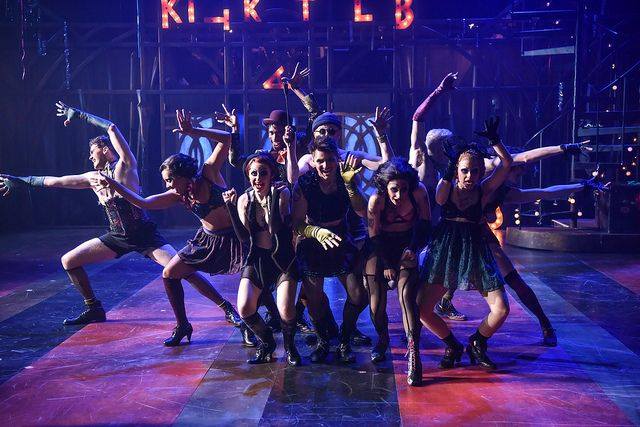
After settling into his apartment, Cliff takes off for the carnal carnival known as the Kit Kat Club… where anything goes.

The Emcee (Zach Herman – alternately played Ramsey Pack) introduces the cabaret boys and girls (the ensemble featuring Daniel Neale, Ben Cherington, Allison Ferebee, Georgia Mendes et al.) and the Kit Kat Club’s star performer, Sally Bowles (Safiya Harris – alternately played by Caroline Mixon).

Sally is fascinated by Cliff. She has high hopes for their relationship, even though Cliff shares a romantic past with a decidedly different member of the Kit Kat Club’s staff.

Backstory: Bobby (Daniel Neale), one of the male dancers, had a romantic liaison in London with our hapless hero.

On his way backstage to meet up with the boy, Cliff runs into the girl. The misinterpretation leads to complications. When the club owner Max (Dylan T. Jackson) fires Sally, she runs off to meet with Cliff and finagles her way into his apartment. Sally becomes his roommate – – with benefits.

Meanwhile, Fraulein Schneider (Gena Sims), Cliff’s landlady, falls for Herr Schultz (Patrick V. Davis), a Jewish fruit vendor. Unfortunately, many of Fraulein Schneider’s friends are in the Nazi party, complicating her relationship unnecessarily.

In the next apartment over, Sally is pregnant, and Cliff discovers he could be the father of Sally’s baby (though they’d be quite a few contestants on that Jerry Springer episode). If Facebook existed in the 30s, Cliff and Sally’s relationship status would definitely be “it’s complicated.”

The apartment building has one other notorious tenant, Fraulein Kost (Cate Hayman), who is turning tricks in her abode, but the good times are coming to a screeching halt as the Nazi’s goosestep into town.

Spoiler: This musical does not have a happy ending.

The Kit Kat Club danceers are ready to entertain you.

Harris is luminous as Sally Bowles. She takes over every moment she’s on stage. Then, when she belts out the titular number “Cabaret,” it’s a showstopper. Her voice is powerful.

Herman’s Emcee is equally engaging. He exudes a sexy magnetism. He plays off the audience’s energy superbly, ribbing and needling the front row with a sly wink and a wry smile.

Norwood is an attractive lead who manages to get his character’s conflicted subtext perfectly.

Then, there’s Fraulein Schneider.

Personal pet peeve: There’s always this weird thing that happens when young actors play old people. They almost always hunch over like Quasimodo and wag their fingers excessively. They almost always look grumpy as if about to say, “Hey you kids, get off my lawn.”

Sims, however, nails it. It’s a beautifully nuanced portrayal. Plus, the woman can sing her heart out. She is brilliant throughout the show. You would not expect a woman to sing about a pineapple with such exuberance…but you can catch Sims doing it.

“Cabaret” captures the public zeitgeist in turbulent times. Director Tome Cousin does a fantastic job reminding us that art can propel us forward. Whenever you shine a light, the cockroaches scurry.

Cousin was the choreographer as well, and the dancing is kinetic and frentic. There are some lovely transitions with graceful movements to catch your eye between scenes. He also has the performers doing some audience work  at the top of act one and act two. Its beautifully done.

This “Cabaret” has everything, including lusciously decadent costumes by Jake Poser (though there are a few wardrobe malfunctions on preview night, they didn’t hinder the production one iota).

Beautiful moody lighting from Alex Gibson and excellent sound design by Scott McDonald on a whimiscal set designed by Jamie Phanekham.

“Cabaret” is a perfectly marvelous show.

-MB

If you’re looking for tickets, the entire run is completely sold out, but if you want to know more about the show, click here.


css.php