Swing, Swing, Swing – An Evening with Catherine Russell

by Claire DeMarco

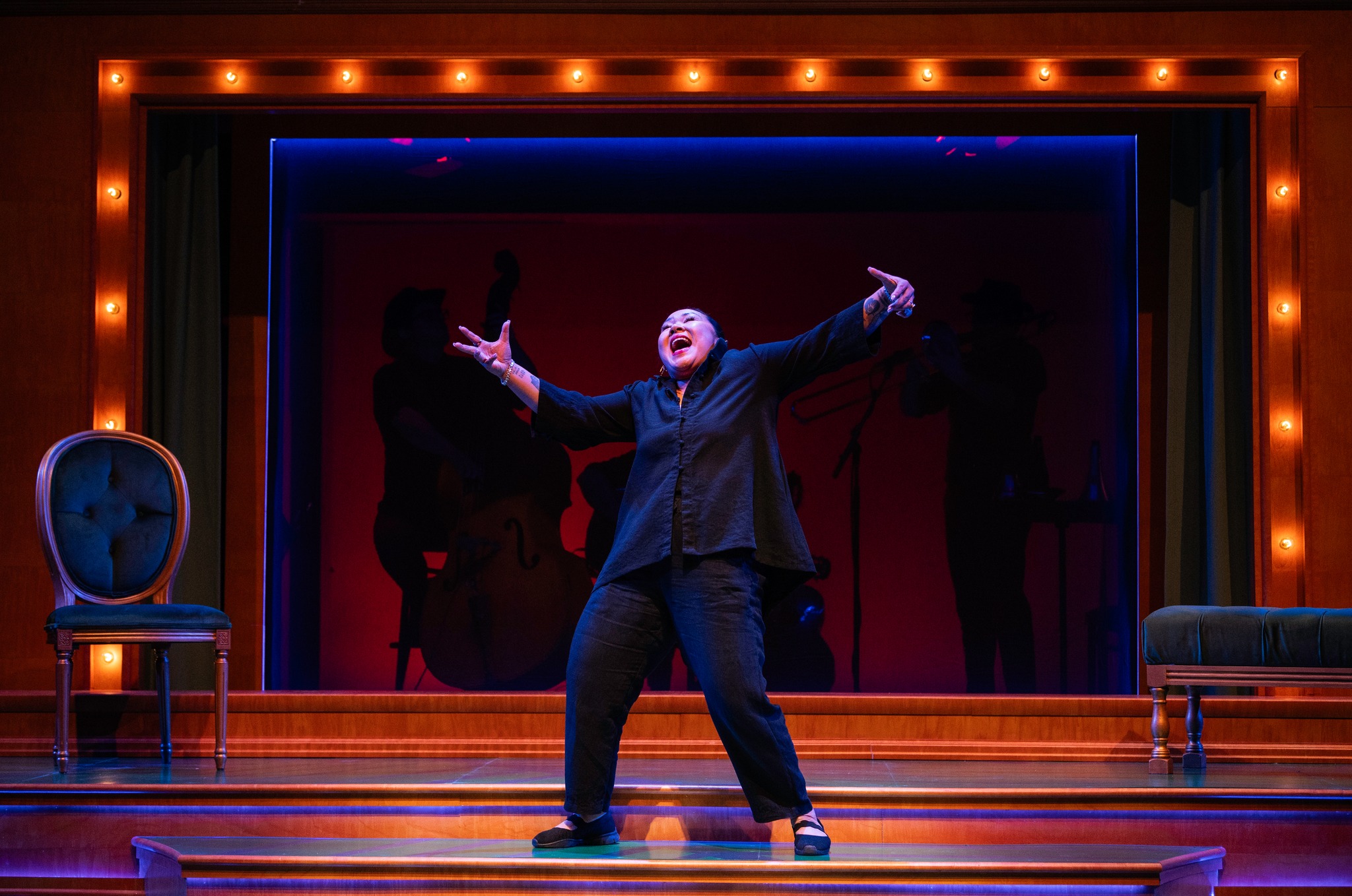
What a treat to listen and enjoy the legendary Catherine Russell on Monday, March 24 at the Greer Cabaret Theater as part of their Trust Cabaret Series!

The Grammy award winning Russell’s singing comes naturally as the daughter of the late Luis Russell and mother Carline Ray, both well known in various roles within the music industry.

Russell was fabulous as she took us on a nostalgic trip back in time singing many old jazz, blues songs. She has a wonderful voice and style that complemented her selections.  Russell interacted with the audience, providing history about the songs she sang and why she selected them.

Highlights included two songs made famous by Fats Waller: “You’re Not the Only Oyster in the Stew” and “I’m Going to Sit Right Down and Write Myself a Letter”.

Other wonderful songs included “Zing Went the Strings of My Heart”, “When Did You Leave Heaven?” and “Did I Remember”.

Russell delivered a song from 1923 (101 years old) “You’ve Got the Right Key but the Wrong Keyhole” that had humorous, sexual innuendoes.

Russell described what she does succinctly: “Swing music is like food and medicine to me”.

It was evident that as much as the audience enjoyed her performance, she equally enjoyed entertaining us.

Ben Paterson accompanied Russell on the piano and he was superb.  There were times when Russell completed the vocals and Paterson focused specifically and brilliantly on the instrumental side of the song.

Note:  The Trust Cabaret Series never fails to please, continually bringing talented and varied acts to Pittsburgh.


-CED

The next show in the Trust Cabaret Series is on Monday, May 20, 2024 featuring Matthew Morrison.

A Rich Boffo – A Review of “Fat Ham”

by Dr. Tiffany Raymond, PhD

City Theatre presents James Ijames’ 2022 Pulitzer Prize winning play, “Fat Ham”, a loose adaptation of “Hamlet”.

Just as “Hamlet” opens with a question, “Who is there?,” Ijames echoes with an interrogative starter. Juicy (Brandon Foxworth) asks his best friend, Tio (Jordan Williams), “Are you watching porn?” Director Monteze Freeland (also co-artistic director of City Theatre) has Juicy’s voice heighten and nearly crack with incredulity. From sentence one, this is unequivocally a modern Hamlet. However, this question also anchors the play. The porn that plays out is not just on Tio’s phone but the suggestion of impropriety with the rapid marriage of Juicy’s mom to his uncle following his father’s death.

The play is set in a Maryland backyard at a BBQ celebrating the nuptials of Juicy’s mom, Tedra (Maria Becoates-Bey) to his uncle Rev (Khalil Kain). Kain also plays the ghost of Juicy’s father, Pap, linking the brothers as two sides of the same coin. The correlation is cemented when Pap’s ghost confesses to Juicy that Rev took out a hit on Pap in prison where he was serving out a sentence for murder.

In this world, neither man is an innocent. However, Pap still wants Juicy to exact revenge on his uncle/stepdad. Tio points out the cycle of incarceration in Juicy’s lineage when Juicy shares the ghost’s request. Juicy’s family history mirrors the history of black America where nationally, black men are incarcerated at nearly 10 times the rate of white men. When Pap makes his ghostly appearance, he pops out of a wheeled, lidded garbage can, and the symbolic overtones of a man most think of as trash are overt.

At the party, Tedra karaokes a ravishing version of Whitney Houston’s “I’m Every Woman” for her new husband. She leans back and shimmies down the wall of the house, oozing sensuality. Like Houston, Tedra is also a battered woman. Becoates-Bey exudes the fevered hope of this second chance marriage being the one, even while she senses it’s not. She actualizes the undercurrent of pain caused by betrayal from those closest to you when she repeats how Juicy’s dad “used to hit me in the titty.”

Juicy follows his mom’s steamy mic drop with the equally symbolic as he sings Radiohead’s “Creep.” Foxworth captures the song’s depressive feel in a vocal performance that doesn’t deviate from flat monotonality. The lyrics of “I’m a creep / I’m a weirdo” correlate to his outsider status as a queer black man seeking his place in a world outside of the incarceration model of his ancestry.

As it turns out, Juicy isn’t the only outsider. The play broadly explores the ways in which familial expectations shape us. Juicy’s friends, Larry (LaTrea Rembert) and Opal (Elexa Lindsay Hammer) battle their own demons regarding the discrepancy between stereotypical gendered expectations from their mother, Rabby (Linda Haston) that are at odds with who they are and want to be. The familial trio of Rembert, Hammer and Haston all shine. The play’s casting is impeccable. Rabby is proud her son is a Marine, and she wants Opal to pursue a stereotypically feminine career trajectory in HR or marketing. Who our family wants us to be versus who we are is the play’s central tension.

Scenic designer Sasha Schwartz leans into primary colors, creating a detail-shy set that is reminiscent of a Fisher-Price Little People playset. Pap’s oil drum BBQ smoker keeps his presence front and center as it’s widely acknowledged Rev’s BBQ is not equal to that of his brother. Rev may have his brother’s house and wife, but it’s a reminder that not everything can be transferred with death.

Freeland is directing perfection in Tio’s stoner monologue about playing a VR video game featuring gingerbread men. Williams’ uproarious storytelling is timed precisely, and there’s unity in the audience’s shared, soaring laughter. Despite the plea for patricide, the play is raucous and comedic.

This Hamlet is ultimately a healthier world. It uses the past not as an excuse to ruminate and exact revenge but as a tool to acknowledge the stifling results of not living authentically. Ijames ultimately posits authenticity as the path to self-fulfillment and a better future. This means being true to yourself, which requires the vulnerable act of letting people know who you truly are, not serving the expectations of others. It’s a radical and affirming act in a world where conformity can feel less treacherous.

City Theatre’s production of “Fat Ham” runs through March 24, 2024.

Goodbye to Sandra Dee? – a Review of “Grease”

by Claire DeMarco

It’s the late 1950’s at Rydell High School and Danny (Davis Wayne), leader of the Greasers gang is reliving his summer adventures on the beach.  He met a girl named Sandy (Maya Santiago).  The romance ended because Sandy and her family, not from the area were moving away.  Danny was local and Sandy wasn’t.

Greaser members Roger (Michael Zak), Sonny (Payton Léger), Kenickie (Brecken Newton Farrell) and Doody (Ben Johnson) prod Danny on how far he went with Sandy.  Danny of course obliged, agreeing to every outrageous action the Greasers mentioned.

Sandy’s family didn’t move out of the area after all and Sandy, also at Rydell High is making new friends.  Her new acquaintances realize that the Danny she is talking about is the Danny they know.

When Danny and Sandy finally meet again, Danny is caught off guard.  His demeanor and behavior when on vacation is very different than his actions at Rydell.  He’s caught in a conundrum.  How does he retain the macho image he portrays at Rydell but reboot his original behavior with Sandy?

How or is their situation ever resolved?

Rizzo (Zanny Laird), Frenchy (Emily Palmer), Jan (Maddie Young) and Marty (Mia Schmidtetter), members of the Pink Ladies (the girl’s equivalent of a gang) attempt to initiate naïve and non-worldly Sandy away from her goody two shoes image.

Note:  Peer pressure, possible pregnancies, sexual promiscuity and conformity had stricter outcomes in the 1950’s.  Although today they still exist, women have more input and control over their resolutions and outcomes.

This is a wonderful production of a classic musical.

We can see the progression in Santiago’s character as she changes from a rather insecure teenager into one more confident, especially in her relationship with Danny.  Any emotional turmoil she harbored finally vanishes as her relationship with Sunny is elevated to a higher level.  Santiago’s performance of “Hopelessly Devoted” is stunning.

Wayne shows us two sides of his character.  As the Danny that Sandy met in the summer, he is sweet and tender.  As a member of the Greasers, he acts like a raging teenager full of himself.

Laird’s rendition of “There Are Worse Things I Could Do” is moving.  Rizzo plays the bad girl that most of us knew in high school but Laird also pulls out the insecurity in Rizzo.  Underneath all that bravado is a sensitive teenager.

Farrell plays Kenickie as the tough guy reluctant to express any emotions but shows a glimpse of softness when his sometime girlfriend Rizzo is in trouble.

Zak and Young deliver a funny, song and dance duet with “Mooning”.

Chris Laitta’s comedic timing is spot on.  Great facial expressions and gymnastic movements enhance her characterization of the spinster school teacher Miss Lynch. Top this off with a great singing voice and you have near perfection.

David Toole’s “Beauty School Dropout” is exceptional.   What a powerful voice!

Kudos to the entire cast of talented actors.  They sing, they dance, they act!  And they all do it well!

Shout out to Music Director Dr. Francesca Tortorello.

Scenic Designer Tucker Topel’s incorporation of a classic car in several scenes is clever and smooth.

Wonderful Direction and Choreography by Danny Herman and Rocker Verastique.

“Grease” Book, Music and Lyrics by Jim Jacobs and Warren Casey.

-CED

“Grease” is a production of Pittsburgh Musical Theater.  Performances run from March 7 through March 17 at the Byham Theater.

History is Closer Than We Think in “And Then They Came for Me: Remembering the World of Anne Frank”

Reviewed by Dr. Tiffany Raymond, PhD and Theron Raymond (5th grader)

As part of its 27th season, Prime Stage presents James Still’s “And Then They Came for Me: Remembering the World of Anne Frank”. Pittsburgh theater directorial legend Art DeConciliis has the depth of experience and range to do justice to Still’s magnum opus that tackles the Holocaust through the eyes of Anne Frank and those who were close to her.

The play is multi-media. It cuts between 1995 video footage of Holocaust survivors Eva Geiringer Schloss and Ed Silverberg remembering their experiences and actors playing young versions of them during the war. The third family in the play is the Franks as all three families lived in the same neighborhood.

The play is unflinching, uncompromising, and uncomfortable, never letting you forget the continual onslaught of horrors and suffering. The palpable discomfort one feels is a recognition of the cataclysmic layers of injustice thrust upon a population who were simply born Jewish. These interconnected familial stories are intersected by the appearance of a young German boy and member of the Hitler youth (played by Colin Bozick).

The boy is never given a name. He’s a synecdoche for the indoctrination of hatred across the Hitler youth. He reminds us hate is taught and intergenerational as he parrots his father’s hatred of Jews – a doctrine that is reinforced by the Hitler youth.

As children, we idolize our parents, and one’s environmental influence has the potential for toxicity. By including the Hitler youth, Still resists easy devolution into an oversimplified black and white world where all Nazis are automatically bad.

We learn that he joined the Hitler youth at age 7, leaving no space for reaching his own conclusions – or questioning those of others. Bozick exudes earnestness. His performance has echoes of Orwell’s 1984 as he proudly brags about how he is expected to report his parents if they do not say “Heil Hitler,” which became a public greeting at the time.

The cross-generational, widespread readership of The Diary of Anne Frank tempts us to put Anne at the center of this narrative. Still’s subtitle of “Remembering the World of Anne Frank” reminds us her experience was widely shared.

Frank is portrayed by Molly Frontz who manifests a spirited lightness and wisdom beyond her years. She is both a boy-crazy teenager and a keen observer of the world around her. When Young Ed (Ayden Freed) confesses that his family worries he’s too old for her at 16, she scoffs and retorts, “Why I’ll be 16 in 3 years!” It’s said with all of the confidence of a teenager with the world in front of her.

As her future readers, her off-handed assumption is heart wrenching. We already know she will never see 16 as Anne dies in a concentration camp at age 15. The play traces the spectrum of oppression from Hitler coming into office through the end of the war.

All three families spend time in hiding with the Geiringer family splitting up – father and son in one place and mother and daughter Eva (Sadie Karashin) in another to reduce the burden and increase their odds of survival. Eva and her mother spend two years in hiding before they’re captured on Eva’s 15th birthday.

Their mother/teenaged daughter tensions are exacerbated by the fact they must spend their days sitting at a kitchen table in silence while the woman who owns the house is at work.

Sound designer Samantha Magill highlights the tedium of survival in silence with the booming sound of a loud ticking clock as Eva talks about minutes feeling like hours.

Opening night ended with a post-show discussion with local priest, Father John Nieman. Father John started corresponding with Otto Frank in the 1970s and visited him in Europe three times.

After Otto’s passing, Father John continued his friendship with Frank’s second wife, Fritzi (mother to Eva Geiringer). When asked, Father John shared that his most significant memory of the Franks was their kindness. Despite all they had suffered as targets of antisemitism and as Holocaust survivors, they were consummately kind, positive people.

It’s an apt reminder in a world that seems to embrace polarization; it is only through light that we shine and unite.

At one point, Heinz Geiringer (Jackson Frazer) comes home from his Austrian school bloody and crying. He tells his sister he was beaten by his classmates just for being Jewish while a teacher looked on and failed to intervene.

Last month’s beating and subsequent death of 16-year-old transgender student Nex Benedict by fellow students in their Oklahoma school bathroom is an echo through time of Heinz’s experience.

Events like these highlight that this play is more resonant and important than ever. The critically important work of protecting vulnerable groups and stopping hate crimes is tragically not timebound. We don’t have to shake our heads at history; we can all help create a more just future.

TKR, Ph.D., & TR

“And Then They Came for Me: Remembering the World of Anne Frank” runs through March 10, 2024 at the New Hazlett Center for Performing Arts in Pittsburgh, PA

Cats Rule and Dogs Drool in “Garfield: The Musical with Cattitude!”

by Dr. Tiffany Raymond, PhD and Theron Raymond (5th grader) 

Stage 62 celebrates its 62nd season with “Garfield: The Musical with Cattitude!”, book by Michael J. Bobbitt and Jim Davis and music and lyrics by John L. Cornelius III. As the owners of four cats, we headed into this production predisposed with love – and weren’t disappointed.

I grew up with cats, and one of my Sunday delights was stretching out on the living room floor reading the comics. Garfield was always my favorite. This tradition has continued with Theron who also loves following Garfield’s ongoing adventures in the Sunday comics. Jim Davis’ lazy, lasagna-loving feline has crossed the chasm with multigenerational appeal.

At one hour, the show’s length is kid-friendly. Set designer Jeff Way engages the eye; his set pops with color. Green striped wallpaper provides a visually contrasting backdrop for the orange Garfield while also mirroring his stripes. The walls defer to the feline king of this castle, revealing glow in the dark paint to showcase changes in emotional depth.

Gavin Calgaro is joyful to watch as Garfield. Calgaro is an elementary school teacher, and his love for kids translates to and radiates as a children’s theater actor. From the opening scene where Garfield is waking up, director Tracy Rudzinski has Calgaro embrace and exaggerate the feline pandiculation from curled, sleeping ball to extended stretch. Garfield can be a cynic, but Calgaro never lets his character linger in that space.

The play’s action centers on Garfield’s dismay that no one remembers it’s his birthday, which triggers his impulsive decision to run away, a decision he ends up reversing in his solo number “Solioquy.” Calgaro’s voice deftly handles the vocals.

Like many of us, Garfield is known for hating Mondays. His song “I Hate Mondays” is a highly relatable homage. Mondays tend not to be a favorite, whether you’re a kid going back to school or a parent going back to work. Calgaro transforms it into a reciprocal relationship as the song ends with “…and Mondays hate me!”

Garfield’s foil is Nermal (Mackenzie Heidenreich). Heidenreich captures Nermal’s youthful kitten energy when she asks Garfield influencer-style which of her expressions is cuter. Her wide-eyed innocence is as irresistible as the kitten she plays. Costume designer Dana Schulte dresses Garfield’s girlfriend Arlene (Jess Whittington) in her signature pink. To create visual unity, Schulte has all of the animal characters wearing fingerless gloves that help read as paws from the audience.

From The Secret Life of Pets to Shaun the Sheep, animal control plays the antagonist when it comes to escaped pets. This show proves no exception. Rudzinski finds the humor in a dark alley (literally) as Odie (Zachary Holderbaum) engages the animal control officer in a dance-off that ends up getting him to release the net. While Odie isn’t known for his intelligence, Holderbaum’s eager, panting dog demonstrates he’s cleverer than he gets credit for, and cats aren’t the only brains in this operation.

Amerik Cirota plays both Jon, Garfield’s owner, and the animal control officer, hinting at a darker Dr. Jekyll/Mr. Hyde dichotomy to the happy-go-lucky pet owner. However, the affable Dr. Jekyll side quickly triumphs as Cirota captures the hapless Jon.

One thing Stage 62 makes clear is that no matter how many birthdays Garfield has, this cat and his antics never get old.

Stage 62’s production of “Garfield: The Musical with Cattitude!” runs through February 25, 2024 at the Andrew Carnegie Free Library & Music Hall in Carnegie, PA.

Emma Let You Finish, but the Bennets are the Best Jane Austen Characters of All Time: A Review of Pride and Prejudice

By Joseph Szalinski

If British Literature is your cup of tea, then The Pittsburgh Savoyards have a treat for you at the Margaret Partee Performing Arts Center in Bellevue. For the fourth production in their 86th season, they’ve decided to bring a classic romance to the stage with their adaptation of Jane Austen’s Pride and Prejudice, adapted and directed by Marsha Mayhak.

The OG Bridget Jones’s Diary follows Mrs. Bennet’s (Apryl Peroney) quest to become an empty nester by marrying off her daughters to well-to-do gentlemen. While Jane (Mary-Cait Cox) and Charles Bingley (Calvin Brookins) hit it off splendidly, Elizabeth (Rebecca Radeshak) and Mr. Darcy (Alex Policicchio) experience a bit of turbulence at first before becoming smitten and then engaged.

Staging a story that’s famous in various mediums, particularly film and television, can be a bit tricky. With a novel, the interior lives of characters can be probed; there’s license to explore and plod. Similarly, miniseries can take the time to touch on a multitude of plot points and ideas. Theatre can’t afford those luxuries. Even with source material provided, the act of condensing the text and converting it into a script can be as challenging as writing a play from scratch. While the runtime could be shorter for pacing’s sake, Mayhak addresses all of the crucial moments in the narrative, occasionally being bogged down by excessively wordy dialogue.

The cast of “Pride & Prejudice.”

Tasked with delivering these academic rhapsodies, with English accents, is a talented cast whose members swap in and out depending on the date of the performance. Despite the reluctant romance between Lizzie and Darcy being the focus of the show, the chemistry between Jane and Lizzie in the scenes they share together is the most palpable. In addition to the more emotional elements, there is also a great deal of comedy in the form(s) of Mr. Bingley, William Collins, and Mrs. Bennet, who all elicit chuckles verbally and physically. The dance is perhaps the scene that stands out the most. Not only is it well choreographed and executed, but the physicality is a great mirror of the battle of wits occurring concurrently.

Aside from performances, this production delights from a technical standpoint as well. The set is expertly designed, taking advantage of the space provided, with a few instances where the performers get particularly close to the audience, making the whole thing seem a bit immersive. Costumes are amazing. They evoke the sense and sensibility of those who don them, existing as set pieces and characters themselves.

Bellevue is another spot close to the city that’s experiencing a revival in art and cuisine. Its residents, and interested thespians, are incredibly fortunate to have a seasoned theatre company and a dependable venue in town, especially one that so heartily encourages all members of the community to get involved in helping to create something meaningful.

-JS

Pride and Prejudice continues its run at the Margaret Performing Arts Center in Bellevue, PA February 16th, 17th, 23rd, and 24th at 7:30 PM and a matinee performance at 2:30 PM on Sunday, February 18th. For more information, click here. 


A Story by the Storyteller—a Review of “Dragon Lady”

By Claire DeMarco

Sara Porkalob invites you into her world to see, hear, and feel her stories about the maternal side of her family in “Dragon Lady.” Her maternal grandmother, Maria the “Dragon Lady” is the center of this adventure into her past.

As Maria’s 60th birthday approaches, she feels the need to pass on details of her life and her confidant is Sara Porkalob. As her story unwinds, its apparent that she has quite a few secrets to unveil, from a brief career as a singer in a tawdry club to a pregnancy (the child is Sara’s mother, also named Maria), a kidnapping and a murder. But through all the drama associated with her life, Maria is a fighter and a survivor (with a sense of humor).

Maria’s life changes again as this young Filipina woman immigrates to the Pacific Northwest. Her oldest child (Porkalob’s mother) is to care for her siblings. Now, without a husband, Maria works several jobs, often leaving her young daughter in charge of not only the running of the household but also caring for her siblings. The ramifications of this situation are that young Maria often isn’t able to attend school. This situation causes the resentment and rift that exists between the young and old Maria. That tension is highlighted at Grandmother Maria’s 60th birthday party.

Sara Porkalob goes full throttle on stage at the O’Reilly Theater.

Porkalob’s performance is brilliant, stunning, and creative! This is not just a solo performance, but many as Porkalob plays the parts of those relatives and acquaintances who are part of her narrative.

Her timing is impeccable as she smoothly reinvents herself as her grandmother, mother, her mother’s young brothers, and any character that’s part of her story. Reinventing also includes not only the vocal pitch of those she’s portraying, but their unique mannerisms as well. Great comedic timing, excellent facial expressions, and a beautiful voice elevate those roles.

There are not enough superlatives to describe this unique, stimulating, and wonderful performance by Sara Porkalob.

Porkalob created the Dragon Cycle, a trilogy of works about her grandmother (“Dragon Lady”), her mother (“Dragon Mama”), and Porkalob herself (“Dragon Baby”–still in development).

The set is striking with a modicum of stage props. The center stage is highlighted and framed as an intricate lounge setting for musical numbers. Different stage levels allow Porkalob to move up and down, often showing a different location and/or time as her story unwinds.

Excellent music by Hot Damn Scandal: Pete Irving, Jimmy Austin and Mickey Stylin.

Kudos to Scenic Designer Sasha Jin Schwartz.

Expert direction by Andrew Russell.

-CED

“Dragon Lady” is a production of the Pittsburgh Public Theater. Performances run from February 7 through February 25. For more information, click here.

The Power of “Black Flowers”

By Gina McKlveen

Along the Allegheny River, beneath the Fort Duquesne Bridge, a garden of greatness is blooming right before our city’s eyes.

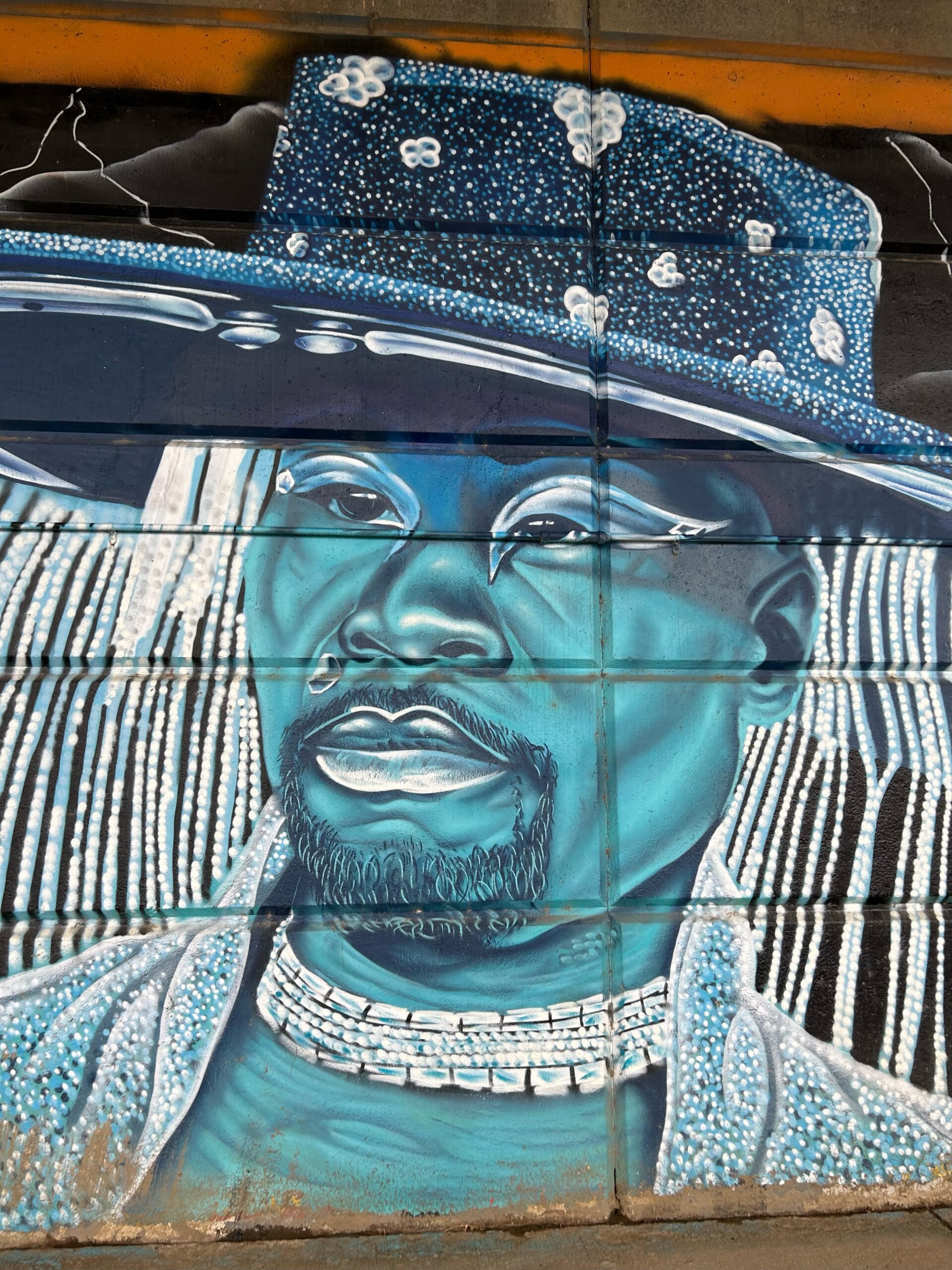
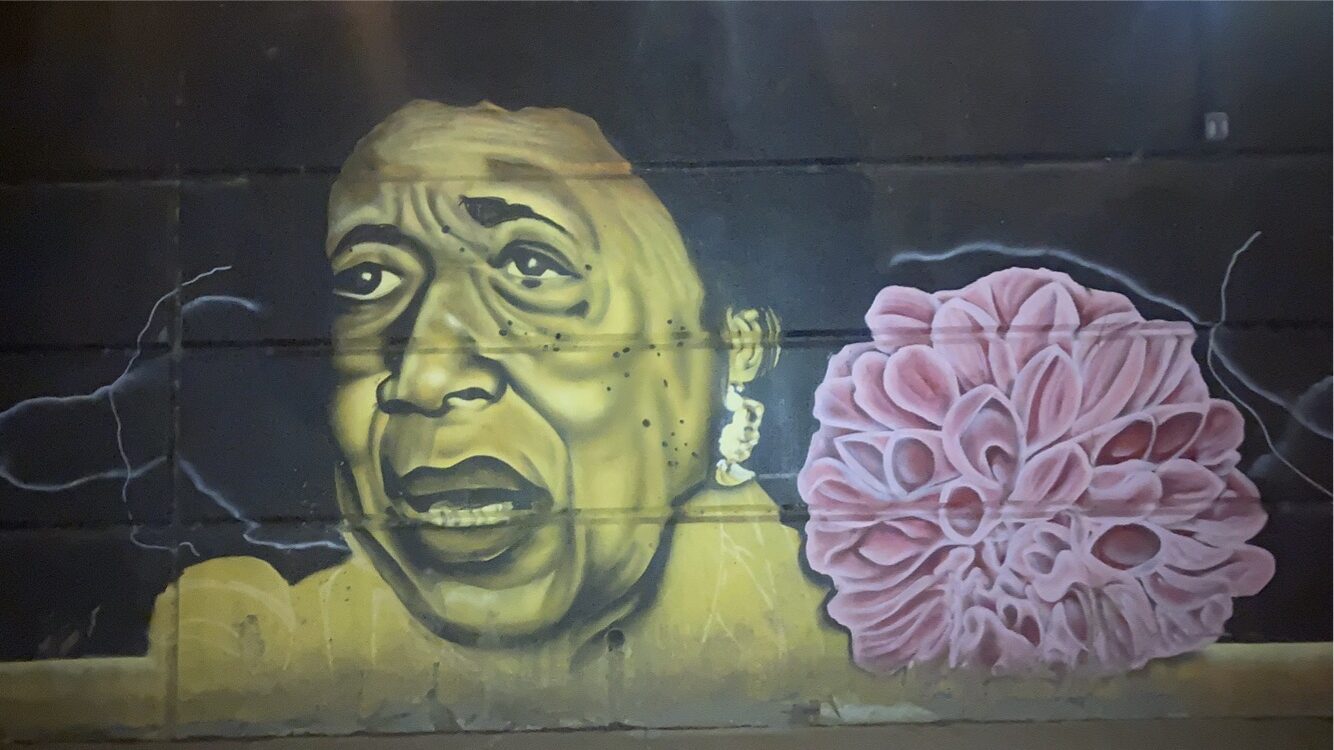
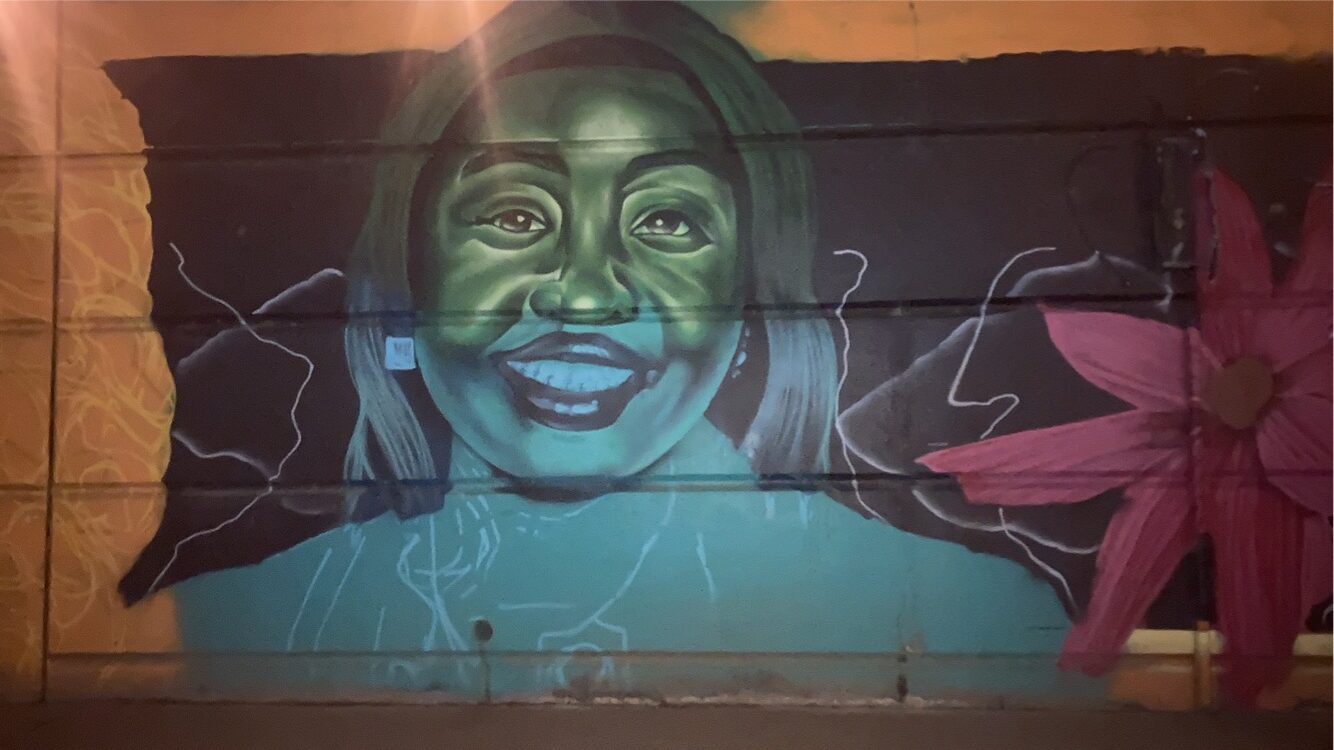
Cameron “Camo” Nesbit, the Artist Resident responsible for the 12 portraits of local Black artists, leaders, and entertainers, “see[s] this site as having the potential to grow into a public art mecca for the city of Pittsburgh, and beyond.” The faces of these colorful portraits stare across the waters towards the North Shore, intertwined with images of various bright flowers and brilliant monarch butterflies that break up the industrial feel of the bridge’s beams and invite the viewer to picture a nourished culture. Among the portraits of Black excellence are the familiar faces of the Artist Resident himself, and other well-known Pittsburghers, like Billy Porter, the Broadway and movie-star actor, Wiz Khalifa, the Grammy nominated rapper, Dr. Ayisha Morgan Lee, founder and CEO of Hill Dance Academy Theatre, Alma Speedfox, the “Mother of Pittsburgh’s civil rights movement.”

A portrait of Billy Porter.


A portrait of Alma Speedfox.

The project, which was established in 2021, grew out of a previous Black Lives Matter mural created along this same pathway by another group of Pittsburgh mural artists following the brutal murder of George Floyd by a Minneapolis police officer in 2020. In concert with those mural artists and in conversation with Pittsburgh’s Office of Public, Camo sought to engage the community around the subjects of healing, strength, and enlightenment. In his artist statement, Camo declared, “I believe Pittsburgh is ready for this: a place for people to gather and celebrate new voices and a new style of street art and murals.”

A portrait of Dr. Ayisha Morgan Lee.
Camerin “Camo” Nesbit

Nourished by its location at the riverfront and sponsored by the Office of Public Art, Riverlife, and Pittsburgh’s Cultural Trust, Camo’s “Black Flowers” is hopefully the first of many art gardens in Pittsburgh where community and conversations around culture, civil rights, and contributions thereto can flourish. “Black Flowers,” in particular though, is a perfect bouquet—a dozen faces—all picked to honor lives and legacies that were at one point or another rooted right here in Pittsburgh. This writer was fortunate enough to experience this beautiful arrangement on the warmth of a recent February weekend, which served as a reminder that as the weather turns closer towards spring by the day soon the City of Pittsburgh will also be in full bloom.

“Black Flowers” is located along Three Rivers Heritage Trail, approximately a half mile from Point State Park, and discoverable by GPS at “Ecstatic RiverFront.” For more information, click here.

-GM

Made to Order? – a Review of “The Perfect Mate”

If you can’t find the perfect mate, why not create one? After all, it is 2063 and technology has advanced to a new level.

Joan Sweete (Autumn Hurlbert) still wants true love with a human but as she pursues the dating scene, no one she encounters passes the test. Humans are letting her down. Her bubbly enthusiasm as she meets new possible love interests dwindles with each new encounter.

Susan Botelli (Josey Miller), a savvy business woman, intent on promoting and gaining funds for her idea, wants to create a humanoid, someone who looks like a man but can be programmed to have the qualifications required by that specific client.

Note: One of those techie advancements but not on the level of a humanoid is HomeBody (Ryan Cavanaugh), a human-looking robot built like a man but with an arm appendage that is a sweeper nozzle. He diligently (with appropriate sweeper sounds) earnestly cleans everything in sight.

Sweete finally agrees to the creation of a humanoid. Kenna and others (Jimmy Nicholas), based on Sweete’s criteria is programmed and created.

The perfect mate is perfect for a short period of time. He is agreeable, maybe too agreeable, doesn’t move much, possibly even boring. He is deprogrammed and Sweete agrees to another incarnation of her perfect mate with perhaps more realistic changes. This perfect mate comes to life as an Elvis-type gyrator who never stops moving and prancing. Another perfect mate
bust!

What does Sweete decide to do after these fiascos?

Note: I think we’ll leave the finale unknown. Come and see this funny, music-filled world premier rom com musical and you’ll find out!

Autumn Hurlbert gets ready to meet her match.

Hurlbert shines as the young woman looking for love (sometimes in the wrong places). Her character evolves from a bubbly energetic woman to one who becomes more frazzled as her experiences in finding the perfect mate reach a dead end. It becomes apparent that she really doesn’t know what she wants. Hurlbert also has a lovely voice and “Ready for Love” exemplifies
that.

Nicholas is excellent as the multiple perfect mates. He is endearing and agreeable in one of his incarnations and extremely humorous as a gyrating Elvis-type in another version. He has great comedic skills and timing and his facial and body movements contribute to his delivery.

Miller does a great job of portraying Botelli as the dominating business woman intent on obtaining funds to produce the perfect mate. She is overbearing at times but she’s on a mission.

Buchheit as Moya delivers with the song “Moya’s Opinion”.

Only making a brief appearance as HomeBody, Cavanaugh is delightful as the human-like robot with the sweeper nozzle arm who consistently exclaims: “I love dirt”! “I love dirt.”

The set’s backdrop is a huge computer with multiple buttons and flashy lights. In front of this mammoth mechanism is a bulky and very large desk. Behind the desk are three people who at first glance appear to be computer operators. It is apparent as the show begins that this large
desk partially hides the fact that the musicians are on stage.

Wonderful direction by Carolyn Cantor.

Hats off to the Pittsburgh CLO Band.

This world premiere of Rom Com Musical of the future was developed and made in Pittsburgh, with book, music, lyrics by Dan Lipton and David Rossmer.

Its genesis is the result of SPARK, an initiative dedicated to the development of new small musicals.

-CED

“The Perfect Mate” is a production of the Pittsburgh CLO Kara Cabaret Series. Performances at the Greer Cabaret Theater run from February 2 through March 17. For more information, click here.

Blues is the Roots and Everything Else is the Fruits – a review of “Blues is in the Roots”

By Lonnie the Theater Lady

This world-premiere biographical musical about Willie Dixon, opens in a courtroom in Chicago in 1977. Willie Dixon (Sam Lothard), his wife Marie (Michele Bankole) and Muddy Waters (Nickolas Page) are suing Chess Records because of a financial dispute.

From the courtroom, the audience is transported back to Willie’s childhood to trace the sequence of events leading up to the courtroom scene. From an early age, Willie spoke poetically and often in rhyme, foreshadowing his songwriting career. His mother Daisy (Angelique A. Strothers) gave birth to fourteen children, of which Willie was number seven. (The inspiration for the song “I’m The One They Call the Seventh Son”). His mother stressed the importance of education to her children as well as the role that their ancestors played in laying the foundation (roots) of who they would become.  Willie started singing in the church choir when he was only four years old. He later spent time in a prison farm when he was just thirteen years old–after being convicted of a fabricated misdemeanor.

He was a heavyweight boxer, a jailed conscientious objector, a producer, musician, vocalist, and musical arranger. He was a prolific songwriter, with over 500 songs written. All of his accomplishments, however, take a backseat to the textured music in this show. This is not simply a play about Willie’s life. It’s a concert/musical revue that entertains and captivates. In addition, it’s a sometimes excruciatingly painful look into Jim Crow laws and the historically brutal treatment of African Americans in this country.

Left to right: Kevin Brown, Angelique Strothers, and Mils MJ James sing.
From left to right: Sam Lothard, Nickolas Page, Cole McGlumphy take the stage.

Sam Lothard is perfectly cast as Willie. He is marvelous in this role. Not only is he comfortable and totally natural in his embodiment of Willie, but he is having the time of his life. It’s a joy to watch him as he confidently enjoys himself on stage. And, oh, yeah, he can sing the blues–with real emotion, — in fact, he owns the blues. I love his rendition of “I’m Ready” as he playfully flirts with Marie, his future wife. He kills it with every one of his musical numbers.

Nicholas Page  (Muddy Waters) exudes charm. His pompadour wig and period costume (Deryck Tines Mitchell, designer) contribute to his striking resemblance to Muddy Waters.

Kevin Brown plays his multiple roles smoothly with sophistication and aplomb. His portrayal of Otis Rush singing “I Can’t Quit You Baby” is a show-stopper.

Michele Bankole as Etta James is comically entertaining as she sings Hoochie Coochie Man– her beautiful, rich voice shines in this and in all of her numbers.

Mils “M.J.” James as Sonny Boy Williamson performs a rendition of “Back Door Man” that is steaming hot—–ever so sexy—phew!  He later transforms into Chuck Berry—singing “Maybelline” as he accurately impersonates many of Chuck’s distinct dance moves. His spirited performance is a real crowd-pleaser!

Angelique A. Strothers beautifully sings Koko Taylor’s hit “All Night Long.” It’s a number that one could listen to all night long. (on repeat and be perfectly happy). Her voice is stunning in every one of her numbers.

Jenny Malarky plays multiple roles–both male and female–she does them all with panache that showcases her great versatility.

The entire cast and ensemble, (too numerous to mention) is strong, energetic and engaging. Every musical number, without exception, is sung with passion and without inhibition. The director, Herb Newsome, brings out the best in all of the actors, in their acting, movement, and vocals. He makes sure that every magical moment is used to its full advantage.

The playwright, Charles Dumas, is not only the first tenured Black professor (now emeritus) in the Penn State Black School of Theater but is Willie Dixon’s great nephew, as well. His loving tribute to Willie is bound to be a hit that withstands the test of time. I think it’s reasonable to expect to see this playing on Broadway in the not-too-distant future.

This production by New Horizon Theater is an exceptionally well-acted musical masterpiece that is not to be missed. It’s a show that begs to be seen, and savored, more than once!

-LTL

“Blues is in the Roots” runs until February 18 at the Pittsburgh Public Theater’s Helen Wayne Rauh Rehearsal Hall – 621 Penn Ave., Pittsburgh, PA 15222. For more information, click here.

-LTL

“Blues is in the Roots” runs until February 18 at the Pittsburgh Public Theater’s Helen Wayne Rauh Rehearsal Hall – 621 Penn Ave., Pittsburgh, PA 15222. For more information, click here.

css.php