

Budding Relationships – a review of “The Verge”

by Tiffany Raymond, ‘Burgh Vivant

It’s tempting to dismiss Susan Glaspell’s play, “The Verge,” as dated, given its one-year shy of its centenary. However, Glaspell was a powerhouse in her day and has ascended to dramatic legend. She was only the second woman to win the Pulitzer Prize for Drama, and she cofounded the Provincetown Players, widely considered to be America’s first theatre company. Her 1916 play, “Trifles” traces a woman accused of murdering her husband and was based on a journalism assignment Glaspell covered. “Trifles” always resonated at the college-level, a testimony to Glaspell’s timelessness.

“The Verge” is not quite as accessible, so it’s a brave choice by the University of Pittsburgh Stages. By 1921, Glaspell was detaching from realism and flirting with dawning expressionism. Where this falls apart is not in the play, but in the production. The weakest link is actress Emily Peifer. Her portrayal of protagonist and botanist Claire Archer embodies the oft-used corporate expression “building the plane while flying it.” This strategy can prove effective in fast-paced business settings, but it’s less successful in the dramatic arts where having a point of view on your character is critical. Peifer never finds Claire as she battles mental health issues, and director Andrea Gunoe leaves her scrambling in the cinders. Peifer attacks her lines with a mad, headlong rush, occasionally punctuated by a deer in the headlights gaze to the galaxies. Nuance is sacrificed to histrionics.

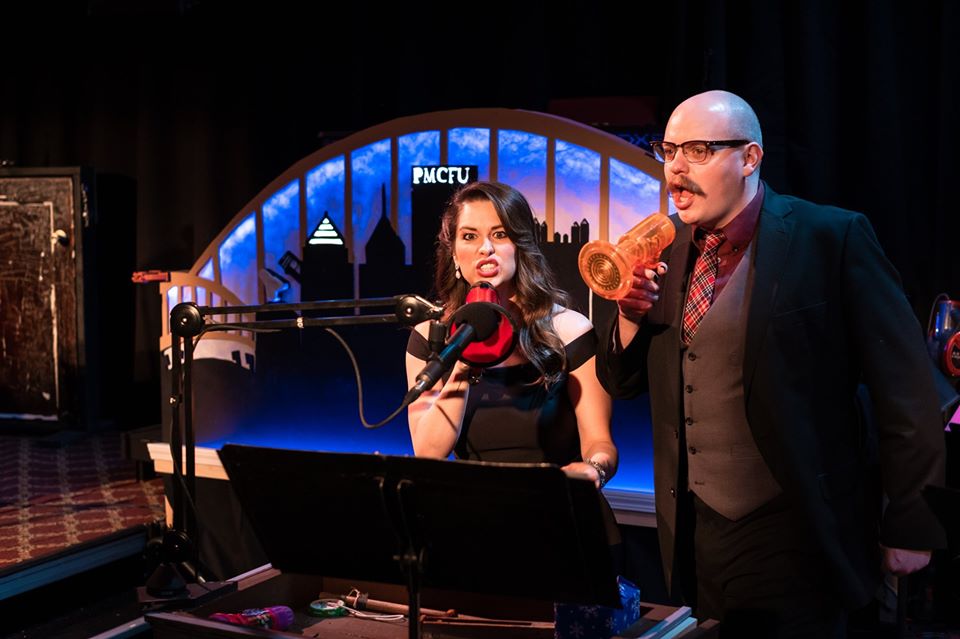
Luckily, there are more roots to this botanical drama than the main character. The play takes place in Claire’s greenhouse. Sound designers Nick DePinto and Parag S. Gohel create an enchanting use of onstage sound effects that hearken back to popular radio dramas of the 1920s. Paper on a roller simulates the wind, and each mention of Claire’s botanical hybrid piece de resistance – the scintillatingly named Breath of Life – is accompanied by an enchanting, fairy-like windchime. Gunoe thoughtfully positions the sound effects team downstage right to minimize intrusiveness while providing real-time optics into the effects. Breath of Life may be hidden for most of the play (and looks a bit flaccid and underwhelming when it is revealed), but the windchimes build anticipation and enhance the play’s ethereal, otherworldly quality.

Sound effects acutely bleed into the physical. Howling winter winds accompany each forceful opening of the greenhouse’s iron-rimmed door on Kami Beckford’s magnificently towering set reminiscent of a slightly ominous Phipps Conservatory. The door always seems most difficult for Claire’s husband to open and close, and you’re never sure if it’s inconsistent direction or correlation to the opener’s status in Claire’s heart.
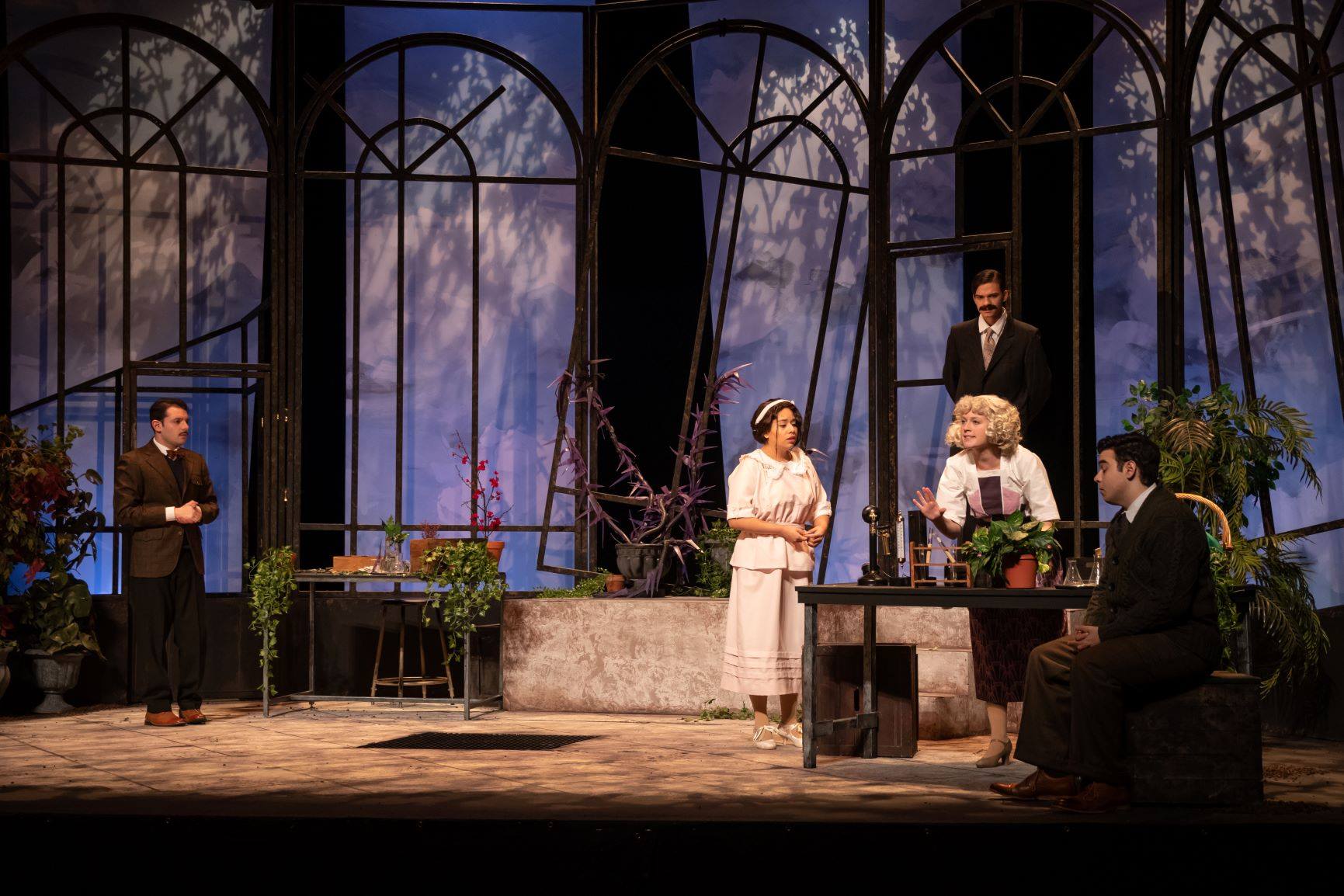
The cast of “The Verge” gather around Claire (Emily Peifer).

Despite (or because of?) her neurotic nature, the beautiful Claire is loved and admired by three men who all want to save her in their own ways. Gunoe turns the trifecta of sexual tension into a quartet with an androgynously well-cast greenhouse caretaker, Anna (Cadence Reid). Yet Claire is living proof that admiration can’t save one’s sanity. She both relishes and is repulsed by the male gazes cast upon her as none of them satisfy, even with the heady cocktail of husband, lover and best friend under the same greenhouse roof.

Claire’s husband, Harry (Cal Behr), is an aviator. She’s embittered that his daredevil nature is delimited to the skies, but she also clearly jumped into this second marriage without taking the time to validate her assumptions. The mustachioed Behr is reminiscent of Inspector Clouseau; he’s clueless and well-meaning, but his good intentions make him sympathetic. He’s a steadying course, which the volatile and often churlish Claire bucks against. From the outset, Claire flaunts her extramarital relationship with artist Dick Demming (Jason Goldstein). Goldstein finds the tension between the exultant masculine pride of conquest and exuding discomfort with Claire’s lack of subtlety.

Tom (Dennis Sen) is Claire’s best friend, and Sen wields his facial expressions with wonderful nuance. He finds an appropriately bemused sensibility towards his fellow challengers who know Claire in the bedroom, while only he seems to be able to calm her. However, Tom’s also the model of lovelorn confidante, torn between the desire for Claire’s continued friendship while coveting the headiness of her romantic affections. At one point, Claire’s hand drops from Tom’s shoulder. He reaches back with a palpable anguish to rest his hand on that spot, his own attempt to capture the Breath of Life that ultimately eludes us all.

-TR

The University of Pittsburgh’s production of “The Verge” plays through February 16th at the Charity Randall Theatre inside Foster Memorial, 4301 Forbes Avenue, Pittsburgh, PA 15213. For more information and to purchase tickets, click here.



There’s No Business Like Show Business – a review of “The Book of Merman”

Mike Buzzelli

By Michael “Buzz” Buzzelli, ‘Burgh Vivant

Leo Schwartz and DC Cathro’s “Book of Merman” is a high concept idea. Take the “Book of Mormon” and add Ethel Merman. It’s simple! You know you’re getting a cross between “The Book of Merman” and “Annie Get Your Gun.”

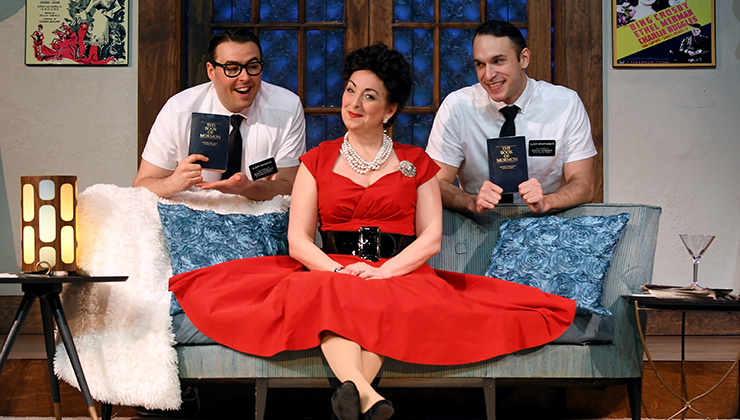
In this show, the two Mormon missionaries, Elder Braithewaite (Jerreme Rodriguez) and Elder Shumway (Quinn Patrick Shannon) are faithfully attempting to execute their plan to go door-to-door to recruit people to their religion, The Church of Jesus Christ of Latter Day Saints. One day, they knock on a hot pink door belonging to Ethel Merman (Christine Laitta) and all – um – heck breaks loose.

There’s not really a lot to the plot. Shumway has desires for a life in showbiz (and he as a few other secret desires). Braithewaite is holding on to a tight-lipped secret of his own. While Ethel Merman (who died in 1984) is a complete enigma.

They express all of their feelings in verse. There’s a lot of songs. The funniest of these ditties is “If It’s Not Hard, I Don’t Like It.” A thinly-veiled song of double entrendes that is meant to be about how there is no greater reward to overcome challenging and difficult tasks, but it’s really about penises.

There are two problems with “The Book of Merman.” One; the concept wears thin pretty quickly. Two; a good satirist knows to skewer a mainstream or more serious idea and turn it into comedy. When Richard Lopez and company decided to make fun of “Sesame Street,” he and his pals came up with “Avenue Q.” Recently, right in the Greer Cabaret Theater, Gerard Alessandrini took the Broadway hit “Hamilton” and created the parody “Spamilton.” The problem with “Book of Merman” is they took a really funny musical “Book of Mormon” and made an adequate one.

Shumway (Quinn Patrick Shannon) and Braithewaite (Jerreme Rodriguez) flank Ethel Merman (Christine Laitta) in “The Book of Merman.”

The cast is working really hard to sell the idea. They are terrific triple threats; each of them can sing, dance and act. But they can’t save this production.

Rodriguez knocks it out of the park, especially with his rendition of the Tin Pan Alley song “Hello Ma Baby!”

Shannon is delightful as Elder Shumway. He is a staple at the Greer and deservedly so. His comedic takes are genius.

Laitta is a true talent, but here she’s imprisoned with Merman’s voice in this show. Her imitation of the undisputed First Lady of the musical comedy stage is not a pleasant noise. She sounds like a cross between Edith Bunker and an air raid siren. Luckily, she does get to sing one song in her regular voice and it’s beautiful.

There also seems to be some crime committed on stage when Merman neither sings nor utters the lines, “There’s no business like show business,” or “Everything’s coming up roses.” If you’re thinking maybe the joke was too obvious, don’t worry – plenty of obvious jokes were made. A lot of clunkers, too.

Tony Ferrieri’s set, however, is a beauty. It’s comprised of the front door, a sumptuous living space and a bus stop all fitting together seamlessly.

John Lindsay McCormick’s costume designs for Laitta’s Merman are gorgeous, and it’s a treat to watch the costume changes.

One audience member, Jason Clark, summed the show up politely and succinctly. He commented, “I’ve seen better stuff here.”

– MB

“Book of Merman” runs until March 8 at the Greer Cabaret Theater, 655 Penn Avenue, Pittsburgh, PA 15222. For more information, click here.


Man-eater – a review of “Little Shop of Horrors”

Mike Buzzelli

by Michael “Buzz” Buzzelli, ‘Burgh Vivant

The Skid Row Urchins, Crystal (Tavia Rivee), Ronnette (Melessie Clark) and Chiffon (Abigail Stephenson), the ever present and ever harmonious chorus, warns us that strange things are about to happen in Howard Ashman and Alan Menken’s “Little Shop of Horrors.” Things get strange right away.

Schlubby Seymour (Philippe Arroyo) spends his days sweeping up the backroom and pinning away for Audrey (Lauren Marcus) in Mushnik’s Skid Row Flower Shop until he finds a very interesting and unusual plant. He dubs the floral enigma the Audrey II.

The problem is the plant is droopy and water, plant-food and direct sunlight do not seem to be helping. When Seymour cuts his finger on the thorn, the plant perks up. He feeds the plant a few drops of blood it blooms.

It’s tasted blood and it wants more. More. More!

Suddenly Seymour realizes that the plant is on a people-based diet. Chickens, pigs and cows do not seem to satisfy it – only human blood will do.

Enter Orin Scrivello, DDS (Patrick Cannon). The sleazy sadistic dentist is dating the original Audrey. The girl comes to work with a black eye one day and a bruised arm the next. Seymour and Audrey II (played by puppeteer J. Alex Noble and voiced by Monteze Freeland) decide that the dentist sure looks like plant food to them.

When the dentist accidentally suffocates on his own nitrous oxide, Seymour feeds him to Audrey II. The plant begins to grow and grow.

Soon, the store owner, Mr. Mushnik (Marc Moritz) becomes suspicious of the dentist’s disappearance when he sees Seymour and Audrey kissing and it’s suppertime for the plant once more.

But how far will Seymour go to get everything he’s always wanted?

Pretty dang far.

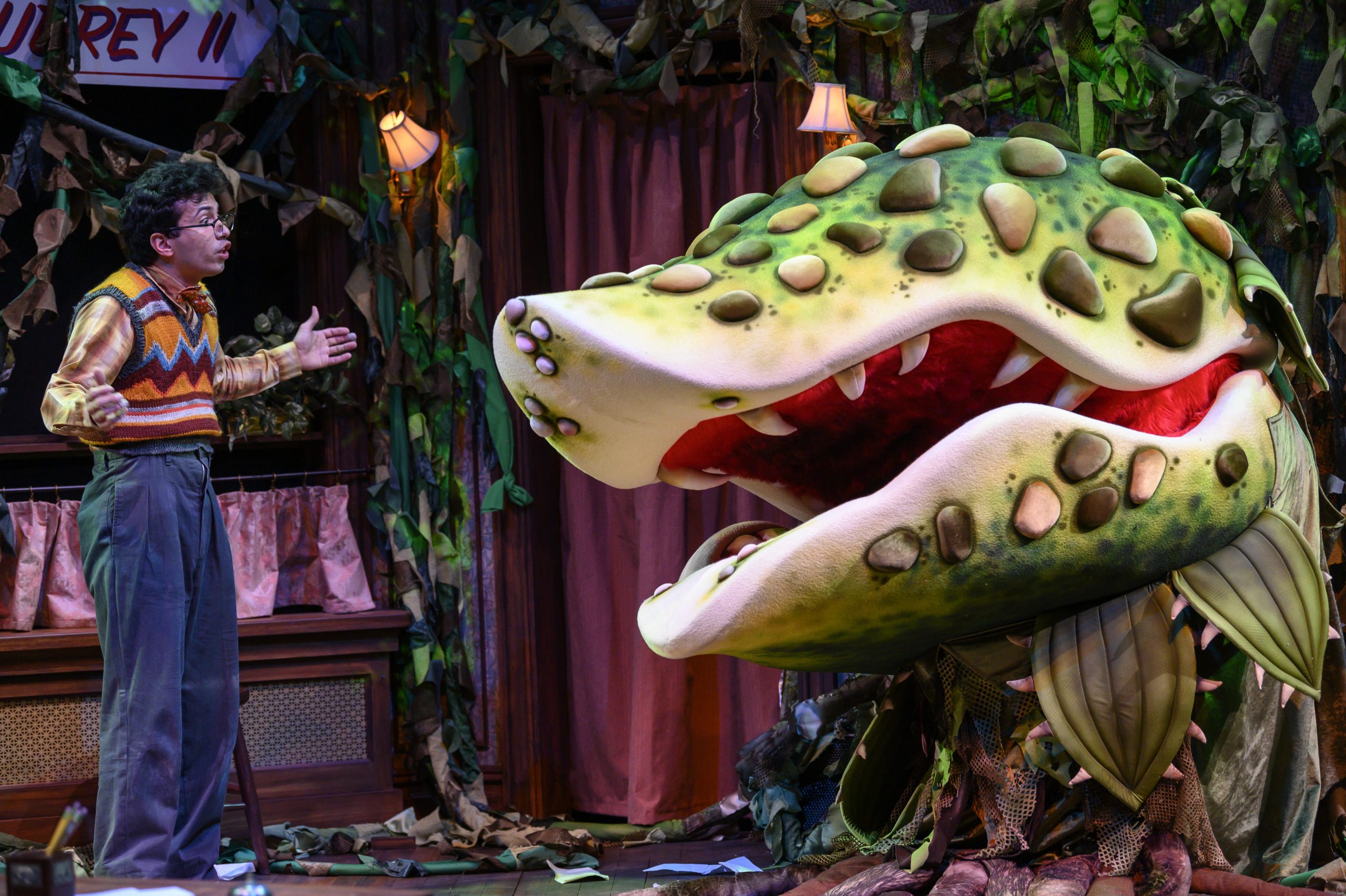
Seymour (Philippe Arroyo) confronts Audrey II (voiced by Monteze Freeland and manipulated by puppeteer J. Alex Noble).

The musical is based on the titular 1960 horror comedy written by Charles Griffith, and directed by the pope of pop cinema, Roger Corman.

The cast, much like Audrey II’s mysterious origins, is out-of-this world. They are backed up by a fantastic orchestra conducted by Catie Brown.

Arroyo is adorable as the klutzy Seymour.

Marcus is a tremendous talent. Her “Suddenly Seymour” is a show stopper. She belts it out beautifully, incandescently.

Cannon is delightful as the deranged dentist with a sadistic streak. He is charismatic and  electrifying in his performance as Orin Scrivello, DDS. He also tackles a few additional roles with aplomb.

Freeland is hilarious as the villainous vegetation, Audrey II. He gives the creature the cadence and lilt of a scary ass drag queen from space. It’s a marvelous interpretation. It’s amazing how fluidly Freeland’s voice matched up to the puppet’s giant Venus Fly Trap of a mouth thanks to puppeteer J. Alex Noble.

Normally, the Urchins (i.e. the Chorus) are regulated to the back of the stage, singing back up. Director Marya Sea Kaminski moves the chorus front and center, and it’s pays off brilliantly. Rivee, Clark and Stephenson are amazing. Their voices combine mellifluously.

All the action takes place on an illustrious and imposing set wondrously designed by Tim Mackabee, and gloriously illuminated with projection design by Bryce Cutler.

If you’re in the mood for a monstrous musical, “Little Shop of Horrors” is the main event.

“Little Shop of Horrors” runs through February 23 at the O’Reilly Theater at the Pittsburgh Public Theater, 622 Penn Avenue, Pittsburgh, PA 15222. For more information, click here.

It Doesn’t Mean What You Think It Does – A review of “The C-Word”

By Claire DeMarco, ‘Burgh Vivant

Mental illness and suicide are very serious subjects but injecting dark humor into the conversation often allows one to avoid coming face to face with those issues.  Conversation about these concerns are presented in the world premiere of “The C-Word” by Olivia LeSuer.

College-age Grace (Audrey Nigh) has recently come home to her mother, Mary (Katelyn Donnelly) after an attempted suicide.  It soon becomes apparent that Mary seems to have as many emotional problems as Grace as they never seem to speak openly concerning the attempted suicide.  They stand apart, skirting the issue in front of them with attempts at comedy and general avoidance.

Grace’s father David (Christian Poach) has been alienated from Grace for fifteen years and now wants to insert himself back into her life.  We don’t know why he hasn’t been in the picture but his concern for Grace appears sincere.  He is able to encourage Grace to stay with him during her transition back into the real world.   But it’s obvious and disconcerting that he doesn’t know much about Grace.  “Are you allergic to anything?” “What school did you apply to?” “What are you studying?”

Insecure Mary constantly texts and calls Grace while she’s with her dad, attempting to interfere with this new relationship.

Every time there is a tumultuous situation or avoidance scenario by Mary, Grace or David with each other, their first reaction is to turn on the T.V.  Insertions of T.V. clips and commercials (usually funny) help break up the turmoil going on with this dysfunctional family.

The use of the T.V. as an avoidance mechanism for all the characters is a clever technique: Tune in to tune out!

It is hard to imagine how a smoke detector provides an avenue for the start of healing and coming to terms with the serious discussion of suicide and mental illness.

Nigh plays Grace as sometimes insecure, many times belligerent, defensive and unsure.

Donnelly’s range carries her from argumentative to, at times, not even speaking.   Even when sitting and seeming to appear calm, she is able to portray any underlying tension by playing with and moving her hands.

Nigh and Donnelly both, especially in quiet moments do not project fully to the audience.   It was difficult at times to hear all of their dialogue which lessened the impact of their otherwise good performances.

Poach provides an even performance, sensitive to his daughter’s needs, but stern when necessary.

Scenes occur in either Mary’s living room or David’s with subtle changes on the couch and a few strategically placed plants an indicator of where we are.

LeSuer discussed in her conversation noted in the program concerning mental health issues that there is no end all cure for mental health issues.  A lot of recovery is learning to accept it and cope.

– Ced

“The C-Word” is a production of The Red Masquers at Duquesne University’s Genesius Theater, 600 Forbes Avenue, Pittsburgh, PA 15282.  It runs from January 29 to February 2, 2020. For more information, click here.

Forgotten Things, Buried Deep – a review of “Downstairs”

Mike Buzzelli

By Michael “Buzz” Buzzelli, ‘Burgh Vivant

Basements, like memories, hold a lot of forgotten things, buried deep. This is especially true in Theresa Rebeck’s darkly comic “Downstairs.”

Irene (Helena Ruoti) has graciously let her brother, Teddy (Martin Giles), camp out in the basement over her suburban home, much to the chagrin of her husband Jerry (a menacing John Shepard). Teddy needs a break from his daily routine, and the dingy squalor of the suburban basement seem to make him happy (for some reason).

Irene is nervous about having her brother squat in the cellar because her husband and brother do not get along. Understatement of the Century alert!

Because Irene is a few years older, the two siblings have vastly different memories of their childhood, but they do share laughs reminiscing about the good times. Their connection has weakened since her marriage, but it begins to blossom again while he is couch-surfing downstairs.

Teddy is ill. It takes a while to figure out if his sickness is physical or mental. Irene pretends her marriage is normal – it very much isn’t, but she doesn’t seem to know what normal is either.

Irene starts to realize her brother is mentally ill. He says things that are unusual. He might be speaking in metaphor, or he might believe what he’s saying. He doesn’t care if he sounds like a whacko. He just says what comes to mind.

Jerry, however, who passes as normal – is far sicker. He hides in shadows, passes through everyday society, but deep down, he’s very troubled. Insidious, actually.

There is a battle of wills waging between the brother and the husband and Irene realizes she has to choose a side before she becomes collateral damage.

The first forty-five minutes of “Downstairs” move at the speed of molasses. However, once Jerry appears for the first time, the play picks up speed. It steamrolls to the ending. There are some major twists and revelations near the end and they are shocking. No spoilers.

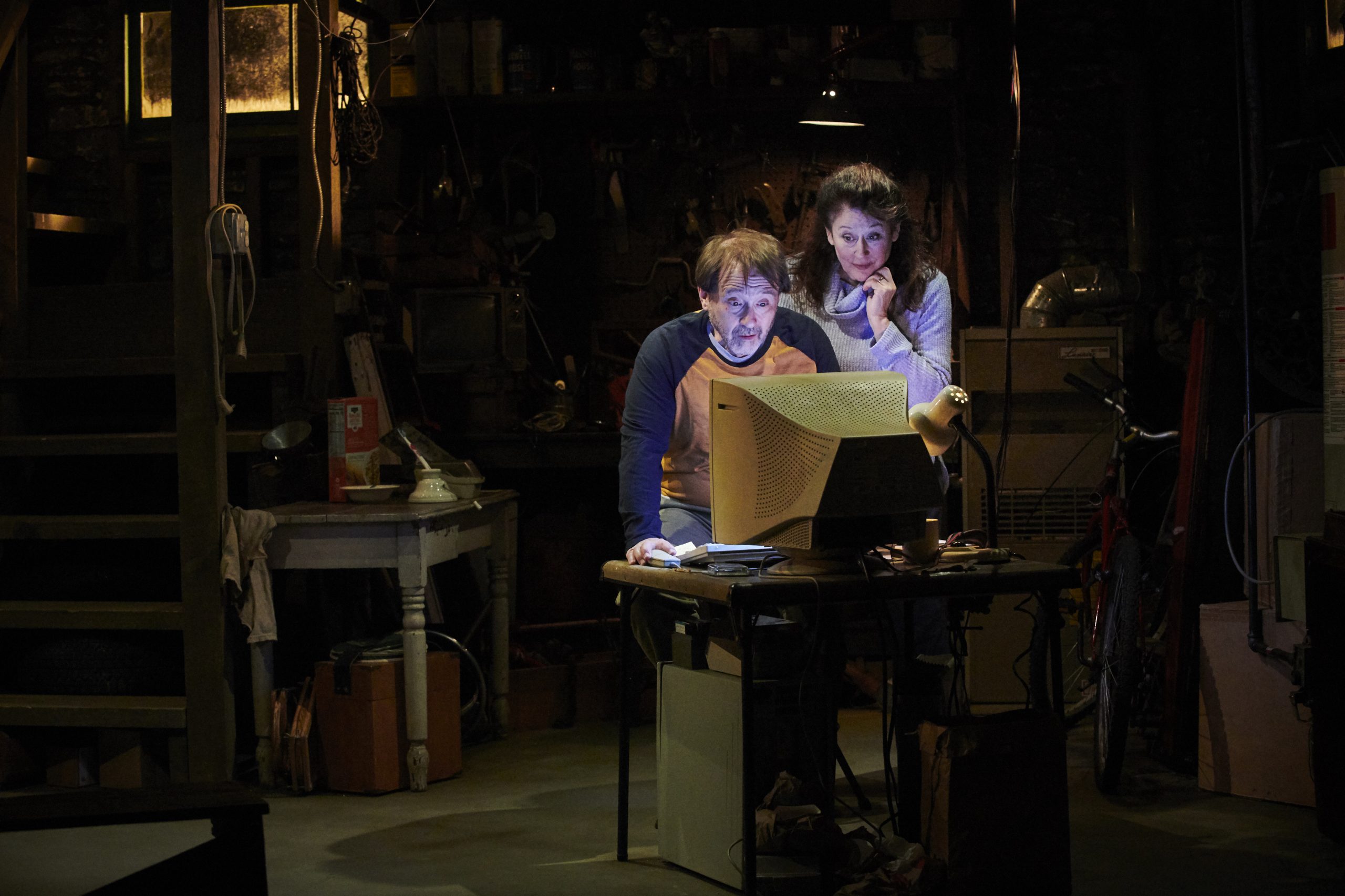
Irene (Helena Ruoti) tries to convince Teddy (Martin Giles) the old computer isn’t working, but he gets it up and running in “Downstairs.”

Rebeck’s dialogue is sharp, crisp and full of unexpected witty moments in dour situations. Each character has a distinct voice. At one point, Irene quotes her husband, and even the words she speaks don’t sound like her own as she says them.

Giles and Ruoti have fantastic chemistry. Their rapport is so fluid and dynamic.

It takes a minute to warm up to Teddy, but Giles plays him with such charm. In Giles’s hands, Teddy is more of a lovable kook than crazy person.

Ruoti does an amazing job. Irene is a duck, trying to appear graceful on the surface, while paddling as fast as she can. A lot of lies are told in this play, but none of them compare to the lies that Irene tells herself to keep her life together.

Shepard is downright chilling as Jerry. He provokes, pushes, bullies and threatens the siblings. He is terrifying. Before November 9, 2016, I wouldn’t have believed a human being could be this self-centered, bombastic, and completely void of compassion.

Director Marc Masterson picked three of Pittsburgh’s best actors for this play.

Tony Ferrieri’s set is filled with all the prerequisite items you would find in a basement, rusted tools, a laundry sink, a dog cage and picnic basket, but there is a pervasive subterranean gloom hanging over the cavernous room.

The lighting and sound design is also impressive. Kudos to Brian Liliethal and Steve Shapiro.

Note: Limit your liquid intake, the play runs without an intermission. And it runs rather long.

While there is a satisfying conclusion to the events in this particular suburban basement, “Downstairs” is not exactly the feel-good play of the year. It is, however, thought provoking. It is also a masterclass in acting, writing and production.

-MB

“Downstairs” is upstairs at the City Theatre, 1300 Bingham Street, Pittsburgh, PA 15203. For more information, click here.


The Dickens you say – a review of “A Christmas Carol”

Tiffany Raymond, ‘Burgh Vivant

The Theatre Factory breathes life back into “A Christmas Carol” by choosing a 2012 adaptation of Charles Dickens’ classic by Patrick Barlow. Barlow thoughtfully reduces the cast. His reimagined version is limited to Scrooge plus an ensemble of five who plug and play into a range of roles. The essence of the story remains unchanged, but it has a quicker, lighter tone. Dickens purists may find fault with Barlow’s generously modernized language. Barlow layers in references to things like “marketing,” which is how Scrooge describes the Christmas music playing at his business.

Director Olivia Hartle severely missteps in allowing the actors to adopt British accents. None of the thespians can consistently maintain an accent, let alone sustain the same one, making the wandering accent tour a chronic source of distraction. Scrooge (David Nackman) finds his dour as the play progresses, but at the start, Nackman can’t suppress his smile, making you wonder if Scrooge opens as an optimist in this adaptation.

Scrooge loves to talk in lofty metaphors that are designed to intimidate his lower-class borrowers. When Mrs. Lack arrives to borrow money and asks for Scrooge’s now deceased business partner, Marley, he tells her Marley has “shuffled off this mortal coil.” She looks at him quizzically until Scrooge finally enunciates “died.” Any negligible grief Scrooge felt has manifested to something he can call up on demand to shed the requisite tear designed to demonstrate a suffering he flips to take advantage of his customers. Scrooge’s turns of phrase come back to haunt him (literally) as the ghosts of Christmas past, present and future later repeat them, cheerfully mocking his air of self-importance.

Ebenezer Scrooge (David Nackman) humbugs his way through the first half of “A Christmas Carol.”

Nackman shines with lightness in moments of disdain, showing us early glimmers that Scrooge may not be all humbug. When Marley fails to leave at Scrooge’s request, he tries to shoo him out of an open window, flicking his wrists and inculcating his rendition of ghost communication with an accompanying, “Whoosh, whoosh.” He mocks Marley when the first spirit fails to arrive exactly at the strike of twelve and churlishly calls out, “Ghost, ghost, ghosty.” The five actors who play a variety of parts are never named beyond their assigned number in the program. This makes it hard to match cast to role, but they all radiate earnestness and prove adequate. Tiny Tim is surprisingly represented by a puppet. The actor who voices him is as laughably poor at ventriloquism as he is at maintaining a British accent, but it’s a quirky moment of shared levity.

Strangely enough, there’s a Pittsburgh connection to this British literary classic. In 1842, Dickens visited Pittsburgh and toured Western Penitentiary prison. It is widely thought that the rattling chains of Marley’s ghost are based on the profoundly despairing sight of shackled prisoners that Dickens witnessed here in Pittsburgh. While not the cheeriest of legacies, given “A Christmas Carol” was published the year after Dickens visited Pittsburgh, it’s not an unlikely inspiration.

-TR

The Theatre Factory’s production of “A Christmas Carol” plays through December 15th at The Theatre Factory, 235 Cavitt Avenue, Trafford, PA 15085. For more information and to purchase tickets, click here.
A Cap and Cheese Christmas – A review of “Yinzer Yuletide: Pittsburgh Lights and Legends”

Mike Buzzelli

By Michael “Buzz” Buzzelli, ‘Burgh Vivant

Take an old-fashioned Perry Como Christmas special, replace the Canonsburg native with WQED’s Rick Sebak and set the whole thing in Pittsburgh and you have, “Yinzer Yuletide: Pittsburgh Lights and Legends.”

“Yinzer Yuletide: Pittsburgh Lights and Legends,” like those Perry Como Christmas specials of yore, have special guest stars pop in and out while Sebak, staying true to his brand, tells tales of Christmases long, long ago. Meanwhile, Nick Stamatakis tickles the ivories (and plays additional instruments).

Side note: Pittsburgh is offering a plethora of Christmas shows this season, with “The Carols,” and “The Santaland Diaries,” just don’t get “Yinzer Yuletide” mixed up with “Yinzer Scrooged” running at the Bricolage, or go to both shows!

In “Yizner Yuletide: Lights and Legends,” actual Pittsburgh legends like Lenora Nemetz and Etta Cox stop over at the top of the show. Then, we get Victory Brinker, fresh out of the box, literally and figuratively. The seven-year-old singer lights up the stage with operatic renditions of Christmas favorites, including a lovely song, written by Pittsburgh’s biggest and brightest star, the legendary Mr. Fred Rogers (who’s having a bit of a resurgence these days).

Josh Verbanets (Meeting of Important People, Josh & Gab Show) stops by for a lively rendition of the Kink’s “Father Christmas.”

We are also treated to Ben Prisbylla who plucks his ukulele to “Mele Kalikimaka,” and O’Ryan “the O’Mazing” Arrowroot who juggles some Christmas ornaments.

Sebak shows a few clips from his various TV specials that amp the nostalgia factor to an eleven. We get a behind-the-scenes look at the Kaufmann’s Christmas window display and a tour of the most decorated homes in Pittsburgh.

Note: While the clips ran, I spent the majority of my time counting the times Yinzer’s said, “Haas” instead of “House.” It’s hilarious.

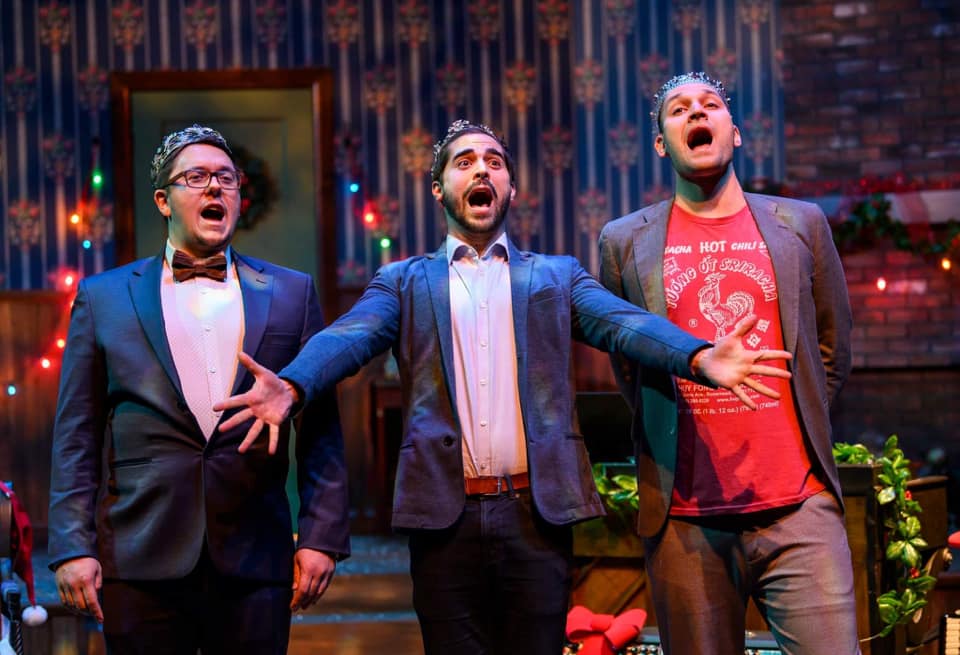
(from left to right) Ben Prisbylla, Nick Stamatakis and Josh Verbanets belt out a Christmas tune.

Nemetz does a spectacular job singing, especially her breathless version of “Jingle Bells.” Cox is always amazing. But Brinker is clearly the star to watch. The child has a powerful voice and a fantastic addition to the Pittsburgh pantheon of legends.

Verbanets has a boyish charm, even when he’s rocking out to the Kinks. If you’ve never seen Meeting of Important People or the Josh & Gab Show, you’re missing another one of Pittsburgh’s hidden treasures.

Stamatakis stands out here. He is more than your average pianist. He is lively, charismatic and provides a great deal of the humor. Plus, Nemetz and Cox each gift him with silly accoutrement to wear throughout the show.

Verbanets, Stamatakis and Prisbylla (the world’s hardest-to-spell trio) perform a beautiful version of “We Three Kings” while wearing sparkly crowns. There is a joy and effervescence to the music they make.

“Yinzer Yuletide: Lights and Legends” is a lot like a Primanti’s sammie. Elements like Capicola, cheese, French fries and Cole slaw are disparate items to fill two thick slices of Mancini’s bread, much like a child opera prodigy, ukulele player, and a juggler seem like unlikely acts for a Christmas show, but, like the sandwich, it all works. Sebak adds thick slices of cheese. “Yinzer Yuletide: Lights and Legends,” much like a Primanti’s sandwich, is quintessentially Pittsburgh. Yinz should go n’nat.

P.S. Check out the windows in the O’Reilly on the way in. They are an extra special holiday treat to go with this show.

-MB

“Yinzer Yuletide: Pittsburgh Lights and Legends” runs until December 22 at the O’Reilly Theater, 621 Penn Avenue, Pittsburgh, PA 15222. For more information, click here. 

Not All Elves are Short – A review of “Elf The Musical”

By Claire DeMarco, ‘Burgh Vivant

Happy, innocent Buddy the Elf (Tanner Yake) grew up in the North Pole. Accidentally plopped into one of Santa’s bags in New York, baby Buddy was reared under Santa’s (Jonny Kigin) supervision along with the elves in his toy workshop. Buddy thought he, too, was an elf even though when grown he towered over his diminutive cohorts.

Santa felt it was time to let Buddy know that he was a human, and has a father, Walter Hobbs (Joe Graff) in New York City. Santa felt it was time for Buddy to meet his dad.

Dressed in his very green and large elf suit, Buddy’s off to the Big Apple. He meets his father who didn’t know he existed, stepmom Emily Hobbs (Tracy Parsons) and half-brother Michael Hobbs (Joshua Clark).

Buddy tries to fit in and his new family attempts to accept him. Relinquishing his elf suit for a business suit to work with Hobbs doesn’t improve the bonding process. Even his acquaintance and potential love interest Jovie (Carly Phillips) has a bad start. When everyone is at their wits’ end, Buddy is pushed out of his new home and forced back into a department store full of Santas.

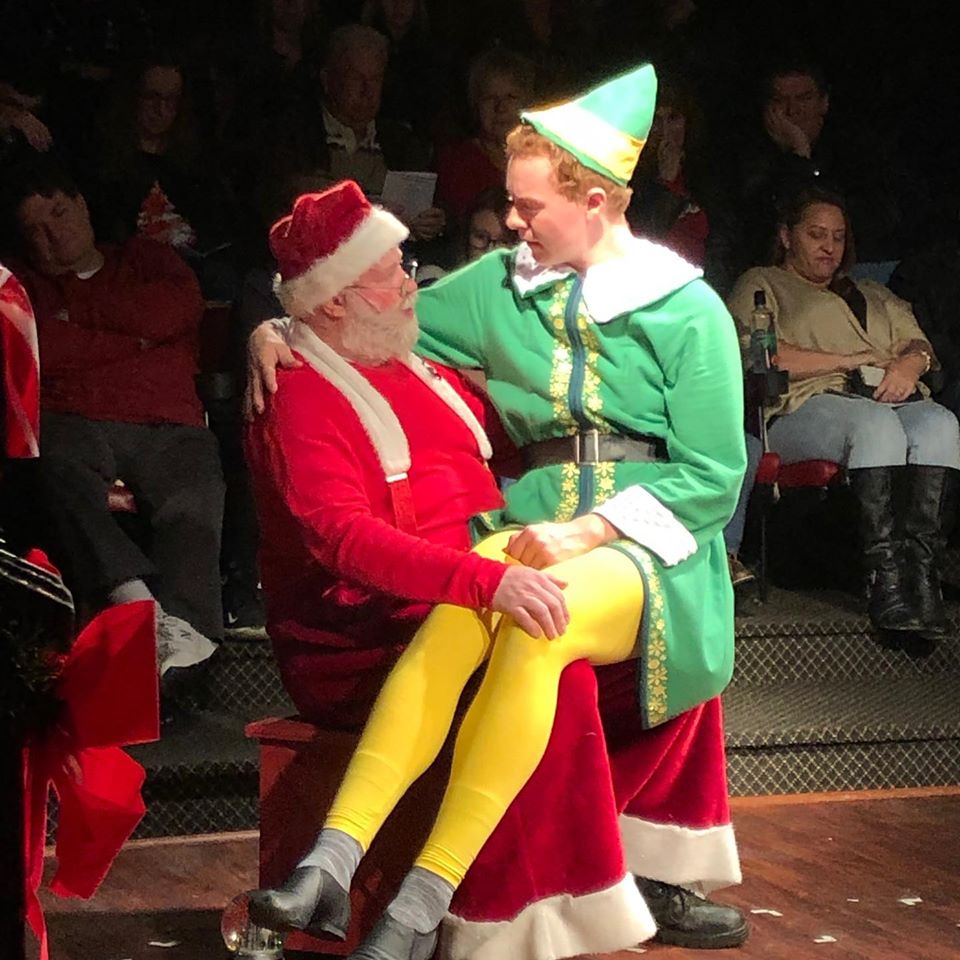
Elf (Tanner Yake) sits on Santa’s (Jonny Kigin) lap.

Innocent words, actions and unfiltered comments not a problem in his previous sheltered North Pole environment often have double, suggestive meanings in this new world. That might be troublesome to overcome.

Yake is tremendous. He begins as a naïve, sheltered young man and transitions into a quasi-grown up (still working on it), not so naïve as he used to be. Much of his emotions are expressed through facial expressions and physical movement.

Nowicki is a gem as Meg. Wonderful singing of “In the Way” but what she does with her facial expressions and general movements says it all.

As the beleaguered dad, Graff progresses from stern and uncompromising to a more reasonable and finally compassionate man.

Parsons and Clark are delightful singing “I Believe in You”.

Phillips packs a lot of emotion in her rendition of “Never Fall in Love”.

Kigin transitions easily from his role as jolly Santa into the authoritative business man Mr. Greenaway.

Impressive direction by Brandon Keller in managing such a large cast in a relatively small space.

“Elf The Musical” is a Christmas story with lots of singing, dancing and general fun. One caution is that the play (especially Act One) is long and very young kids may lose interest.

Ced

“Elf The Musical” is a production of Comtra Theatre, 20540 Route 19, Cranberry Township PA 16066 and runs from December 6 – December 15, 2019. For more information, click here.


A Pittsburgh Twist on Dickens N’at – A review of “Yinzer Scrooged: A Pittsburgh Christmas Carol”

By Claire DeMarco, ‘Burgh Vivant

Imagine “A Christmas Carol” told from a present-day Pittsburgh perspective. The Charles Dickens classic is updated with a Pittsburgh twist at the fictitious “dahntahn” WBRC Studios in Bricolage’s 11th annual Midnight Radio Series, “Yinzer Scrooged: A Pittsburgh Christmas Carol.”

We follow Jeffenezer Scroogeoff (Wali Jamal) as his story is told – his early upbringing, why he became a mean, stingy, Jagoff, and the people he affected along the way.

Andrew Carnegie (Michael McBurney) is one of the ghosts who haunt Scroogeoff while Lena Horne (Shammen McCune) sings to him.

Flashbacks to a Young Scroogeoff (Connor McCanlus) give us some indication as to how he behaved in his youth. His awful treatment of his housekeeper Barbara Cratchet (Jaime Slavinsky) supports his present miserly behavior.

References to Pittsburgh people, locations and food are often interspersed with Pittsburgh accents.

The actors’ movements are confined to traveling from one part of the studio to another in order to assume another role or to participate in making the appropriate sounds associated with the story. But it’s really about the vocals.

If you close your eyes for a few minutes you won’t miss anything. It’s all about sound.

Jaime Slavinsky and Connor McCanlus provide many different voices during the production. Photo Credit: HG Photography.

McBurney, McCanlus, McCune and Slavinsky take on multiple roles in this 1940’s radio-style format.

Jamal’s deep, rich voice is a joy to hear as he portrays the mean, rich guy.

McBurney is able to easily transition from an Andrew Carnegie ghost with a beautiful Scottish brogue to a mellow Fred Rogers.

McCune’s skit as an audio recording spewing out directions on MapBurg is excellent.

McCanlus transitions easily from a youthful sounding Young Scroogeoff to an even younger Tiny Tony.

Slavinsky’s Pittsburgh accent is spot on.

Musical Director Deana Muro’s music was subtle, yet sharp.

If you’re the least bit nebby on how this radio show ends, finish your pierogi dinner, head down to Pixburgh and become part of the audience n’at. It’s an enjoyable evening.

-CeD

“Yinzer Scrooged: A Pittsburgh Christmas Carol” is a production of Bricolage Production Company, 937 Liberty Avenue, Pittsburgh PA 15222 and runs from December 5 – 21, 2019. For more information, click here.


A Change for the Halibut – a review of “The (Christmas) Lake Effect”

By Tiffany Raymond, ‘Burgh Vivant

Each holiday season, ballet companies expectantly produce their obligatory rehashing of “The Nutcracker.” So too do America’s playhouses delve into the shallow pool of holiday theatrical options with perennial appearances of “A Christmas Carol” or “White Christmas.” Little Lake Theatre’s production of “The (Christmas) Lake Effect” successfully colors outside the lines of tried (and tired) holiday options. This original play is written by former Little Lake artistic director, Sunny Disney Fitchett. Little Lake’s current artistic director, Jena Oberg, takes the sleigh’s reins as director. Oberg finds the right balance, keeping a vibrant show from veering into a madcap frenzy.

The play traces the final dress rehearsal for a production of “A Christmas Carol.” It’s no smooth run-through after the cast is inadvertently locked in an unheated barn during a blizzard. The locked door leaves 12 cast members negotiating the stage for most of the production. Managing a dozen actors is a staging challenge, particularly at Little Lake where the audience flanks all four sides of the stage. Oberg artfully circulates the actors to balance sight lines without making their movements arbitrary or distracting.

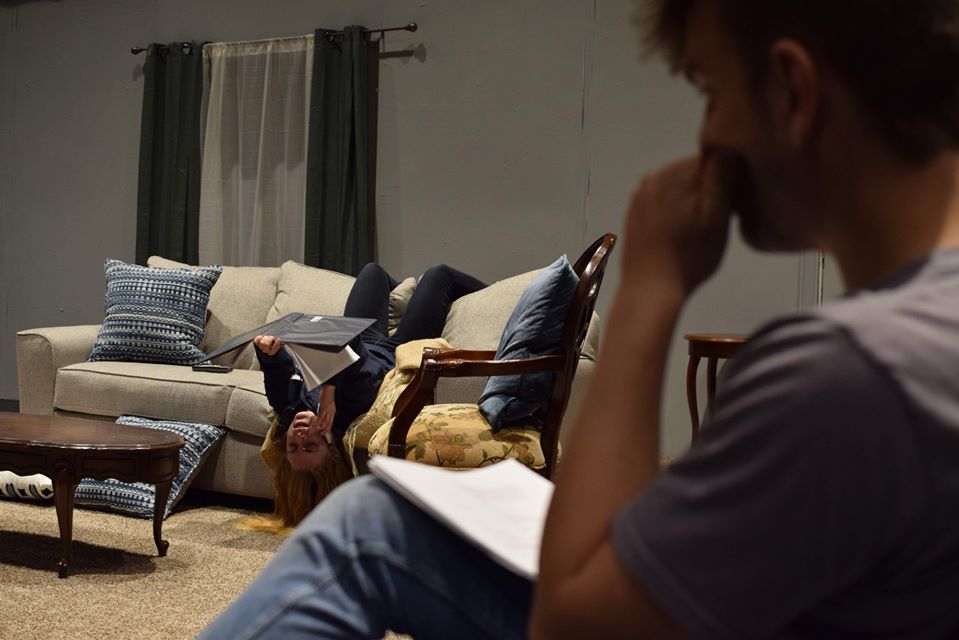
A misguided costume delivery for “Cats” instead of “A Christmas Carol” creates endless visual and verbal comedy as the actors hiss and cough up faux furballs. The close quarters also exacerbate the full range of large theatrical personalities, particularly leading man, Felix (Art DeConciliis), who will be playing Scrooge. The middle-aged DeConciliis particularly shines in verbal parlance with Martha McElligott, who plays teenaged actress, Riley. Riley is overly enthusiastic, but McElligott keeps her genuine. This is thanks to steadfast direction from Oberg who reinforces Riley’s excited speech by having McElligott bounce on the couch as she talks. Riley is respectful, calling Felix by his last name, but she’s also young and clueless. When Felix is quoting Hamlet’s “to be, or not to be” soliloquy, Riley eagerly asks, “Is that from Game of Thrones?” It’s the perfect summation of generational gaps, and the somewhat saturnine Felix handles it with good-natured grace.

The cast of “The (Christmas) Lake Effect.”

Beyond DeConciliis and McElligott, the rest of the cast also shines. Elizabeth (Mary Meyer) is set to play Mrs. Cratchit and poignantly wishes her character “had a fancy dress – or a first name.” It’s a subtle acknowledgement of historically marginalized roles for women. The play gracefully bounces between past and present as not sleigh bells, but cell phones, ring during rehearsal, sparking the show’s director Beatriz (Stacey Rosleck) to order everyone’s phones removed from the premises. Felix gesticulates and dramatically announces in a sonorous tone, “No Venmoing, No LinkedIn-ing. Welcome to back in the day!”

Inexplicably, the Secret Santa gifts were somehow in the barn before the lock-in. Fitchett’s writing could be tightened up a bit here. While there are no shortage of surprises pulled from the red sack, watching a 12-person Secret Santa exchange inevitably gets a tad tedious.

DeConciliis expertly channels miffed diva over the fact it’s the first year Lakeside Theater (a clever renaming of Little Lake) isn’t producing their signature holiday show, “A Halibut Christmas” (a clever renaming of holiday classic “A Tuna Christmas”). Felix has always headlined in “Halibut,” which only has two roles. He laments not being able to don the faux fur coat required for the role, making the faux fur cat costume an ironic tease. In the program, Oberg notes her first holiday memory at Little Lake was as a teen laughing at DeConciliis in “A Tuna Christmas,” which was directed by none other than Sunny Disney Fitchett. It’s one more layer of metatheatre, but somehow, it’s a heartwarmingly sweet circle of life within the context of the holidays.

Fitchett undoubtedly bakes in other Little Lake jokes us outsiders will never know, but that doesn’t diminish the impact of the show. Oberg ensures it’s accessible, so it never feels like an insider’s club. We all get to toast a hearty wassail and laugh at the effect – or rather “The (Christmas) Lake Effect.”

-TR

Little Lake Theatre’s production of “The (Christmas) Lake Effect” plays through December 14th at Little Lake Theatre, 500 Lakeside Drive, Canonsburg, PA 15317. For more information and to purchase tickets, click here.

 

css.php