Bearing False Witness – a review of “The Crucible”


By Michael Buzzelli

When suspicion falls on a group of women freely dancing in the woods, in the Puritanical town of Salem, the girls redirect their mischief and turn it into chaos in Arthur Miller’s iconic play, “The Crucible.”

Miller wrote “The Crucible” as a parable to his experience in the McCarthy era Red Scare, when he was asked to name members of the Communist Party, and, sadly, there are some parallels in modern society. In an uncanny and frightening side note: On opening night, Tennessee republicans accused and expelled two of three democratic representatives for speaking up in public about gun violence instead of listening to their disgruntled constituents.

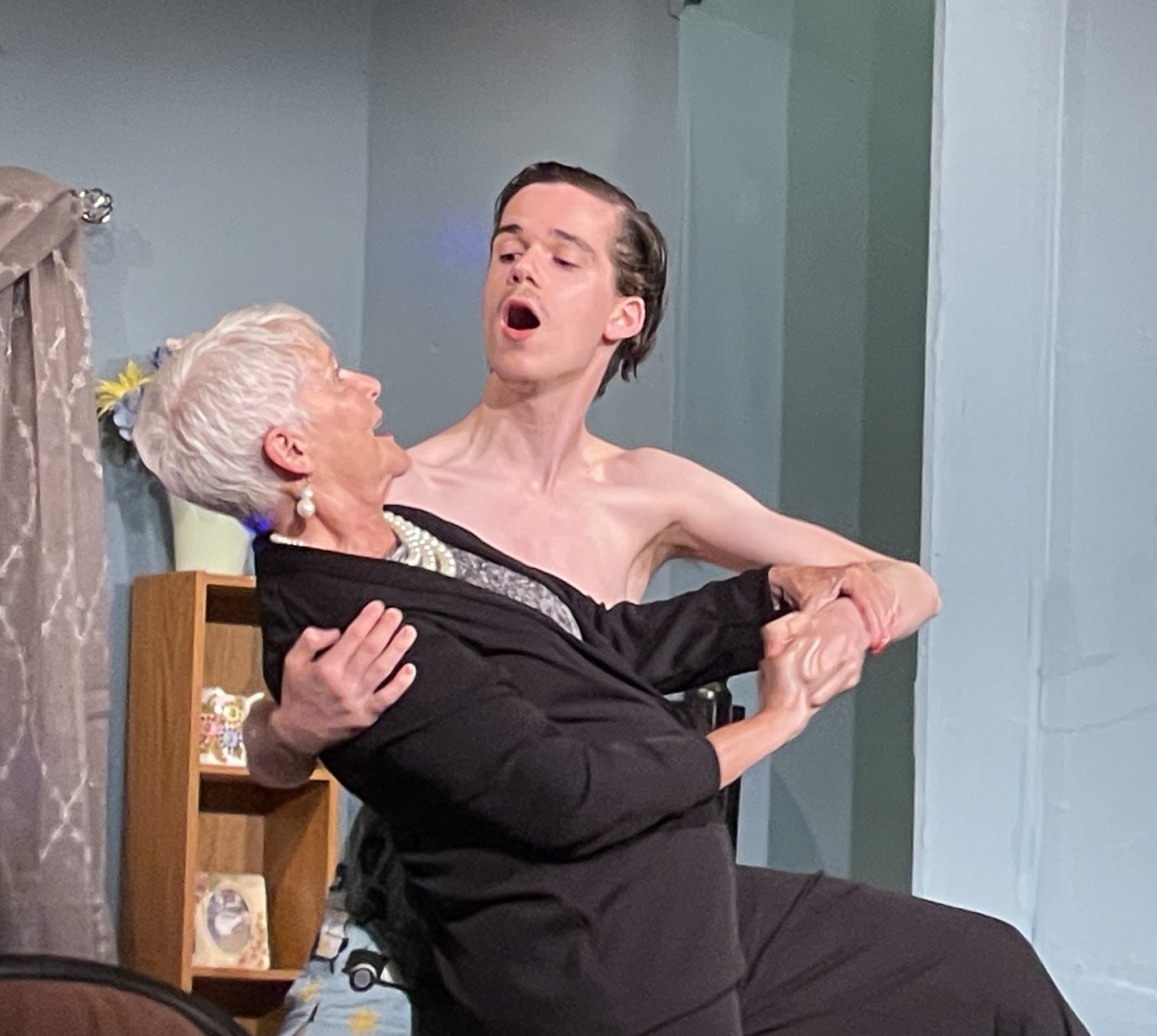
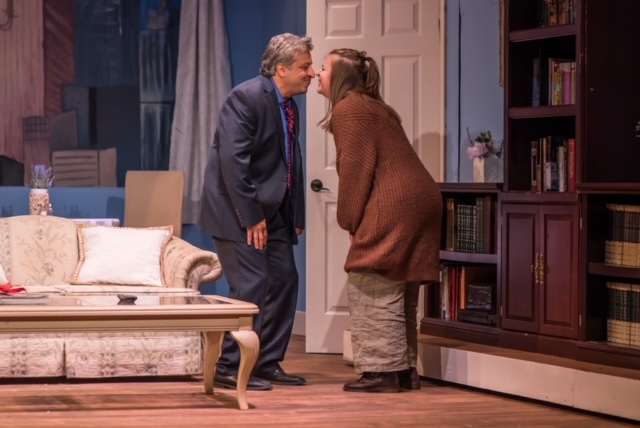
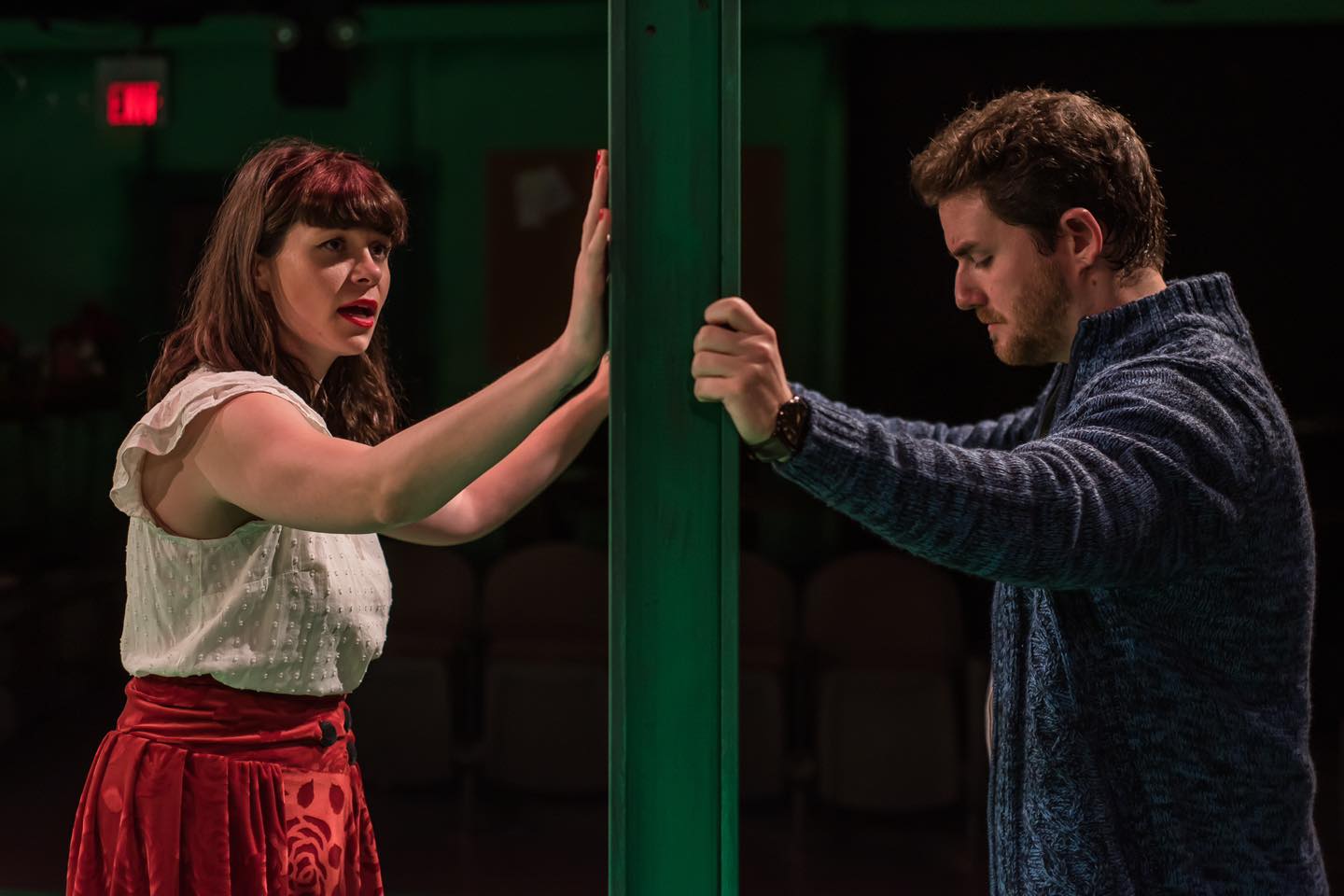
In the play, Abigail Williams (Jackie Mishol) becomes the ringleader of the girls who foment hysteria throughout the town, accusing their neighbors of witchcraft (a sin punishable by death in Ye Olde Salem Towne).  Once she realizes she can get away with her falsehoods, she goes after Elizabeth Proctor (Tamara Siegert), wife of John Proctor (Brett Santry Sullivan) for personal reasons. Abigail feigns possession to carry out revenge on her, because she covets Elizabeth’s husband.  The elder Proctor had a secret affair with his former maid and Elizabeth cast Abigail out of their household when she found out.

In one of the most humorous moments of the play, Reverend Hale (a gender-swapped Brooke Echnat) asks John to recite the Ten Commandments and he can only remember nine, conveniently forgetting “Thou Shall Not Commit Adultery.”

John convinces Mary Warren (Maddie Kocur)  into confessing to taking part in Abigai’s conspiratorial scheme to save the life of his wife, and Hale begins to see through the Deception. Unfortunately,  the Judge (Isaac Miller) has let things gone on too far – and it’s resulted in many deaths in the community – he refuses to believe he’s been duped. John is sent to the gallows in place of his wife. If he confesses to consorting with the Devil, he will be saved, but he, and Rebecca Nurse (Apryl  L. Peroney) can’t confess to crimes they did not commit.

Tamara Siegert as Elizabeth Proctor in Vigilance Theater Group’s “The Crucible.” Photo by Sean Collier.

Director Renee Rabenold makes great use of the setting, North Park’s Parish Hill Barn, to create an immersive experience. Before the play begins, the women frolic in the forest surrounding the creaky, old barn.  Its a masterful use of the area.  The audience becomes enveloped by the story as they move around the structure, from scene to scene.

Fair warning: Opening night it was 42 degrees and a section of the play takes place outdoors (though under a covered shelter in case of rain).

The cast elevated the material. While Miller wrote the story in the 50s, the players gave viscerally charged performances.

Mishol was hypnotic as Abigail. While the character is a villainous harlot who condemns her fellow villagers, Mishol finds a sympathetic core – a young woman scorned by her former lover, who suddenly finds power in her voice – even if she uses it in an diabolical manner.

Sullivan Santry brought a hefty gravitas to John Proctor, effortlessly spitting out swaths of difficult dialogue, seamlessly.

Siegert plays the much-put-upon spouse with aplomb. Her character has to agonize over moral decisions.

There were fantastic performances by the entire cast.

Dylan Marquis Myers as a vile and hypocritical preacher, Reverend Parris, and Miller as the pompous and preening judge who will not stop citizens from dying because it would make him look foolish. Michael McBurney’s Giles Corey gives an impassioned speech to save the life of his unseen wife. The actor’s eyes water when he realizes he is losing her to the whims of an insane court proceeding.

Many theater critics have seen multiple iterations of this timeless  (and unfortunately timely) tale, but this version of “The Crucible” stands out as one of the best, telling the tale in an exciting and fresh manner.

The entire Vigilance Theater Group should be commended for bringing “The Crucible” back to life at yet-another critical juncture in our democracy.

-MB


“The Crucible” runs from April 6 to April 16 in and around Parish Hill Barn in North Park. For more information, click Here.


Simply the Best – a review of “Tina: The Tina Turner Musical”

By Michael Buzzelli

Anyone who has seen the 1993 movie, “What’s Love Got To Do With It,” or read the 1986 autobiography, “I, Tina,” knows that the relationship between Tina Turner (Ari Groover) and Ike Turner (Garrett Turner) was tumultuous.  “Tina: The Tina Turner Musical” is an energetic, Cliff Notes version of the Queen of Rock & Roll’s triumphant rise to fame after her famous divorce written by Katori Hall (creator of TV’s “P-Valley) with Frank Ketelaar and Kees Prins.

The story starts at a massive concert venue in Brazil. Right before Tina takes to the stage, the self-proclaimed Baptist-Buddhist chants “nam-myōhō-renge-kyō.”

Flashback to young Anna-Mae Bullock (an amazing Ayvah Johnson) taking the lead in the church choir back in Nutbush, Tennessee. Her mellifluous-albeit- loud voice is  an embarrassment to her mother, Zelma (Rox White). Things between mother and daughter don’t improve. Zelma skips out on her husband (Kristopher Stanley Ward).  Then, her dad leaves. Anna-Mae moves in with her grandmother (Ann Nesby).

At sixteen, she was sent to St. Louis to live with her mom. Once there, Anna-Mae meets Ike and rechristens her Tina Turner (in a proprietary way – not yet in a legal way).

Things get rocky pretty fast, but the Ike and Tina Turner Revue keeps rolling (rolling) along on tour.  Until she can’t take the abuse anymore and flees with .36 cents in her pocket.

In her forties, Tina Turner has to reinvent herself once more. With the help of Roger Davies (Zachary Fereier-Harrison) she does just that, and the rest, as they say, is history…or, in this case, herstory.

Tina (Ari Groover) sings a string of recognizable pop songs and power ballads.

Groover isn’t Tina Turner, but she is setting her own star into the firmament. She rocks out with vivacious charm. Part of the gig is imitating a world-renown celebrity and its an intimidating gig. If you can separate yourself from the True Tina and take Groover for her own unique talent, you’ll have more fun.

Note: Lonnie the Theater Lady claims that the original Broadway cast was better, and that Adrienne Warren was Tina 2.0, looking and sounding like the iconic pop star.

We may not need another hero, but Groover is the hero(ine) of the national tour, moving and grooving for almost the entire 2 hours and forty-seven minute run of the musical.  She is phenomenal.

Garrett Turner (not to be confused with any of the original family members) plays a villainous Ike. Yes, there’s some nuance, but this is from Tina’s POV and not his. The Real Life Ike wrote a rebuttal to Tina Turner’s autobiography, “I, Tina,” in an autobiography titled, “Taking Back My Name.”

Zelma also gets very few nuance, but she is played with panache by White.

There’s a terrific cameo by Geoffrey Kidwell playing the notorious record producer Phil Spector.

For some reason, jokes in musicals are big and broad. Often,  the writers tend to pander to the lowest common denominator. Freier-Harrison is delightful as Roger Davies. He is able to transcend some of the cornier lines he has to utter with wit and charm.  When Davies meets Tina Turner for the first time, his reaction is joyous, continually telling her, “You’re Tina Turner!” As if she didn’t know.

“Tina – the Tina Turner Musical” is filled with pomp and circumstance. It revels in being over-the-top. Bruno Poet’s lighting design is flashy and exuberant. Jeff Sugg’s projection design adds additional layers to the show. In a powerful scene, Tina, on a cold, wet street in London, feels alone in the world. The lighting and projection go above and beyond to tug on your heartstrings, bathing the stage in deep blues and cold grays. The ensemble in dark coats and black umbrellas bustles around her.

The end is bright and beautiful. “Tina – the Tina Turner Musical,” proves, once and for all, that the rock legend is “Simply the Best!”

Additional note: Stay after the curtain call. Much like a real concert, the show continues after the cast clasps hands and bows.

-MB

“Tina” runs from April 4 to April 9 at the Benedum 237 Seventh Street, Pittsburgh, PA 15222. For more information, click here.

“Vintage POP!” – A review of American Pop Music

By Claire DeMarco

It was a pleasure and delight to spend last Monday evening, March 27th with Carole J. Bufford.

Note:  Okay, there were several hundred other people there, too!

Bufford wowed the audience at the O’Reilly Theater as she presented her “Vintage POP!” show as part of the Pittsburgh Cultural Trust’s Cabaret Series.

Carole J. Bufford getting jazzy. Photo Credit: Sarah Haley

Multi-talented with a wonderful singing voice and a big personality, she often incorporated a little dance or two while performing.  Bufford had a rapport with the audience that you could feel was genuine and the audience responded in kind.

“Vintage POP!” took us on a journey from the 1920s to the 1980s – years considered to be the prime years of American pop music.

Some of the songs included in the program had interesting stories behind them and Bufford enjoyed highlighting them. “Somewhere Over the Rainbow” was almost eliminated from the classic movie “Wizard of Oz.” Bei Mir Bist Du Schön started out as a Yiddish love song and was popularized by the Andrews Sisters, Lutheran siblings from Minnesota.

Bufford regaled us with a variety of songs from the 1919 “There’ll Be a Change in the Weather” through the decades to the 1980’s Tina Turner classic “The Best.”

Bufford is “simply the best.”

-CED

The Greer Cabaret Theater is temporarily closed for renovation. The next show in the Trust Cabaret Series is on Monday, May 8, 2023 at the O’Reilly Theater featuring Norm Lewis.  For more information, click here.

Southern Grit(s) – a review of “Steel Magnolias”

By Claire DeMarco

A big wedding is happening this afternoon in a small rural town in 1980’s Louisiana.

Truvy (Robyne Parrish) owner of a home-based beauty salon expects this day to be a bit busier than normal.

She just hired Annelle (Saige Smith) as an assistant and poor Annelle will be thrown head first into hairspray overload, giant rollers and ever churning hair dryers.

Note:  Those old dryers that look like space helmets!

Bride-to-be Shelby (Kyra Kennedy), her mother M’Lynn (Monica Wyche) and Clairee (Elizabeth Elias Huffman) are in various degrees of “hair care.”  Ouiser (Helena Ruoti) arrives late, in a bad mood from the get-go.

Note:  She will later claim that she’s “been in a bad mood for forty years.”

Conversation is centered on Shelby’s upcoming wedding, the preparations, the excitement, promises and hopes to come.

The seasons change, the beauty salon doesn’t.  The customers and friends are still there.

Shelby is married and has a new baby. M’Linn is concerned since Shelby is a diabetic and has been cautioned not to conceive.  A beauty salon is not only a social center for light conversation. It’s a gossip hub as well, where some secrets and discussions are best left at home (but aren’t).

Time passes and Shelby’s health worsens. M’Lynn, Truvy, Clairee, Annelle and Quiser provide the support, comfort, tears and laughter for dealing with life and its many ups and downs.

As the gum chewing, flashy dresser, Parrish shines as Truvy.  She is definitely the epitome of a Southern belle. She gives her opinions willingly, whether you asked for them or not.

We watch Smith transition from a backward, awkward new employee to an assertive and confident member of the group.

Truvy (Robyne Parrish) preps her hair before opening her beauty salon.

Elias Huffman captures the essence of a wealthier, more poised member of the group but one who interjects her verbal shots as well as her cohorts.

Kennedy is the perfect Shelby.  She’s positive, upbeat, forward looking in spite of her limitations.

Wyche portrays M’Linn as the ever-present concerned parent who has watched over Shelby for years.  She shows us how she adapts when Shelby determines her own destiny.

Ruoti is delightful as the ouchy, grouchy Ouiser.  She captures us the moment she hits the stage.  Hardly ever smiling and squinting like she just swallowed a lemon slice.  Ruoti subtly hints that there is a softness behind that façade.

You go Girl(s)!!!

Excellent production and so appropriate for Women’s History Month. Kudos to Director Marya Sea Kaminski.

– CED

 “Steel Magnolias” is a production of Pittsburgh Public Theater.  It runs from March 22 through April 9. For more information, click here.



Corny Antics from Pittsburgh to London – a review of “Serenade”

By Claire DeMarco

Tess Townley (Rachel Lewandowski) is a psychologist.  She is also a bit wacky, enthusiastic, prone to jump into situations where she often causes more problems than solutions.  Her friend and colleague, Owen York (Garrett Galcik) are great friends with York wishful that the relationship could be deeper. Owen refers to her as “I Love Lucy with a phd”.

Following the cries of a missing cat, Tess meets the cat’s owner, Englishman Terrence Wakefield (Sam Ruffino).  Time is as fast-paced as the play’s action and Tess and Terrence immediately fall in love with a promise to meet in London on Christmas Eve.

Tess interacts with a menagerie of different people as her journey to London progresses.

Religious Sisters Manchester – Terrier Vashon (Vivian Rose Ferris) and Chautauqua Thibault (Ellie Troiani) interact with Tess at the airport and on the plane.

Wink Shanahan (Benjamin Steffey), a well-known Cornhole Champion (and Tess’s brother-in-law) is also off to England for a large International Cornhole competition.

Note:  Wink is also on the same plane.

Does Tess meet up with Terrence in London?  Is there a happy ending?  What happens to the nuns and of course, Wink, our world class cornholer?

Lewandowski’s Tess is energetic and sometimes child-like.  She is especially funny as she gets stuck attempting to exit a window, legs and butt hanging and flailing frantically.

Galcik is convincing as the solemn, downtrodden, depressed professor.

Ruffino’s English accent is spot on, portraying Terrence as the typical steady Brit.

Ferris and Troiani work well together.  Troaini’s character plays the old school nun (with ever present ruler in hand) while Ferris represents the more modern, compromising nun.

“Serenade” is a buffet of corny, crazy actions as we follow Tess on her wild journey from Pittsburgh to London.

Note:  These antics are presented in an over-the-top frantic way that at times becomes a distraction.

The world-wide premiere of “Serenade” was written by Timothy Ruppert.

-CED

 “Serenade” is a production of the Red Masquers at Duquesne University’s Genesius Theater. It runs from March 23 through April 2. For more information, click here.

You’ve got a friend in Pennsylvania – a review of “Shantytown – The Ballad of Fr. James Cox

By Michael Buzzelli

A cynical reporter, Stephen (Joseph McGranaghan), sets out to expose a nationally known celebrity working in Pittsburgh, Father James R. Cox (Michael Fuller), only to realize the good in humanity in Ray Werner’s “Shantytown – the Ballad of Fr. James Cox – the Musical.”

If the plot sounds familiar, you may have seen “A Beautiful Day in the Neighborhood,” wherein a cynical reporter sets out to expose a nationally known celebrity working in Pittsburgh only to realize the good in humanity.  The biggest difference in the plot is that Father Cox was on the radio, Mr. Rogers was on TV, and “Shantytown” is a musical.

Despite the recognizable plot, Father James Cox was a fascinating historical character.  The  graduate of Holy Ghost College (now Duquesne University), he was the youngest priest to lead Old St. Patrick’s Church in the Strip District.  During the Depression, Cox  organized a food-relief program and helped the homeless and unemployed find shelter (i.e. creating Shantytown in the Strip). 

In January 1932, Cox led a march of 20,000 unemployed Pennsylvanians, dubbed “Cox’s Army,” on Washington, D.C to confront Herbert Hoover (J. Alex Noble in a variety of roles). The march sparked the Jobless Party, and Cox ran for president.  When his efforts failed, he backed Roosevelt who took the White House later that year.

The cast of Shantytown assembles on stage. Photo Credit: Mark Clayton Southers.

Making “Shantytown – the Ballad of Fr. James Cox” is an ambitious move. There are two really fun songs in the show, “Johnny, I hardly knew ye,” a traditional Irish ballad and famous anti-war song (versions of the song go back to 1867, but it became popular again in the 1970s to protest the Viet Nam war), and “The Haircut Song,” a humorous and original ditty about men kibitzing in the barber shop (delightfully sung by Sam Lothard and the cast). Lothard’s beautifully shiny head gets the biggest laugh in the show when he runs his hand over his bald pate and sings about the army barber cutting off all of his hair.

The cast does a great job with the material. In the chorus, the voices meld together mellifluously.  Despite the gloom of the Depression, the actors look like they’re all having a ball on the stage and their exuberance is contagious.

There’s a stand out performance by Dominique Briggs, who plays Catherine, Cox’s secretary and all-around right-hand-woman. Briggs electrifies the stage in every scene. She has a strong stage presence.

Another outstanding member of the cast is Michele Bankole who sings her heart out.  Pittsburgh stages need more Briggs and Bankole in the future.

There is, however, a weird and mostly unnecessary bit of shadow puppetry, literally and figuratively, hammering away at any subtleties in the show.  The play’s subject matter is so engaging, it doesn’t need shadowy reenactments of the lyrics to make a point.

Werner, best known in advertising for his song, “You’ve Got a Friend in Pennsylvania,” has picked a worthy historical figure to create a show about, Cox was credited with dishing out 300 million meals.

In the recent past of Pittsburgh productions, there have been a plethora of plays based on true-life characters Point Park’s “Men in Boats” about Powell’s expedition down the Colorado River, and the National Tour of “Six: The Musical,” about the six wives of Henry VIII. Now, “Shantytown” joins their ranks. In all cases, it might lead audiences to learn more about the historical shows these characters are based on. The life and times of Father James R. Cox is a worthy subject to take you down an Internet rabbit hole.

“Shantytown – The Ballad of Fr. James Cox – the Musical” gives us Hope (so much so there’s an entire song dedicated to it), and hope is always a good thing.

-MB

“Shantytown – The Ballad of Fr. James Cox” runs until March 26th, 2023 at the  Madison Arts Center, 3401 Milwaukee Street, Pittsburgh, PA For more information, click here

Border dispute – a review of “Native Gardens”

By Michael Buzzelli, an Irish Twin

Pablo (Juan Rivera Lebron) and his very pregnant wife, Tania (Evelyn Hernandez), are trying to lay down roots, literally and figuratively, in a swanky neighborhood in Washington, D.C., but their plans go awry when they meet their neighbors, Frank (Cotter Smith) and Virginia (Laurie Klatscher), in “Native Gardens,” by Karen Zacarias.

When the neighbors meet, the seeds of a friendship are sown. Things start off as friendly, even though generational differences, politics and and race seep through the cracks of their friendship like weeds on the sidewalk.

Frank prides himself in his almost award-winning garden (he keeps coming in second to an unseen enemy). He has meticulously maintained the green space with weed-killers and pruning shears. Tania, however, wants go wild, planting native species in her backyard, even though it will attract bugs and bees into the space. Pests that Frank has been desperately attempting to destroy to save his hydrangeas.  The central conflict between the neighbors is around twenty-two inches long. Frank’s garden encroaches into Pablo and Tania’s newly surveyed land and a dispute ensues.

Frank, a dyed-in-the-red-wool Republican, has unknowingly crossed the border into Pablo and Tania’s yard, and he tries to save his garden before the contest judges come by to declare it a winner. Pablo and Tania, however,  are trying to get their backyard fence up in time for a garden party with Pablo’s law firm.

Tensions mount and the backyard brawl begins to escalate, a war of words and petty battles begins (a cigarette butt becomes the butt of a joke in their skirmish). While their opinions are quite contrary, their gardens grow!

Photo credit: Kristi Jan Hoover

Zacarias adds complexity to a simple story about a land dispute between neighbors. It’s sharp and witty, but it’s text and no subtext. Everyone says and does exactly what their thinking. While it takes on some very substantive issues in a humorous way, it hammers them down hard like the stakes in Pablo’s new fence.

The acting is superb. Marc Masterson does another outstanding job directing, letting the cast blossom in their own vibrant colors.

Hernandez is a delight as the soon-to-be mom Tania.  She’s strong and forthright without ever being a pest.

Frank’s crotchety old man is a trope, but Smith gives him nuance and vulnerability. Smith lands some  great silent gags as he putters around in his garden, germinating on revenge.

Klatscher’s Virginia is so immensely likable, even when she tries to be the bad seed, sewing chaos by summoning a lawyer (Maame Danso in a silent cameo) to produce a cease and desist.  Virginia is  lovably awkward thanks to Klatscher’s charm.

Rivera Lebron is no wilting flower, but his costars get more time in the sun.

All of the elements align in perfection in this production.

Tony Ferrieri isn’t your garden variety scenic designer.  He creates another stunning set. Half of the set is Frank and Virginia’s pristine yard, and the other is Pablo and Tania’s more rustic space. The large oak, a plot point in the play, looms majestically over the set.

Paul Whitaker’s lighting design brilliantly sets the time of day for each scene.

The show is about  a minor grievance between neighbors, but in the end, compassion wins. Love wins (even for Frank and Virginia’s off-stage son).

The characters are all likable and their arguments valid. “Native Gardens” makes a strong point about seeing past our differences and being human beings together.  It’s the petty squabbles that crop up on our garden path. What better way to break down barriers – than through laughter?

“Native Gardens” is not an easy plot to hoe, but it’s an important idea to cultivate.

-MB

“Native Gardens” is planted at the City Theatre, 1300 Bingham Street, Pittsburgh, PA 15203, until April 2. For more information, click here


A Grand Adventure – a review of “Men in Boats”

by Michael Buzzelli

In 1869, Civil War veteran John Wesley Powell (Haley Holmes) was appointed to President  James A. Garfield to take  a group of men on  an exploratory mission down the Colorado River and through the Grand Canyon (as it would be named later). Playwright Jacklyn Backhaus delves into Powell’s journals  of that fateful expedition in a bright, imaginative way in “Men in Boats.”

First, there are no men in “Men in Boats.” The cast is made up of women and non-binary actors.  It is the single most fascinating thing about the play.  Gender doesn’t matter.

The men in the boats were Jack Sumner (Isabella Duran Shedd), William Dunn (Chloe Chamberlin), Walter “Old Shady” Powell (CG Squire), the Howland Brothers, Oramel (Esther Lee) and Seneca (Ariela Pineda Salgado) among others.

They journeyed on boats that the group named “Emma Dean (after Powell’s wife),” “Kitty Clyde’s Sisters,” “Maiden of the Canyon,” and “No Name.”

While Powell professes brotherhood, we quickly learn that brotherhood is not a noble tie that binds all human hearts and minds. Many of the men are seeking fame or glory, particularly William Dunn . There relationship is contentious, but it is Frank Goodman (Hattie Baier) who is the first to abandon the mission.

Additional Historical side note: When the Howland’s leave with Dunn, they name the point of departure Separation Canyon.

Archive photo of one of Powell’s boats.

While the subject is serious, “Men in Boats” is a delightful little trip. It’s a playful reimagination of historical events. Backhaus’s script is sharp, but a little too repetitious. While I wasn’t rooting for any of the men to die, boredom crept in as they continued to survive every deadly encounter.  Their continued survival sucked the suspense out of the show. Any deaths that may have actually occurred happened off stage.

Side note: It’s possible that some of the explorers were killed by the Shivwits band of Paiutes, a native American tribe who believed that Powell’s men were encroaching on their terrority.

The acting is superb.  Cheers to the entire ensemble. Sha Cage’s direction is frenetic, exciting and fun.

Holmes is terrific as the leading person. Like the real Powell must have been, you can see the gleam in their eye at each new discovery, their steadfast determination.

Goodman, an Englishman, is the butt of a few of the jokes. The character has a lovely little monologue about retreating to Provence, France, and Baier’s accent is spot on, old chap!

A good deal of comic relief comes from the cook, Hawkins (Kaitlyn Hare), who delivers her lines like Hawkins doles out biscuits – with flair.

Under Backhaus’s writing, each personality shines. The men in the boats are very different from each other. Adventure, however, works better in films than on stage.

Daniel Allen’s scenic design is brilliant. There’s a small tributary around the set, a two inch gulley of water surrounding a long island. Propped up on the island are the remnants of the boats. On one end of the theater space there is an immense rock wall expertly lit in crimson hues by Madelyn Miessmer.  Strewn about the stage are Cedar Sage Ellwood’s very authentic looking props.

While there are flaws in the script, Point Park’s production of “Men in Boats” is well crafted, and it’s an amazing exploration of history told in  a unique way.

– MB

“Men in Boats” runs from March 15 – 19 at the Highmark Theatre, In the Pittsburgh Playhouse, 350 Forbes Avenue, Pittsburgh, PA 15222. For more information, click here

Yaaaasss, Queen – a review of “Six”

By Michael Buzzelli

The six wives of Henry VIII rap battle for dominance as they sing their story in modern parlance in  Marlow and Moss’s “Six the Musical.”

Think: A distaff “Hamilton” across the pond.

Things aren’t so merry for these wives of Windsor. Henry divorces two of them, and decapitates two more. They are, in chronological order:

Divorced: Catherine of Aragon (played on opening night by Jana Larell Glover) has a  divorce is so messy that England leaves Catholicism behind and forms the Church of England.

Beheaded: Anne Boleyn (Zan Berube) has her head cut off for being as sexually free as her hubby. While Henry wanted a son, Anne’s daughter goes on to get a whole era named after her.

Died: Jane Seymour (Amina Faye)  is not “Dr. Quinn, Medicine Woman,” but the O.G. Jane.

Divorced: Anna of Cleves (Terica Marie) was the only queen to live in luxury after her marriage to the monarch ended.

Beheaded: Katherine Howard (Aline Mayagoitia) may or may not have had an affair with her cousin Thomas.

Survived: Catherine Parr (Sydney Parra) is the only one to outlive the king.

Though he was famous/infamous historically, he was not a popular king when he was on the throne, and these ladies set out to prove it.  While there were seven Henry’s before him, Henry VIII was such a royal pain that there were no kings named  Henry after him.

The six queens of “Six the Musical.”

The story of the regal dames isn’t really a story, just a song about each of them.  Technically, “Six the Musical” is more of a musical revue than a musical, but it, literally and figuratively, dazzles.   The six stars, each getting equal time to shine, are amazing.

Glover (who replaced regular Catherine, Gerianne Pérez) was spectacular. You won’t regret getting “stuck with the understudy” as you would with some shows.

The six are backed up by a glorious band banging drums and strumming guitars on a rock concert stage by scenic designer, Emma Bailey.

Gabriella Slade’s costumes are to die for. They sparkle with bling. It won’t be long before a drag queen bedazzles up Catherine of Aragorn’s gold lamé bodice and struts around dahntahn.

The show is energetic and fun, and it’s also short (under 90 minutes with no intermission) with top-of-the-line production values.

There’s an interesting side effect: It may cause you to look up the actual histories of the queens of Henry VIII, or, at the very least, cause you to get out of your chair and dance.

-MB

“Six” runs till March 19, 2023 at the Benedum Theatre, 237 Seventh Street, Pittsburgh, PA 15222. For more information, click here.

There’s Only One Today – a review of “Once”

By Claire DeMarco

Guy (David Toole) is a singer/lyricist living in Dublin.  He strums his guitar and sings to passersby, hoping to catch a few euro in his open guitar case propped beside him.

One of those passersby is Girl (Kate Queen), a Czech citizen separated from her husband.  Working close by she hears and enjoys his music and begins a conversation with Guy.

Guy and Girl have something more in common than their mutual love of music (she plays the piano).  He sells sweepers to support himself and she has one that needs repaired.

Note:  There’s obviously a vacuum in their lives!

In order to pay for the sweeper repairs, Girl decides she’ll play piano for him in the piano store owned by Billy (Jack Boice).

As their music binds them closer together, Guy confesses that his former girlfriend left him and is now in New York.  The lyrics in his songs reflect that despair.

It’s apparent to Girl that Guy does not have any confidence in himself or his music so she becomes his biggest cheerleader.  Full of life she prods him into taking chances.  Through her encouragement she pushes him to make a CD of his works and contact a local bank for funds to help promote his songs.  The money also provides a means to get to New York (possibly to his ex-girlfriend).

Guy and Girl make several suggestions as to how their lives will proceed, with or without each other.   Does Guy go to New York?  Does Girl reconcile with her husband?  Do we even know for sure?

David Toole sings and strums a guitar as Guy. Photo credit: Matt Polk

Toole plays a perfect Guy.  He develops his character from the rather shy, dejected soul into one who grows exponentially as he regains lost confidence and sets future goals.  His guitar playing and vocal presentations are spot on.

Queen shines as the Czech immigrant who is assertive, opinionated and bold.  She also brings out the soft side of Girl.   She is a skilled pianist with a lovely singing voice.

Both Toole and Queen provide a tender rendition of “Falling Slowly”.

Boice provides both serious and comedic moments.  His characterization of Billy fluctuates between loud mouth anger to silly mannerisms and funny moments.  Proud of his bit of Spanish ancestry, he often invokes the physical movements of a Spanish dancer in response to a question or comment.

It is the music itself from the entire cast that is the heart of “Once”.  All of the actors play an instrument, dance and sing to perfection.  It is amazing that these musicians are able to play their instruments, dance while playing, all in unison.

Note:  It is especially fascinating to see the cello player with the other musicians as they all lift their instruments up while playing and dancing at the same time! Kudos to Music Director Dr. Francesca Tortorello.

A wonderful production of a Tony award winning musical!

Once is at Pittsburgh Musical Theater’s Gargaro Theater, 327 S. Main St., West End, March 9-April 2. For tickets and info click here

css.php