

Truth or Consequences – a review of “Game On”

Mike Buzzelli

By Michael “Buzz” Buzzelli, ‘Burgh Vivant

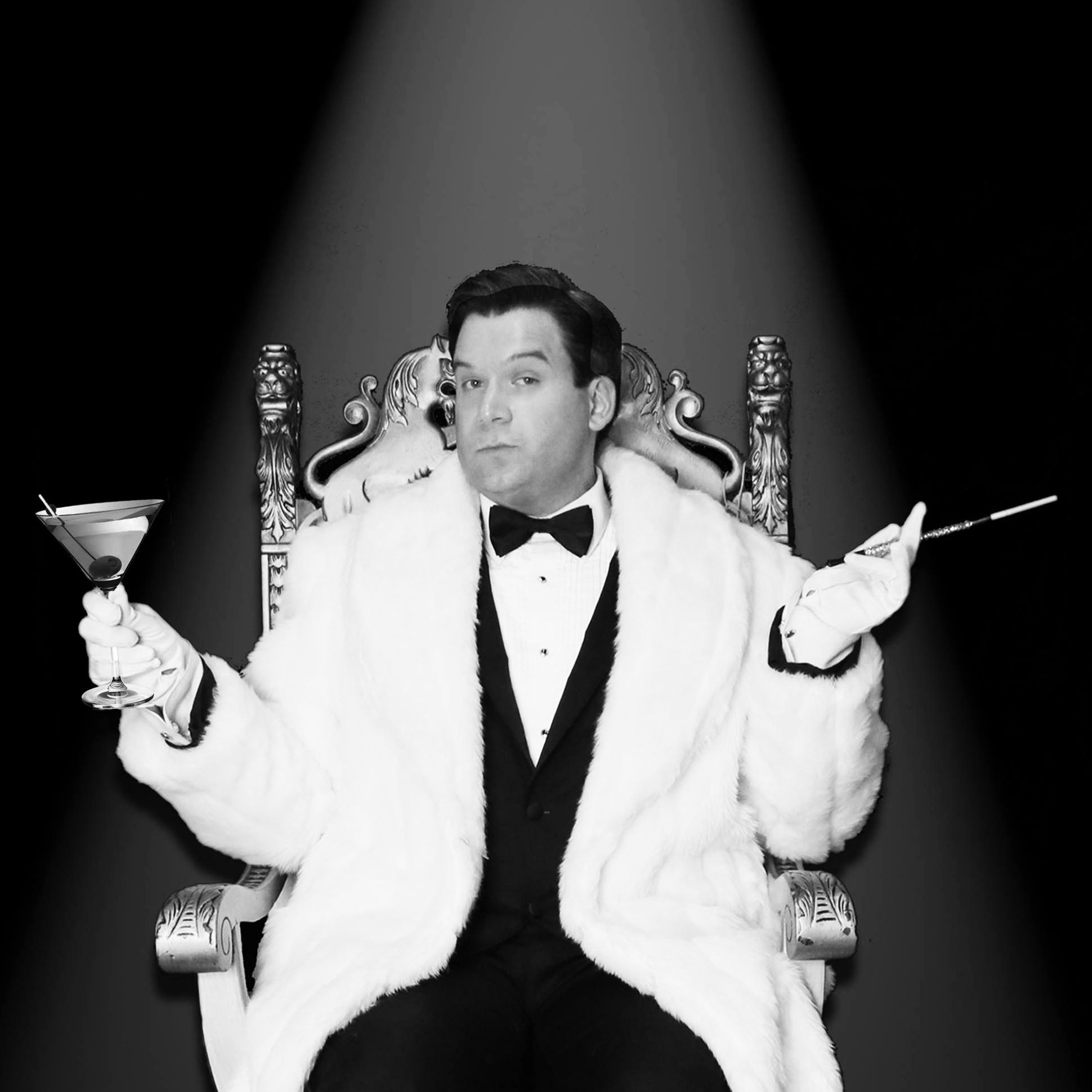
Monty Price (Jason Shavers) welcomes contestants to the anniversary episode to everyone’s favorite game show in “Game on.” It’s okay if you’ve never heard of “Game On” before, it’s an imaginary anniversary for a fictional TV show.

It’s not easy to describe the show in 25 words or less. It’s sort of “Let’s Make a Deal/or No Deal,” with a little bit of “Family Feud” thrown in just for the hell of it.

Like the Howie Mandel hosted show, there are a variety of numbered mystery boxes, each containing a prize from a penny to a million dollars. Monty’s beautiful assistant, Gillian Van Ness (Marissa Buchheit) opens the boxes on command. The player must decide to keep his/her box or trade it in for some bigger prize negotiated by the Banker…er…um…Executive (a silhouette of a beautiful woman in a smart pantsuit).

The prize is usually one million, but, on this special anniversary episode, the Executive decides to up the ante to TEN MILLION DOLLARS! Gasp!

While there is some interactivity to the evening, it’s a scripted show with a book by Marcus Stevens and music by David Dabbon. These contestants have to carry the tune, not name it. Luckily, three of the four contestants are actors.

The contestants are schlubby, worrywart Felix (Connor McCanlus), decisive and forthright Natalie (Josey Miller) and newly retired Grace (Christine Laitta). As for the fourth contestant; it could be you!

While Natalie and Felix are chosen from opposite ends of the room, we learn that the duo share a past. The two have baggage. During the show, their past unfolds. The couch potatoes were once lovers who bonded over their love of “Game On.”

Grace also has a secret.

As the show goes on, the Executive raises the stakes and things get weird. Things go from typical game show shenanigans to a million dollar mind game.

Who will win? Will Natalie and Felix reignite the fire between them? Will they make a love connection, or does Felix just have a candy crush?

There will be only one survivor.
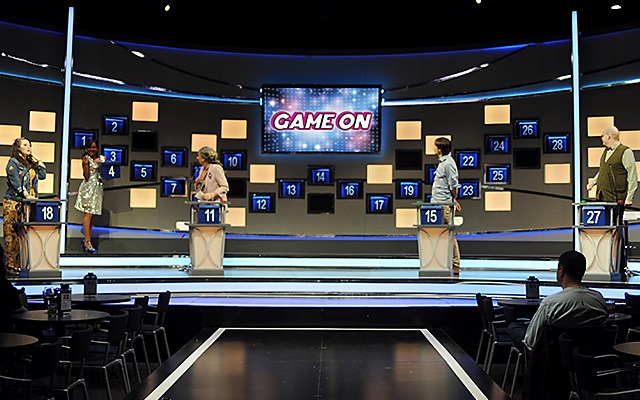
From left to right: Natalie (Josey Miller), hostess Gillian (Marissa Buchheit), Grace (Christine Laitta), an audience member, and Felix (Connor McCanlus).

The actors are magnificent. Shavers plays Monty as the quintessential game show host, with a nod to Chuck Woolery and a wink to Wink Martindale. As the show goes on, Monty gets grouchier than Groucho, but Shavers remains charming.

Buchheit is buoyant and adorable as Gillian Van Ness, earlier in the evening Buchheit shows up as a contestant from the previous episode, Deborah, and she’s and even bubblier and bouncier.

McCanlus does a superb job as Felix. He gets most of the evening’s laughs with his indecisive character, wringing his hands as he tries to decipher the clues Natalie is dropping as he tries to win the game. You can almost see the flop sweat from the back of the room.

Miller’s Natalie is a lot of fun. Of the three scripted contestants, she seems like the one you’d most want to grab a beer with.

Laitta’s Grace is reminiscent of a Rachel Dratch SNL character. Laitta gives the performance oodles of depth.

Director Jen Wineman perks the show up with some really skillful choreography, especially in the number “I Want It.” The cast executes said choreography wonderfully.

Tim Mackabee’s set is dazzling, enhanced with lighting from Alan C. Edwards. It looks like an actual set from a million dollar game show.

Christian Fleming’s costume design is artful and fun, from every button on Natalie’s jean jacket down to the Monty Price’s fabulous footwear. If the Wicked Witch of the East had workout clothes, Shavers’ sparkly kicks would be in her gym bag.

To tell the truth, “Game On” isn’t as funny as it could be. The actors are great, but the writing is… the weakest link. While it is funny, I was hoping “Game On” would try harder to make me laugh, but no dice.

Dabbon’s idea, a musical about a game show, is brilliant. It’s just not executed as well as it could have been. One or two more catchy songs and a bit more wit would have made this show a blockbuster. Luckily a talented cast, a smart director and a gorgeous set keep “Game On” from being a wipeout.

-MB

You can get your “Game On” at the Greer Cabaret Theater, 655 Penn Avenue, Pittsburgh, PA 15222. For more information, click here.



The Dickens you say  – a review of “The Old Curiosity Shop”

Mike Buzzelli

By Michael “Buzz” Buzzelli, ‘Burgh Vivant

A gambling grandfather (Patrick Conner) loses everything except the love of his granddaughter, Little Nell (Caroline Lucas), in Charles Dickens’s “The Old Curiosity Shop.”

Mrs. Jarley (Kendra McLaughlin) and her carnival barkers (Jonathan Visser and Ken Bolden) describe the tragic circumstances of Nell’s life, briefly narrating her tale.

Through our whimsical narrators, we quickly learn that the grandfather is on the verge of losing his shop to the sinister Mr. Quilp (Martin Giles) playing poker after dark (way before Jennifer Harman, Phil Laak and Daniel Negreanu made it cool).

Quilp wants the shop, the money and the granddaughter. It’s a sick package deal. Quilp is dark and twisted (physically and emotionally) and pines lustfully for the fourteen-year-old Nell. Let’s face it, this dude is creepy.

Quilp is often seen in the company of his lawyer, Brass (James FitzGerald) and a ragamuffin he simply calls Boy (Matt Henderson).

The grandfather has very few allies. His grandson, Nell’s brother Fred (Sean Lenhart), is after his nonexistent money. The grandfather and Nell only have the extremely loyal shop boy, Kit (Jacob Epstein), to count on.

When Fred is convinced his grandfather can’t help him, he confides in his best friend, Dick Swiveller (Jordan Ross Weinhold), that he has to leave town to escape his creditors.

The grandfather and Nell also flee in the middle of the night to escape Quilp’s clutches, but the villain does not give up easily. He begins his manhunt…er…um…girl-hunt. The vile man moves people around like chess pieces. He gets Dick Swiveller to a job working for Brass and his sister Sally (Karen Baum) in case Nell contacts him.

Meanwhile, Kit gets a job working for the law firm of Garland (Visser) and Witherden (Bolden), but Quilp finds a way to manipulate Kit with his treacherous underlings, Brass and his sister.

Out on the road, the old man and his granddaughter face all sorts of calamity. Luckily, a landlady (Kaitlin Kerr) takes them in. They are befriended by a schoolmaster (Sean Lenhart) who employs them as caretakers to the property surrounding his school.

All the while, Quilp gets one step closer to his prey.

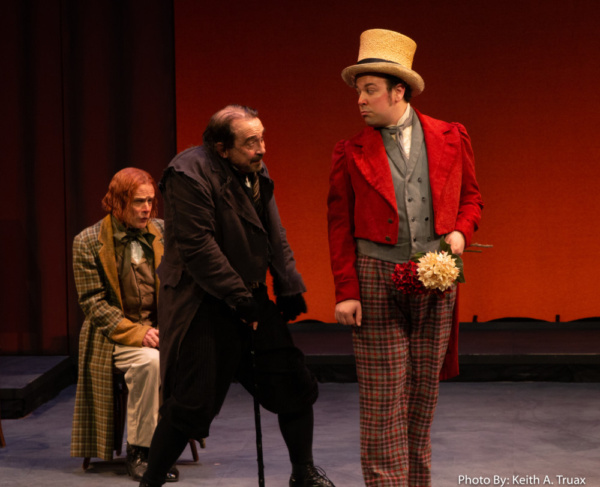
From left to right: Brass (James FitzGerald) cowtows to his boss, Quilp (Martin Giles) while chatting with the aimable Dick Swiveller (Jordan Ross Weinhold). Photo credit: Keith A. Truax.

“The Old Curiosity Shop” is filled with plot and character. There’s a lot going on. While it’s a lengthy show, it’s never tedious. It’s chock full of Dickensian wit and charm.

The cast is magnificent under Alan Stanford’s guiding hand.

Giles romps around as the villainous Quilp. There’s a glint in his eye as he beats back the Boy with a cane and slobbers over young Nell, relishing in his dastardly deeds. It’s a grand performance.

FitzGerald and Baum are incredible as the Brass siblings. FitzGerald’s Brass strongly correlates to our contemporary times. He’s Cohen to Quilp’s Trump, devilishly sycophantic until the worm turns and he is caught. Baum’s Sally is basically an Ebenezer Scrooge without the redemption.

Side note: There’s a prevailing theory that the nameless handmaiden, the Marchioness (Calema Graham), is the illegitimate offspring of a devious union between Sally Brass and Quilp. It’s icky enough to be true (as true as anything in this fantastical tale).

While the villains attempt to steal the show, there are some amazing turns among the heroes and those who live in the lines between good and evil.

Weinhold’s comic timing is impeccable. When Dick Swiveller has the unfortunate assignment of describing an apartment, he says, “They are very charming apartments, sir. They command an uninterrupted view of – of over the way, and they are within one minute’s walk of – of the corner of the street.”

Epstein’s Kip is marvelous. The young lad holds his own amongst a bevy of Equity actors. He is charming and charismatic.

Visser and Bolden do a remarkable job with their multiple roles, each, literally and figuratively, wearing many hats.

Joan Markert’s costumes are flawless. She captures 1850’s London raggedy and sooty style with an artistic flair.

The Christmas season is upon us, but, instead of seeing the same old Scrooge, mix up your Dickens a bit and go to “The Old Curiosity Shop.

-MB

“The Old Curiosity Shop” runs through December 15 at WQED’s Fred Rogers Studio, 4802 Fifth Avenue, Pittsburgh, PA 15213. For more information, click here.


Variations and Fugue – a review of “Coram Boy”

Mike Buzzelli

By Michael “Buzz” Buzzelli, ‘Burgh Vivant

After a dispute with his father, a talented young composer and singer, Alexander Ashbrook (Sophie Aknin), runs away to pursue a musical career in Helen Edmundson’s adaptation of Jamila Gavin’s “Coram Boy.”

Alexander is a happy child. He spends his days and nights in the choir at the Gloucester Cathedral, composing music in his off hours and hanging with his bestie, Thomas Ledbury (Mei Lu Barnum). His father, Sir William Ashbrook (Chris Knudsen), however, thinks it’s time to put away such childish things and become a man.

During a performance in front of his family and friends, his voice cracks and young Alexander becomes a man (Kyle Irish-Gorvin). He falls for the governess’s daughter, Melissa (Alysia Vastardis) and they do what young people in fresh out of puberty often do. Boom Chicka Wow Wow.

Unable to comply with his father’s wishes, Alex flees the family estate and runs away. His father scratches his name out of the family bible. Gasp!

However, he left Melissa with an unexpected consequence of their brief encounter (the unitended result of said puberty).

Meanwhile, the devious Coram Man, Otis Gardiner (Mike Mekus), takes unwanted children from hapless mothers and buries them (dead or alive) for a price. He tells them that the children will be cared for at the well-known Coram Hospital (for wayward children). Otis accomplishes his wicked deeds with the aid of his own indentured servant and son, Meshak (Daniel Murphy).

Melissa gives up her newborn to the housekeeper, Mrs. Lynch (Blake Doyle), who is in cahoots with the Coram Man. Otis commands Meshak to dispose of the baby. Meshak runs away with the child.

Several years later, an orphan, Aaron Dangerfield (Sophie Aknin in a dual role), ends up in a choir with the same desire to pursue a musical career.

A famous composer, George Frideric Handel (Michah Stanek) discovers the child’s talent and brings him to be tutored by Thomas Ledbury (now played by Tommy Bo).

Alexander Ashbrook, now living under a nom de guerre, reunites with Thomas and meets Aaron, unaware that the boy is his son. Dunt dunt da!

But wait! There’s more! Aaron’s best friend, Toby Gaddarn (Zetra Goodlow) is taken in by a dastardly slave trader (who may or may not be someone from Alex and Melissa’s past). And, for some reason, there are angels (Augustine Ubannwa and Tyquan White) flying about.

It’s difficult to pick a central character or theme to the show, because there isn’t one. There is no central POV (Point of View) and myriad plotlines go off of their own accord much like the aforementioned angels.

The play is very long. Toby’s storyline started midway through the second act. It was the “Look down at the watch moment.” There was, however, no kitchen sink in the play, but it felt like the only thing missing.

Frankly, it’s hard to imagine why Edmundson gathered numerous Tony nominations for this adaptation.

Director Tome Cousin does garner some fantastic performances out of his actors.

Murphy does a stellar job writhing around as the tortured Meshak. Think of him as a quasi-Quasimodo – – without the spinal malformation.

Aknin does a spectacular job as both young Alex and Aaron.

Mekus is reprehensible villain. He pulls it off, despite his boyish good looks. Doyle’s Mrs. Lynch is delightful as the unscrupulous maid.

There are some great but tiny performances from Blumethal, Barnum and Goodlow, and Stanek’s Handel is a hoot.

“Coram Boy” is not a musical but a play with music. It’s a fine distinction. No one bursts into song unexpectedly, but the number one reason to see the play would be for the choir. They are heavenly.

-MB

“Coram Boy” runs until December 2 at the new Pittsburgh Playhouse, 350 Forbes Avenue, Pittsburgh, PA 15222. For more information, click here.


Walk the Line – a review of “Sweat”

Mike Buzzelli

By Michael “Buzz” Buzzelli, ‘Burgh Vivant

After eight years in prison, two ex-convicts return to their hometown of Reading, PA, and face the consequences of their actions while trying to pick up the pieces of their former lives in Lynn Nottage’s Pulitzer Prize-winning play, “Sweat.”

Two childhood friends, Jason (Patrick Cannon) and Chris (Ananias J. Dixon) have followed completely different paths in prison. Jason has covered himself in Nazi images, including a Swastika tattoo that blankets half his face, from his forehead to his chin. Chris found Jesus in lock up and carries a small, leather bible everywhere. Both men meet with their parole officer, Evan (Monteze Freeland) and discuss life outside the penitentiary.

Chris and Jason’s lives diverged, but they share a common past. “Sweat” flashes backward to let their mutual past unspool, slowly, methodically.

Eight years earlier. Three women, Cynthia (Tracey Conyer Lee), Tracey (Amy Landis) and Jessie (Michelle Duffy), hang out at local bar after finishing their shifts at Olstead Steel Tubing, a steel mill. The ladies get together to gripe about the job, even though it’s the best paying gig in town. Between beers, Cynthia spends time arguing with her ex, Brucie (Kevin Mambo).

The bartender Stan (Tony Bingham) relentlessly flirts with Tracey, but she doesn’t take the bait. Jessie gets too drunk, and the bar back, Oscar (Jerreme Rodriguez), polishes the tables quietly in the background. It seems like a series of regular nights in small town America  – until the plant begins laying off its employees.

Meanwhile, Cynthia gets a management position, right before the lay-offs begin, and racial tensions balloon like subprime mortgages.

Hint: Racism, sadly, has never really gone away. It just festered underneath everything like cancer, destroying everything in its path.

“Sweat” examines the 2016 election through a tiny microcosm in an American bar – a tempest in a shot glass. The play is a treatise on how the USA began falling apart when corporations busted unions and moved jobs to Mexico.

Why did Jason and Chris go to jail? Sorry. The captain has raised the spoiler shield. The gory details will not be revealed in this review.

Caption: (left to right) Stan (Tony Bingham), Cynthia (Tracey Conyer Lee) and Tracey (Amy Landis) discuss the circumstances of the lock out at Olstead Steel Piping.

Nottage wrote a whip-smart script, but the plot is a slow burn with a fiery climax and a coal black ending. Each character gets a storyline, but the play never feels crowded or disjointed. It is, however, very confusing. Patient audience members will be rewarded.

Director Justin Emeka has an excellent cast sweating on stage. While the ensemble is terrific, there are several stand outs.

Landis is brilliant. Her character, Tracey, is a maniac. Seriously. She’s a Steeltown girl on a Saturday night looking for the fight of her life. And, boy, does she gets one!

Cannon is explosive as Jason. When he first wanders into the bar in the flashback, he’s infused with boyish charm. But as his circumstances change, he becomes more and more bitter and jaded. He smolders in his ex-convict scenes.

Conyer Lee is magnificent. She gets a lion’s share of the story as Cynthia goes from working class woman to management and elsewhere.

Bingham is amazing. He transforms himself in the final scene of the play (spoiler shields are still engaged).

Dixon is walking around with some kind of young Forest Whitaker energy, and, that, my friends, if a very good thing.

All the action takes place on an exquisite swiveling set by Michael Schweikardt. There’s very effective lighting and sound design by Sherrice Mojgani and Zach Moore respectively.

Milquetoast warning: “Sweat” is not for the faint of heart. It is violent and laced with profanity. If you have to cover your eyes for the squeamish scenes or cover your ears for the dirty words, it’s worth it.

P.S. Don’t be fooled by the play’s title. The theater is actually quite chilly. Bring an extra sweater.

“Sweat” runs until December 9 at the O’Reilly Theater, 621 Penn Avenue, Pittsburgh, PA 15222.

For more information, click here.


Rumor has it – a review of “Much Ado About Nothing”

Mike Buzzelli

By Michael “Buzz” Buzzelli, ‘Burgh Vivant

Huzzah! The war is over and Beatrice (Sarah Kwiatek) and Hero (Emily Peifer) learn that a phalanx of soldiers are returning to Messina to celebrate their victory in William Shakespeare’s “Much Ado About Nothing.”

Hero has her eye on Claudio (Adam Nie), but Beatrice can’t be bothered with the affairs of the heart. She does not wish to marry, but she does enjoy sharpening her wit and verbally sparring with Claudio’s friend, Benedick (Brenden Peifer).

The wooing commences and Hero and Claudio are quickly engaged. Both of them want to rush into the wedding right away. They’re so enamored of one another that the happy couple wants to spread the joy by getting Beatrice and Benedick hooked up.

Meanwhile, Don John seeks to make malignant mischief with his accomplices, Borachio (Joe McHugh) and Conrad (Robert Pell). Don John plans to thwart Claudio and Hero’s wedding by pulling a horrible stunt. Barachio goes to Hero’s window and romances Margaret (Madalyn Lenahan), Hero’s chambermaid. Don John convinces Claudio and Don Pedro (Jahir Christian) that Hero is unfaithful and entertains a man…even the night before the wedding.

Claudio falls for Don John’s evil plot and breaks it off with Hero at the wedding!

Spoilers: Dogberry (Meg McGill), Verges (Diane Brunke) and the night watchmen (Nico Bernstein and Zev Woskoff) overhear Borachio brag about his nefarious deed.

Things get even crazier, but all’s well that ends well. Whoops! Wrong play.

The Stephen Foster Memorial Theater is adorned with a handcrafted sign.

The problem with “Much Ado About Nothing” is that it has two distinct plotlines that don’t seem to mesh well. Shakespeare tells the A story and then the B story – instead of weaving the two storylines together.

Also, there’s a lot of dancing and singing that fills up the time. The Bard also teases us with a sword fight between Claudio and Benedick that never happens. Where was Anton Chekov when you need him?

Brenden Peifer, however, gets some terrific moments riffing with the audience. Peifer is exceptional as Benedick. He plays the role with the right amount of brazen vanity and boyish charm.

He is evenly matched with Kwiatek’s Beatrice. Beatrice and Benedick get some of the best lines in the play.

McGill is hilarious as Dogberry. She is delightful, especially when hearing her lament, “Oh, if only the sexton had recorded that I’m an ass!”

McHugh’s Borachio gets the best of her character every time and it’s a joy to watch him verbally catapult over her head.

Honorable mentions to Bernstein and Woskoff. While they don’t have very many lines, they have oodles of comic chemistry.

Scenic Designer Gianni Downs does a marvelous job with the multi-tiered Messina; a stately Italian villa with sun dappled waters off in the distance. It looked gorgeous at sunset and dawn – thanks to Lighting Designer Steven Yates.

Despite some terrific talent on a beautiful stage, “Much Ado” seems overly long. Director Victoria Rhoades could have tightened up the running time by trimming out some of the singing and dancing.

If nothing else, “Much Ado About Nothing” will certainly provide much needed laughs. And we always need more laughter.

-MB

“Much Ado About Nothing” runs till November 18, 2018 at the Charity Randall Theatre, 4301 Forbes Avenue, Pittsburgh, PA 15213. For more information, click here.


The Haunting of Row House – a review of HOLLOW MOON, Vigilance Theater Group

Mike Buzzelli

By Michael “Buzz” Buzzelli, ‘Burgh Vivant.  

Strangers gather in a venerable and stately house on a hill (at an undisclosed location in hipster Lawrenceville). The enigmatic Jack Warrington (John Feightner) has called together this motley crew to play a deadly, little parlor game in Sean Collier’s immersive theater experience, “Hollow Moon”

Warrington’s guests include a Tarot card reader, Theodora Court (Lee Lytle); ghost hunter, Dr. Cedric Montague (Michael McBurney); gruff mystery man, Luke Hollywood (Tyler Ray Kendrick) and flustered flibbertigibbet, Eleanor Abbot (Ashley McKinney). If the names sound familiar, you might recognize them from Shirley Jackson’s gothic horror novel “The Haunting of Hill House.” “Hollow Moon” is an homage to Jackson’s spine-tingling story.

In “Hollow Moon,” Each of four strangers has a surreptitious connection to Warrington, but what happens next is a mystery. Whether this pot-boiler simmers or bubbles over, depends largely on the audience, because the audience are active participants in the show. Each audience member can contribute to the story as much or as little has he/she chooses.

It’s not your typical Choose Your Own Adventure/Murder Mystery/Ghost Story. Can such a genre-bender even be typical?

There’s a big reveal that can’t be spoiled, but – let’s just say – there’s also a disturbing reference Jackson’s short story, “The Lottery.”

Eleanor (Ashley McKinney) recounts her ghost story while a mysterious visitor (Karen Forney) lurks in the background. Photo credit: Renee Rabenbold

Collier has written a tight script, but there are chances for the actors to go in several different directions. It’s tautly directed by Renee Rabenold.

The cast (including Karen Forney in a secret role) is terrific.

Kendrick is masterful as Luke Hollywood. He’s a dynamic actor. It’s easy to get swept up in the story as he tramples around the house, looking for some secret that can help him escape his fate.

McKinney is a joy. She is deeply immersed in the immersive experience. She effortlessly blurs the line between fact and fiction and you begin to believe her plight.

Feightner is maniacal as Warrington. He is larger-than-life in his cameo role.

There are very fine performances by McBurney and Lytle, and spooky special effects by Aaron Tarnow (he’s credited with technical direction, set design and artistic design).

Vigilance Theater Group is new to Pittsburgh’s burgeoning immersive theater scene, but they hit the ground running with their first show, “Hollow Moon.”

If you venture out to “Hollow Moon,” you will get one warning, that will sound a lot like a non-sequitur from Suzanne Collins’ “Hunger Games” YA novels, “May the odds be in your favor!”

– MB

For more information about “Hollow Moon,” head over to Vigilance Theater Group’s website here.

Rage against the machine: a review of PIPELINE at City Theatre


By Michael “Buzz” Buzzelli, ‘Burgh Vivant.  

When an iPhone captures Omari (Carter Redwood) lashing out against a teacher at his private school, his mother, Nya (Nambi E. Klley), must figure out how to save him from being expelled in Dominique Morisseau’s “Pipeline.”

Nya teaches in a troubled public school, but has sent her son off to a more reputable school, but now the incident weighs heavily on her. She tries very hard not to discuss it with her colleague Laurie (Sheila McKenna), a fellow teacher who is returning to work after a student slashed her face, and Dun (Gabriel Lawrence), a school security guard, who has a sordid history with Nya, but they learn of her son’s misfortune.

Meanwhile, Omari confides in his girlfriend, Jasmine (Krystal Rivera) about running away. Of course, Jasmine doesn’t want him to leave, but Omari feels like his options are limited.

William Woodsworth lamented against the Industrial Revolution way back in his 1802 poem “The World Is Too Much With Us.” Nowadays, the cell phone sees all. This tiny video recording device has become judge, jury and executioner. The world is, indeed, too much with us.

While shoving a teacher is a violent act, there are extenuating circumstances. Omari is a bright, talented boy with some anger issues, which seem to stem from his parent’s divorce. He is also facing a mountain of racism from his teachers and classmates at his mostly white private school.

His father, Xavier (Khalil Kain), wants to throw money at the problem; unaware that the issue could be solved with love and tenderness and not cold, hard cash.

Nya is emotionally crippled from trying to fix her son’s problem. She keeps coming back to

Gwendolyn Brook’s poem, “The Pool Players – Seven at the Golden Shovel.”

The words of the poem flash around her (thanks to Adam J. Thompson’s video design), “We real cool. We left school. We lurk late. We strike straight. We sing sin. We thin gin. We jazz June. We die soon.”

She fears her son is lost in the system. She can’t help but believe he’s headed to a disastrous outcome, like the seven pool players at the Golden Shovel.

With police shootings and rampant racism on the news every single day, it’s hard not to sympathize with Nya’s plight.

The world is too much with us.

Xavier (Khalil Kain) and and Nya (Nambi E. Kelley) discuss their son’s fate. Photo credit: Kristi Jan HooverDominque Morisseau’s play is brought to life with the aid of some incredible talent, guided along by Reginald L. Douglas.

Redwood is stunning as Omari. He is charismatic and real cool and definitely did not leave school. He is a returning Pittsburgh native who graduated from Carnegie Mellon University and has gone on to be seen on television in “Blue Bloods,” “The Good Wife,” “Rise” and more.

There is a brilliant father and son scene between Redwood’s Omari and Kain’s Xavier. Redwood is heartfelt and emotional, while Kain is cold and distant. The father demands respect instead of asking for love or forgiveness. It’s a beautiful yet sad treatise on the father/son dynamic.

While McKenna provides some of the heartiest laughs in the show, she gets to sink her teeth into her part later in the show in an argument with Lawrence’s Dunn. It’s another powerful moment in a play with a lot of powerful moments.

Rivera gets some great lines, too, and she executes them brilliantly. There is some hip, contemporary music from Jasiri X and the artists over at 1Hood Media.

The biggest star on the stage is the stage itself. Tony Ferrieri’s set rotates like a rotisserie chicken, allowing for multiple set changes to take place unseen. It’s the perfect design for a show with multiple scene changes. Coupled with Adam J. Thompson’s video design and Andrew David Ostrowski’s lighting design, the most basic elements of theatre become magical.

The title comes from schools with zero-tolerance policies that have been blatantly racist and have criminalized African American kids, instead of nurturing them in the school system. There are some difficult moments in the show for any parent struggling to raise their children where fear and hatred seem to lurk everywhere. The world is too much with us.

Luckily, Morisseau doesn’t give us a pat, happy ending, but she does leave us with hope for the future.

City Theatre has been doing some amazing new theater, with themes of sex, gender, and race, and it’s just the sort of art we need right now.

– MB

You can find “Pipeline” at the City Theatre, 1300 Bingham Street, Pittsburgh, PA 15203. For more information, click here.


Dark Art – a review of “Frankenstein”

By Michael “Buzz” Buzzelli, ‘Burgh Vivant

Dr. Victor Frankenstein (Brett Goodnack) makes a grand, scientific achievement that forever haunts him in Midnight Radio’s “Frankenstein.” Mary Shelley’s classic novel comes alive in an adaptation by Bricolage co-founder, Tami Dixon – complete with a Midnight Radio twist.

Doo Doo Doo Doo Doo Doo Doo.

Caveat: Midnight Radio is not on the radio, nor does it take place at midnight. It’s a hip, little moniker for a staged reading with actors providing quirky sound effects, like crinkling bubble wrap to simulate a roaring fire. Think of it as a modern version of those old-timey radio plays. They’re usually irreverent and hilarious. “Frankenstein” is a much more faithful adaptation, and not jam-packed with the typical humor associated in the Midnight Radio series. It is, however, dark, moody and haunting with a few laughs – mostly at the front of the show.

Dixon dumps all the familiar trappings from Peggy Webling’s stage version, which later became the James Whale film, “Frankenstein.” The show opens with the cast mocking the film’s most iconic moment  – when Dr. Frankenstein glorious proclaims, “It’s alive!”

The story circles back to the novel, “Frankenstein or Modern Prometheus.” Victor is quietly creating new life sans Igor (or Fritz as he was known in Whale’s movie). He is disgusted by his creature (Cotter Smith) and abandons him/it.

The creature learns how to read and write by watching an old blind man (Parag S. Gohel) and his children (Maura Underwood and Goodnack). Hoping to befriend them, the creature moves in on the family. The blind man accepts him, because he’s unable to see the creature’s hideous appearance. When the kids come home, all hell breaks loose. The creature grapples with them, and, out of spite, burns down their cottage.

Then, the monster meets young William (Goodnack, again), and strangles him when he learns his surname is also Frankenstein (William was Vic’s youngest brother).

Meanwhile, Victor wrestles with his conscience – who happens to sound a lot like Mary Shelley (Jamie Agnello).

When Victor learns of William’s death, he travels back to Geneva to be with his family and fiancé, Elizabeth Lavenza (Underwood). But danger lurks. Victor’s creation is stalking him.

Bodies begin to pile up, and Victor goes mad from the mounting pressure. It’s a psychological thriller with ghoulish details.

Cotter Smith focuses on the board game Operation, with the game tweezers in his hand. In front of him is a microphone attached to a Foley station featuring various ordinary noisemaking props constructed of a coat hanger, and a basket of raffia. Photo Credit: Henderson Gomes at HG Photography

We also get a treatise on the life of Mary Shelley. Hint: it’s not much happier than that of her protagonist. The credit originally went to her husband, but she fought to get her name on the book. It is a seminal work in horror. It’s also one of the first science fiction stories since the creature is brought to life by Galvanism, Luigi Galvani’s method of sparking dissected frog legs with electricity to get them to kick.

Director (and the other Bricolage co-founder) brought some remarkable actors back to the Midnight Radio stage.

Goodnack, who normally gets broad laughs in many comedic roles, is deadly serious as Dr. Frankenstein. He is a talented and very versatile actor.

Smith looks affable and neighborly, but close your eyes and you will be terrified of his rendition of Frankenstein’s creature. Truer to Shelley’s words, the monster is intelligent, lonely and homicidally cruel, referring murder as mischief as if it were a parlor game.

Underwood is assigned several female roles, including Justine, who is wrongly accused of William’s murder, and Elizabeth, Victor’s love interest. She excels in every role. Underwood gives each character a distinct personality and voice, even when it’s a townsperson with one line.

Gohel provides most of the humor. Though it’s in small supply, there are a few really good laughs.

Agnello gets a solid moment toward the end to really shine and she does with aplomb.

The sound was a combination of haunting sound effects by Brendan Kepple and the cast acting as Foley artists. Cello Fury, a cello band that plays progressive rock, comprised of David Throckmorton, Nicole Myers, Simon Cummings and Ben Munoz, provided additional music. The band also performs a brief interlude between the two acts.

Midnight Radio has a sleek new look, thanks to set designer Hank Bullington.

Note: If you are expecting a light, pithy play to cheer you up from all real horrors of the world around you – this is not the show for you. It is downright macabre.

Spoiler: The Grim Reaper gets the Frankenstein family on a frequent flyer plan.

Midnight Radio’s “Frankenstein” is a flawless. For those of you who love horror, it will bring joy to your dark, little hearts.

  • MB

Bricolage, 937 Liberty Avenue, Pittsburgh, PA 15222. For more information, click here.



Perfectly Marvelous – a review of “Cabaret”

By Michael “Buzz” Buzzelli, ‘Burgh Vivant

Point Park Conservatory Theatre Company debuts one of its brand new black box theater spaces, the Rauh Theatre, by opening its season with Kander and Ebb’s iconic “Cabaret.”

Based on Christopher Isherwood’s “I am a Camera,” “Cabaret” is a snapshot of Germany, right before the impending chaos of World War II. Decadence abounds, especially in the eponymous cabaret.

Seeking inspiration for his writer’s block, American author Cliff Bradshaw (Evan Ellicott Wormald) heads to Berlin, and becomes enamored and entrenched in the lives of the performers at the Kit Kat Club.

The cabaret is a low and lascivious joint filled with scantily-clad young women and dashing but equally provocatively-dressed young men. The entertainment is conducted by the Emcee (Will Burke) who slinks around the club with a gargantuan grin – looking a lot like Brain Bolland’s artistic representation of Batman’s nemesis, the Joker (Google it).

Cliff enters the club and runs into a flaming old flame, Bobby (Michael Morley), one of the dashing young performers. Then, he meets the headliner, Sally Bowles (Alexis Rae Smith). A detour to the wrong dressing room creates an interesting situation. Plot twist!

Soon, Cliff and Sally are cohabitating in a building run by Fraulein Schneider (Lielle Kaidar). The POSSLQs befriend their new neighbors. There’s the kind and patient Jewish fruit vendor, Herr Schultz (Matt Fawcett) and a hooker with a heart of Nazi gold, Fraulein Kost (Allison Beauregard). Cliff supplements his income teaching English to Ernst Ludwig (Gill Vaughn-Spencer) and his friends.

When money is tight, Cliff takes a job from Ernst as a messenger moving between Germany and France. Unbeknownst to our hero, the briefcase he transports is filled with some sort of Nationalist treasure (Nationalist as in Nationalsozialistische Deutsche Arbeiterpartei AKA the Nazi party).

While fear, hatred and divisive politics (ominously current again)  infiltrate Berlin, the show must go on, and it’s all fun and games at the Kit Kat Club until someone gets hurt.

P.S. It’s Cliff. Cliff gets beat up by Brown Shirts.

The boys and girls of the Kit Kat Club rally around the Emcee (Will Burke) at the close of a spectacular number. Photo credit: John Altdorfer

There’s a lot more to “Cabaret.” The show has some really fun musical numbers like “Don’t Tell Mama,” “Two Ladies” and “Maybe This Time,” perennial favorites at every piano bar in Provincetown.

Each song – every note – performed by an astounding young cast.

Burke is incredible as the Emcee. He struts and saunters around the stage as if he owns it. He is charismatic, charming and joyfully malevolent.

Smith’s Bowles was also impressive. She was poised and yet vulnerable. It was a nuanced performance. Sally Bowles hides a deep complexity behind a mask of frivolity and Smith captured the layers perfectly.

The doomed romance between Fraulein Schneider and Herr Schultz was poignantly performed by Kaidar and Fawcett. It’s a sad and touching moment.

For the leading man, Cliff isn’t given a lot to do. The character spends most of his time basking in Sally’s bright glow. He doesn’t seem to have any emotions beside shame, until the second act. When he does finally gets a chance to shine, Wormald does so brilliantly.

Thanks to the masterful direction of Zeva Barzell, the chorus of young men and women each get a wonderful little moment. Barzell’s squeezes every erg of vitality out of the young, enthusiastic cast.

The Kit Kat band played in perfect pitch. They were even dressed for the occasion. In many shows, the band either overpowers the singers or the microphones overpowers the band. The music for “Cabaret” was in the Goldilocks zone. It was just right.

Costume Designer Cathleen Crocker-Perry brings her A-game. The costumes are imaginative, inventive, wild and wonderful. Burke’s Emcee is given so many clever costumes, and he wears them with panache. In a drag outfit at the beginning of the second act, the Emcee looks like a cross between “Hot in Cleveland” star Wendie Malick, and femme fatale Natasha from “Rocky and Bullwinkle.”

Johnmichael Bohach transforms a dark, little black box into a sumptuous feast for the eyes. Deep, rich crimson drapes hang between pillars of brick, partially obscuring a dark chestnut fleur de lis print wallpaper. The drapes are bits of fabric from the curtains of the old playhouse theater. It’s a reverential callback to the first show in a brand new venue. It’s also an ingenious sleight-of-hand trick by Bohach.

The play happily trundles along until the Nazi’s rise to power and everything gets exceedingly worse. The finale is staggering, heart-wrenching and feels hauntingly familiar (see recent newspaper headlines).

Because so many German citizens just let the wave of fear and hatred take them downstream, “Cabaret” becomes oddly empowering.  You leave wanting to do something.

Lift a glass to the beginning of remarkable new season with the perfectly marvelous “Cabaret.”

The bar has been set very high for Point Park’s newest venue. Long live the Pittsburgh Playhouse.

-MB

Unfortunately, “Cabaret” is sold out for the remainder of its run at the Pittsburgh Playhouse, 350 Forbes Avenue, Pittsburgh, PA 15222. However, you can find additional details about the show and the theater here.


“Attend the tale” – and make the drive: a review of SWEENEY TODD at Lincoln Park Performing Arts Center

by Brian Edward, ‘Burgh Vivant.

When Stephen Sondheim’s Sweeney Todd debuted on Broadway in 1979, it was considered groundbreaking for its technical effects and dark themes, bordering the genre of horror; a far –  and perhaps blood-curdling – cry from the likes of Hello, Dolly!  On nearly all fronts, Lincoln Park Performing Arts Center admirably manages the massive undertaking.

And that’s exactly how director Justin Fortunato stages the opening moments: with an undertaking.  The corpse of the titular character is unceremoniously dumped into a grave by two undertakers, who, along with the ensemble, invite the observer to “attend the tale” of the deceased.  Rising from the earth to the tune of Sondheim, appears Sweeney Todd (Noah Pleunik), returned to London after a long incarceration, seeking vengeance on the diabolical Judge Turpin (Jeffrey Howell) and Beadle Bamford (Joe York).  After crossing paths with Anthony Hope (Matthew Fedorek), a young sailor enamored with the Judge’s ward Johanna (McKenna Howell), Todd sets up shop as a barber above the pie shop of the widowed Mrs. Lovett (Lucia Williams).  Throughout the two acts, Sweeney Todd plots and enacts his revenge, through missed connections, murder, and more than a few droplets of blood, all with the help of his enamored conspirator, Lovett.

Noah Pleunik’s Sweeney Todd is an enigma, portrayed with a sinister – and at times tender – stoicism.  His choices keep you on edge.  Even if you’ve seen the production before, you’re still not quite sure what this Sweeney’s going to do next.  Both he and Lucia Williams display their best onstage chemistry in the enjoyable Act I finale “A Little Priest.”

Williams’ cloyingly sweet Mrs. Lovett more closely resembles a Shirley Temple characterization than “the devil’s wife,” as she is later described, and although one may not entirely buy the concept that this woman is warped enough to carry out a plan to murder local citizens and bake them into pies, Williams provides us with more than enough evidence of her strength as a performer in the musical numbers.  Act II’s Mrs. Lovett solo “By the Sea” is often a forgettable bit of light, comedic fluff in a dark and cold second act.  However here, Ms. Williams sells it like a pro – entirely comfortable and delightfully in command, making it one of the more memorable numbers of the production.

Also notable are Joe York’s Beadle Bamford and Connor Bahr’s Signor Pirelli.  Both actors present strong vocals and a comedic mastery that elevate the production to a superior standard.  It’s not at all unthinkable that either would be completely capable delivering their roles to a Broadway audience.  York and Bahr are very well cast here, and leave you wishing that Sondheim had given them more to do.

In a show that can very easily devolve into “a play about blood spray,” the special effects by Tolin FX are entirely appropriate and thoroughly satisfying.  Also effective is Tony Ferrieri’s massive and flawlessly functioning set, showcasing the different locations of the Lovett home and pie shop, and tackling the difficult dynamics of disposing of corpses from a second-floor barber chair.

Though very impressive in its technical achievement and stand-out performances, the production overall lacks a bit of polish, primarily in the absence of the vocal dexterity necessary to conquer what is arguably one of Sondheim’s most complex orchestrations.  The swallowed notes and flubbed rhythms do stand out, perhaps because so many other elements of the piece are spot-on.  It’s for those elements that Lincoln Park’s Sweeney Todd is worth a look.  Theatre-goers that have never seen the show will enjoy the story – which does come across compellingly due to the talents of all involved, from designers, to crew, to ensemble.   Those that have enjoyed Sweeney previously will especially appreciate the handful of clever directorial choices by director Fortunato, and a different approach, devoid of imitation, to some of Sondheim’s most classic and complex characters.

Sweeney Todd: The Demon Barber of Fleet Street continues at Lincoln Park Performing Arts Center in Midland, PA through October 21st, 2018.  For tickets and more information, visit www.lincolnparkarts.org.


– BE


css.php